The Research & Writing of Louis A. DeCaro Jr.


"The world needed John Brown and John Brown came, and time will do him justice." Frederick Douglass (1886)

Search This Blog & Links

Translate

Sunday, June 09, 2013

Source & notes--

"John Brown As A Farmer"
[From the New York Observer, Nov. 3 (1859)]

The late strange and thrilling events at Harper's Ferry, which have startled the public mind and revealed such hidden dangers to the country, excite a natural curiosity in respect to the prominent actor in the scene.  I have no knowledge of the origin or early career of Brown.  It was about ten years ago that he made his appearance as a farmer or cattle breeder in north Elba, and of the interior and most secluded towns of Essex county, and verging upon the vast wilderness of northern New York.  The humble farm of Brown is situated on an elevated and broad plateau, embosomed in the giant arms of the Adirondacs [sic].  No district of the State is more impressive by the grandeur of its physical features or its natural beauties.  The town is separated from the outer world by a barrier of dark and lofty mountains.  Although embracing a territory equal to that of some counties, its population does not exceed four hundred souls.

North Elba was the scene of Gerrit Smith's abortive attempts at negro colonization.  The scheme may have been suggested by honest and sincere philanthropy, but its issue was an utter failure, entailing upon the author disappointment, and sorrow and suffering on the recipients of his bounty.  Scarcely a vestige now remains of this colony, although at one time so numerous that it seemed probable the anomalous political aspect would be exhibited of a town in New York controlled by negro suffrages, and represented in the country board by a colored supervisor.  Only two or three of the colonists remain.  They have either abandoned their farms or the lands have been sold for taxes.  Nothing remain of this vaunted city of refuge.

Brown made his appearance in North Elba near the advent of the negro immigration.  I do not know, however, that he had any connection with the movement, or any agency in promoting the eccentric vagaries of Mr. Smith.  Recent occurrences seem to warrant the conclusion that even at this period an association of sentiment and action existed between these infatuated enthusiasts.  In a political speech in Essex county last autumn, Smith referred to Brown with high eulogium, and while he denounced all parties for their course in Kansas, he asserted that John Brown has done for Kansas more than all other men combined."

At the Agricultural Fair of Essex county for 1850, a great senstation was created by the unlooked for appearance on the grounds of a beautiful herd of Devon cattle.  They were the first that had been exhibited at the county festival, and every one was surprised and delighted by the incident.  The inquiry was universal, Whose are these cattle, and from whence do they come?  The surprise and excitement was not diminished when it was understood that a certain John Brown was the owner and that he resided in the town of North Elba.  The report of the society for that year contains the following reference to this event--"The appearance upon the grounds of a number of very choice and beautiful Devons, from the herd of Mr. John Brown, residing in one of our most remote and secluded towns, attracted great attention, and added much to the interest of the fair.  The interest and admiration they excited have attracted public attention to the subject, and has already resulted in the introduction of several choice animals into this region.  We have no doubt but that this influence upon the character of the stock of our county will be permanent and decisive."  (Trans. 1850, page 229.)

The writer of this article soon after opened a correspondence with Brown in relation to these cattle.  His reply is now before me.  The letter is written in a strong and vigorous hand, and by its orthography, accurate punctuation and careful arrangement of paragraphs, evinces far more than ordinary taste and scholarship.  I consider it remarkable, not only for the force and precision of the language for a business letter, and for the distinctness of the statements, but equally for its sound sense and honesty of representation.  I think I am not wrong in the impression that in extract will interest your readers, as illustrating the former habits and pursuits of a man who has impressed an ill terms[?] episode upon our national history--
Your favor of the 30th of September came on seasonably; but it was during my absence in Ohio, so that I could not reply sooner.  In the first place, none of my cattle are pure Devons, but are a mixture of that and a particular favorite stock from Connecticut, a cross of which I much prefer to any pure English cattle, after many years experience of different breeds of imported stock. . . .  I was several months in England last season, and saw no one stock on any farm that would average better than my own, and would like to have you see them all together.
Such were the habits and tastes of the man while engaged in the pursuits of husbandry.  What a contrast is presented, by the intelligence and zeal here displayed in a worthy and useful occupation, which was leading him along the  pleasant paths of peace, contentment and prosperity, to the career of violence he has since been impelled less perhaps by his own insane fanaticism than by stimulations applied by the profligate designs of others to his ardent and fearless temperament.  The natural impulses of Brown, those who knew him well affirm, were honorable and just, and his education and abilities of a superior order; but his mind has been distorted and his passions inflamed by a mad delusion.  The evil influence of others, who shrunk from the perils on which they precipitated him, has betrayed him into deeds of blood and treason, and consigned a band of gallant sons to bloody shrouds, and himself to an ignominious death.  Whilst every well constituted mind must denounce his course, the bold and heroic bearing of the man, his inflexible zeal and devotion, and the appalling end of his schemes, assert a claim that we scarcely can resist to our pity and commiseration.

Brown was at North Elba during a large part of the last summer, engaged everywhere in disseminating his fanatical opinions.  The small remnant of his family which have escaped his fatal schemes still remain on the farm at that place, clustering around the hearth that has become so fearfully bereaved and desolated.

Source:  Reprinted in The New York Herald, 6 November 1859, p. 1, col. 3


Neither the New York Observer or The New York Herald  were friendly to the antislavery cause, both being publications of a right-wing nature, especially the latter, which is remembered in history for publishing the most outright racist vulgarities along with its wide-ranging and often valuable reportage.   The article above, published first in the former New York paper, is written anonymously by someone likely resident in Essex County, N.Y., whose association with Brown dated back to 1849-51, when Brown had moved his family up to the Adirondack community of North Elba, N.Y. after spending a few years in Springfield, Mass.  The Browns lived in North Elba in a rented farm throughout this stage of residence, then removed to Akron, Ohio, to complete a partnership with Simon Perkins, Jr.   After successfully fulfilling his work with Perkins as overseer of the magnate's flocks and farms, the Browns returned to the Adirondacks in the spring of 1855, moving into their newly constructed but humble dwelling, which is the present John Brown Farm in Lake Placid, N.Y., a state historical site.

Clearly the author of this reminiscence knew and liked Brown, but parted ways with him over his strongly abolitionist and militant attitude toward slavery.  The conservative author was typical of a lot of "anti-slavery" people in the North who disliked slavery but were not willing to take any political action and preferred to let enslaved blacks languish in chains until the nation somehow worked out a peaceful way of resolving the "peculiar institution" to the satisfaction of all whites.  It is understandable that this piece would appear in conservative publications at the time of the Harper's Ferry raid, since the overwhelming attitude among so-called free state or anti-slavery northerners was one of compromise and gradualism, and certainly no willful position in opposing slavery by use of force.

The author of the article thus suggests that John Brown once was a civil and decent man of great ability and talent, but sadly had gone astray into fanaticism.  Interestingly, however, the author does not blame Brown, but rather insinuates that he was driven to such fanaticism by exploitative abolitionists, who exploited and drove him to desperate acts in Virginia.  Of course, such an apologist might as well have been Brown's enemy, and certainly the Old Man--still incarcerated in Virginia at the time this was published, could not have been pleased by the piece, and probably knew its author.  While in jail in Charlestown, Brown had little access to the press, with the possible exception of the Herald, which was a racist journal, sympathetic toward the South and slave masters, and certainly far more interested in preserving the union of white people than even the basic human needs of enslaved and repressed blacks.  Yet if Brown saw this article while in jail, he seems to have made no effort to respond by letter.

Besides its function as a right-wing political commentary, the reminiscence offers two positive aspects.  First, it rightly provides a vignette of Brown's expertise and notable abilities in animal husbandry--something that he almost has never been credited with by historians and biographers.  In fact, John Brown was a learned and successful breeder of livestock and one of the foremost experts on fine sheep and wool in the northeast prior to the Civil War.  Those interested in this otherwise unexciting aspect of his biography may consult my little book, John Brown--The Cost of Freedom, which actually provides a little more insight into this aspect of his life than other writers.  Second, the article provides a portion of a John Brown letter that is otherwise out of reach.  I have not seen this letter extant in any source, so the article inadvertently preserves an interesting slice of Brown's life in the less than dramatic days circa 1850.  Internal evidence suggests it was written in late October or November 1850, as he was answering the writer's letter of late September.  He also mentions having been in England "last season," or the previous fall.   Brown was abroad in England and the European continent for wool matters in the late summer and fall of 1849, so most likely he wrote the letter excerpted above in the fall of 1850.  There are not many extant letters of John Brown from 1850, and the only one that I have not seen is one he wrote to a "G. Watson" on 11 November 1850--a letter held in The Newport Historical Society, Newport, R.I. (if anyone chances to visit there and can obtain a copy or transcript of their John Brown materials, I'd be most grateful for the favor!).   At this point, I can only speculate that the Watson letter held in that institution may have the same author as this November 1859 piece.

Of course, I would hardly take the author's political view or assessment of Brown as truth.  His thinking is reflective of the conservative mind of the 19th century--indifferent to the cause of black freedom, hostile toward any demand that fighting slavery was morally necessary, and oriented toward blaming and stigmatizing the abolitionists.  Unfortunately, Brown was swimming against the tide of white northern opinion, a fact that the paranoid and reactionary Southern states could not see at the time.

Still, in the end, the author pitied Brown and believed him a heroic figure.  This kind of sideways sympathy is common in northern conservative and Republican writing from this period.  On one hand, conservative whites condemned Brown's extreme actions and dismissed his political position as "mad"; but on the other hand, they could not overlook the bravery, boldness, and devotion that he showed to his convictions.  In the end, the North could not hold its John Brown cake and eat it too--the North either would have to dismiss Brown or embrace his vision, and this came about steadily as the South moved more and more toward rebellion.  While the conservative spirit would later return to attack Brown's legacy with the demise of Reconstruction, during the Civil War era, selfish white conservatism was forced into submission by the unprecedented historical and spiritual power unleashed by Brown's last witness and death--a power that steadily overcame the North and forced even the most hesitant compromisers, including President Lincoln, to accept the final necessity of abolishing slavery.


Wednesday, June 05, 2013

Side note--
The Rock as Monument


After visiting John Brown's grave in 1867, a correspondent of the New York Times was struck by the profound setting of Adirondack glory that surrounds his last resting place, especially the large boulder that marks the site of the grave.   Thus he momentarily considered whether the great natural wonders were themselves intended as monuments to Brown: 

"Was this rock placed here purposely as a monument for the one who alone and silently lies at its base?  Was this mountain chain designedly reared to wall this spot around?"

Source: "John Brown's Grave," The Independent, 22 Aug. 1867, p. 4.


Thursday, May 23, 2013

Noteworthy--
Walt Whitman Didn't Understand John Brown

I will leave it to the literary scholars to address this one, but I thought it an interesting observation that the celebrated poet Walt Whitman, not only disdained John Brown, but evidently held to his stubborn prejudice again the abolitionist for years.  According to the diary of Horace Traubel, published in With Walt Whitman in Camden, Brown was one of Whitman's "weak spots."  It is probably the case that race and black equality were also points of weakness with Whitman, as it was with other 19th century literary figures--including those upheld recently in the deplorable response to David Reynolds by Christopher Benfey in The New York Review of Books.  Regardless, here is the segment from Traubel's reminiscence:
W[alt Whitman] instanced the case of Emerson's acceptance of John Brown. "When Emerson did come out it was with the power, the overwhelmingness, of an avalanche: I, for my part, could never see in Brown himself, merely of himself, the evidence of great human quality: yet Emerson said when they killed Brown: 'Now you have made the gallows as holy as the cross.' That was sublime, ultimate, everlasting: yet they will not permit us to say Emerson was extreme." I said to W[alt]: "You have a few very weak spots: John Brown is one of them: you never show that you understand Brown." "That's what William used to say: he would sometimes say to me: 'Walt, you let off the God damnedest drivel on some subjects!' Brown was one of these subjects: I don't seem to like him any better now than I did then." I said: "Emerson and you are alike in one remarkable respect: you both resent argument: you simply take your positions and stay there." W[alt] said: "That would be a great virtue were it so: is it so?"

Source: Scully Bradley, editor.  Horace Traubel, With Walt Whitman in Camden, January 21 to April 7, 1889 Vol. 4 (Philadelphia: Univ. of Pennsylvania Press, 1953), 293,  Journal entry for Thursday, March 7, 1889.


. . .But Dick Gregory Understands
"'This man John Brown is real,' said the comedian and social critic Dick Gregory addressing the nearly 300 people attending John Brown Day 2013 commemoration held at the State Historic Site on Saturday, May 11. 
'Every year on my birthday October 12th I go to Harper's Ferry, and every 2nd of December I go to Charles Town, West Virginia and hug the tree next to where John Brown was hung. I hug the tree for the white man who gave up his life for a black man. John Brown took his two sons with him. Then the whole world changed thanks to John Brown. I came here to say thank you. On the ride up from Albany my driver pointed out all the trees you have here, this vast forest that surrounds us. There are trees all over the world. Lots of other places have trees. What they do not have that you have here is John Brown.'"
Source: Naj Wikoff, "On the Scene: John Brown 2013," Lake Placid News  [Lake Placid, N.Y.], 23 May 2013. 

Sunday, May 12, 2013

In the News--
Jean Libby on Quarles' Black Abolitionists; Kate Clifford Larson, Tubman Biographer

Jean Libby
Jean Libby is the radio interview guest on Lesley Gist's American History through Black Literature series, The Gist of Freedom, on May 9 at 8 p.m. EDT.  The program will reprise the reading of the last chapter of Benjamin Quarles' Black Abolitionists discussing John Brown beginning at 7:30 p.m.  Libby will describe how Professor Quarles research and encouragement was formative in her John Brown studies beginning in 1977 and continuing with naming the ad hoc group which wrote and published John Brown Mysteries in 1999 "Allies for Freedom" in his honor. http://www.blogtalkradio.com/thegistoffreedom

Kate Clifford Larson

The John Brown Farm in Lake Placid, New York, is holding its annual commemorations on May 10 and 11, 2013.  Of particular interest to John Brown scholarship, Kate Clifford Larson, a biographer of Harriet Tubman, will discuss the Tubman-Brown friendship.  That program begins at 2 p.m. at the John Brown Farm.  For further information call 518-962-4798.  

The Spring 2013 newsletter at the John Brown Farm has Jean Libby's article, "Recent Discoveries Relating to the John Brown Raid," detailing the Dauphin Thompson rifle acquired by Mick Konowal of Washington State and the photograph of John Brown with a pasted signature that is inscribed on the back by John Brown's daughter Ruth (probably) to Dauphin:  "I would not speak of love even to (or tho) my father ..."  The photograph was found in the collection of artist Louis Ransom and documented with essays by archivist Warren F. Broderick.  The writing was identified by Marcel Matley, handwriting expert of San Francisco and librarian for the American Handwriting Analysts Foundation.

Thursday, May 02, 2013

From the Field--

“His Then Present Dwelling Place”: THAT CHAMBERSBURG STONE QUARRY
H. Scott Wolfe

Every April I find it a personal necessity to visit the Gettysburg National Military Park. This is not only to satisfy my innate interest in the American Civil War, but also to serve as my annual physical examination. This aged veteran of the Truman administration devotes an entire day to a seventeen mile saunter about the battlefield. And if I survive, I feel that I am good for another year.  But if, perchance, I neglect to sojourn in Gettysburg, I begin to exhibit bizarre behavioral symptoms such as: 1) making a special effort to obey my wife; 2) gnawing on granite paving stones; and 3) deriving keen enjoyment from broadcasts of the Fox News Channel. Needless to say, I was there this April past.

My customary itinerary is from the west, following US Highway 30 (aka, the “Lincoln Highway”). It is not the quickest of routes, there being many ups and downs and, in some places, it is as crooked as a Chicago election. But in this way I am able to approach Gettysburg as did the Confederates of long ago. And twenty-five miles short of my destination, I roll through Chambersburg, Pennsylvania.

Now I would swear on a tall stack of John Brown biographies that if you grabbed your copy of Webster’s and looked up the words “urban sprawl,” you would find a colored picture of Chambersburg, Pennsylvania. It is not a tremendously large city, but it seems you encounter its western outskirts just east of Toledo, Ohio. Shopping malls, fast food outlets and stoplights abound. Alas, while navigating its streets, it seems that the community embraces about nine hundred square miles.

Still Standing: the site of Mary Ritner's
boarding house in Chambersburg
But wait! Let us set the present aside and consider Chambersburg’s past. Not only did General Robert E. Lee’s legions occupy the place on the way to Gettysburg…Not only did a vindictive General Jubal Early burn the town the following year…But, as we all know, antebellum Chambersburg possesses tremendous import for those tracing the career of John Brown. The physical connections are twofold:
First, on East King Street can be found a simple, two-story frame dwelling (suitably designated with a historical marker) that once comprised the boarding house of Mrs. Mary Ritner. This location served as a staging area for the Harpers Ferry incursion, and from its confines both men and materiel were forwarded to John Brown’s hideaway, the Kennedy farm in Washington County, Maryland.

And second, on the southwest side of Chambersburg, where Highway 30 (now called West Loudon Street) crosses a creek known as Conococheague, was once a stone quarry…where the Old Man, “disguised” as a fisherman, attempted to convince a notable companion to assist in hiving the swarming bees. A historical marker, set at the eastern end of the bridge, provides the background of the meeting:
FREDERICK DOUGLAS AND JOHN BROWN

The two abolitionists met at a stone quarry here, Aug. 19-21, 1859, and discussed Brown’s plans to raid the federal arsenal at Harpers Ferry. He urged Douglass to join an armed demonstration against slavery. Douglass refused, warning the raid would fail; the Oct. 16, 1859 attack confirmed his fears. Brown was captured with his surviving followers and was executed Dec. 2, 1859.
Douglass himself, in his autobiographical Life and Times (1882), interestingly describes his approach to the quarry:
I  called upon Mr. Henry Watson, a simple-minded and warm-hearted man, to whom Capt. Brown had imparted the secret of my visit, to show me the road to the appointed rendezvous…I approached the old quarry very cautiously, for John Brown was generally well-armed, and regarded strangers with suspicion. He was then under the ban of the government, and heavy rewards were offered for his arrest, for offences said to have been committed in Kansas. He was passing under the name of John Smith. As I came near, he regarded me rather suspiciously, but soon recognized me, and received me cordially. He had in his hand when I met him a fishing tackle, with which he had apparently been fishing in a stream hard by; but I saw no fish, and did not suppose that he cared much for his ‘fisherman’s luck.’ The fishing was simply a disguise, and was certainly a good one. He looked every way like a man of the neighborhood, and as much at home as any of the farmers around there. His hat was old and storm-beaten, and his clothing was about the color of the stone quarry itself – his then present dwelling place.
Douglass was accompanied by his friend Shields Green, the Old Man by his “Secretary of War,” John H. Kagi. Seated amidst the rocks, Brown revealed his “settled purpose” to capture Harpers Ferry, and inquired as to Douglass’s opinion of the scheme. The latter continues:
I at once opposed the measure with all the arguments at my command. To me, such a measure would be fatal to running off slaves... and fatal to all engaged in doing so. It would be an attack upon the federal government, and would array the whole country against us…I told him, and these were my words, that all his arguments…convinced me that he was going into a perfect steel trap, and that once in he would never get out alive; that he would be surrounded at once and escape would be impossible. He was not to be shaken by anything I could say, but treated my views respectfully, replying that even if surrounded he would find means for cutting his way out; but that would not be forced upon him; he should have a number of the best citizens of the neighborhood as his prisoners at the start, and that holding them as hostages, he should be able, if worse came to worse, to dictate terms of egress from the town. I looked at him with some astonishment, that he could rest upon a reed so weak and broken, and told him that Virginia would blow him and his hostages sky high, rather than that he should hold Harpers Ferry an hour.
This humble observer, at the risk of censure, has always taken this last account with a healthy grain of salt. It is too perfect. If true, Frederick Douglass should have received the Congressional Medal of Prescience. Written long after the Old Man was a-mouldering (by the meeting’s sole survivor), it essentially tells the story of the Harpers Ferry raid…that “perfect steel trap;” being “surrounded at once;” and taking “the best citizens of the neighborhood” as hostages “to dictate egress from the town.” Was it 20/20 hindsight? Or could it have been justification for his non-presence?

In years past, while interviewing the descendants of those of Brown’s recruits who evaded the steel trap, I picked up a consistent thread. These men, in later life, did not want to talk about their association with the Old Man.

“Why not?” I would inquire.

“We don’t know,” the families often responded, “perhaps they still feared arrest.”

Perhaps…but I always adhered to another theory…and it consisted of a five-letter word which starts with G and ends in T. That word would be GUILT.  While their beloved comrades had either been shot to pieces in the streets of Harpers Ferry…or suspended from gibbets at Charles Town…these men had been allowed to reach a ripe old age and die upon crisp sheets and fluffy pillows. How or why had they escaped from such a fate? Were they cowards to have lived long, happy lives with their families? There were certainly psychic consequences.

Yes, Frederick Douglass minutely described his visit with John Brown at the Chambersburg stone quarry. Perhaps his warnings of impending doom at Harpers Ferry were literally true. But one solid fact is indisputable: Douglass declined to accompany the Old Man and his Provisional Army. And I would surmise that, in 1895, Frederick Douglass died on crisp sheets and fluffy pillows.

*****

I passed over the West Loudon Street bridge on a hazy, balmy (at least for us warmth-starved Midwesterners) April 7th.  While my eye was fixed upon the blue and yellow plaque of the Douglass/Brown monument…the attention of my nuptial companion was upon the large CVS Pharmacy looming in the distance. So while she purchased sundry sundries meant to enhance her natural beauty, I wandered down the hill to take a closer look at the old quarry site.

The scene I witnessed cannot be termed bucolic. Urbanization has virtually consumed the Chambersburg stone quarry. While still swiftly flowing beneath the cement bridge, Conococheague Creek seems to be channeled more through a drainage ditch than through any natural, free-flowing meanderings.

And a quick look about reveals not just the CVS. The vista now reveals the  “Southgate Shopping Center;” the “Minute Car Wash;” the garage of “Expert Tire,” offering “everyday discount prices” on brakes, alignments and shocks; and the “Rent-A-Center,” a popular source of furniture, appliances, electronics and computers.

Perhaps if I slid down to the stream bank I could picture the Old Man with his fishing tackle. So there, among the jumbled rocks where the famous conference is said to have occurred, I noted the following objects: a crumpled package of Newport cigarettes; a large plastic cup (with straw) from a Sheetz convenience store; a green bottle of Sprite (half full); a colorful package which once harbored “Reese’s Peanut Butter Eggs;” and a small canister of “Grab and Go” Pringles potato chips. Not exactly relics to conjure up visions of Shields Green saying: “I b’leve I’ll go wid de old man.”

But I had visited the spot…and, as I scrambled up the bank amidst last year’s shaggy weeds, I spotted a small patch of color…pink and pale lavender. There, peering from beneath a chipped cement sidewalk, was a cluster of freshly blooming blossoms of the spring beauty. Nature’s last bastion along Conococheague Creek. And with that simple floral tribute in mind, I found myself smiling as I headed down the road toward Gettysburg.

H. Scott Wolfe

* H. Scott Wolfe is the Historical Librarian of the Galena, Illinois, Public Library District.  He is a regular correspondent of this blog, and considering his many years of grassroots research on John Brown, the Harper's Ferry raiders, and related themes, I am most grateful for his  contributions.--LD

Saturday, April 27, 2013

The New York Review "Exchange":
Uneasy About Brown? 

On February 25, this blog featured comments on Christopher Benfey's article in The New York Review (Mar. 7) of the latest effort by John Stauffer and Zoe Trodd, The Tribunal.   In response, I wrote: "The professor's argument is as clear as it is disturbing.   He writes as if standing with those in the 19th century who put "moderation" over black life and freedom--as if the nature of chattel slavery in the antebellum era, as well as the state of the political circumstances then reigning, rendered an attack upon slavery as worse than slavery itself."  Unfortunately, my remarks seem confirmed in the most recent "Exchange on John Brown," published in the The New York Review, after David S. Reynolds, Distinguished Professor at the City University of New York's Graduate Center, took Benfey to task in the latest edition of the Review (May 9).  Following Reynolds' criticism, the Review printed Benfey's response.  The latter writes quite in keeping with the outlook of an elitest 20th century academic hold over.
David Reynolds

"Hawthorne's Jaundiced Lens"

In his rejoinder, Reynolds writes that "Benfey devotes a sizable amount of his review to discussing Hawthorne. . . a political doughface who had virtually nothing useful to say about John Brown or slavery," as well as Herman "Moby-Dick" Melville, whose writings added "little to the political debate [over slavery] other than underscoring its complexity."   Reynolds rightly contends that it was Emerson and Thoreau's consideration of Brown that merits "far more space--and respect--than Benfey gives them," the latter preferring "Hawthorne's jaundiced lens."

To Reynolds' well-placed mark, Benfey attempts evasion.  "The subtle men of Concord are uneasy allies in the canonization of John Brown," he writes in response.  Benfey thus argues that Thoreau's attraction to Brown was based only on the fact that the former was a "writer of blunt and pungent rhetoric"--a notion that is reductionist and self-serving.  To the contrary, Thoreau wrote that "no man in America has ever stood up so persistently for the dignity of human nature" than John Brown.  "He could not have been tried by his peers, for his peers did not exist."  This hardly sounds like the words of someone who was uneasy about Brown.

Christopher Benfey
Benfey attempts the same slight-of-hand on Emerson, claiming that it was Brown's courage that most captured the eminent author.  Not only did Emerson have "little to say about slavery in his praise of Brown," writes Benfey, but he apparently plagiarized his famous statement that Brown would make his gallows as sacred as the cross.  Whether or not this is true is not clear, although Benfey makes much of the fact that the "gallows glorious" remark was apparently removed from Emerson's published work in later years.

Undoubtedly, Reynolds can better prove that Benfey is making a desperate attempt to diminish Emerson and Thoreau's admiration for Brown because he cannot escape the point: Benfey looks to 19th century writers like Hawthorne and Melville, who were racially prejudiced and indifferent to the antislavery cause, as his basis for approaching Brown.  This is like using Lincoln's disparaging Cooper Union remarks to form an opinion of Brown.  It simply does not work in historical terms. Since he cannot defend Hawthorne and Melville from Reynolds' piercing criticism, Benfey can only attempt to fool the all-too-willing readers of the Review into thinking that Emerson and Thoreau were actually "uneasy" about John Brown, a ludicrous claim.

Even if we acknowledge that Emerson's "gallows glorious" remark was edited out of his published words in later years, this doesn't negate Reynolds' point.  Rather, it suggests that if Emerson later backed away from his earlier, admiring remarks as Benfey says (actually he draws this from a note in Stauffer & Trodd's The Tribunal), this only reflects the mood of the nation following the Civil War--a backing away from the abolitionist zeal of the former antebellum era.  As such, it is more suggestive of how Emerson changed in the post-war period.  A lot of white folks did, such as the New York Tribune's Horace Greeley.  Like Greeley, many whites wearied themselves over black freedom and wanted to get past the drama of slavery, even to the point of backing away from the vital concerns of the freedmen.  So Benfey's remark only takes advantage of the nation's historic backsliding.  The question, then, is which provides the more correct assessment of Brown by Emerson--the "gallows glorious" remarks of 1859, or his post-war back-peddling?

Mocking Contextualization

Reynolds
Another point of evasion by Benfey is made in response to Reynolds' valid criticism of his remarks on the 1856 Pottawatomie killings.  The latter rightly observes that Benfey had failed to "contextualize the incident adequately," particularly the fact that proslavery thugs had been active in murder, vote tampering, and terrorism in the Kansas territory well before Brown led the killing of five proslavery thugs in May 1856 along the Pottawatomie creek.   Reynolds concludes: "John Brown, as a journalist of the time wrote, 'brought Southern tactics to the Northern side.'"

Supposedly addressing this criticism, Benfey relies on sarcasm, writing: "Ah, contextualization, that magic wand by which so many bad deeds. . . can be forgiven. . . .  That is always the defense for atrocities. . . ."  He then quotes Willie Lee Rose, an anti-Brown writer in the 20th century who remarked that it was true enough that proslavery thugs were wicked.  "But it happens that none of those men of blood has ever been, at least to my knowledge, in the slightest danger of being canonized."

But this is wise-cracking disguised as debate.  First, it is true enough that the proslavery thugs from Missouri and the South were not canonized--except, perhaps, for Jesse James, who was of the same ilk that Brown killed at Pottawatomie.  Jesse James was in the company of "Bloody" Bill Anderson and the vile William Quantrill, and yet "American" society has "canonized" him by rendering Jesse James as a kind of Robin Hood of the old west.   But that's really a secondary issue.  More importantly, the point is precisely that John Brown is not "in danger of being canonized" either, particularly in the mainstream thinking of the nation, and in the halls of academia where some scholars like Benfey continue to denigrate him.  Furthermore, none of us--neither Reynolds, Carton, nor I--have tried to "canonize" Brown in our biographical work.  Rather, we simply have tried to help people read the fullest extent of the evidence and the argument in the certainty that he will be seen for the good and worthy man that he was.  

Still, Benfey dodges the issue by diminishing contextualization as a means to rationalize or cover crimes.  But there is a difference between rationalization and contextualization, and the point of contextualizing Pottawatomie is hardly about rationalization.  No one, especially Reynolds, has rationalized these killings led by Brown.   However, the overwhelming number of descriptions of the Pottawatomie affair have failed to present the fullest context, including the brief treatment in the recently published, Midnight Rising, by Tony Horwitz.  So contextualization is vital if we are ever going to fairly discuss this bloody episode.  Indeed, there is a strong argument, including sufficient evidence, that the Pottawatomie killings were preemptory, exercised in the context of absolute lawlessness and the absence of justice, amid a state of war, and in response to a conspiracy that was afoot. While the killings cannot be literally characterized as "self-defense," they were arguably far more akin to self-defense than to war-time "atrocities."  The real problem with the Pottawatomie killings in retrospect is the manner in which historians and writers--from Villard to Horwitz, and Benfey (who is not in the company of the former, to say the least) have decidedly refused to consider the evidence for Brown's desperate actions in Kansas.  Mocking contextualization simply will not do.

Fanaticism and Nuance

Finally, Benfey settles comfortably on the language of "fanatic" in his assessment of John Brown, and repeats Sean Wilentz, another ivory tower anti-Brown sniper, who criticized Reynolds' biography of spending too much time "in establishing Brown's sanity," when the "really important point is that it is entirely possible to be sane and rational and also, like Brown, a fanatic."  Excuse us, Doctors Benfey and Wilentz: the whole of the 20th century was spent by scholars impugning Brown as "insane"--but Reynolds was not supposed to address the issue?  Admittedly, Robert McGlone probably beats a dead horse in his exhaustive treatment of mental illness in his 2009 bio-study, John Brown's War Against Slavery.  Anyone who reads that great effort will certainly get tired at the lengths that McGlone goes to extend this really needless discussion regarding Brown's mental state.  But to suggest that Reynolds made too much of the issue in his breakthrough biography, John Brown Abolitionist (2005), is simply incorrect.

In the end, Benfey appeals to "nuance" in suggesting that Reynolds is unable to get past "bludgeoning 'contextualization.'"  However, in Benfey's case, "nuance" is a euphemism that allows him to suggest that calling Brown a "fanatic" is historically reasonable--that somehow he stands, along with Hawthorne and Melville, between anti-slavery “ideals” and the so-called fanaticism of "questionable physical means."  But as Reynolds' work reveals, in the antebellum era of the United States, it was the majority of white people who actually were racial "fanatics," not John Brown.  Indeed, as the abolitionist understood, the non-violent anti-slavery side was already "nuanced" to the point of inaction and lack of a real strategy to end slavery in the United States.  

Contrary to Benfey, Brown's plan for a liberation movement in the South was the finest expression of real political and ethical nuance, because he sought justice for the slave as a priority without blunt insurrection--which necessitated the killing of slave masters as a point of strategy.  As Brown put it on the last day of his life, he wanted a movement that could accomplish freedom for the slave "without very much bloodshed."  If this not "nuanced," I do not know what is.  Quite unlike David Reynolds, Christopher Benfey remains incapable of reading this story without prejudice and caricature, and his arguments smack of evasion more than fact.


Friday, April 19, 2013

Notice--

Jean Libby to Lecture at San Jose University on John Brown's Black Support and Local Connections

The SJSU History Department and Burdick Military History Project present "The American Civil War," Saturday, April 27, 2013, 12:00-4:00 p.m., in the Engineering Auditorium (ENG 189)
of San Jose State University

Lecture and demonstration of cavalry kit and packing
12:00 to 1:00 in the Plaza in front of the Engineering Building
Mr. Kermit Claytor, Public Historian and Civil War Re-enactor

Introduction and Welcome (1:00)
Dr. Jonathan Roth, History Department SJSU

John Brown the abolitionist: African-American Support and Local Connections
Mrs. Jean Libby, Public Historian

The Economic and Political Aspects of the American Civil War
Dr. Jeffrey Hummel, Economics Department, SJSU

African-American Soldiers and the Civil War
Dr. Libra Hilde, History Department, SJSU

Admission to this event is free and open to the public.
For more information contact Dr. Roth at (408) 924-5505 or jonathan.roth@sjsu.edu

Jean writes:

I look forward to participating in the Symposium with these distinguished scholars from San Jose State University 

My talk on John Brown will include African American support evident in San Jose in the time of the Civil War.  The Trinity Episcopal Cathedral on 2nd Street where the first ordained African American deacon in the west, Peter Williams Cassey,  managed a mission for refugees that was a station on the Underground Railroad.  This became the first secondary school for African Americans west of the Mississippi, the Phoenixian Institute (later Academy).   The Cassey family has direct connections to support for John Brown. 

In the present day, the pastor of St. James A.M.E. in San Jose, Rev. A.R. Rollins, was born and raised in Quindaro, Kansas.  First an abolitionist and fugitives community on the Missouri River (well known to John Brown), the town was settled by African Americans after the Civil War who opened Western University, the first black college in the west.  Rev. Rollins will attend on April 27.

We call the roll for Shields Green, recently featured with Frederick Douglass and John Brown on the PBS series "The Abolitionists."  And for Lewis Leary, whose widow Mary was the first black woman graduate of Oberlin College.  She married Charles Langston, a friend of John Brown and first principal of Western University in Quindaro, Kansas.  Their grandson was the poet Langston Hughes.

Please share notice of this event among your organizations and networks as appropriate.  I will publish the presentation and other recent research.

Jean Libby
Allies for Freedom
www.alliesforfreedom.org 

Monday, April 15, 2013

Retro--
Albert Fried, author of John Brown's Journey, Reviews John Brown--The Cost of Freedom


When my book, John Brown--The Cost of Freedom, was published, Albert Fried was kind enough to read the manuscript and provide a "blurb" for the cover.  Fried's book, John Brown's Journey (1974), is a modern classic, and provides a unique scholarly approach.  Journey is a reflective history and historiography combined, the author writing about Brown and his times during the political crises a century later, particularly amidst the Civil Rights and Vietnam War era.  He also provides a helpful review of the books and authors up to the 1970s.   I consider John Brown's Journey one of the most important books written about the abolitionist in the 20th century.  In many respects, it is far more important than some of the cultural and biographically oriented studies written in this era, and should be read by any serious student of John Brown.  When I revisited his review recently, I thought it would be appropriate to publish it in its entirety, given the depth of Fried's political perspective.  Apart from its concerns as a review, this piece is a substantive reflection upon the John Brown theme from an intellectual and progressive with a great appreciation for and understanding of the abolitionist.--LD

"I am happy to add my brief comments to Louis A. DeCaro's important contribution to the literature on John Brown. Markedly distinguishing Mr. DeCaro's book from all the others, even the fair and objective scholarly ones, is the amount of valuable and hitherto unacknowledged data he has unearthed from neglected or overlooked sources. These reinforce the fact that Brown was, as paterfamilias, entrepreneur, Christian fundamentalist, citizen, quintessentially a man of his time, a man who had the unfailing respect of his contemporaries despite his many business setbacks (typical of his day and age). To read Mr. DeCaro is to realize yet again‑to realize once and for all how outlandish is the myth of John Brown as bloodthirsty religious fanatic and suicidal maniac whose bankruptcies drove him in desperation to embrace the anti‑slavery cause‑the myth that his numerous detractors propagated and too much of the public came to take for granted.
Albert Fried, May 2007, in New York
City (photo by L. DeCaro Jr.)

With a nice display of erudition, logic and eloquence, Mr. DeCaro takes us through all the phases of Brown's abolitionist career, from its emergence to its denouement at Harper's Ferry. We see clearly how he was from the start an abolitionist with a very pronounced difference, espousing as he did violent resistance to an evil that seemed absolutely invincible and also establishing unusually close relations with free blacks, not only prominent ones like Frederick Douglass and Harriet Tubman, but also rank‑and‑file men and women whose consciousness he sought to raise and whom he helped materially, inviting a number of them, for instance, to live in his North Elba community. Brown's belief in violent resistance matured into a plan of attack when the slavery issue suddenly took an acutely critical turn in 1854 with the passage of the Kansas‑Nebraska Act. Northerners now angrily confronted the prospect that slavery, which is to say the Southern slavocracy, would expand into free territory, until then legally protected by the Missouri Compromise. Thus arose overnight the Republican Party with its ironclad demand that slavery must remain within the prescribed limits. And when Kansas exploded into open warfare between pro‑ and anti‑slave factions, John Brown and members of his family made their way there, and there he learned to play the extraordinary role history assigned him.

Here Mr. DeCaro convincingly reveals the larger policy implications of Brown's part in the Kansas civil war‑ specifically his responsibility as leader of a group of radical free soilers, for the notorious Pottawatomie massacre of five pro‑slavery activists. Over the years Brown's critics have cited these horrific deeds to justify their merciless condemnation of his character and values. They totally miss the point. What comes through in Mr. DeCaro's pages is precisely Brown's intention to exacerbate the sectional and ideological conflict, the better to advance the larger policy he had in mind. So yes, for him, given the transcendent evil against which he was taking up arms, the end did sanction the means, his deep‑seated humanity notwithstanding. (It was his humanity, as Mr. DeCaro explains, that led to his undoing at Harper's Ferry.) From his intensive study of books on guerilla warfare (amply summarized by Mr. DeCaro) Brown understood that provoking hated enemies to show their true colors, their brutality beneath the veneer of legitimacy, is a time‑honored tactic for radicalizing the moderates, the fence‑sitters, the non‑engaged, and getting them to support the insurgency. And so as the general crisis over slavery steadily worsened from the mid‑1850s on, John Brown's strategy was to devise a provocation capable of taking Americans along a path of high destiny from mere opposition to the expansion of slavery to its destruction root and branch, from Republicanism to abolitionism.

This brings us to Harper's Ferry. Brown's critics regard the assault he led as a piece of lunacy, proof of his death wish, his insensate desire for martyrdom. Nothing, as Mr. DeCaro attests, can be further his intention to overthrow the slave system by force and violence. He and his men would probably have escaped after carrying out the attack had he not wasted precious minutes in his humane treatment of the captured slaveowners. Had he and his men and the ex‑slaves gotten away (thanks to his indefatigable research, Mr. DeCaro informs us that in fact far more slaves from the surrounding region joined Brown at Harper's Ferry than any previous accounts have revealed) they would have operated as planned from their guerilla redoubt in the mountains of southern Pennsylvania. From there they would presumably have taken on local and state authorities and even the U.S. army, and if all went well they would have gained the backing of like‑minded abolitionists along with runaway slaves drawn to the insurgent cause. Now that insurgency, I assume, would have stood little chance of getting off the ground, much less of surviving for long. My commonsensical assumption, however, scarcely invalidates the project itself and certainly does not invalidate the moral conviction on which it was based‑the conviction that only a war to the death could realistically abolish slavery. For Brown and company to try to do what they could to initiate such a full‑scale war was, yes, entirely reasonable.

Reading Mr. DeCaro’s book makes us aware again of how history has vindicated John Brown's project, fulfilling the famous dark prophecy he uttered as he awaited the gallows on December 2, 1859: "the crimes of this guilty land will never be purged away but with blood." Only sixteen months later the Civil War began. And only four years after that President Lincoln, who once had nothing good to say about John Brown, in his great Second Inaugural Address‑600,000 Americans having died in battle‑fully justified that terrible gallows prophecy in words that make us shudder no matter how often we hear them. "Fondly do we hope‑fervently do we pray‑that this mighty scourge of war may speedily pass away. Yet if God wills that it continues until every drop of blood drawn with the lash shall be paid by another drawn with the sword, as was said three thousand years ago, so still must it be said, 'the judgments of the Lord are true and righteous.'"

Albert Fried, 2007
Author, John Brown's Journey

Thursday, April 11, 2013

April Fools! Not--
Misquoted?  Whatever!

Horwitz: notable journalist
is badly reported
Tony Horwitz dropped me a note this past week regarding his recent appearance in Lawrence, linked to in the Lawrence Journal-World  (Apr. 4), saying the article was "filled with laughable inaccuracies."  Tony was not exaggerating.   "[M]ost notably," he writes, "the alleged quote of mine saying that Annie Brown [one of the abolitionist's daughters] was 'an upscale privileged New York teenager.'"  It seems Tony actually had referred to Anne as "an upstate New York teenager who was rather provincial, having spent her previous years in a remote farming community."  Pretty annoying, to be sure.  "Upstate/upscale, privileged/provincial. Whatever," the author concluded.

A Wolfe in Man's Clothing,
Pictured Here in Hudson, O.
Cemetery
Reports of Harpers Ferry's Non-existence Are Greatly Exaggerated

H. Scott Wolfe, the Maitre de la librairie of Galena, Ill., and the special correspondent of our frequent "From the Field" feature, is on the historical road once again.  Herr Wolfe made a special investigation of Harpers Ferry (formerly Harper's Ferry) in response to rumors that the historic site of John Brown's 1859 raid had become non-existent.  Happily, his communication of 10 April puts the matter to rest: "This is to inform you that Harpers Ferry still exists," Wolfe writes. "This is the result of my personal observations of yesterday."  As Brown would put it, we are all most gratifyed by the report.
"John Brown Day" declaration
read by Pitt Master Bowen
(photo by L. DeCaro Jr.)

"John Brown Day" Declared in New York City (Well, in Queens, Anyway)

April 7th has been declared "John Brown Day" according to a proclamation of New York City councilman Jimmy Van Bramer of District 26 in Queens.  On Sunday, April 7, a representative of Councilman Van Bramer's office presented the official proclamation to Josh Bowen, proprietor and pitt master of John Brown Smokehouse, the home of serious Kansas City-style barbecue in the Big Apple.  The proclamation was read aloud by Mr. Bowen before a small but enthusiastic audience, and witnessed by John Brown portrayer, Norman Marshall (pictured above, left), and your blogger (not pictured).
Among those in attendance were activist Martha Swan of John Brown Lives!, the sponsoring organization of the featured program of the day, "The Afterlife of an Abolitionist."  The John Brown Lives! program featured scholars John Stauffer and Zoe Trodd, co-editors of the notable publication, The Tribunal.  Prof. Trodd was also present for the presentation of the "John Brown Day" proclamation afterward.  As yours truly pointed out to the audience, New York City was not one of Brown's favorite cities, probably due to its prominent racism and economic and business ties to slavery in the antebellum era.  Interestingly, after his hanging in December 1859, his body was briefly held over in New York City en route to burial in the Adirondacks.  It is a little known fact that during the stop over, Brown's remains were prepared for burial in a rented facility on Bowery Street by an anti-slavery mortician before being shipped to its final resting place in present day Lake Placid, N.Y.   It seems that April 7 has no special relevance to the John Brown story.  However, Norman Marshall pointed out that it is the birthday of jazz great Billie Holiday.


Friday, April 05, 2013

Author, Author--
John Brown "Debated" in Lawrence Program

According to a report by Giles Bruce of the Lawrence Journal-World online, an authors' "debate" on John Brown took place last evening (Thur., 4 Apr.) in the Liberty Hall Cinema of the Lawrence Public Library, in Lawrence, Kansas.  The program was presented as part of the institution's commemorate observation of the 150th anniversary of the massacre--a so-called "raid" carried out in that city by pro-slavery terrorist, William Quantrill on Aug. 21, 1863.  
Jonathan Earle, author of
John Brown's Raid

The authors in discussion were Tony Horwitz and Jonathan Earle.  Horwitz is well known as the author of Midnight Rising: John Brown and the Raid that Sparked the Civil War (Holt, 2011), the latest and most discussed book on the raid thus far.   Earle, a history professor at Kansas University, is the author of John Brown's Raid on Harper's Ferry: A Brief History with Documents (Bedford/St. Martin's, 2008), perhaps not as well known a book, but a helpful handbook published in the Bedford Series in History and Culture.  

The Lawrence event, oddly entitled, “Reconstructing John Brown,” drew a crowd that even surprised the award-winning Horwitz, who doubtless is no stranger to large crowds.  According to The Journal-World, the gathering was "at least twice as large as any he’s spoken to about Brown, a historical figure the author said is as well known in Lawrence and Kansas as anywhere in the world."

The Journal-World reports that one of the two discussants--which one is not identified--made reference to Brown as “the most polarizing figure in American history.”  Of course, there is some truth in the remark, but Thomas Jefferson actually was far more polarizing, in that he both embodied and bequeathed ideas of individual human liberty and the example of a slave master to the nation. Jefferson helped to create the polarity between democracy and slavery that finally came to an explosive conclusion in the U.S. Civil War.  
Tony Horwitz,
author of Midnight Rising
On the other hand, Brown was controversial, but only so because his actions brought the polarity to the surface and helped to force the nation to a resolution (of the institution of slavery, not its racism).  It is easy to label Brown as "polarizing," but he was only struggling within the currents already working within the nation.  Was Brown really "the most polarizing figure in American history"?  After all, white folks were already "polarized" over slavery.
Horwitz made a notable point in observing that Brown's famous battles at Black Jack and Ossawatomie were “arguably the opening shots of the Civil War.”  He stated further that Brown's war against slavery in the Kansas territory “led directly to Harpers Ferry,” since it allowed him to raise money for that battle from wealthy Northern abolitionists who fawned over Brown."  True enough.  Conventionally it has been stated that Harper's Ferry was the beginning of the Civil War; but certainly the Civil War unofficially had begun in the Kansas territory in the 1850s.  The real start of the war was not the Confederates firing on Fort Sumter, but pro-slavery thugs pouring into Kansas territory with the intention of violently forcing slavery upon the forming state of Kansas.

As to the perhaps inevitable discussion of the Pottawatomie killings, Horwitz stated, “I think most of us would agree he’s on the right side of history, but his means were very troubling.” Quoting historical novelist Truman Nelson, Horwitz referred to Brown as “the stone in the shoe of American history.”  As far as Brown's later trial in Virginia, Horwitz compared it to as sort of the O.J. Simpson trial of that day, “one of the first breaking-news stories in America.”

Professor Earle pointed out that Abraham Lincoln probably would not have been elected President of the U.S. were it not for Brown, who rendered William Seward--the favored Republican--unelectable.

The reporter seems to have given preference to reporting Horwitz's remarks, but it seems likely there was not much of a "debate" between the two writers.  Based upon what Earle has written, it does not seem his view of Brown, for instance, is significantly different from Horwitz's approach to the Pottawatomie killings.  Both see the killings primarily as sheer murder--although Horwitz has notably rejected the later claim that Brown and his men had heard of the violent beating of Charles Sumner in Washington by an irate South Carolinian politician.  In his book, Professor Earle conveys the conventional story that this news drove Brown's men "crazy." Neither Horwitz nor Earle sufficiently recognize the actual danger faced by Brown and his family in May 1856, nor do they evidently credit the ample evidence stating that the killings specifically targeted a circle of pro-slavery conspirators.  To both Horwitz and Earle, the men killed at Pottawatomie were more victims than dangerous foes, and the killings led by Brown essentially are vengeful and vindictive.  

According to the report, Horwitz concluded his part in the discussion by stating that Brown “forces us to ask the question, do the ends justify the means?”  

Of course, the answer is "yes."  Anne Brown, a daughter of the abolitionist, would probably have disdained such a question, since the answer should be obvious to anyone standing on the right side of history.  "Moral suasion and non resistance are excellent doctrines to preach in times of peace," she wrote in 1908.  "But often in troublous times, some one has to fight for peace--and fight hard too.  And then endure the remarks that are made by the carpet knights and quill-drivers who were not in the fray but stayed peacefully at home enjoying the after benefits derived from other's exertions."

See Giles Bruce, "Historians debate 'the most polarizing figure in American history," Lawrence Journal-World (LJWorld.com), 4 Apr. 2013.

*     *     *
Postscript

Larry Lawrence, chairman of the John Brown Society in New York City, recently issued a statement regarding Midnight Rising that raises a perspectival issue worth noting:
The contradiction that I believe that Horwitz faces is that he mainly wrote his book for a Civil War military history audience. That audience of active book buyers is as large, or probably larger, than the audience for 19th century abolitionism on its own. The main interest of the military audience is to see Kansas and Harpers Ferry principally in the light of the military meaning of both as military-only preludes to the greater conflict. We have always had this problem in the US with the war. The racial, social and political has always been slighted for the military. (This implies nothing at all about the real politics of Mr. Horwitz of which I know nothing. I presume that he is a leftist, as I am, sympathetic to racial justice.) 
(Larry Lawrence, 25 March 2013)


Monday, April 01, 2013

Well Versed--
Langston Hughes: "Shame On You"

Many are aware of the great Harlem Renaissance poet Langston Hughes and his admiration of John Brown. Hughes' grandmother was Mary Patterson, the widow of Harper's Ferry raider, Lewis Leary.  After Leary's death in 1859, she remarried Hughes famous forebear, the abolitionist orator Charles Langston.  Young Langston Hughes was reared with a great respect for Brown and his black and white raiders, and sometime in the 1920s he authored his wonderful poem, "October 16" ("Perhaps you will remember John Brown").  

Less popular perhaps is another poem by Hughes, written about two decades later and published in Phylon, the Atlanta University's publication founded by W.E.B. DuBois.  This poem is entitled, "Shame on You," and expresses Hughes' disdain for the failure of historical memory in the nation at large, as well as that of the black community.  Its brief verses go:
The Lincoln Theater, 1930s
If you’re great enough 
And clever enough 
The government might honor you. 
But the people will forget 
—Except on holidays. 

A movie house in Harlem named after Lincoln. 
Nothing at all named after John Brown. 
Black people don’t remember. 
Any better than white.  
If you’re not alive and kicking, shame on you!

The former Lincoln Theater today,
The Metropolitan Church in Harlem
According to the fascinating blog, Harlem + Bespoke (2 Mar. 2010), the "movie house in Harlem named after Lincoln" to which Hughes referred was the old Lincoln Theater, located at 58 West 135th Street in the heart of Harlem.  The blog says that the Lincoln Theater was the "first theater in Harlem to cater to an African-American audience."  It was opened in 1915, when Harlem was still "vastly white."  Later, it became a notable venue in the Harlem Renaissance for entertainers like Bessie Smith and Fats Waller.  In the following decades, the Lincoln Theater became a movie theater, as shown in Harlem + Bespoke's 1936 photograph.  In the 1960s, the theater was purchased by the Metropolitan Church and was given a new facade, although Harlem + Bespoke says that the interior theater was preserved.  Maybe the closest John Brown got to The Lincoln Theater was the showing in 1955 of "Seven Angry Men," a mediocre film about the abolitionist and his sons in which Raymond Massey reprised his role as Brown from the terribly distorted portrayal in "Santa Fe Trail" (1940).

The Hughes poem, "Shame on You," appeared in Phylon, Vol. 11, No. 1 (1950), page 15.


Thursday, March 21, 2013

Grave Matters--
Henry & Ruth Brown Thompson

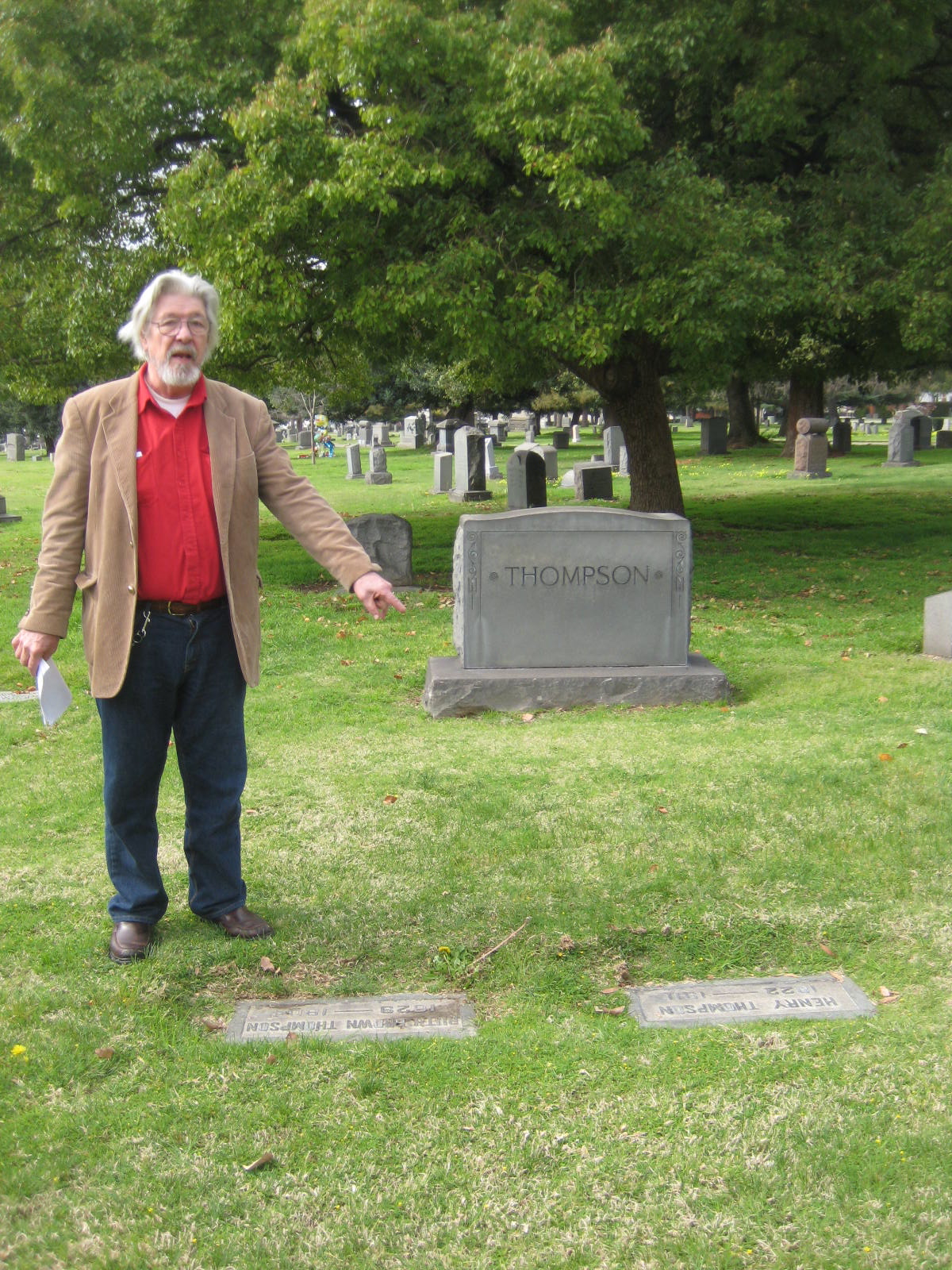
Norman Marshall, portrayer of John Brown, is currently visiting the west coast, and will be performing his one-man play, "John Brown: Trumpet of Freedom" at the University of LaVerne, LaVerne, Calif., on March 26th (see information below).  Norman made a point of searching out the resting place of Henry and Ruth Brown Thompson in Pasadena, and has provided some pictures of the grave markers.  Rather than simply post the pictures, I have endeavored to provide a short historical sketch--although I regret that I do not have the time to provide a more extensive overview.  Thanks to Norman and his lovely wife, Gwen Gunn, for sharing these pictures with me and the readers of this blog.--LD

Norman Marshall points to the resting place of
Henry and Ruth Brown Thompson
(photo courtesy of Gwen Gunn)

Ruth Brown Thompson was the eldest daughter of John Brown, born Feb. 18, 1829 in Richmond, near Meadville, Pa.  When her father moved the family to North Elba, N.Y. in the spring of 1849, she was a young woman of twenty years, described by Richard Henry Dana in retrospect as a "bonny, buxom young woman of some twenty summers, with fair skin and red hair."1  Around this time Ruth had taken a bad fall on the ice, hurting her back.  According to another family letter, she never fully recovered, and suffered with back problems throughout her life.2  I do not know about the courtship of Ruth by Henry Thompson, however they were married on Sept. 26, 1850, during the Browns' first stay in North Elba.  Upon the urging of his wealthy partner, Simon Perkins, Jr., John Brown returned to Akron, Ohio, in March 1851, in order to continue their business endeavors.3  Naturally, Brown left Ruth with her husband in North Elba, although the father remained close to his daughter.  His correspondence--especially in religious matters--shows that she, unlike most of her siblings--shared her father's evangelical faith, and shared also his concerns for the heterodoxy of her brothers.4   

Like any family, the Browns had some relational rough spots.  As far as the spouses of his adult children, neither John Brown nor the rest of the family seem to have been very impressed by Ellen Sherbondy Brown, the wife of his son Jason.  For whatever reason, Ellen "was not well liked by the Browns," in the words of John Brown aficionado, Boyd Stutler.5 Quite to the contrary, perhaps Brown's favorite "child"-in-law was Henry Thompson, Ruth's husband.  Like Ruth, Henry came from a large family, being the third of eleven children born to Roswell and Jane Thompson of North Elba.  Henry was born on Jan. 21, 1822, and was both a farmer and carpenter--and built John Brown's farm house, which still stands near Lake Placid, N.Y. as a  state historic site.   By arrangement with his father-in-law, Henry undertook to build the house for his father-in-law's return to North Elba from Ohio, in the spring of 1855.  However, Brown's return to the Adirondacks in May 1855 was more about settling his family in the home, since he shortly went to the Kansas territory to rescue his other family members from proslavery thugs, and never personally resided in North Elba again, except for short visits.  Of course, the rest is history--Brown went to Virginia and died as a result of his liberation efforts.  However, Henry Thompson figures importantly in Brown's story, insofar as he went to Kansas with his father-in-law, and proved a devoted and faithful son and warrior to the old man.  Thompson was one of the Pottawatomie killers, and until the day of his death held that the bloody act was a matter of necessity and survival. When Brown turned his focus to Harper's Ferry, however, neither Ruth nor Henry himself wanted to follow the old man into Virginia.  This was just as well for the dler Thompsons: they sacrificed two sons to John Brown's cause--Henry's younger brothers William and Dauphin.  Their sister, Isabella Thompson, was also married to Watson Brown in 1856, and was left a grieving widow when Watson was slain at Harper's Ferry.  Thus, the Thompson family paid dearly for their association with John Brown.6

      In June 1860, a month before the Brown's hosted a July 4th commemorative meeting at the family farm in Lake Placid, Ruth Brown Thompson wrote to Mary Stearns, the wife of one of her father's "Secret Six" supporters, George Luther Stearns.  The letter clearly shows that she carried on the legacy of her father and fallen brothers:
The very idea of slavery is so galling to my feelings that I can hardly endure the thought. How many times I have heard my dear sainted Father, say he "hoped to live to see the day when the slaves would all be free." What an awful sin is slavery, yet how quietly the people of this country sleep over it. How many sleepless nights Father used to pass, thinking of the poor slaves, years before he made an attempt to rescue them. His great kind heart was ever "awake to their wrongs.7
Ruth & Henry Thompson portrayed in celebration of their 50th wedding anniversary in The San Francisco Call (5 Oct. 1900, p. 4).  The article says the couple resided "in a humble cottage, on the banks of the Arroyo Seco, in Pasadena."

In 1884, the Thompsons moved west, settling in Pasadena, California.  They were joined by brother Jason Brown. Brother Owen also settled in the following year--the two Brown brothers settling in the Las Cacitas mountains, northeast of Pasadena.  In the later decades of the 19th century, the Browns were a noted presence and enjoyed the friendship and support of many black friends, especially clergymen.  According to a 1940 article in The California Eagle, the writer looked back to the time when the Thompsons and Browns hosted a number of black ministers, carrying on the tradition of John and Mary Brown, who enjoyed close relationships with many black leaders and lay people.  The author, the Reverend William Prince, even recalled a fund-raising picnic that African American friends sponsored in order to raise money to assist Grace Thompson, Ruth and Henry's daughter, with her college tuition.8

In the 1960s, Mary Mackenzie, a grassroots researcher on the Browns in North Elba, wrote to a direct descendant of Henry and Ruth Thompson, Adeline Bryant.  Drawing from memories of her own youth, Bryant provided a brief but poignant description of her grandparents in their last years:
. . . [Y]ou ask me to tell you something about Grandpa Henry Thompson.  He and grandma were always very devoted to each other.  I lived in their home for two years while I attended Pasadena High School and I never heard them say a cross word to each other.  Grandma had trouble with her back, so used to stay in bed until around ten o’clock at which time, before she dressed, grandpa would bring her a cup of coffee, always saying, “Here’s your coffee, mama.”  After that she would dress, have a little breakfast and then go to sit in her willow rocker in the living room where she could look out upon their orange trees, when she would raise her eyes from whatever book she happened to be reading.9  
Ruth Brown, the beloved daughter of the abolitionist leader, went to her rest in 1904.  Her faithful husband Henry lingered on the John Brown trail a little longer, finally departing in 1911.--LD

Photo courtesy of Norman Marshall

Notes

1 Richard Henry Dana, "How We Met John Brown," Atlantic Monthly (Jul. 1871), p. 5.
2 Transcription, Ruth Brown Thompson to Henry Thompson, 14 May 1856, in Edwin N. Cotter Jr. Papers, Letters, No. 2/68/10, Feinberg Library Collection, Plattsburgh State University, Plattsburgh, N.Y.
Photo courtesy of Norman Marshall
3 Louis A. DeCaro, Jr., "Fire from the Midst of You": A Religious Life of John Brown (NY: NYU Press, 2002), p. 206.
4 Ibid., p. 208.
5 Boyd B. Stutler to Clarence S. Gee, 25 July 1949, p. 1, in Hudson Library and Historical Society Collection, Hudson, Oh.
6 DeCaro, p. 214.
7 Ruth Brown Thompson to Mary Stearns, 13 Jun. 1860, MS05-0061 A-E, Boyd B. Stutler Collection, West Virginia Division of Culture and History.

         8 Dorothy Hassler, "Trail's End on Little Round Top," Westways Magazine (Sept. 1952), p. 25; Rev. William Prince, "Turning Back the Pages of Pasadena's Past," California Eagle (2 May 1940), in Pasadena Historical Society Collection.
9 Adeline Towne Bryant to Mary Mackenzie, 28 April 1966, in Box 2, file 68 (no. 22), Cotter Papers.