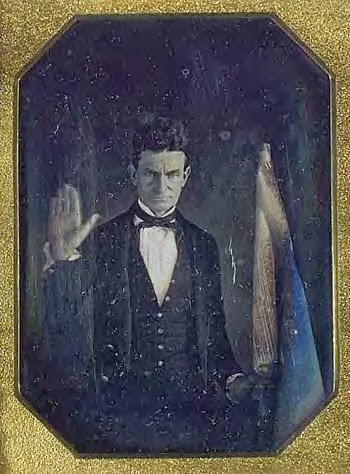
The Research & Writing of Louis A. DeCaro Jr.


"The world needed John Brown and John Brown came, and time will do him justice." Frederick Douglass (1886)

Search This Blog & Links

Translate

Monday, December 02, 2013

154 Years Ago Today--

John Brown Wanted to Walk to the Gallows

This account is excerpted from Crosby S. Noyes' report in The Washington Star, December 3, 1859.  John Brown aficionado, Boyd B. Stutler, considered Noyes' coverage to be the best single report on the hanging of the abolitionist.
Shortly before 11o’clock Brown was led forth from the jail.  He emerged with a firm step, ascended to the cart (arms pinioned), and seated himself coolly upon his own coffin, upon which he remained seated all the way to the gallows.  The cart was a yellow, rather clumsy vehicle, drawn by two white horses.  Brown was accompanied by Sheriff Campbell, Jailer Avis, and other guards; also, by a strong military escort.  He gazed with quiet scrutiny in every direction as if to take in the whole scene and all its surroundings.


Sheriff Campbell remarked, “Why, Mr. Brown, you don’t seem at all excited!”

“There is no occasion for excitement,” calmly answered John Brown.
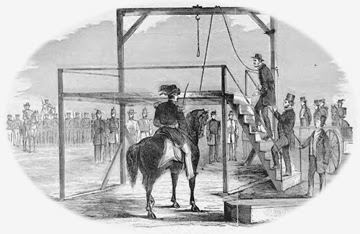
It is understood that he begged hard to be allowed the privilege of walking to the gallows.  The distance from the jail to the gallows is perhaps 400 yards.
The various representatives of the press were conducted to the place assigned to them some two hours before the execution.  Their position, though somewhat more favorable for seeing what transpired than had seemed probable at one time, was of an unnecessary distance from the gallows, and we believe that it was the unanimous verdict of the “Fourth Estate”1 present that the reason assigned for this exclusion, viz. that John Brown might say something and the press report it, was too childishly puerile to do credit to the Executive of Virginia. 
The military within the field were located at points designated by white signal flags, bearing the names of the different companies.  Their lines formed two octagons, one within the other, and of which the gallows was the centre.  Drawn up beyond the rail fence of this field were long lines of cavalry; and the country in every direction as far as the eye could reach was dotted with squads of sentinel soldiers, their brilliant uniforms bringing their figures out in strong relief against the somber autumn brown of the landscape.  The number of spectators, aside from the military, was not large, perhaps a couple of hundred in all, and these, with the exception of the members of the press, and some half dozen privileged civilians seated upon the gallows steps, were excluded from the field. Not a female was to be seen by the naked eye in any direction, but by the aid of a glass some few were observed at the windows of distant dwellings.  A few colored people were seen along the road skirting the field, apparently slaves, sent by their masters to learn a salutary lesson.  Almost every tree in the vicinity was loaded down with boys.  The appearance of a single carriage upon the field, bearing a crippled man, attracted attention.  It proved to be Samuel C. Young, of Harper’s Ferry, one  of the citizens wounded by Brown’s men, and permitted, therefore, to enter the lines as a spectator.  Shortly before 11 o’clock Gen. Taliaferro, with a formidable staff, entered the field, and soon after the prisoner and cortege came up and halted in front of the gallows.
Brown descended from the cart and mounted the platform with the same imperturbable wooden composure which had distinguished him at every step of his progress.  He was dressed in a well worn suit of black cassimere—the same which he were on first entering Harper’s Ferry, --white woolen stockings; red, figured carpet slippers, (that he had, previously used in jail;) a colored cotton shirt; gray wool undershirt; no neck cloth of collar.  It was noticed that his neck and breast were as white as a woman’s.  The sheriff and jailor mounted the platform with Brown, and quickly adjusted the white cap over his head and the rope round his neck, and had tied his feet securely.  Then occurred another remarkable exhibition of nerve by Brown.  He was requested to take his place on the drop, (trap door,) “I can not find it blindfold[ed]; guide me to it,” he answered in the same even tone of voice as if asking for a chair.  He was placed in position, and then there was an unpleasant pause of some eighteen minutes while some companies at a distance were brought up.  The sheriff made some explanation to the prisoner about the delay.  “I don’t care,” he replied, “only don’t keep me waiting unnecessarily.” 
After some further moments of suspense, during which the prisoner stood without a tremor, at a quarter past 11, Col. Smith called out audibly, ‘All ready, Mr. Campbell.”  The sheriff touched the spring, the flooring dropped beneath the prisoner’s feet; down he shot through the trap, then up, then down; there was quick, convulsive movement of the hands; a slight muscular tension of the limbs, then they straightened, and the body swung perpendicular, turning slowly round and round—this motion, with the fluttering of the coat skirts in the breeze, giving it singularly the appearance of a corn-field scarecrow, and the more that his gaunt frame and limbs bore apparently not an ounce of surplus flesh, and thus did not fill out his clothes.  Yet he had positively gained in weight while in jail.  As Gov. Wise said, he must have been a bundle of nerves—and nothing else!  It was a relief to turn from the ghastly  spectacle to the tranquil beauty of the neighboring landscape—the mountains of the Blue Ridge bathed in soft purple haze, and the green, undulating wheat fields on the opposite horizon. 


The body hung 20 minutes or more, and then Drs. Starry, Cook, and Straith, with blue ribbons at their buttons, ascended the platform, felt the hanged man’s pulse, examined his neck, and applied their ears to his heart.  Then they withdrew, and four Regimental Surgeons went through the same programme.  Then they too retired, (as the platform was not deemed strong enough to bear more than half a dozen persons at a time,) and so on, (including several slips of boy-surgeons) to the number of twenty.  Then “Porte Crayon,” Strother, the artist, a thin, sickly looking young man, with others, visited the platform for  a moment, and at the end of 36 minutes the body was cut down.  The neck was not broken, and the medical examiners declined certifying to death having taken place until after a further examination to be held at the jail at 3 p.m.  Dr. Mason held to the opinion that it was possible in such a case to restore life by galvanic action.3  It was supposed, however, that strangulation took place after less than four minutes suspension. 
The rope left no mark of abrasion on the neck.2  The eyes of the corpse were open, but not staringly so.  The mouth also was open and would not close.  The face was not unnaturally distorted, though the blood vessels were somewhat distended, as occurs in death by strangulation. 
The body was placed in the coffin (of black walnut) and this again in its “shell” of white pine.  This exterior casing bore the penciled lettering “John Brown, Esq.,” doubtless an achievement of the undertakers.  At 6 o’clock in the evening the corpse was taken from the jail and conveyed by an extra train to Harper’s Ferry, where Mrs. Brown was awaiting it.  She stopped at the Wager House, and in the morning she proceeded North by the three o’clock train, proposing to take the most direct route and with the least publicity to their home at North Elba, N.Y.  She was accompanied by a gentleman by the name of McKim.
Notes

        1 The Fourth Estate was a publication for newspaper publishers and advertisers.
       2 Based on other eyewitness accounts, this is doubtful.  The deep rope mark around Brown’s neck was quite visible to others, so Noyes either did not get a good look or he intentionally played down the appearance of Brown’s body.
    3 According to the New York Herald, 6 Dec., some of the doctors mentioned were not convinced that Brown was dead after his body was cut down from the gallows.  The remains actually were left in the jail and re-examined later in the day before being released to Brown's widow.  One source says that one of the examining physicians wanted to administer poison to the corpse in order to make certain of his death.


Sunday, December 01, 2013

A Novel Idea--

What James Baldwin Might Say to James McBride on 110th Street

According to Chris Vognar of the The Dallas Morning News (Nov. 30), novelist James McBride appeared at the Texas Book Festival in Austin, Tex., on October 26th, and spoke about his award-winning novel, The Good Lord Bird.  Vognar quotes McBride as saying of Brown, “The guy was crazy. . . He was a madman. But we’re still talking about him, and I kind of fell in love with him a little bit.”  Vognar's article also reports:
The level of distrust between whites and blacks in this country is something that is really hard to talk about,” McBride says. “John Brown shows up and says, ‘I’m gonna free every black person here,’ and every black person there jumps up and runs out of the room. That’s funny, and it probably happened. I can’t say it definitively happened, but that’s one of the things fiction allows you to do. It allows you to discuss things that are really hard to discuss.”
James McBride
As I also wrote to the Morning News, this is almost always the problem with historical fiction writers and John Brown, even when they "kind of fall in love with him," as it seems was the case with Russell Banks also.  The problem is that fiction writers like McBride have only done as much "research" as necessary in order to set up a plausible framework and characterization of their subject.  Beyond that, they are free to go in any direction in the name of art.   While all historical fiction threatens to confuse and mislead readers, this is particularly the problem with Brown, who often doesn't even get a fair shake from historians and popular historical authors.   Russell Banks thinks John Brown was a terrorist (I know this, because I heard him say it with my own ears in 2009), and James McBride thinks Brown was "crazy" and a "mad man."  Invariably these novelists took these notions with them into the writing process and produced whatever portrayal of Brown suited their imaginations.

It's only fiction, why be concerned?

Unfortunately, the public has been digesting fiction about Brown for nearly a century, in various forms and media, and McBride's presumptions are only going to further contribute to the mistaken notions that prevail among people in this society about him.  As irrational as it may sound, it is also likely that many whites (not all) will take McBride's fictive view of Brown more seriously because he is a black writer, and because he does not overtly wish to diminish Brown's stature as many white writers have sought to do over the years.
McBride on Brown:
"The guy was crazy"


Worse, it is too bad that McBride couldn't have limited his words about Brown to his fiction. Instead, he has presumed to speak to the real John Brown of history, and has framed his presumption with supposed facts.   The 19th century theologian Tryon Evans once observed that fiction is "the fanciful and dramatic grouping of real traits around imaginary scenes or characters," and may just as easily convey "false views of men or things" as portray life truthfully.  I don't know how James McBride has used fiction, whether for conveying "false" or truthful representation of John Brown. However, it is apparent that he has taken his own fiction too seriously.  And this is the rub.  Writers of historical fiction should recognize the limits of their role.  The historical fiction writer's role ends with the end of his/her novel.

When James McBride stands before people and pontificates on Brown's mental state or the reaction of blacks to his appearance in Virginia in 1859, he has presumed to play another role, one which he has no business undertaking unless he's done all his homework.  And clearly, he has not.

McBride has recently been announced as the winner of the National Book Award, and he is to be congratulated for his success in writing fiction.   Yet he has hardly done a kind service to John Brown's legacy.  Whatever impact his novel has on popular thinking about Brown, it probably will result in more misinformation; I doubt people will finish The Good Lord Bird, and then devote themselves to a more serious consideration of Brown by reading a number of biographies. Rather, they will embrace McBride's fictive Brown as the man who lived, and get on with the rest of their lives, laden with all kinds of mistaken notions, based upon The Good Lord Bird.  The admiring audience in Austin, Texas, who heard McBride speak (and the readers of the Morning News), will also move on with the novelist's sentiments echoing in their minds--about a "mad" John Brown who scared black people away.


I'd like to do a short, fictional story about a novelist named James McBride, who writes a cockeyed story about a "mad" John Brown, wins a big award, and makes a name for himself at the expense of history and the legacy of the abolitionist.  Then, in my story, the ghost of James Baldwin (who loved and respected Brown) would chase McBride down Lenox Avenue in Harlem, then west along 110th Street until McBride comes to Frederick Douglass Circle, where the author hides behind the statue of Frederick D., hoping Baldwin's Ghost won't find him.  But Baldwin does find him and calls him a few choice words that would not be correct for me to write on this blog.  I know it's only fiction, but I'm almost sure that after lecturing McBride for several hours on John Brown, James Baldwin would tell McBride precisely what to do with his award.

Thursday, November 28, 2013

Pop Culture--

Is John Brown the Next Story for Quentin Tarantino?

Michael West reports on Contactmusic.com that Quentin Tarantino is preparing a "follow-up to Django Unchained," and "almost has a script, which the prolific director has penned himself and plans to develop in 2014."  According to West, the upcoming project will be a western, which may or may not fit the Brown story, except for the Kansas episode.  "During the publicity tour for his last movie," West writes, "Tarantino spoke about making a movie about the abolitionist John Brown, treating him as mythic hero from a western standpoint."  This may be true, but it is also possible that Tarantino is looking at other projects, including an Australian cowboy film or an adaptation of an Elmore Leonard novel.

West reiterates Tarantino's enthusiastic words from a previous interview revealing his warm admiration for Brown and his desire to make a film about the abolitionist.  However, if I recall, Tarantino said he was thinking of doing this somewhat further in the future, perhaps in his later years, and might even consider playing the role of Brown himself.  It may be that the recent appearance of books and the latest accomplishment of the award-winning novelist James McBride has caused Tarantino to move the John Brown project to the front burner.

It remains to be seen whose John Brown film makes it to the screen first. There is no lack of talk on the subject, but it is hardly worth holding one's breath at this point.

Source: Michael West, "Is Quentin Tarantino's Movie About Abolitionist John Brown?" Contactmusic.com, 28 Nov. 2013


James McBride Wins National Book Award for His John Brown Novel

James McBride's The Good Lord Bird, which imagines a teenage slave joining abolitionist John Brown's 1859 raid on Harpers Ferry, won the National Book Award for fiction Wednesday night.  The judges praised McBride for "a voice as comic and original as any we have heard since Mark Twain."

McBride, 56, who hadn't prepared an acceptance speech because he didn't expect to win against the likes of Thomas Pynchon, Jhumpa Lahiri and George Saunders, said, "They are fine writers. But it sure is nice to be here."

Source: Excerpted from Bob Minzesheimer, "James McBride wins National Book Award for fiction," USA Today, 21 Nov. 2013


Wednesday, November 27, 2013

Osawatomie Notebook--
Tribute to the "Old Man's" "Old Man," 
Owen Brown

Grady Atwater

John Brown’s father, Owen Brown, was a dedicated peaceful abolitionist who advocated that African-Americans deserved an equal opportunity for education and asserted that African Americans’ lack of civil rights and spiritual growth were being denied because of their lack of education.
Owen Brown, ca. 1830
(Hudson Library & Historical
Society, Hudson, Oh.
)

Owen Brown wrote a letter to the Ohio Anti-Slavery Society on April 27, 1837, in which he stated:
Resolved, that education lies at the foundation of elevation in civil and religious liberty, and that it is expedient that there should be a State Anti-Slavery Education Society formed, and that it be recommended to the county and town societies to form societies auxiliary to the State Anti-Slavery Society.
Owen Brown proceeded to list the reasons he believed the Ohio Anti-Slavery Society should form an Anti-Slavery Education Society, and pointed out that African-Americans were excluded from attending schools with European-American students.  “Public sentiment forbids them from their being schooled in common schools at the present, even when they are able to pay for their schooling,” he wrote.

He added the observation that when abolitionists attempted to organize schools for African-Americans, their efforts were met with legal and social opposition. He wrote: “Where schools have been set up at the expense and self-denial of individuals, in most cases they have met with great opposition; their expense has increased; their patience tried, and they have had the aid of but very few.”

African-Americans were largely denied access to formal education in the 1830s in both the North and the South, which was a means of enforcing the social stratification that worked to keep African-Americans legally and socially subservient to European-Americans. His proposal to work to provide formal education to African-Americans was a radical and revolutionary proposal in the 1830s, and he did not mince words when he pointed out the negative effects a lack of education had on African-Americans.

“For want of education, newspaper and periodical is in a manner lost; correspondence with each other is cut off, and much kind advice and instruction are lost, such as are necessary to regulate their conduct, make them good members of religious and civil society, and make them useful and happy neighbors, lessen their crimes, and raise their prospects for time and eternity,” he states.

Owen Brown was a Christian who believed that all people were equal in the eyes of God, and that all people deserved to be equal in American society regardless of their race. This made him a radical revolutionary in the 1830s.  He inculcated his Christian faith and his strong abolitionist beliefs into his children, and both his son, John Brown, and his daughter, Florella Brown Adair, put their father’s beliefs into action, both standing up for his abolitionist beliefs.

Owen Brown is an unsung abolitionist hero.

Grady Atwater is site administrator at the John Brown Museum State Historic Site.

Source: Grady Atwater, "Brown's anti-slavery fervor learned at father's knee."  Osawatomie Graphic [Osawatomie, Kan.], 27 Nov. 2013.

Thursday, November 21, 2013

Film--
A John Brown Movie, This Time?  Ed Harris, Giancarlo Esposito to Star in Film Adaptation of Carton's Patriotic Treason

According to Deadline Hollywood (11/20), "Giancarlo Esposito has lined up historical drama, Patriotic Treason, as his next directing project, with Oscar-nominated Ed Harris set to star as radical abolitionist John Brown."  The story, adapted from Evan Carton's 2006 book on Brown, Patriotic Treason: John Brown And The Soul of America, is supposed to be adapted by Oscar nominee Jose Rivera (Motorcycle Diaries, On The Road), and centers on the Harper's Ferry raid.  According to According to Jen Yamato, "The Emmy-nominated Esposito will also star in Patriotic Treason as Frederick Douglass, the freed slave-turned-abolitionist and orator who declined to join Brown’s Harper’s Ferry attack."
Ed Harris
Esposito is quoted as saying: “John Brown was the lightning rod of his place and time, but, to me, his story is just as electric in our world today, where controversies about race, religion, patriotism, and the use of violence for democratic ends are as intense as they were then.” Yamato reports that the project came about because Keith Sweitzer, one of author Carton's former students at the University of Texas, now represents Spectrum Films, "and helped develop the book deal." Sweitzer, Robert Knott, and Esposito will produce the film, along with Act 4′s Jesse Singer & David Johnson, "who are eyeing an early summer shoot."  

Of course, the wind is full of old and new reports about John Brown movies, but despite the good news that friend Carton's book will be adapted for the silver screen, we won't hold our breath.  If we've learned anything from observing the story of almost-made movies about Brown, there will be no movie made about the Old Man until all the paperwork has been signed, all legalities are finalized, and all money is certain for all interested parties.  
Giancarlo Esposito

Evan Carton
This now makes two current John Brown book deals (the other being Tony Horwitz's Midnight Rising), not to mention the ghosts of older "book deals," like Stephen Oates' 1970 biography and Russell Banks' 1998 fiction.  There are also a few screenplay projects underway, some with great hopefulness.   Indeed, it would be nice if more than one of these projects come to production, but I'll be happy with the film that most fairly and accurately portrays Brown.  In film, or so I understand, this largely depends on the director, regardless of the book from which the story is adapted.  So I am hopeful that Giancarlo Esposito will bring a positive influence upon this important contemporary treatment of Brown's story.  Certainly, we need a John Brown film for the 21st century, not a rehash of the "crazy" 20th century cinematic representation or the more recent "terrorist" analysis.

Best wishes to Evan Carton, the putative film producers, and both director/actor Giancarlo Esposito and the would-be "John Brown of the screen," Ed Harris.  Mr. Harris might find it interesting to know that an old friend of John Brown, who wrote to him during his last days in Virginia, was a prominent tycoon and antislavery man from Rhode Island named Edward Harris.  

Saturday, November 16, 2013

Auction News--
"A Life View" of John Brown for Sale

Historical Collectibles, a notable auction house based in Dallas, Tex., is now advertising "A Most Unusual and Rare Tintype Image of the Notorious Leader of the Harper's Ferry Raid."  The image is to be auctioned at HC's Americana Signature Auction in Dallas on November 23-24. According to HC, this tintype was included in an 1862 series of tintypes published by Abbott and Company of New York featuring prominent Americans. "These were widely distributed," declares HC's website, although this is the first they have seen of "this John Brown variety."  Quite in contrast, HC has seen "several dozen examples of the popular Lincoln version."  This is hardly a surprise.  

However, the John Brown image is not a new discovery, unlike the one recently reported on this blog--that image not yet being a public matter.  Brown image and document aficionado, Jean Libby, has included this image in her indispensable, John Brown Photo Chronology (Palo Alto, Calif., Allies for Freedom, 2009).  Libby notes that it originated as a daguerreotype made in January 1857, at the time Brown was moving among eastern antislavery people as an advocate of the Kansas Free State cause.  Libby provides an 1864 letter by James Redpath, who recalls that Brown had three copies of the daguerreotype made, one of which was personally given to him by the abolitionist.  

Subsequently, a lithograph engraving of Redpath's copy of the daguerreotype was made by John Chester Buttre for Redpath's 1860 authorized biography, The Public Life of Capt. John Brown.  Libby quotes a plastic surgeon and a forensic anthropologist, both of which believe the original daguerreotype image (now held by the Boston Atheneum) shows signs that Brown had had a small stroke; other health professionals have suggested Bell's palsy, which is more likely the case. Brown was also suffering with recurring bouts of malarial "Ague," and may have had related problems in his eye and ear as a result.  For many years, the daguerreotype image has been mistaken as Brown's "crazy picture," due to the prejudiced misrepresentations of writers and film makers in the 20th century.  Buttre's 1860 engraving ameliorated the sickly appearance of Brown to a great degree, although the tell-tale drooping mouth is still evident in the lithograph.

When apprised of the "tintype" on auction, Libby wrote: 
Mary Brown was directly involved in the distribution of photographs and the decision for Redpath to write a biography instead of Lydia Maria Child.  This occurred at the meetings in December 1859 at the time of Brown's funeral.  Redpath notes that she has approved the Buttre engraving, indicating that she did not like the original daguerreotype which shows the onset of an episode of Bell's Palsy.  
The January 1857 daguerreo-
type (the entire half-plate is
in the Boston Atheneum)
Libby also observed that "the tintype at auction was made from the engraving, therefore it is a mirror view of it, becoming a life view."

The latter point is worth reiterating: The HC tintype image is a derivation of the Buttre engraving, which itself was based upon the 1857 daguerreotype.  However, the tintype presents a real "life view" of Brown.  This is because daguerreotypes present a reversed image, and Buttre's engraving only reproduced the same reversed image.  This is important, particularly in this case, because the drooping side of Brown's face and mouth actually was on the right side.  In the Boston Atheneum daguerreotype and the Buttre engraving, it appears on the left side.   However, this tintype, being a photograph of the image, thus reverses the reversed image--setting right the actual appearance of the abolitionist's drooping mouth.  This is John Brown in 1857.

Historical Collectibles lists the image in Lot 38183, noting also that it is in "choice condition with original I.D. card on verso.  1.375 inches x 1.625 inches. Estimate: $1,000 - $2,000."

Wednesday, November 13, 2013

Iconic--
Black People's Ally, White People's Bogeyman

I borrow this entry's title from a piece that I contributed several years ago to The Afterlife of John Brown, an essay collection edited by Andrew Taylor and Eldrid Herrington (a UK production, not cheap, but probably better than most of the essay collections published about Brown in the USA). The following images are culled from the internet and reflect the historic rift between the way the white "majority" (not all co-called whites, of course!) and the black community (for the most part!) have perceived John Brown, especially in the 20th century.  The images speak for themselves.

First, John Brown, the white man's bogeyman. . .


Some illustrations are just peculiar and or portray Brown with a dark complexion, and it is not clear what the artist was trying to suggest. . .


Then there are images prepared by black artists, or which were associated with black publications:


These images reflect the historigraphy and general narratives published respectively by whites and blacks in the 20th century.  Of course, many positive and realistic images of Brown have been rendered by white artists over the past 150 years, and I can think of one black artist with (in my opinion) a perverse orientation, who has portrayed Brown in a sexually vulgar manner with the intention of undercutting his political significance.  On the whole, however, the "ally vs. bogeyman" theme is significant and finds its way into film and television documentaries as well, most of which are done from the "white" perspective in the USA.--LD


Sunday, November 03, 2013

Brown Family News--
There's Something About Mary


In recent years, the growth of interest in John Brown has happily sparked interest in the abolitionist's faithful second wife, Mary Ann (Day) Brown. Certainly, Jean Libby has once again led the way in exploring the Brown family's westward sojourn and later years in California, and has focused research on Mary Brown and her daughters for quite some time.  More recently is the publication of The Ties That Bound Us: The Women of John Brown's Family and the Legacy of Radical Abolitionism (Cornell University Press, 2013) by Bonnie Laughlin-Schultz, Professor of History at Eastern Illinois University.  Laughlin-Schultz had evidently made a notable contribution to the study by producing the first extensive study of Mary Brown, who was an antislavery figure in her own beliefs.  The author also provides material on Anne Brown Adams, perhaps the most colorful of the abolitionists' daughters.  I look forward to reading The Ties That Bound Us, although I am sorry that Laughlin-Schultz chose to emphasize Anne's later years to the exclusion of the later years of Brown's eldest daughter, Ruth Brown Thompson.  It would seem to me that Ruth, being the eldest daughter, bears far closer examination.  Laughlin-Schultz is reasonable in focusing on Anne, since she did spend some months in Maryland, keeping house for her father prior to the Harper's Ferry raid.  In contrast, Ruth was not present with her father in the famous episodes of his antislavery activity, Kansas and Virginia.  Yet she was the eldest, and was married to Brown's favorite son-in-law, Henry Thompson, who was in Kansas with the Old Man.  An expansive study of Ruth's life would have made a study of "the women of John Brown's family" truly complete. Notwithstanding this gap, this book appears to be well-researched and documented, and will stand as a major contribution to the literature.  As to her reading of the Old Man both personally (including religion) as well as politically, I hope to provide a more helpful review in the near future.

Mary Brown en route to meet
her husband for the last time
(Frank Leslie's Illustrated News, 
Dec. 12, 1859)

Mary Brown, "A Bastion of Strength," Says Atwater

Osawatomie, Kan.--John Brown’s widow, Mary Day Brown, had the daunting task of caring for her family after John Brown’s hanging at Charlestown, Va. (now West Virginia), and John Brown’s supporters came to her aid.

Mary was a strong woman who took up the challenge of being a widow and a single mom amid the glare of publicity that came with being the widow of John Brown in the 1860s.
Mrs. George Stearns was one of John Brown’s supporters, and Mary related her gratitude for Stearns’ support for her family and John Brown’s abolitionist crusade in a March 13, 1863, letter. She wrote:
I saw the same account in the Liberater [sic] of the meeting of some the most noble souls that our country contains at your beautifull [sic] home and I must say that my soul leaped for joy when I read it. I was indeed and truly with you in spirit on that most glorious and long to be rememberd [sic] day. I saw that a committee of the same noble spirits visited the Presidend [sic] soon after I was much rejoiced at hopeing [sic] that some great good might result from it. My mind has been much with you ever since I knew the bust of my dear beloved husband was in your house. It was truly a place that he delited [sic] to visit when he was in the body. Oh I am so glad that he never made any move that you have to reflect on him for but that you rather rejoice over he done. It has been a great comfort to me to know that his own personal friends have never condemed [sic] his movements. It is only those that are capable of appreatiating his motives that can see any beauty in them.
Mary's last meeting with Brown, Dec. 1, 1859
Her faced obscured, this artist's rendering reminds
us that the devoted wife of the Abolitionist has
often been overlooked by historians
(Frank Leslie's Illustrated News, 17 Dec. 1859)
Mrs. George Stearns had helped John Brown’s daughters, Sarah and Annie, attend school, and Mary gave Mrs. Stearns a report on how Sarah and Annie were faring at school:
Sarah is realy [sic] doing well and Annie is doing quite well. I shall have them stay at school another term. I think that if you ever feel like doing any more for Sarah you will find it more satisfactory than you did before. She is capable of more improvement. I will send your love to them when I write.
Mary also thanked Mrs. George Stearns for story books that Mrs. Stearns had sent her daughter, Ellen, and wrote, “Ellen is a learning a great deal at home this winter. She begins to read the story books you sent her. She is a good girl.”

Mary Day Brown was a bastion of strength for the Brown family when John Brown was alive and engaged in his abolitionist crusade and stood stronger after John Brown’s death in 1859. She worked to provide for her family’s support and education in difficult times and is an unsung heroine in the John Brown saga in American history.

— Grady Atwater is administrator of the John Brown State Historic Site

Source: Grady Atwater, "John Brown' widow an unsung heroine," Osawatomie Graphic, 30 Oct. 2013

Saturday, October 26, 2013

News and Views--

Historic Trail for John Brown’s Connecticut Birthplace

The Torrington Historical Society is teaming up with the Northwest Connecticut YMCA’s Torrington Trails Network to create a hiking trail at the birth site of the city’s most famous native.  The two groups are coordinating volunteers to clear a new hiking trail of three-fourths of a mile at the John Brown Birthplace site on Saturday. The work is being done as part of the group’s efforts to make the historic site more accessible to the public. The site has been owned by the Torrington Historical Society since 2000.

New Daguerreotype of John Brown Emerges

John Brown documentary scholar and image expert, Jean Libby, contacted me earlier this month to examine a daguerreotype that has surfaced recently, the owner evidently intending to sell it at auction.   The dag is not characteristic of images of Brown that are more familiar to historians and students, and so it required closer examination.   My own inclination upon first hearing of the image was skepticism.  After all, in 150 years, it seemed logical to me that there were no surviving images of Brown that we have not seen. However, the longer that I examined it, studying the particulars of the face, it seemed harder and harder to deny that it is indeed the face of John Brown.  Jean Libby, the leading authority on Brown daguerreotypes and derivative images, pointed out that the photographer likely prepared the daguerreotype in two phases.  Since daguerreotypes are reverse images, he then made a daguerreotype of the first daguerreotype, thus effectively producing a real-life image of Brown.

The reversal correction on the part of the photographer probably accounts for some of the initial unfamiliarity evoked by the image.  However, the image is also unfamiliar in certain details because of Brown's appearance--especially his long, dark sideburns and a frontal view of his face, which provides a slightly different perspective on his nose.  Brown's sons humorously described their father's nose alternatively as resembling a "meat axe" or a "bird of prey."  These descriptions are better appreciated in this new daguerreotype.

Another unusual feature of the image is that he is very well attired, and even has a stud in his shirt collar.  However, this is probably explainable by the fact that it seems to have been taken in the early 1850s, at the point when Brown was still collaborating with the wealthy Simon Perkins, Jr.  Although the wool commission house of Perkins & Brown had folded in 1849, Brown actually continued a fairly successful partnership with Perkins, who had his own flocks and wool business.  Brown was also entangled in a number of law suits and legal demands that stretched through the early 1850s, requiring him to travel from Akron, Ohio throughout the northeast.  The image of Brown is perhaps the most "bourgeois," and this seems consistent with his profile as a businessman and wool expert in that era.   Too many have been poisoned by half-baked historical presentations and unfounded exaggerations of Brown's rocky business life prior to 1855, so this will surprise many who think he was just an abject failure.  However, notwithstanding his financial difficulties in the late 1830s and 1840s, Brown had somewhat improved through his highly successful work in sheep and wool in the later 1840s, and by his association with notable Ohio names like Oviatt and Perkins.   Most narrators in popular culture are clueless as to Brown's great success and reputation as an expert in "fine sheep and wool."  At any rate, Harvard University archives possesses a stud with small diamonds in the shape of a "B" that was owned by Brown, probably in this period.  (It was later gifted to Abraham Lincoln.)   So despite the novelty of seeing Brown attired like a prosperous businessman, there is nothing untenable about the dag in this regard.

I shared the dag with a prominent illustrator who has worked extensively in portraying Brown, and he too was stunned at the familiarity of important details, especially the hairline, which he found to be the same as in other dags of Brown.  There are other notable facial features--the shape of his closed mouth, the lines and shaped of the flesh near his nose, and the "wear-and-tear" around his eyes, all of which suggest Brown's aged appearance was already starting before he went off to Kansas in 1855.  While his hair was already starting to show signs of gray in the first part of the 1850s, he was obviously far more grayed in the late 1850s.

For evident reasons, I cannot post the image made accessible to me.  However, the image will probably be generally available once the dag is placed on auction.  Assuming its authenticity  and the general nod of approval from Brown scholars and others associated with his image, there is no doubt that this dag will bring a lot of money to the owner.   The appearance of this dag reminds us that just because we had not seen it, does not mean there wasn't more history to uncover.  This is true both in regard to images and documents. These discoveries are far more accessible to us today because of the internet, and so we should not be surprised that other discoveries are made.  For instance, I was recently informed about a letter, written the week after the Harper's Ferry raid in October 1859, by the superintendent of the armory, which had also gone to auction online.

This is a good lesson for narrators and cultural "experts" who think they know all there is about the Old Man, and rely on the opinions and hearsay of tour guides and academics with little grounding in the primary documents.   Much of what is already believed about Brown is untrustworthy and negative; and there is still more that may yet be uncovered that demands a revision of popular notions about the Old Man.


Wednesday, October 16, 2013

Remembrance--
154 Years Ago Today, John Brown and His Men Tried to Start the Second "American" Revolution

Brown and raiders leaving for Harper's
Ferry, Sunday night, Oct. 16, 1859
(artist unknown)
In 1859, October 16th fell on a Sunday.  That cold, rainy night was the time that Brown and his raiders left their Maryland farm, walking into the town of Harper's Ferry, Virginia [today in West Virginia, the state having been created four years after the raid].  As Brown surmised after extensive preparatory work, Harper's Ferry was completely vulnerable and taken off guard.  The two federal armories, Harper's Ferry and Springfield, Mass., were under civilian supervision, without a military presence of any kind.  This is why Brown knew that seizing the armory was a feasible strategy.

Brown left some men at the Maryland headquarters with different orders than those who went with him to seize the town and the armory.  It is often said that Brown seized the "arsenal," but the arsenal was only one part of the operation.  Properly speaking, Brown seized control of the town and the entire federal armory operation.

Although the number of raiders with him was small, Brown had sufficient men to carry out his plan, which was to make a quick strike, rally available enslaved men, gather important hostages (slaveholders) from the immediate vicinity, and withdraw to a strategically advantageous position.  From that position, he intended to barter hostages for more enslaved men before withdrawing into the mountains nearby.  There is ample witness, even from local testimony, that had Brown gone into the mountains with his men, it would have been almost impossible to get him out or stop his movement deeper into the South.  (Because I am writing on these matters now, I'm not going to give explicit citations, but it was the opinion of both a local political figure and the armory superintendent that Brown's mountain strategy was very strong.  Brown himself stated that he and his men had spent considerable time exploring the mountains surrounding Harper's Ferry, and that he knew them better than many of the locals did.  I do not think that was a vain boast.)
Brown's Plan (Jacob Lawrence)

Typically, historians immediately project failure into the raid by discussing the death of Hayward Shepherd, the black porter and "freeman" at the train depot.  None of Brown's men were pleased at the killing of Shepherd, but there is good evidence that Shepherd was deliberately killed because he was extremely difficult, refused to cooperate, and was trying to get away to warn whites in the vicinity.  Apart from some of the slaveholders who tried to fight Brown's men, Shepherd was probably the most troublesome figure at Harper's Ferry.   Shepherd was of that stripe that Adam Clayton Powell Jr. and Malcolm X later referred to as a "house" servant.  He may not have been enslaved on a plantation, but he was entirely bound up in the interests of the slave masters, which had become a source of income and prosperity for him.  A liberated black man, he was a token in the community, since free blacks were not allowed to stay in Virginia; the community of slaveholders loved and trusted Shepherd completely because he was thoroughly their man.  His patron was the mayor, Fontaine Beckham, his former master, and Beckham and enabled him to amass money and property in a manner impossible for his enslaved brethren.  Apparently, Shepherd did not care that his prosperity was made in spite of the plight of his brethren, and he was willing to risk his life and disdain every warning from Brown's men, even to the point of trying to sneak over to the Maryland side to warn whites.   It is no wonder that local whites whined and wept over his death.  I doubt there was any mourning in the slave quarters for Hayward Shepherd; even Osborne Anderson, the only primary witness among Brown's men to write an account of the raid, spoke of Shepherd as an unfortunate but problematic figure.
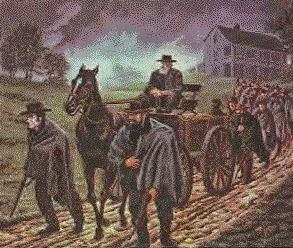
Having failed tactically, Brown withdrew to make a last
stand at the HF engine house (artist unknown)

Shepherd's death was no signal that Brown was going to fail.  It only signified that Brown's men were consistently following orders.   The real problem with Brown's own tactical failures, which were signs to his men that things might not work out.  I respectfully disagree with Tony Horwitz on this point: I fully believe Brown's testimony regarding his failure, and I think it makes sense--he failed at Harper's Ferry because he delayed; he delayed because he became overly ponderous and worried over managing his hostages.  Brown bent over backwards to assure hostages and railroad personnel that he was not going to do them harm.  Brown let a train pass through and even walked the train across the bridge himself to assure the engineer that the train was not in danger.  When the night grew cold, he then made the lethal mistake of taking the hostages into the armory facility where it was warmer; he had intended to keep the hostages at convenient points of escape on the Maryland side of the bridge.  He wasted time "parleying" (as Anderson put it) with his hostages, in part trying to get them to agree to hand over choice enslaved men, and afterward trying to get them to agree to cooperate in a safe withdrawal from the town.  He pondered and got lost in his own extreme tendency to be excessively thoughtful; he became paralyzed long enough that opposition forces gathered and cut off escape routes.  John Brown failed at Harper's Ferry because of tactics, not strategy.  This is a long misunderstood and misrepresented point.
From John Hendrix, John Brown: His Fight for Freedom

Historians' attempts to belittle Brown's overall plan, and even the entry into Harper's Ferry itself, are not well founded.  Much has been made of Frederick Douglass' warning (of which we know only from Douglass) that Harper's Ferry would prove a "steel trap" for Brown.  Perhaps Douglass actually said this to Brown prior to the raid; but if he did, Douglass was speaking from ignorance.  Like others, he probably believed the town and armory were under military supervision.  But Brown conducted advance tours incognito, studied the whole town and operation meticulously (this was his nature), and had a plan that was quite good--except that it was time sensitive.  Brown admits to all of this in the journalistic accounts taken immediately after the raid, and repeatedly states these matters in personal letters from jail.

One of the pikes Brown designed to
arm the liberated slaves
The most unfortunate point missed in conventional (and often hackneyed) accounts of the Harper's Ferry raid is that Brown's larger plan--his intention to start a south-wide liberation movement was never tested.  I believe the invasion of Harper's Ferry was a political statement, as Robert McGlone has pointed out; but I hope to provide even more persuasive evidence than he does to that end.  Regardless, the raid was not Brown's plan, and his south-wide plan ought not to be dismissed as quixotic, simply because he failed to carry out his plans in the town of Harper's Ferry.   Had Brown withdrawn into the mountains, it is doubtless that he would have drawn many enslaved people away from plantations and farms, and that he would have been able to throw the entire South into a state of panic, offset the "peculiar institution," and become an entrenched movement that the small, undeveloped U.S. army could not have stopped, nor local militia effectively prevented from spreading across slave states as far as Texas.  The problem is serious consideration is rarely given to Brown's plan, nor is his plan placed in the context of the larger situation among slaves and slaveholders in the late 1850s.  Many local slave revolts had taken place, often overlooked by conventional historians.  Brown could have found ample opportunity in various regions to build his movement even further.  This was the material of which revolutions are made.
Original sketch of Brown's hanging (Alfred Berghaus)

Unfortunately, Brown failed--John Brown failed, and is to blame for his own failure.  However, as a man of faith and purpose, he did not fail to regroup and seize upon the next possible opportunity to serve the cause he loved.  As a prisoner, he decried any vain notion of rescue and he resented northerners who sent harassing letters to Governor Wise of Virginia.  He was a realist enough to see that his hanging would still serve the cause of the enslaved African.  Every evidence is that Brown found a sense of peace and spiritual contentment in the waning days and weeks of his life in Virginia.  He knew his martyrdom ("martyr" is a Christian word in its origins, which simply means "witness") would provoke the nation in both its best and worst inclinations; perhaps he understood, too, that since whites valued white lives above black lives, then his death would move whites in the North more than the deaths of many blacks.  Even his jailer later said that Brown seemed joyful on the day of his hanging, December 2, 1859.   Of course, I attribute this much to his Christian faith and belief in the divine purpose being fulfilled, regardless of human failure.  But Brown went happily to the gallows, hoping it would in some way make amends for his failed leadership, and even more that he would prove a hinge upon which would turn the next great movement for black freedom.

History has shown that he was correct.

Sunday, September 29, 2013

Autographa--
Two John Brown Letters to be Auctioned in October

One of the leading auction houses for historical manuscripts, Heritage Auctions of Dallas, Texas, is currently advertising two John Brown letters to be sold between October 16-18, 2013.  Probably coincidentally, the letters will be sold during the 154th anniversary of the Harper's Ferry Raid (or as some of us Browniacs like to call it, "Independence Day").

The most notable letter, starting at $4000, is written from Brown to his half-sister and brother-in-law, Florella ("Florilla") and Samuel Lyle Adair on April 22, 1856.  Brown wrote the letter from his sons' settlement, known as "Browns Station," to the Adairs in the burgeoning free state center of Osawatomie. (Brown later earned the sobriquet, "Osawatomie Brown" engaging the proslavery enemy at that place; the enemy identified Osawatomie as a target of assault because it, following the town of Lawrence, was distinguished for its anti-slavery stance.)  The Adairs met at Oberlin College and Samuel was an ordained Congregational minister; they went to Kansas in advance of all the Brown family to establish missions work, and were also expressly anti-slavery.  Brown's letter to the Adairs reports events preceding the attempted coup by proslavery terrorists--including the proslavery courts that endeavored to prosecute free state activists, especially abolitionists like the Browns.  Brown was particularly mindful of a proslavery Judge named Cato, who was intimidated the previous day when Brown and his men showed up at court unarmed to oversee the hearing.  "The Court is thoroughly Bogus," Brown wrote, but the Judge had not the nerve to avow it openly."  Brown also mentions the arrival of a relative, Orson Day, the oldest brother of his wife, Mary Day Brown, who answered the free state call and migrated to Kansas; the Browns labored to prepare a dwelling for Orson in advance of his arrival. 

A little over a month after this letter was written, Brown, some of his sons, and a number of local allies, struck a preemptive blow against proslavery neighbors involved in a plot to eliminate the abolitionist element in their vicinity.  The strike resulted in the deaths of five proslavery men, including a man and his two sons, both young adults.  Unfortunately, this so-called "Pottawatomie massacre" has been consistently portrayed in a one-sided manner--as if Brown were the originator of terrorism in the U.S., and as if the attack were simply an act of malice, retaliation, or gratuitous political violence.  Most popular narratives continue to present a one-sided approach and do not take into consideration the evidence that abolitionists in that locale were literally in danger of an imminent assault by invading proslavery forces, and that the proslavery assault was enabled and guided by local proslavery people--including the unfortunate "victims" of Brown's assault.  Initially, Brown had gone to Kansas to protect his family and support the free state cause against militant assault; a genuine study of the evidence will show that Brown would not have taken such harsh action were it not considered a matter of necessity, not only by him, but by others in the vicinity.

Of additional interest is a bonus: an older letter from Samuel Adair to Florella, only months before their marriage in 1841.  Adair wrote from Oberlin, Ohio, but speaks of being called to pastoral positions.  He answered one such call in a Congregational Church in Sandyville, Ohio, where he was pastoring at the time he married John Brown's younger, half-sister Florella (born 1816).  Florella first met Samuel while studying at Oberlin College, notable in history for both its anti-slavery and coeducational stance, as well as its heterodox "Perfectionist" doctrine, especially espoused by evangelist Charles G. Finney, who divided his time between Oberlin and New York City.   

As for the Brown-Adair letter of 1856, it is not unknown to me, although this is the first time in recent years (as far as I'm aware) that it has come up for sale.  In the mid-20th century, the Rev. Clarence S. Gee, a Brown documentarian and genealogist of the Brown family, obtained a copy of the letter, which today can be found in the Gee Papers at the notable Hudson Library and Historical Society in Hudson, Ohio.   Prior to that, Katherine Mayo (who did the greater part of the research work for biographer Oswald Garrison Villard) made an excellent transcription of the letter in 1909, now available in Villard Papers of Columbia University's Rare Book and Manuscript Collection.


The second letter is not signed by Brown, but represents business correspondence of the firm of Perkins and Brown, which the abolitionist founded with Simon Perkins, Jr. of Akron, Ohio.  The letter, dated May 1, 1851, is less interesting to many people, who are mainly focused upon Brown's controversial abolitionist activities.  However, for a few enthusiasts like me, it is always exciting to see any document in Brown's hand, including those offering insights into his earlier life.  The letter, written to one of Perkins and Brown's clients named Beall, pertains to matters of an overdrawn account.  The letter reflects the extensive business loose ends and concerns that plagued Brown following the folding of their wool commission operation in 1849; that spring, Brown had moved his family to the Adirondacks, but he was obligated to make frequent and extensive trips to Springfield, Mass., the site of their former operation, to deal with legal and business matters over the next few years.  Conventional writing on Brown's wool business has greatly exaggerated his role as a "bad businessman" in the failure of the wool commission house.  While there is some truth in the portrayal, it is also true that Brown's efforts to support wool growers met with unified opposition and counter-tactics (including surveillance and subterfuge) by powerful manufacturers in New England.  He also found it difficult to work with the wool growers themselves, who had not yet evolved as a community in regard to their collective interests.  Their refusal to work cooperatively for the greater good in preparing wool for market, as well as their ongoing demand for immediate results from Perkins and Brown, proved a great disadvantage in addition to the opposition of manufacturers.  As a last measure, Brown tried to circumvent the powerful manufacturers by proposing partnerships with European firms in Belgium and France.  However,  ultimately he found them unreliable, particularly when they could purchase cheaper wools from their own colonial wool growers.  More often than not, Brown was left holding the (wool) bag, and bears the blame for the Perkins and Brown failure.  Yet a half-century later, the wool growers of the same region finally formed a coalition and accomplished many of the things that Brown had sought to realize in the 1840s.  It seems that Brown was a multi-faceted visionary.

The letter from Perkins and Brown is entirely in John Brown's handwriting but does not have his signature, rather being signed, "Perkins & Brown."  It was previously put for sale by Signature House Auctions (Bridgeport, West Va.) in 2010, and either was not sold at the time, or is now being resold by Heritage Auctions with a starting price of $1,500.

Interested in purchasing these letters?  Visit the Heritage Auction site at:
http://www.ha.com/c/search-results.zx?N=793+794+791+792+2088+0&chkNotSold=0&Ntk=SI_Titles&Nty=1&Ntt=%22John+Brown%22&ic=homepage-search-


Tuesday, September 17, 2013


John Brown Legend
ca. 1945
William H. Johnson

oil on board
38 5/8 x 36 1/4 in. (98.2 x 92.2 cm)
Smithsonian American Art Museum
Gift of the Harmon Foundation

1967.59.1145