The Research & Writing of Louis A. DeCaro Jr.


"The world needed John Brown and John Brown came, and time will do him justice." Frederick Douglass (1886)

Search This Blog & Links

Translate

Thursday, February 25, 2010

A Message to New York State Representatives from Your Blogger

Daniel J. O'Donnell (2/26)

I am writing as a scholar, clergyman, and citizen of New York State to urge you to make every effort to sustain funding for the John Brown Farm as a state historic site. As a biographer of the man, I believe that John Brown the abolitionist is one of the most important figures in 19th century U.S. history and has found increasing appreciation as scholars and historians have revisited his story with greater depth. Brown has been lauded as a vanguard egalitarian, a forerunner of the Civil Rights movement, and a heroic figure representing the highest belief that this nation should be a land of equality for all peoples under its banner. However controversial, John Brown is no longer viewed through the prejudiced, skewed lens of old, racist assumptions. As our state and nation continues on the road to global diversity, it is important that we honor the memory and contributions of those who lived, fought, and died to end slavery and racial oppression.

New York State has admirably sustained a historic commitment to maintain the John Brown Farm and land over the decades, and it would be a travesty of history and the present should our state leadership reverse this policy. The John Brown Farm is not an inordinately costly or extravagant operation and it annually functions as a place for students, scholars, and the public in general to learn and appreciate a very important chapter in our state's history.

Please do not permit this precious site to be closed down, or worse, be sold away into the hands of local entrepreneurs, who will exploit and sell this historic parcel of land to the highest bidder. Please think of the value of this site as a treasure for the posterity of our state and continue the valued policy of sustaining it. If the John Brown Farm is allowed to slip away under your watch, you will have inadvertently assisted in the debasement of our history and the robbery of a valued New York site from future generations of citizens and tourists.

We look forward with optimism to your positive response in fighting for the John Brown Farm as a state historic site.

Thank you.

Yours truly,
Rev. Louis A. DeCaro Jr., Ph.D.
Don't Let Lake Placid Turn John Brown's Front Yard into a Parking Lot!
A Missive from Our Friend Naj Wikoff

Yesterday, Assemblywoman Teresa Sayward to the Arts, Parks & Tourism Committee that the Town of North Elba is willing to take over John Brown State Park. They applauded the news until it was pointed out to them that the Town wants to turn part of the farm lands into a parking lot and location for sports facilities. That surprised and confused them.

It is critical that letters be sent immediately to the Committee co-Chairs Assemblyman Englebright and Senator Serrano that the Park must remain in State ownership, must remain intact and must remain open. If the Town is willing to care for the grounds, meaning mowing the lawns and keeping the grounds clean, that would be a good partnership, put that State oversight is vital to protect and properly interpret the collection, gravesite and buildings.

Note Town Supervisor Roby Politi's remarks in the Adirondack Daily Enterprise: "If we ever bid for another Olympic games in the future and had to expand our facilities, we'd be able to extend our facilities onto that property," he said. "We're trying to ensure the sustainability of our venues and our history."

-Naj

Call and/or leave messages for these NY State Officials on their websites [by clicking on their names]. Urge them to keep the John Brown Farm under state control and to find the minimal resources needed to sustain it as a functioning historic site.

Assemblyman Steven Englebright, Chair Assembly Tourism Committee
518-455-4804

Senator Jose Serrano, Jr., Chair Senate Tourism Committee
518-455-2795

Assemblywoman Teresa Sayward [JB Barn is in her district], member of the Assembly Tourism Committee
518-455-5565

Monday, February 22, 2010

Statements Regarding the John Brown Farm and New York State Government

My position is that New York State should be forced to come up with the very tiny money that is required to keep the site open. Local, and larger national, forces can form a friends group with contributions and a local bank account that can be used for occasional crisis moments, and as a fund for contributions to site improvements, etc. (That is as a supplement and not a substitute for state funds.) The John Brown Society would, of course, be proud to be a dues paying member of such a friends group.

Privatization plans, no matter how well intended, open the road to possible sales of parts of the property. We should fight these ideas. The site should continue to be maintained as an entire site, and run by New York State.

Larry Lawrence, Chairman, The John Brown Society


Thank you everyone for all of your emails, phone calls, letters and updates on what is being done to fight for the survival of the John Brown Farm. It is amazing what can be accomplished by a few dedicated souls.

I have heard about support from Roy Innis and Joe Lovece of C.O.R.E. Dr E Faye Washington and Dick Gregory have tossed their hats into the ring, and are writing to the Governor and others about the importance of the farm. Danny Glover has been contacted and asked to assist. I have calls into Hillary and Bill Clinton to alert them to this travisty and try to get their support. Scholars, historians, Brown Family members, musicians, and laypeople are all working together to keep the farm open to the public.

To each and every one of you, I say THANK YOU for your help in saving a site that is not only important to me personally, but is also important to American history.

Please continue to update me on your status. Together we CAN SAVE THE FARM!

Alice Keesey Mecoy, Great-Great-Great Granddaughter of John Brown

Wednesday, February 17, 2010

John Brown Farm in Peril? N.Y. may close some historic sites

Call or write NOW!

Senator Betty Little

little@senate.state.ny.us
506 Legislative Office Building
Albany, NY 12247
Phone: (518) 455-2811

Assemblywoman Teresa Sayward
sayward@senate.state.ny.us
LOB 940
Albany, NY 12248
518-455-5565

=========

Governor David Paterson's budget plan calls for cutting almost $30 million from the state's parks and recreation office. That would mean the closure of 16 parks in the Albany-Saratoga area. Two of those sites are in Essex County. The Crown Point historic site and the John Brown Farm would be forced to close if the Governor's plan is finalized.


Gov’s office says fate of parks like John Brown Farm, Crown Point Historic Site not yet decided

LAKE PLACID - Although there has been talk of lists of parks that could close in New York's proposed 2010-2011 budget, a spokesman for Gov. David Paterson stressed Monday that nothing has been finalized.
The Times Union of Albany reported Sunday that the John Brown Farm State Historic Site is on a list of parks that could be "closed or curtailed" if the legislature doesn't approve a proposed transfer of $5 million from the Environmental Protection Fund to a park operating fund, or refund it from another source. The Crown Point Historic Site is also on this list.

However, Paterson spokesman Morgan Hook said the state Division of the Budget and parks officials are still working on plans to meet the governor's savings targets, and talk of closing specific parks is premature.

"There is no list that exists right now of state parks that are going to be closed," Hook said. "Anybody who is distributing a list (to) different publications of what they say are the list of parks that are going to be closed is simply not accurate."

New York's proposed 2010-2011 budget includes cutting the operating budget of the state office of Parks, Recreation and Historic Preservation by 16 percent, or $29 million. Parks Commissioner Carol Ash said at a budget hearing last month that some parks will likely close, reduce their hours or increase fees as a result of the budget, but didn't say which ones. At least two media outlets on Long Island are reporting that some parks there are on a closure list.

State Sen. Betty Little, R-Queensbury, requested a list of parks that could close last week, said spokesman Dan Mac Entee, and was told at the time that no such list was available.

"It's clear that someone is giving lists to reporters, but these are not accurate lists," Hook said. "There's nothing final; a plan is still being developed. Any lists that have been published, they certainly haven't been lists that have been approved by the people that have the power to approve them, so they're really not even worth publishing."

Mac Entee said cuts are unavoidable, given the state of the economy, but that they can be done in a smart way.

"I think that (Little's) desire certainly would be for the agency as well as the legislature to work with any community that would be affected by a closure," Mac Entee said. "There's obviously an economic impact."

Mac Entee said legislators will be hearing, over the next several weeks, from communities that will be affected by cuts, asking for more information about the criteria used to decide where to cut or close, and discussing what to do in conference committee.

"That's why it's important we have an open public conference committee process, so that the public really understands what's happening before the budget is actually adopted," Mac Entee said.

New York's budget process has been criticized for years for the secretive "three men in a room" manner in which it is often drafted by the governor and by the leaders of the Senate and Assembly. Republicans have said the 2009-10 budget, drafted by three men who were all Democrats from New York City, was one of the most secretive in years, and most legislators on both sides of the aisle didn't see it until days before they were supposed to vote on it.

Saturday, February 13, 2010

Perfuming the Pig and Other Historical Lies: Paul Petersen’s Quantrill of Missouri: The Making of a Guerrilla Warrior

In my sojourning on the internet I happened to come upon an article about the pro-slavery terrorist, William Quantrill, published in The Conservative (Nebraska City, Neb.) in 1898. My search had brought me to a reference to Brown, of course, but the peculiar claim of the author drew me down another path. In the article, the author, a former captain in the Kansas cavalry, states that Quantrill was a young associate of John Brown, becoming “one of his best men” prior a sudden “conversion” to the pro-slavery cause. According to this article, Quantrill turned against the free state side due to an “embittered mind” and because he had been betrayed by a free-state friend. Of course the notion that Quantrill had been an associate of John Brown is complete fiction. Quantrill’s appearance on the Kansas scene occurred after Brown’s death, although Quantrill knew of Brown through the jaded perspective of pro-slavery Missourians.

This untenable claim sparked a passing interest in Quantrill, particularly because I was aware that he was born in Ohio, not the South. Not willing to devote an entire afternoon to the study of historical vermin, I did find an author of interest in a quick search who appears to be a flagrant apologist of Quantrill. In an online article about Quantrill by Paul Petersen, a biographer of Quantrill, the author writes:
Everything about Quantrill's life has been greatly distorted by prejudicial historians and journalists. The hatred of his Kansas enemies and of those he fought against during the war were manifested in writings and were grossly exaggerated by those who had never come face to face with him. Only sensational claims previously heard by those who had cause to try to blacken his name because of their own political views and sectional feelings have been noted for history.
I found this an interesting claim, considering it is almost precisely what I would say is true about the way John Brown has been treated. Although I was unconvinced that Quantrill was the heroic figure portrayed in Petersen’s article, I extended my consideration to his book, Quantrill of Missouri: The Making of a Guerilla Warrior (Nashville: Cumberland House Publishing, Inc., 2003). It seemed to me that if Petersen could make such an appeal on behalf of his hero, he should at least be cognizant of the role that prejudice has played in the negative portrayal of Brown by historians and journalists over the past century. Unfortunately, Petersen proved otherwise. The very sins he decries on behalf of Quantrill are the ones he commits against John Brown.

In fact, Petersen's treatment of Brown is worthy of the worst southern screeds written in the 19th century. Petersen says that John Brown came to the Kansas territory after John Jr. wrote to request arms and ammunition, a fact true enough. But he and his brothers merely found life "difficult" in Kansas, which is why they wrote asking for weapons to fight "the pro-slavery faction" (p. 6). Were Petersen truthful with the facts, he would acknowledged that the Browns and other free state settlers were facing blunt terrorism and violence at the hands of invading pro-slavery thugs. There was no mere “pro-slavery faction” to fight—it was an invasive movement of pro-slavery terrorists.

As to Brown himself, Petersen says that he had a "curious" past, which is typical terminology for this writer. Typically, Petersen writes in a tone and uses certain terms that suggest his bias. For instance, he exaggerates Brown's business failings and lawsuits and mentions Brown having had twenty children from two marriages as if it were a mark of immorality. Petersen purports that Brown helped to fund a publication called A Call to Rebellion, which is completely unfounded. To Petersen, Brown is a leader who gathered desperate criminals with whom he plundered and murdered along the Missouri border (p. 7). Equally problematic, he writes that Brown knew all the pro-slavery thugs that he and his men killed in May 1856. This is not the case. Furthermore, Petersen provides little or no scholarly references and his narrative is evidently fraught with errors, suggesting that he is probably just as untrustworthy in his positive report concerning Quantrill.

In fact, Petersen writes with the accent of a Klansmen, particularly in his tendency to highlight and emphasize the fact that some of Brown’s associates and followers were foreigners. He mistakenly labels the great John Henrie Kagi as an Austrian (p. 19), which is not true. But even when he is correct, Petersen seems to suggest that there is something sinister about the fact that Brown would have foreigners, especially Jews, as allies—some of whom he labels quite incorrectly as “foreign anarchists” and “henchmen” (pp. 19, 20, 30).

As to Quantrill, Petersen offers little in the way of explaining or making reasonable basis for Quantrill’s passionate devotion to the pro-slavery side. Sounding like a re-warmed Confederate, Petersen writes that Quantrill foresaw the "subjugation" of the South by the North following Brown's raid (p. 20), as if the South were not conspiring to secede for years prior to the unfortunate outcome at Harper’s Ferry in 1859. Like the murderous John Wilkes Booth in the same era, Quantrill wrote in a personal letter about his disdain for the free state side, his resentment of Brown, and his utter contempt for those who saw Brown as a hero (p.21).

Petersen says that Quantrill was a Kansas settler and school teacher, which is true enough. He also acknowledges that he stood on the margins of the conflict between Missouri and free state Kansans, "a spectator of the events transpiring along the border" until he was victimized by a jayhawker (p. 17). Quantrill typically conferred with southerners about the injustices perpetrated by free state “jay-hawkers.” While there is no doubt that free state attacks took place upon pro-slavery communities, Petersen fails to acknowledge that it was pro-slavery fanaticism that brought this kind of violence down upon Missouri. The facts of history show that the free state migrants in Kansas were peaceable and ill-prepared for warfare. Free state people only took up the gun because they were left with no choice in the face of pro-slavery thugs and violence. Petersen is entitled to love the bad guys and stand on the wrong side of history, but it is hard to take him seriously in light of the fact that his analysis of the problem of slavery is non-existent in discussing Quantrill's homicidal devotion to the South.

As to Quantrill himself, Petersen writes that he “weighed the actions of the pro-slavery men against those of the free-state men and found the preponderance of unjustifiable deeds clearly against the free-state side" (p. 17). If this is true, then Quantrill was either stupid or depraved in his outlook, and the truth seems to be closer to the latter. Quantrill was not stupid. He was a school teacher, a cunning conspirator, and a loyal devotee to white supremacy. Along with a personal vendetta that he felt because of being victimized by free state raiders, the only thing that Petersen can say to explain Quantrill’s hostility toward the North was that he was embittered in mind. These strong feelings ultimately led Quantrill "to mete out his own kind of justice and revenge" (p. 18) by murdering free state settlers in Lawrence, Kansas.

However, as Petersen reveals, there was a truly malignant side in Quantrill’s character long before he became a pro-slavery terrorist and murderer. Posing as "Charly Hart," Quantrill went as far as joining the free-state side so that he could spy on his future victims and get revenge against the men who had personally harmed him and the pro-slavery side in Missouri. As a school teacher who boarded with various settlers including free state people, he was taken into the confidence and friendship of free state people whom he privately intended to destroy, As “Charly Hart,” Quantrill hid his malicious sentiments and pretended to be a free-state sympathizer, while privately blaming his free-state neighbors for all of the difficulties and denying the integrity of any newspaper reports concerning southern outrages being committed against free state people (p. 18). It is true that Brown sent John Cook to Harper's Ferry to spy out the town and work in advance of the raid; but neither Cook nor Brown intended such malice and murder as Quantrill designed.

Petersen has done anything but show a man of integrity in his portrayal of William Quantrill. Although he attempts to reason that Quantrill must have been a good man in order to have the support of Confederate soldiers, etc., this is not very convincing. An array of men won the support of Confederate officers, from Lee to Forrest, and Quantrill was far closer to Forrest than to Lee. Unlike John Brown, who was ultimately admired even by his southern captors, Quantrill never won the admiration of his foes, nor did he leave behind a redemptive story that has proven transcendent despite his critics. We may concede that in a civil conflict, crimes and deprecations may take place on either side of the conflict. But we do not concede that John Brown was one such criminal, but rather one defending himself and his family from such criminals as later personified in the person of Quantrill.

Finally, to explain Quantrill’s violent terrorism one must strike at the heart of the issue, something that Petersen and other romancers of the South invariably refuse to do. The driving force of Quantrill’s life was his racism and his devotion to white supremacy. Only strong racism can explain why he would sympathize so desperately with the pro-slavery cause when he had no personal or familial roots in southern life. Only strong racism can explain why Quantrill preferred to claim that he was born in a slave state when he was actually born in a free state. Only strong racism can explain why he hated John Brown and the free state community. Only strong racism can explain his murderous, malicious, and wicked career as an anti-free state terrorist.

One may baptize a pig in the finest perfume but that doesn’t make it any less a pig. One may dress up the devil like the angel Gabriel, but that will not make him any less sinister, nor justify a message of deceit. But this is precisely what Petersen has done, and what other apologists of the South have done. Even the best figures in history have problems, deficiencies, and question marks over their heads; yet a fair and honest treatment requires that the wheat be separated from the chaff. John Brown was a flawed man (although no more flawed than our nation's greatest heroes), but he was certainly a good one. He lived and died to see the end of slavery. William Quantrill was a villain, a man of depraved thought albeit smart and industrious in his deceit and malice. Brown killed in defense and out of necessity, and refused to pursue personal vengeance; Quantrill killed from motives of malice, revenge, and prejudice. He bemoaned the downfall of slavery and grieved for a spoiled and decadent southern society. Brown died a martyr for the oppressed and left a legacy that lovers of freedom find irresistible. Quantrill died in an ambush and left a corpse to rot with the institution of slavery itself. No one sings of Quantrill's soul "marching on" because most people with a sense of history recognize that there is little marching room in hell.

Friday, February 12, 2010

Side Note: 153 Years Ago in Albany, New York

In 1857, John Brown traveled extensively in the east to raise funds for the free state cause in Kansas. During this period he made valuable connections with abolitionists with whose assistance he segued into planning for his own anti-slavery campaign in Virginia. This image is found in the frontispiece (with inserted image of Brown's signature) in Richard D. Webb's The Life and Letters of Captain John Brown (London: Smith, Elder, & Co., 1861). According to Jean Libby, the singular authority on John Brown images, the frontispiece image is an albumen print based upon the original daguerreotype for which Brown sat in Albany, N.Y. in early 1857. Libby says that Webb, an Irish publisher, acquired the negative from abolitionist Samuel D. May, who himself had it made from the daguerreotype after Brown's hanging in 1859. (According to Libby's source, Brown was in Albany in February 1857; Katherine Mayo (biographer Villard's researcher) constructed a chronology that placed him there on April 28. Two visits to Albany by Brown are certainly possible, so there is no substantial reason to disregard the February 1857 date.)


Wednesday, February 10, 2010

JB NEWS

Lawrence, Kansas: Exhibit on the Battle of Black Jack

Through Feb. 28, the Lawrence Public Library is hosting a traveling exhibit that depicts the story of the Battle of Black Jack. The battle, which occurred in 1856 in Douglas County, is considered by some historians to be the first battle of the Civil War. A panel discussion on John Brown and his impact on Kansas will be at 7 p.m. on Wednesday at the Lawrence Public Library Auditorium, 707 Vt. The exhibit premiered in Harpers Ferry, W. Va., at the 150th anniversary of John Brown’s raid there. After its stay in Lawrence, the exhibit will continue through other sites in the Freedom’s Frontier Heritage Area.


Berkeley, Calif.: Musically Improvised Opera on John Brown

Exactly 150 years ago, in 1859, John Brown, a white/Euro-American anti-slavery abolitionist, led 21 Africans and white/Euro-Americans in a raid on the federal armory at Harpers Ferry, Virginia. This American Folk-Hero has been called “the most controversial of all 19th Century Americans.”

Composer William Crossman examines this historical figure with his opera John Brown’s Truth, which runs Friday, March 12th at 8 PM at the Live Oak Theatre, 1301 Shattuck Avenue in Berkeley, and Sunday, March 14th at 3 PM at the Eastside Cultural Center, 2277 International Blvd. in Oakland, and Sunday, April 25th at 4 PM at the Community Music Center, 544 Capp Street in San Francisco. William Crossman created the musical conception and wrote the libretto for John Brown’s Truth, the first full-length musically improvised opera. Tickets may be purchased at brownpapertickets.com, by calling (800) 838-3006, or at the door. For more information, visit www.johnbrownstruthopera.com.

John Brown’s Truth has an extraordinary cast of classical & jazz singers, musicians, dancers, and spoken-word artists. The cast includes: India Cooke, Raymond Nat Turner, Eliza O’Malley, Lewis Jordan, Akinyele Sadiq, Linda Johnson, Maria Medina, Cheryl Schwartz, Henry Mobley, Zigi Lowenberg, Lea Weinstein, William Crossman, Isabel O’Malley-Krohn, Nora Hylton, and the Linda Johnson Dancers. The musical conception includes having a different singer step into the John Brown role at the start of each new scene, with the previous John Brown singer returning to the chorus. Male and female singers of diverse ethnic backgrounds will perform the John Brown role.

In a radical departure from traditional opera, the libretto is written, but the music is not. All music—including that performed by the principals, the chorus, and the orchestra—is entirely improvised on the spot. This means that each performance of the opera is musically unique, newly recreated “in the moment.”

The opera covers selected events, all within the year 1859, in the life of anti-slavery abolitionist John Brown as he prepares and carries out his raid on the federal armory at Harper’s Ferry, Virginia and, afterwards, as he is put on trial for the raid. Though the timeline of events depicted is historically accurate, the libretto is a mostly fictionalized rendering of conversations John Brown might have had—and in some cases actually did have, according to historical reports—expressing his actual beliefs, intentions, and plans. The opera is receiving its first performances on the 150th anniversary of the very events it is depicting.

Brown’s plan was to take a large number of guns to use as defensive weapons to defend his greater plan for ending the Southern system of African slavery. That greater plan was not to foment an armed insurrection by enslaved Africans—though most history books assert that Brown did plan such an insurrection. Brown planned, instead, to create a massive “underground railroad” system similar to that established by Harriet Tubman. However, while Tubman guided smaller groups of Africans out of the South to freedom in Canada, Brown planned to guide thousands to Canada along a route of hidden Appalachian mountaintop bases. He envisioned that, as the South’s enslaved African workforce escaped, the Southern slave system would collapse. Brown’s raid failed, some of his men were killed, while he and others were captured, tried, and executed. Brown hoped his plan would prevent a Civil War, but today his raid is viewed as a pivotal event that sparked the Civil War, ending slavery.

John Brown’s Truth is a production of Mimesis, a performing arts organization, a California non-profit 501(c)(3).

For more information, images, or to arrange interviews, contact Lori Shepherd at (510) 967-4691 loriann20002000@yahoo.com

Where/When:

Friday, 03/12/2010, 8 PM, Live Oak Theatre, 1301 Shattuck Ave., Berkeley
Sunday, 03/14/2010, 3 PM, Eastside Cultural Center, 2277 International Blvd., Oakland
Sunday, 04/25/2010, 4 PM, Community Music Center, 544 Capp Street, San Francisco.

Cost: Friday, 03/12/2010, 8 PM, Live Oak Theatre, General $20., Students $12.
Sunday, 03/14/2010, 3 PM, Eastside Cultural Center, General $15., Youth free.

Sunday, 04/25/2010, 4 PM, Community Music Center, General $15., Students $10.

Friday, January 22, 2010

All About Abe

We've had the Harper's Ferry sesquicentennial. That means we're rapidly heading for the Civil War and Emancipation Proclamation sesquicentennial celebrations in which Abraham Lincoln will probably be inflated to heavenly proportions and blazoned across the national consciousness by media, academics, and even the business world, like some float in the Macy's Day Parade.

Of course the so-called "John Brown community" is hardly a monolith when it comes to Abe. After all, John Brown has admirers from the right and the left: the former tend to see Brown and Lincoln as de facto allies in history; the latter tend to see the latter as the antithesis of the former. I have shared in this blog (Dec. 23, 2005) my own thoughts on Abe Lincoln, so the reader may wish to revisit that entry (or not). I only mention this because a thoughtful visitor to my blog submitted an apologetic (defense of) comment about the 16th Prez in response to that 2005 entry. Since he was kind enough to put forth such a good effort, I have published it below, followed by my response. Hopefully it will encourage further research and discussion during the upcoming remembrances of the Civil War. Was Abe Lincoln really the "Great Emancipator"? Well, we know that he issued the Emancipation Proclamation and promoted the 13th Amendment. We know that compared to the myriad hateful, vicious white racists of his era, Abe was not a bad guy. But comparing him to the worst element in the nation (which was also the majority) is not the best measure. The question remains whether Lincoln lead, followed, or possibly was even pushed by political forces toward taking an increasingly stronger anti-slavery stance. Certainly we do not embrace the naive notion that the Abe Lincoln of 1865 was the Abe Lincoln of 1860, let alone 1850. But even the Lincoln of 1865 was a complexity, a political jig-saw puzzle whose real sentiments about black liberation will never be fully known. Certainly we remain incredulous toward the conventional school book notion that Abe was a vanguard defender of black freedom.
=======
JEFF'S REMARKS

In an 1865 speech, Frederick Douglass called Lincoln "Emphatically the Black Man's president." Douglass also has written, "In all my interviews with Mr. Lincoln, I was impressed with his entire freedom from popular prejudice against the colored race."

Lincoln's claim to being the Great Emancipator lies not just with his Emancipation Proclamation, but also with the 13th Amendment, which he insisted on & sheparded through Congress. Those who feel Lincoln was insincere about freedom and equality would do well to read LaWanda Cox's Lincoln and Black Freedom: A Study in Presidential Leadership, Richard Striner's Father Abraham: Lincoln's Relentless Struggle To End Slavery, and Harry Jaffa's Crisis of the House Divided: An Interpretation of the Issues in the Lincoln-Douglas Debates, as well as Allen Guelzo's Lincoln's Emancipation Proclamation: The End of Slavery in America; and James Oakes's "The Radical and the Republican." Lincoln felt that politics was the art of the possible. His political artistry included an acute knowledge of public opinion(and prejudices), a finely-honed sense of timing, and political discretion. Lincoln never retreated from emancipation once it was decided upon, just as he never affirmed black inferiority to be inherent. During his debates with Stephen Douglas he never said that he would never(in future) support equality. He didn't put stock in physical differences. In a well-known private memoranda he mused how anyone could be enslaved if the criterion was to have darker skin, or lesser intellect, because everyone was lighter or darker, or of varing degrees of smartness. In Chicago, in July 1858, he implored people to "discard" all their "quibbling" about supposed inferiority, and unite around the equality of the Declaration of Independence. However, a race-baiting Stephen Douglas forced him to subsequently in those debates down-play the full implications of his anti-slavery position. Again, he was a politician seeking an anti-slavery (extension) victory in a racist state[Illinois]. But, during his presidency he approved of bills abolishing segregation on horse-drawn streetcars in D.C., for equal pay for black troops, for black witnesses in federal courts, for equal penalties for the same crimes, for the Freedmen's Bureau. He supported education for the freedmen. He had African-Americans picnic on the White House lawn, bowed publicly to a black gentleman in Richmond, welcomed(for the first time) an ambassador from Haiti, and met African-American leaders in the White House for discussions. Any colonization (Lincoln recognized the intransigence of white prejudice "even when freed") was to be voluntary, and was later dropped, whites and blacks having to "live out of the old relation and into the new." Sojourner Truth said that she had never been treated with more "kindness and cordiality" by anyone. Lincoln called for the vote for educated blacks and soldiers[a first step]. John Wilkes Booth was in the audience, and told a companion that that meant "N-- citizenship" and vowed it would be Lincoln's last speech. He was assassinated 3 days later. Lincoln was a friend of freedom and equality, but he worked as a politician.
Best, Jeff

. . . AND MY RESPONSE

Dear Jeff,

Thanks for writing so extensively in defense of your man Abe. I do not have time to track down the 1865 statement, but we can probably attribute that to the year and sentiments at that time. Certainly Douglass would want to support him; but the fact that Douglass specifically called Abe the white man's president in an 1870 speech, which he published in his final autobiography, displays a more objective, long-term assessment of the president--over against John Brown. Check out Forced into Glory by Lerone Bennett. Even if Bennett is too harsh (and I'm not sure he is), you have to balance Lincoln worshipers like Guelzo against him. I have no doubt that Lincoln was a "friend of freedom," but the point remains that it is possible to befriend black freedom from the vantage point of a whites-first position OR from the standpoint of a radical egalitarian and abolitionist. It is clear that Abe never was the latter and all the twists and turns of his apologists cannot get one of his long legs into the pants of a Garrison, let alone a Brown. I sympathize of course. The poor fellow took a bullet because he was mistaken by radical racists as being a "N---r lover"; but then again, secession began because the south attributed similar ideas to the North based upon John Brown. So Booth's murderous perceptions of Abe are not a valid barometer as black folks go. I cannot remember the source quoted at a scholarly conference this fall, but it was shown that Lincoln discussed the possibility of compromise with confederate reps in 1864. I'm sure it was reliable scholarly work. I think the point is that Lincoln's devotion to black freedom was not a political a priori; he would have compromised it if it helped end the war. And I wonder if Abe would have implored people in southern Illinois to stop quibbling about black inferiority? While I respect your efforts to show that Abe did have good intentions, I believe it is just too difficult to really know where he stood; his complexity is a sign of his entangled devotions. The idea that he only "worked as a politician" like some secret agent of pro-black politics just doesn't fly except with Lincoln's apologists, who realize nowadays that this is the only thesis that stands between the real man and history. To the contrary, ABE WAS a politician and it is for this reason extremely difficult--perhaps impossible--to prove Abe was a true hero of black liberation. Abe carefully navigated the waters of white society's opinions and he was able to make the war for the union into a war against slavery. You may say this was his long-term, secret goal; others will say that he "grew" in consciousness. But it is just as easy to say that he was pushed in that direction by the currents of history. Abe was a moderate, whites-first politician who disliked abolitionists but had real humanitarian sympathies for blacks, even though he would have preferred if they left the country. The real friends of black freedom were the so-called Black Republicans who enjoyed an all-too-brief control of the nation. These politicians knew that it was not enough to free blacks; black liberation required the crushing of white supremacist leadership in the South and they were intent on doing it. Lincoln's Second Inaugural Address definitely shows that he was not going to hold Confederates, let alone white supremacists, fully accountable. His message, "With malice toward none, with charity for all" was a not so subtle declaration that white people's interests were first and foremost. Read what Douglass said in his 1870 speech. That's the man Lincoln really was.

image source: from the cover of Punch [United Kingdom], Aug. 23, 1862


Thursday, January 21, 2010

What John Brown Did NOT Say

A friend of mine wrote to inquire the source for a supposed quote from John Brown which goes:

"Be mild with the mild, shrewd with the crafty, confiding to the honest, rough to the ruffian, and a thunderbolt to the liar. But in all this, never be unmindful of your own dignity."

I must confess that I had no idea, and although the quotation seemed like it could be something Brown said, I did not recall where. Given the imperfections of memory, however, I conducted a fairly careful search and scan of letters and books and did not find the quote. In contrast, a basic search on google showed many quotations of the same saying attributed to John Brown the abolitionist without citation. Upon further search, I discovered that the saying is an old legal maxim. Apparently it is associated with cross-examining witnesses in the courtroom. Not being a a student of the law, I have not determined its origin, but I have found this quote in some digitized 19th century law books and journals, one as early as 1843, when Brown himself was struggling with business issues. I'll bet you my spare pike that Paul Finkelman or Brian McGinty could make easy work of this. I think we can fairly well conclude that John Brown is not the original source of this statement, nor have I yet to find a place where he quotes it. If you do, let me know.


Friday, January 15, 2010


Haiti, Slavery, and Muhammad Ali: Reflections on "Pat" Robertson's Family Legacy

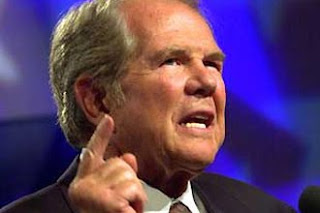
As a so-called evangelical, minister, and scholar I do not normally use this blog to write about current themes or express my opinion on matters beyond the limits of the John Brown study. However, once in a while an issue arises that seem so spiritually apropos of the Brown theme, or so strongly interconnect in principle to his life and values, that I have to make an exception. Certainly the recent remarks about the devastating Haitian earthquake by televangelist mogul, right-wing activist, and Christian Zionist "Pat" Robertson demand some sort of evaluation and critique.


I. Evangelicals, John Brown, and Haiti

According to a report published by ABC news on-line (Jan. 14), Robertson said: "You know ... something happened a long time ago in Hait . . . . They got together and swore a pact to the Devil. They said, 'We will serve you if you get us free from the French.' True story. And so, the Devil said, 'OK, it's a deal.' And they kicked the French out. . . . You know, the Haitians revolted and got themselves free. But ever since, they have been cursed by one thing after another."

It is actually a popular notion among many white evangelicals in the U.S. that Haiti's impoverished plight is specifically the result of the prevalence of "voodoo," or witchcraft, in that country. While I hardly embrace the practice of "voodoo" myself, I find such reasoning speculative and self-serving. As Robertson's words may reflect popular thinking among many white evangelicals, it suggests that perceptions of Haiti are steeped by generations in a politically conservative and culturally condescending mindset. This accepted church pew wisdom, that Haiti's historic plight can be reduced to the practice of African witchcraft, reflects ignorance, not malice. Many white evangelicals simply do not comprehend the whys-and-what-fors of Haiti's place in the western world, nor are they sensitive to the nature of systemic racism in the historical development of U.S. domestic and foreign policy. In this regard they are no different than most whites in the U.S., who have no idea that the Haitian liberation movement was not only rooted in the same political ideas underlying the "American Revolution," but that the Haiti's remarkable triumph over the French actually prevented Napoleon Bonaparte from invading North America. Had it not been for Haiti's bold stance for independence, there would have been no Louisiana Purchase and Napoleon may very well have advanced in North America to the undermining of this nation.

In contrast to "Pat" Robertson, the evangelical Christian abolitionist John Brown was a great admirer of Haiti's revolution, especially the heroic leadership of Toussaint L'Ourverture, the carriage driver-turned-brilliant military commander who led Haiti's forces, blocked the Napoleonic invasion, and ultimately died in a European prison, after being betrayed into the hands of the French tyrant. Brown studied Toussaint with great zeal and read anything he could find on the black hero and his revolution. To Brown, the liberation of Haiti was not the work of the devil, but rather the kind Providence of God and a true demonstration of the fact of black equality.

In turn, the Haitian people loved John Brown's legacy. After his hanging in Virginia, the Haitian people mourned Brown's death in ceremony and celebrated his life and legacy by naming a main thoroughfare after him. Haitians collected money to send to Brown's widow, and Haitians opened their arms to African Americans wishing to expatriate themselves to the free black nation. Among those who supported this effort in conjunction with the Haitian government were Brown's son, John Jr., and his first biographer, James Redpath. Redpath's association with Haiti is another story in itself, but his admiration for Brown and Haiti is perhaps best exemplified by his 1863 publication of John R. Beard's Toussaint L'Ouverture: A Biography (1853), very likely the same biography that John Brown read so devoutly during his last days in Virginia. Redpath went beyond Beard, however, by personally seeking--and finding--Toussaint's own prison autobiography, which he included with the Beard biography.

Redpath notes in his prefacing remarks that in his day there were "three versions of Haytian [sic] history,--the white, the black, and the yellow: the white representing the pro-slavery party, the black that of the negroes, and the yellow that of the mulattoes. The abolitionists of England and America have adopted the negro standard." Redpath understood then, as we should now, that one's perspective on Haiti is defined by one's politics, and that in the U.S., politics are inseparable from issues of race and racism--and this is precisely the point of "Pat" Robertson's reading of the recent tragedy in Haiti. His interpretation of the Haitian earthquake is actually his interpretation of Haiti, and his interpretation of Haiti is essentially that of the pro-slavery party in its most refined and advanced version.

Pat Robertson's interpretation of the Haitian earthquake is actually his interpretation of Haiti, and his interpretation of Haiti is essentially that of the pro-slavery party in its most refined and advanced version.


II. "Pat" and the Slave Master Legacy

Marion Gordon Robertson, a.k.a. "Pat" Robertson, was born in 1930, from a long line of elite Virginians. On his website, PatRobertson.com, he boasts of his descent from statesmen and noblemen and even posts his family's genealogical descent as recorded in Count D'Angerville's Living Descendants of Blood Royal in America (1964).

On another page of his website, Robertson recalls his family and upbringing, recalling his father, Absalom Willis Robertson (1887-1971), a lawyer and Democratic politicians from Virginia who served in the House of Representatives and the Senate. "Pat" writes of his father, that in 1946 he was elected to fill the U.S. Senate seat, "and there he served for 20 years, becoming one of the handful of senior conservative southern Democrats who controlled much of the business of the United States Senate." He goes on to write: "Both my mother and my father instilled in me the responsibility that we had to our family tradition" [my emphasis]. As "Pat" himself points out, this family tradition included the veneration of Confederate generals and slave masters like Robert E. Lee.


Daddy Absalom and the "Southern Manifesto"

What "Pat" does not reveal on his website is that his father was also a strident supporter of school segregation. The elder Robertson actually was one of nineteen southern senators to sign the so-called "Southern Manifesto" (1956), which condemned the Supreme Court's decision in favor of school desegregation in the landmark case, Brown v. Board of Education. According to Time magazine (Mar. 26, 1956), this pro-segregation document was conceived and advanced by South Carolina's premier political figure of the era, Strom Thurmond. The "manifesto" thus required its signers "to exert 'all lawful means' toward reversing the Supreme Court's desegregation decision." Thurmond and his allies called the Court's decision an "unwarranted exercise of power," complaining in the document that the landmark decision was "creating chaos and confusion" in the South and "destroying the amicable relations between the white and Negro races that have been created through 90 years of patient effort by the good people of both races." Of course, had there truly been "amicable relations" between whites and blacks in the South, there would have been no need for the Civil Rights movement. But it was the very nature of racists in the South to blame civil rights activism in the 20th century, just as it was in the nature of slave masters to blame abolitionists for disturbing and upsetting the peaceful, contented state of "their" slaves in the 19th century.

Clearly, another part of "Pat" Robertson's "family tradition" was this strident devotion to racial segregation. While Reverend Doctor Robertson has seemingly abandoned his father's overt devotion to racial segregation, it is nevertheless true that he has neither acknowledged it nor apologized for it on his proud website. Indeed, his silence in this regard is telling: it tends to convey the impression that he is not entirely honest nor sincere in his role as a so-called evangelical leader, many of his faithful followers being the Christian descendants of enslaved blacks. It may also suggest that his devotion to justice and equality are actually limited despite his claims to represent the righteous Kingdom of God and His Christ.


A Lesson from Ben

In light of this facts, it is probably no surprise that after years of being supported by his faithful African American sidekick, Ben Kinchlow, on his "700 Club" program, Robertson apparently threw Ben under the bus when he left the Club for his unsuccessful run for the presidency in 1988. Now, I'm no great fan of Ben Kinchlow either; I'm particularly disappointed in his blind devotion to the Zionist State of Israel which, like that of Robertson (and most televangelists), is a fundamentalism-turned-political idolatry that is the exact opposite attitude displayed toward poor, dark nations like Haiti. Nevertheless, I remember very distinctly talking with a highly respected black evangelical leader not long after Robertson's failed attempt to take the White House. This black leader, apparently on a first-hand basis, complained of the sense of betrayal that Kinchlow felt after being put aside. He had exerted real leadership and influence as co-host of the "700 Club," the leader told me. But when "Pat" made his move for the White House, he promptly handed over the reins of the program to his son, Gordon. Unfortunately Reverend Ben had to learn a hard lesson. Helping Massa steer the wagon doesn't mean you own a piece of the plantation. (Kinchlow has since ventured out on his own, essentially parroting Robertson's ideological bent; in 2008, "Pat" even welcomed Ben back to the Club house to promote his new book, Black Yellowdogs, a black conservative production.)


Speaking of Plantations . . . Some Interesting Robertson Family History

Another key aspect of Robertson's family tradition are his proud Virginia aristocratic roots. According to an on-line genealogy by William Addams Reitwiesner, one of those roots is Great-Great-Grandfather, Larkin Willis, born a few months before John Brown was born, on February 26, 1800. Larkin Willis was born in Culpeper County, Virginia and died in Woodland, Orange County, Virginia, on February 21, 1856 (about the same time that Brown was facing off with pro-slavery terrorism in the Kansas territory). Of course, Willis would have despised John Brown, and he probably despised abolitionists in general, given that he was a bona fide slave holder.

According to the 1850 slave schedule,* "Pat" Robertson's great-great grandfather owned 27 human beings as property--a real asset to the "family tradition" given the amount of stolen profit that surely accrued from the labor of these enslaved people. The slave schedule provides no names, only age and sex. "Pat" can also brag that his forebear owned 17 males ranging from 7 to 63 years of age, and 10 females, ranging from 9 to 55 years of age. We have no idea if Massa Larkin raped any of the women or if he beat the men, but even if he was a moderately "good" master, it would not be unusual for a little of both to have taken place. After all, brutality and sexualized violence were essential to the nature of the so-called "Peculiar Institution."


Chumps and Champs in the Family Tree

Another point of "Pat" Robertson's noble line is also worth noting: According to Reitwiesner, Robertson is also a direct descendant of John Armistead (1635-98), who is also the great (x7) grandfather of the world champion boxer and sports legend, Muhammad Ali (nee Cassius Clay). Based on Reitwiesner's genealogical research, I assume here that this stream of Ali's family lineage turned "black" sometime in the 19th century, when Armistead's descendant, Armstead Morehead (1808-65), a farmer from Green Ridge, Logan County, Kentucky, "sired" (and I use that term loosely) a son with his enslaved female property, known only as "Dinah." The offspring of this legalized rape was Thomas Morehead, who was kept a slave by his father until the Civil War. Thomas, who died in 1913, fought for the Union along with his white half-brother, James Morehead.


III. "Pat" Thus Considered

What can we learn from these genealogical and historical reflections upon the background of Marion Gordon "Pat" Robertson? First, I suggest that we can observe in both recent and remote family history that he can be as ashamed of his family line as he is proud of it. Frankly, it always amazes me when the descendants of slave holders either defend their ancestors or refuse to apologize for their sins--as if having held slaves and stolen their bodies and their labor was something of a minor offense, easily put aside in the grand scheme of things. If my forebears owned slaves I'd be godawfully sorry about it to say the least. I would make every effort to acknowledge and renounce this shameful blot, particularly if I were a famous evangelical Christian leader. Certainly I would make some effort to acknowledge the guilt of my ancestors instead of pretending to be an heir to some great and noble legacy.

People like "Pat" Robertson hide the bones of their family's slaves in the folds of their ancestral records and pretend that it's just water under the bridge, even though it's really blood in the ground crying out against them. If "Pat" Robertson is a man of God, he needs to come clean and show a little humility on behalf of his segregationist and slave holding forebears. By the way, somebody ought to raise the issue of reparations to "Pat." After all, repayment for damage is a biblical principle and "Pat" is supposed to be a righteous man of God. Perhaps he should do some genealogical research and start cutting some checks.

Second, it is no surprise that "Pat" can reflect such a condescending snobbery in his misinformed summation of the background of Haitian independence. Although dressing his critique in religious language, "Pat" did not simply blame this chapter of Haiti's problems on "voodoo" as do many white evangelicals in their ignorance. The televangelist struck specifically at the Haitian overthrow of white supremacy, declaring: "the Haitians revolted and got themselves free. But ever since, they have been cursed by one thing after another" (my emphasis).

This is no small point: If you will, the televangelist is also the slave master in this episode. He attributes the ability of black people to "get themselves free" to the work of the devil. From the slave master's standpoint, only the devil would connive to remove the chains of slavery and colonialism. Furthermore, according to Robertson, Haiti, the little black mouse that roared, is "cursed" because it had the audacity to overthrow white leadership--something that is inherently valued by "Pat" Robertson. It is a fact of history that Southern slave holders looked at Haiti with fear and contempt because they dreaded the possibility that "their" blacks would rise up and do the same thing. In his own way, "Pat" has demonstrated the resentment of his forebears by declaring the small black nation "cursed." He believes this as much as his great-great grandfather believed he had a right to own black people as property.

"Pat" may slip and squeeze his way out of it, and even his naive black followers will probably let him off the hook. On Pat's website, a spokesman for the Robertson television network has argued that his boss's remarks "were based on the widely-discussed 1791 slave rebellion led by Boukman Dutty at Bois Caiman, where the slaves allegedly made a famous pact with the devil in exchange for victory over the French." This "history," taken along with "the horrible state of the country has led countless scholars and religious figures over the centuries to believe the country is cursed." The spokesman concludes by denying that "Pat" spoke of the earthquake as a manifestation of "God’s wrath." It may be that Massa "Pat" never attributed the Haitian earthquake to God's "wrath," but in fact he has done far worse. He has not only misrepresented the nature of the Haitian independence movement, which was won by Providential heroes like L'Ouverture and Dessalines, but he has attributed a "cursed" status to Haiti, something that white racists have generally done to Africans for centuries in justification of enslaving them.

A Closing Word to "Pat" Robertson

From one clergyman to another, Reverend "Pat," whether or not there is a curse on Haiti, there is a far greater curse upon teachers of God's word who mislead the church and bring shame on the gospel of Jesus Christ. Watch your words and your doctrine carefully lest you find yourself reading the handwriting on the wall: MENE, MENE, TEKEL.
========================

*1850 Slave Schedule, Orange County, Virginia, August 15, 1850, p. 11

Tuesday, January 12, 2010

John Brown Farm Update

LAKE PLACID — The New York State Office of Parks, Recreation and Historic Preservation will be undertaking critical repairs at John Brown Farm State Historic Site this winter.

The project will include new siding, window restoration and other minor repairs at the John Brown farmhouse.

The farmhouse was John Brown's home at the time of his renowned raid on Harper's Ferry and is immediately adjacent to his grave site. The farmhouse and grave site are open for tours each year from May through October, and the historic site is a popular heritage tourist attraction.

John Brown Farm State Historic Site celebrated the 150th anniversary of John Brown's funeral and burial with a series of commemorative events in December 2009.

An effort is now under way to ensure the preservation of the historic farmhouse for future generations.

The exterior siding of the house has deteriorated to the point that air and water infiltration threaten to damage the house. The old siding has warped and cracked, window frames are cracked and caulking is missing, and other exterior elements need repair.

Over the winter, the windows of the farmhouse will be removed and restored by restoration carpenters at State Park's regional maintenance shop in Saratoga.

New eastern white cedar siding, cut by Fort Edward Supply Inc. to replicate the profile of historic period cladding, will be milled, prepped and treated before installation.

In the spring, the entire farmhouse will be re-sided, the newly restored windows will be installed, and other necessary repairs completed. The exterior rehabilitation will ensure the preservation of the 154-year-old farmhouse.

None of the current siding on the building is original or historic, having been replaced a number of times over the life of the house, most recently in the 1970s.

The window restoration work, new cedar siding and other repairs to the house are being conducted under the guidance of historic-preservation specialists from the State Historic Preservation Office. All work is being completed in accordance with the Secretary of Interior's Standards for Rehabilitation, as required by the National Historic Preservation Act of 1966.

The John Brown Farm State Historic Site is located two miles east of the Village of Lake Placid, a half mile north of Route 73 at the end of John Brown Road.

Saturday, January 02, 2010


There is no need to render John Brown a complicated jigsaw-puzzle of a man but writers and scholars continue to do so. . . . Why?

Regarding the “Complexity” of John Brown and His Readers

I

In a recent presentation before the Historical Society of Pennsylvania (Philadelphia), I made a point of saying that contrary to what is often said, John Brown is not a complex historical figure. Abraham Lincoln, with his personal racism, his political ambitions and connections, his simultaneous devotion to the Declaration of Independence and white supremacy, and his contempt for slavery, makes for a much more complex and difficult study. Quite the opposite, John Brown is simple to understand once you comprehend the grade of his fiber and the knit of his thoughts and convictions. W.E.B. DuBois put it best when he said of Brown, “He was simple, exasperatingly simple.”

Recently even some admirers of Brown have been quoted as speaking of him as a "complex" person. Perhaps their claim of his complexity may have seemed to them a profound but salutary historical observation; or it may have been intended as a kind of apologetic given the fact that so many people tend to dismiss Brown as a “terrorist” with little or no actual knowledge of his life and activities. Given their good intentions, I’m sure that his admirers can be forgiven the error of burdening Brown with a certain “complexity” that actually did not exist. To the contrary, the more I study his life and seek to understand his words, the more I have concluded that John Brown was not at all complex. DuBois was right: John Brown is "exasperatingly simple.”

Of course, as far as human beings go, he was no less complex than the rest of us. But ask yourself to what degree you would admit to your own complexity and you can fairly well attribute that same sort of complexity to Brown. But if you are so complicated that people find it hard to be certain of your motivations, or if your life is fraught with obvious contradictions, and your efforts are subject to radically different interpretations, then you are actually more “complex” than John Brown the abolitionist. Indeed, you are more like Lincoln than Brown. To be sure, his was a unique blend of conservative Protestant theology and an egalitarian anthropology, and this did make him radically different from the majority of whites in his day. But being exceptional does not mean one is “complex.”

II

It is unfortunate that historians and journalists have long been making a complicated mess of understanding John Brown by imposing their own contradictions and complexities upon him. Fifty years ago academics were troubled by the John Brown they had contrived in their own writings, the supposedly insane man who started an allegedly unnecessary war. Although contemporary writers have moved beyond the baseless notion that Brown was insane, they still entangle him in lamentations about how the Civil War might have been avoided, or further these ill-founded complications with the faddish comparison of Brown and his men with contemporary terrorists.

As to the latter, the most recent foray into the realm of John Brown’s alleged complexity was an op-ed piece published in the New York Times (Dec. 1) by the noteworthy and esteemed author, Tony Horwitz, whom I had the pleasure of meeting at a conference at Yale University this fall. In his op-ed, Horwitz compares the Harper’s Ferry raid to “9/11,” but admittedly has done so with a good deal more caution and respect for the differences between the abolitionist agenda of the 19th century and the terrorist agenda of the Muslim fanatics who brought down the World Trade Center towers in 2001. Horwitz acknowledges that “Khalid Shaikh Mohammed is no John Brown” and observes the concern for human life that the latter displayed during his occupation of Harper’s Ferry. Yet he subjects the abolitionist to a hermeneutic of cynicism by insisting that there is sufficient justification to keep the bearded Brown in the same ideological holding pen with the bearded Shaikh who mastermined “9/11.”

Obviously I disagree. Specifically, Horwitz says that in 1859, “Brown occupied the far fringe of abolitionism.” To justify this notion he quotes the New York Times, which referred to him in 1859 as a “wild and absurd freak.” This is hardly substantial. The Times was never the voice of abolitionism in the antebellum era and could no more evaluate Brown’s relation to the anti-slavery movement than it could properly evaluate the relation of Malcolm X to the black freedom movement in the 1960s. Considering the notoriety that Brown gained in the Kansas territory and the confidence and support that he enjoyed among black and white abolitionists, it simply is not correct to speak of him as having been on the fringe of abolitionism in 1859. This kind of caricaturing may be easily swallowed by the public, but it does nothing to service the historical record.

Horwitz further errs by concluding that “John Brown sought not only to free slaves in Virginia but to terrorize the South and incite a broad conflict.” It is true that Brown recognized the value of creating a panic in the South, but his conception of creating “terror” is not categorically the same as “terrorism” today. Brown’s idea of “terror” was founded upon the biblical story of Gideon, for instance, who employed lamps and horns to scare his enemies into a subversive panic in the midnight hour. If Brown hoped to incite anything it was a panic among slave holders that would cause them to sell their slaves deeper into the South, disrupting southern communities by throwing the slave economy into an upheaval. Furthermore, he was aware that far more violent measures might be taken to strike at the South. For instance, in a clandestine meeting in Detroit in 1859, one black leader suggested that Brown and his men might blow up a number of white churches, a notion that he completely disdained for its fundamental violence.

Furthermore Horwitz has misread the abolitionist’s strategy and purpose. The point of Brown’s effort actually was to divert the course of the nation away from “broad conflict.” As journalist William Phillips later recalled, Brown clearly understood that pro-slavery leaders were preparing for war in the 1850s. The goal of destabilizing slavery in the South was, in Brown’s mind, a last ditch effort toward evading a likely civil conflict of tragic proportions. In his famous last note written prior to his hanging. Brown jotted down these very sentiments, lamenting that a great deal of blood would have to be shed in order to end slavery now that his own plans had failed. He was correct.

Another unfortunate complication of Horwitz’s piece is that by imputing a kind of terrorism to Brown, he is impugning the black community’s historic reading of the Harper’s Ferry raid by suggesting that African Americans were applauding terrorism, and that the black perspective on slavery was actually warped in comparison to the prevailing consensus of white society. Is Horwitz really suggesting that we should trust his reading of the Harper’s Ferry raid over that of Frederick Douglass, Harriet Tubman, and others who knew Brown as well as the depth of slavery’s own fundamental terrorism? Of course the author is entitled to remain “on the fence” regarding Brown; he told me personally that in his former work as a journalist he saw many awful things in the field, and it may be that he simply cannot separate his ideas about religious extremists and violence. Horwitz’s passing reference to Brown as “a bearded fundamentalist who believed himself chosen by God” is no simple description, but a loaded innuendo coming from an author who has already made up his mind that John Brown is a complex, troubling figure.

III

Writing an online piece for the History News Network (Nov. 30), David Blight, a renowned scholar (and our gracious host at Yale University this past October) also makes of John Brown a complex figure. While he handles the abolitionist more objectively, he tends to stoke the flames of historical complexity by the problematic assumption that “[e]very discussion of the history of revolutionary violence or terrorism (choose your label) in American history begins with John Brown’s efforts to destroy slavery.” Once more I respectfully disagree. To mark the genesis of “American revolutionary violence” or “terrorism” with John Brown is sheer presumption: There are many examples of militant campaigns of revolutionary violence or terrorism, especially violent efforts to assert white supremacy, from the earliest stages of European settlement in North America. Even if one sees Brown as a terrorist (and I do not), why start with him? According to whose history book does such violence and terrorism begin with Brown? Once more, I doubt that Frederick Douglass would agree with his esteemed biographer on this point.

Blight goes on to warn against the “extremes” of interpretation regarding Brown: either he is a redemptive, heroic figure or a “midnight terrorist.” Either one “can keep us comfortable with our prejudices and our desires,” says Blight, “but blind to the authentic fated tragedy in Brown’s acts. . . . [W]e should never let him or his story rest too easily in the narratives we tell ourselves.” Furthermore, we should avoid what Blight calls the “pleasing sense of the inevitability of the Civil War,” or that the battle at Harpers Ferry was “the ordained” initiation of bloody civil conflict.

Frankly, I am not clear as to what he means by “authentic fated tragedy,” especially since he opposes the notion of historical inevitability in the same context. If he is saying that John Brown’s actions cannot be justified in the name of divine determinism, I would agree. On the other hand, if he is suggesting that responsible historians must religiously embrace a world view where nothing can be seen as having been determined, ordained, or predestined, then he is dictating a secular world view and I would respectfully disagree with him. Contrary to what Blight may be suggesting, just because one believes that God has ordained all the events of history does not mean that one will distort the evidence and manipulate the narrative in order to sustain the comfort of one’s prejudices. Certainly Pelagian historians, whether secular or religious, are just as capable of manipulating historical narratives to suit their own prejudices.

Blight argues further that if Brown had succeeded in launching his liberation movement, if he “had not been captured so readily, if a slave insurrection in Virginia had killed thousands and Brown himself had been merely shot on some country road and the body never found we would not be thinking about him today. It is all about the gallows.” I appreciate Blight’s point: The John Brown story, culminating as it does with martyrdom, would be quite a different narrative had he died in the battle of Harper’s Ferry, or sometime afterward in a skirmish with southern militia. His last days, letters and interviews, and his brave, dignified bearing on the gallows have given us a greater understanding of the man who was John Brown. But to say that “we would not be thinking about him today” had he died otherwise is untenable.

First, given Brown’s notoriety in Kansas, he was already a controversially popular figure in the North. He would not have been revered or memorialized in song, but historians would be talking about him. Second, had Brown been able to make even three months’ work of his efforts in the mountains leading into the heart of the South, he would have been the subject of a whole different kind of historical discussion, probably just as politicized and equally polemical. Third, there is no saying for certain that had Brown died of a bayonet attack in the armory engine house at Harper’s Ferry that he would not have been memorialized as a fallen hero, the same way that his pro-slavery counterparts died at the Alamo. Who knows, instead of “John Brown’s body,” Union soldiers might have been charging into battle with shouts of “Remember Harper’s Ferry!”

Apart from this point, however, I do agree with Blight that the gallows made the difference. Although I disagree with those who say that Brown “reinvented” himself as a martyr, it is clear that he understood the power of the voice he possessed within his jail cell. The problem with the complicating notion that he “reinvented” himself is that it suggests a certain contrivance or posturing that is not the case with John Brown. From the earliest stages of his activism, he made use of the pen as well as the sword, but he believed it a point of weakness to rely on words when action could be taken. From “Sambo Mistakes” to the organizational papers of the United States League of Gileadites to his free state circulars, and from his “Provisional Constitution” to “John Brown’s Parallels,” the man clearly believed in the power of the pen and sought to use it effectively as a complement to his militant struggle. As a prisoner of Virginia, he did not make himself into someone new, but rather threw himself completely into the power of words because this was all he had left to him. The compelling, charismatic Christian man writing from his jail cell is the same man who had previously used militant means to oppose slavery. John Brown was as much a praying-and-Bible-reading Christian activist before his defeat and arrest as after when he awaited his appointed hour on the gallows in Virginia. So it was not John Brown who “reinvented” himself in the shadow of the gallows, but rather the North which was compelled to “reinvent” itself by the fact of Brown’s witness in words and death. In this sense too, it is not only the gallows, but the road to the gallows that enables us, even today, to see the man who lived and died as John Brown the abolitionist.

Finally, Blight sounds much like another Douglass biographer, William McFeeley, who has written of the vexing nature of John Brown as a historical figure. Blight opines:
John Brown should and does still trouble us; his “soul” may “go marching on” in the song that bears his name, but we should never let him or his story rest too easily in the narratives we tell ourselves. History should never come so cheap as to simply make us feel good about murder in the name of vengeance for slaveholding. . . .
This is probably one of the best examples of how scholars complicate Brown’s place in history. This caveat, coming from one of the most admirable and brilliant U.S. historians of our day, that Brown “should and does still trouble us” raises questions to those of us who simply cannot understand why we should feel the way Blight says we should. Blight is an excellent man, but he is no more moral or spiritually high-minded than others who have been devoted to Brown without apology. In fact, it is interesting that over a few generations some of the leading proponents of Brown have been clergymen (including a rabbi named Louis Ruchames). While none of them have taken the Pottawatomie killings lightly, nor have they retreated so bashfully from Brown as have academics like Blight. (I should add, too, this is not simply a “white” thing; as much as we love and appreciate the work of Benjamin Quarles, his assessment of Brown is occasionally marred by small but demeaning concessions made in deference to the ivory tower in his day.)

Contrary to Blight and other academics, the issue of “murder” in the case of the Pottawatomie killings is not a settled fact of history. That one can so easily throw down the gauntlet of “murder in the name of vengeance for slaveholding,” in my opinion, suggests a deficiency in consideration of the facts, and perhaps an all-too-easy acquiescence to ivory tower assumptions. For too long scholars have uncritically accepted Villard’s thesis of the Pottawatomie killings as having been “murder,” which has more recently lent itself to the terrorist-minded detractors of Brown. To the contrary, there are alternative readings of these infamous killings, especially that they were preemptive and counter-terroristic by nature and must be understood in the context of a lawless and bellicose situation where the Browns had no recourse to constabulary protection.

Finally, it is more than interesting that Blight and McFeeley, both notable biographers of Frederick Douglass, would depart so drastically from their subject’s assessment of Brown. Does Blight consider Douglass’s reading of Brown as “cheap” and “feel good”? Is not Blight being a bit more than “preachy” to moralize so about embracing Brown too closely? Many of us who have studied Brown simply do not feel so troubled, nor do we speak of “murder” and John Brown in the same historical breath. What is it really that so vexes and disturbs these scholars about John Brown? Is this really about “murder,” or is it about the unspoken assumptions, values, and cultural pressures inherent in academia, or the politics of naming and grading our heroes and banishing our rebels to the margins of the history text? Was Frederick Douglass being cheap when he wrote in retrospect, “John Brown saw slavery through no mist or cloud, but in a light of infinite brightness, which left no one of its ten thousand horrors concealed”?

There is no need to render John Brown a complicated jigsaw-puzzle of a man, vexing to assemble, hard to handle, and impossible to appreciate except without constantly reminding us of his allegedly difficult, problematic, and troubling legacy. The issue here is not Brown’s complexity, but that of his readers, many of whom are themselves so entangled in a complexity of their own presumptions that the profound simplicity of the man simply frightens them.-LD


IN THE BEST OF COMPANY. . .

It was an honor indeed for your blogger to be a co-presenter at the "John Brown Coming Home" Symposium, Lake Placid, N.Y., on December 5, 2009, with Dr. Margaret Washington, Professor of History, Cornell University. Most recently, Margaret has authored the scholarly masterpiece, Sojourner Truth's America (University of Illinois Press, 2009), which Ellen Carol DuBois calls "a tour de force of extraordinary research, powerful writing, and compassionate historical reconstruction." (Photo by Michele Sweeting-DeCaro)