The Research & Writing of Louis A. DeCaro Jr.


"The world needed John Brown and John Brown came, and time will do him justice." Frederick Douglass (1886)

Search This Blog & Links

Translate

Monday, April 15, 2013

Retro--
Albert Fried, author of John Brown's Journey, Reviews John Brown--The Cost of Freedom


When my book, John Brown--The Cost of Freedom, was published, Albert Fried was kind enough to read the manuscript and provide a "blurb" for the cover.  Fried's book, John Brown's Journey (1974), is a modern classic, and provides a unique scholarly approach.  Journey is a reflective history and historiography combined, the author writing about Brown and his times during the political crises a century later, particularly amidst the Civil Rights and Vietnam War era.  He also provides a helpful review of the books and authors up to the 1970s.   I consider John Brown's Journey one of the most important books written about the abolitionist in the 20th century.  In many respects, it is far more important than some of the cultural and biographically oriented studies written in this era, and should be read by any serious student of John Brown.  When I revisited his review recently, I thought it would be appropriate to publish it in its entirety, given the depth of Fried's political perspective.  Apart from its concerns as a review, this piece is a substantive reflection upon the John Brown theme from an intellectual and progressive with a great appreciation for and understanding of the abolitionist.--LD

"I am happy to add my brief comments to Louis A. DeCaro's important contribution to the literature on John Brown. Markedly distinguishing Mr. DeCaro's book from all the others, even the fair and objective scholarly ones, is the amount of valuable and hitherto unacknowledged data he has unearthed from neglected or overlooked sources. These reinforce the fact that Brown was, as paterfamilias, entrepreneur, Christian fundamentalist, citizen, quintessentially a man of his time, a man who had the unfailing respect of his contemporaries despite his many business setbacks (typical of his day and age). To read Mr. DeCaro is to realize yet again‑to realize once and for all how outlandish is the myth of John Brown as bloodthirsty religious fanatic and suicidal maniac whose bankruptcies drove him in desperation to embrace the anti‑slavery cause‑the myth that his numerous detractors propagated and too much of the public came to take for granted.
Albert Fried, May 2007, in New York
City (photo by L. DeCaro Jr.)

With a nice display of erudition, logic and eloquence, Mr. DeCaro takes us through all the phases of Brown's abolitionist career, from its emergence to its denouement at Harper's Ferry. We see clearly how he was from the start an abolitionist with a very pronounced difference, espousing as he did violent resistance to an evil that seemed absolutely invincible and also establishing unusually close relations with free blacks, not only prominent ones like Frederick Douglass and Harriet Tubman, but also rank‑and‑file men and women whose consciousness he sought to raise and whom he helped materially, inviting a number of them, for instance, to live in his North Elba community. Brown's belief in violent resistance matured into a plan of attack when the slavery issue suddenly took an acutely critical turn in 1854 with the passage of the Kansas‑Nebraska Act. Northerners now angrily confronted the prospect that slavery, which is to say the Southern slavocracy, would expand into free territory, until then legally protected by the Missouri Compromise. Thus arose overnight the Republican Party with its ironclad demand that slavery must remain within the prescribed limits. And when Kansas exploded into open warfare between pro‑ and anti‑slave factions, John Brown and members of his family made their way there, and there he learned to play the extraordinary role history assigned him.

Here Mr. DeCaro convincingly reveals the larger policy implications of Brown's part in the Kansas civil war‑ specifically his responsibility as leader of a group of radical free soilers, for the notorious Pottawatomie massacre of five pro‑slavery activists. Over the years Brown's critics have cited these horrific deeds to justify their merciless condemnation of his character and values. They totally miss the point. What comes through in Mr. DeCaro's pages is precisely Brown's intention to exacerbate the sectional and ideological conflict, the better to advance the larger policy he had in mind. So yes, for him, given the transcendent evil against which he was taking up arms, the end did sanction the means, his deep‑seated humanity notwithstanding. (It was his humanity, as Mr. DeCaro explains, that led to his undoing at Harper's Ferry.) From his intensive study of books on guerilla warfare (amply summarized by Mr. DeCaro) Brown understood that provoking hated enemies to show their true colors, their brutality beneath the veneer of legitimacy, is a time‑honored tactic for radicalizing the moderates, the fence‑sitters, the non‑engaged, and getting them to support the insurgency. And so as the general crisis over slavery steadily worsened from the mid‑1850s on, John Brown's strategy was to devise a provocation capable of taking Americans along a path of high destiny from mere opposition to the expansion of slavery to its destruction root and branch, from Republicanism to abolitionism.

This brings us to Harper's Ferry. Brown's critics regard the assault he led as a piece of lunacy, proof of his death wish, his insensate desire for martyrdom. Nothing, as Mr. DeCaro attests, can be further his intention to overthrow the slave system by force and violence. He and his men would probably have escaped after carrying out the attack had he not wasted precious minutes in his humane treatment of the captured slaveowners. Had he and his men and the ex‑slaves gotten away (thanks to his indefatigable research, Mr. DeCaro informs us that in fact far more slaves from the surrounding region joined Brown at Harper's Ferry than any previous accounts have revealed) they would have operated as planned from their guerilla redoubt in the mountains of southern Pennsylvania. From there they would presumably have taken on local and state authorities and even the U.S. army, and if all went well they would have gained the backing of like‑minded abolitionists along with runaway slaves drawn to the insurgent cause. Now that insurgency, I assume, would have stood little chance of getting off the ground, much less of surviving for long. My commonsensical assumption, however, scarcely invalidates the project itself and certainly does not invalidate the moral conviction on which it was based‑the conviction that only a war to the death could realistically abolish slavery. For Brown and company to try to do what they could to initiate such a full‑scale war was, yes, entirely reasonable.

Reading Mr. DeCaro’s book makes us aware again of how history has vindicated John Brown's project, fulfilling the famous dark prophecy he uttered as he awaited the gallows on December 2, 1859: "the crimes of this guilty land will never be purged away but with blood." Only sixteen months later the Civil War began. And only four years after that President Lincoln, who once had nothing good to say about John Brown, in his great Second Inaugural Address‑600,000 Americans having died in battle‑fully justified that terrible gallows prophecy in words that make us shudder no matter how often we hear them. "Fondly do we hope‑fervently do we pray‑that this mighty scourge of war may speedily pass away. Yet if God wills that it continues until every drop of blood drawn with the lash shall be paid by another drawn with the sword, as was said three thousand years ago, so still must it be said, 'the judgments of the Lord are true and righteous.'"

Albert Fried, 2007
Author, John Brown's Journey

Thursday, April 11, 2013

April Fools! Not--
Misquoted?  Whatever!

Horwitz: notable journalist
is badly reported
Tony Horwitz dropped me a note this past week regarding his recent appearance in Lawrence, linked to in the Lawrence Journal-World  (Apr. 4), saying the article was "filled with laughable inaccuracies."  Tony was not exaggerating.   "[M]ost notably," he writes, "the alleged quote of mine saying that Annie Brown [one of the abolitionist's daughters] was 'an upscale privileged New York teenager.'"  It seems Tony actually had referred to Anne as "an upstate New York teenager who was rather provincial, having spent her previous years in a remote farming community."  Pretty annoying, to be sure.  "Upstate/upscale, privileged/provincial. Whatever," the author concluded.

A Wolfe in Man's Clothing,
Pictured Here in Hudson, O.
Cemetery
Reports of Harpers Ferry's Non-existence Are Greatly Exaggerated

H. Scott Wolfe, the Maitre de la librairie of Galena, Ill., and the special correspondent of our frequent "From the Field" feature, is on the historical road once again.  Herr Wolfe made a special investigation of Harpers Ferry (formerly Harper's Ferry) in response to rumors that the historic site of John Brown's 1859 raid had become non-existent.  Happily, his communication of 10 April puts the matter to rest: "This is to inform you that Harpers Ferry still exists," Wolfe writes. "This is the result of my personal observations of yesterday."  As Brown would put it, we are all most gratifyed by the report.
"John Brown Day" declaration
read by Pitt Master Bowen
(photo by L. DeCaro Jr.)

"John Brown Day" Declared in New York City (Well, in Queens, Anyway)

April 7th has been declared "John Brown Day" according to a proclamation of New York City councilman Jimmy Van Bramer of District 26 in Queens.  On Sunday, April 7, a representative of Councilman Van Bramer's office presented the official proclamation to Josh Bowen, proprietor and pitt master of John Brown Smokehouse, the home of serious Kansas City-style barbecue in the Big Apple.  The proclamation was read aloud by Mr. Bowen before a small but enthusiastic audience, and witnessed by John Brown portrayer, Norman Marshall (pictured above, left), and your blogger (not pictured).
Among those in attendance were activist Martha Swan of John Brown Lives!, the sponsoring organization of the featured program of the day, "The Afterlife of an Abolitionist."  The John Brown Lives! program featured scholars John Stauffer and Zoe Trodd, co-editors of the notable publication, The Tribunal.  Prof. Trodd was also present for the presentation of the "John Brown Day" proclamation afterward.  As yours truly pointed out to the audience, New York City was not one of Brown's favorite cities, probably due to its prominent racism and economic and business ties to slavery in the antebellum era.  Interestingly, after his hanging in December 1859, his body was briefly held over in New York City en route to burial in the Adirondacks.  It is a little known fact that during the stop over, Brown's remains were prepared for burial in a rented facility on Bowery Street by an anti-slavery mortician before being shipped to its final resting place in present day Lake Placid, N.Y.   It seems that April 7 has no special relevance to the John Brown story.  However, Norman Marshall pointed out that it is the birthday of jazz great Billie Holiday.


Friday, April 05, 2013

Author, Author--
John Brown "Debated" in Lawrence Program

According to a report by Giles Bruce of the Lawrence Journal-World online, an authors' "debate" on John Brown took place last evening (Thur., 4 Apr.) in the Liberty Hall Cinema of the Lawrence Public Library, in Lawrence, Kansas.  The program was presented as part of the institution's commemorate observation of the 150th anniversary of the massacre--a so-called "raid" carried out in that city by pro-slavery terrorist, William Quantrill on Aug. 21, 1863.  
Jonathan Earle, author of
John Brown's Raid

The authors in discussion were Tony Horwitz and Jonathan Earle.  Horwitz is well known as the author of Midnight Rising: John Brown and the Raid that Sparked the Civil War (Holt, 2011), the latest and most discussed book on the raid thus far.   Earle, a history professor at Kansas University, is the author of John Brown's Raid on Harper's Ferry: A Brief History with Documents (Bedford/St. Martin's, 2008), perhaps not as well known a book, but a helpful handbook published in the Bedford Series in History and Culture.  

The Lawrence event, oddly entitled, “Reconstructing John Brown,” drew a crowd that even surprised the award-winning Horwitz, who doubtless is no stranger to large crowds.  According to The Journal-World, the gathering was "at least twice as large as any he’s spoken to about Brown, a historical figure the author said is as well known in Lawrence and Kansas as anywhere in the world."

The Journal-World reports that one of the two discussants--which one is not identified--made reference to Brown as “the most polarizing figure in American history.”  Of course, there is some truth in the remark, but Thomas Jefferson actually was far more polarizing, in that he both embodied and bequeathed ideas of individual human liberty and the example of a slave master to the nation. Jefferson helped to create the polarity between democracy and slavery that finally came to an explosive conclusion in the U.S. Civil War.  
Tony Horwitz,
author of Midnight Rising
On the other hand, Brown was controversial, but only so because his actions brought the polarity to the surface and helped to force the nation to a resolution (of the institution of slavery, not its racism).  It is easy to label Brown as "polarizing," but he was only struggling within the currents already working within the nation.  Was Brown really "the most polarizing figure in American history"?  After all, white folks were already "polarized" over slavery.

Horwitz made a notable point in observing that Brown's famous battles at Black Jack and Ossawatomie were “arguably the opening shots of the Civil War.”  He stated further that Brown's war against slavery in the Kansas territory “led directly to Harpers Ferry,” since it allowed him to raise money for that battle from wealthy Northern abolitionists who fawned over Brown."  True enough.  Conventionally it has been stated that Harper's Ferry was the beginning of the Civil War; but certainly the Civil War unofficially had begun in the Kansas territory in the 1850s.  The real start of the war was not the Confederates firing on Fort Sumter, but pro-slavery thugs pouring into Kansas territory with the intention of violently forcing slavery upon the forming state of Kansas.

As to the perhaps inevitable discussion of the Pottawatomie killings, Horwitz stated, “I think most of us would agree he’s on the right side of history, but his means were very troubling.” Quoting historical novelist Truman Nelson, Horwitz referred to Brown as “the stone in the shoe of American history.”  As far as Brown's later trial in Virginia, Horwitz compared it to as sort of the O.J. Simpson trial of that day, “one of the first breaking-news stories in America.”

Professor Earle pointed out that Abraham Lincoln probably would not have been elected President of the U.S. were it not for Brown, who rendered William Seward--the favored Republican--unelectable.

The reporter seems to have given preference to reporting Horwitz's remarks, but it seems likely there was not much of a "debate" between the two writers.  Based upon what Earle has written, it does not seem his view of Brown, for instance, is significantly different from Horwitz's approach to the Pottawatomie killings.  Both see the killings primarily as sheer murder--although Horwitz has notably rejected the later claim that Brown and his men had heard of the violent beating of Charles Sumner in Washington by an irate South Carolinian politician.  In his book, Professor Earle conveys the conventional story that this news drove Brown's men "crazy." Neither Horwitz nor Earle sufficiently recognize the actual danger faced by Brown and his family in May 1856, nor do they evidently credit the ample evidence stating that the killings specifically targeted a circle of pro-slavery conspirators.  To both Horwitz and Earle, the men killed at Pottawatomie were more victims than dangerous foes, and the killings led by Brown essentially are vengeful and vindictive.  

According to the report, Horwitz concluded his part in the discussion by stating that Brown “forces us to ask the question, do the ends justify the means?”  

Of course, the answer is "yes."  Anne Brown, a daughter of the abolitionist, would probably have disdained such a question, since the answer should be obvious to anyone standing on the right side of history.  "Moral suasion and non resistance are excellent doctrines to preach in times of peace," she wrote in 1908.  "But often in troublous times, some one has to fight for peace--and fight hard too.  And then endure the remarks that are made by the carpet knights and quill-drivers who were not in the fray but stayed peacefully at home enjoying the after benefits derived from other's exertions."

See Giles Bruce, "Historians debate 'the most polarizing figure in American history," Lawrence Journal-World (LJWorld.com), 4 Apr. 2013.

*     *     *
Postscript

Larry Lawrence, chairman of the John Brown Society in New York City, recently issued a statement regarding Midnight Rising that raises a perspectival issue worth noting:
The contradiction that I believe that Horwitz faces is that he mainly wrote his book for a Civil War military history audience. That audience of active book buyers is as large, or probably larger, than the audience for 19th century abolitionism on its own. The main interest of the military audience is to see Kansas and Harpers Ferry principally in the light of the military meaning of both as military-only preludes to the greater conflict. We have always had this problem in the US with the war. The racial, social and political has always been slighted for the military. (This implies nothing at all about the real politics of Mr. Horwitz of which I know nothing. I presume that he is a leftist, as I am, sympathetic to racial justice.) 
(Larry Lawrence, 25 March 2013)


Monday, April 01, 2013

Well Versed--
Langston Hughes: "Shame On You"

Many are aware of the great Harlem Renaissance poet Langston Hughes and his admiration of John Brown. Hughes' grandmother was Mary Patterson, the widow of Harper's Ferry raider, Lewis Leary.  After Leary's death in 1859, she remarried Hughes famous forebear, the abolitionist orator Charles Langston.  Young Langston Hughes was reared with a great respect for Brown and his black and white raiders, and sometime in the 1920s he authored his wonderful poem, "October 16" ("Perhaps you will remember John Brown").  

Less popular perhaps is another poem by Hughes, written about two decades later and published in Phylon, the Atlanta University's publication founded by W.E.B. DuBois.  This poem is entitled, "Shame on You," and expresses Hughes' disdain for the failure of historical memory in the nation at large, as well as that of the black community.  Its brief verses go:
The Lincoln Theater, 1930s
If you’re great enough 
And clever enough 
The government might honor you. 
But the people will forget 
—Except on holidays. 

A movie house in Harlem named after Lincoln. 
Nothing at all named after John Brown. 
Black people don’t remember. 
Any better than white.  
If you’re not alive and kicking, shame on you!

The former Lincoln Theater today,
The Metropolitan Church in Harlem
According to the fascinating blog, Harlem + Bespoke (2 Mar. 2010), the "movie house in Harlem named after Lincoln" to which Hughes referred was the old Lincoln Theater, located at 58 West 135th Street in the heart of Harlem.  The blog says that the Lincoln Theater was the "first theater in Harlem to cater to an African-American audience."  It was opened in 1915, when Harlem was still "vastly white."  Later, it became a notable venue in the Harlem Renaissance for entertainers like Bessie Smith and Fats Waller.  In the following decades, the Lincoln Theater became a movie theater, as shown in Harlem + Bespoke's 1936 photograph.  In the 1960s, the theater was purchased by the Metropolitan Church and was given a new facade, although Harlem + Bespoke says that the interior theater was preserved.  Maybe the closest John Brown got to The Lincoln Theater was the showing in 1955 of "Seven Angry Men," a mediocre film about the abolitionist and his sons in which Raymond Massey reprised his role as Brown from the terribly distorted portrayal in "Santa Fe Trail" (1940).

The Hughes poem, "Shame on You," appeared in Phylon, Vol. 11, No. 1 (1950), page 15.


Thursday, March 21, 2013

Grave Matters--
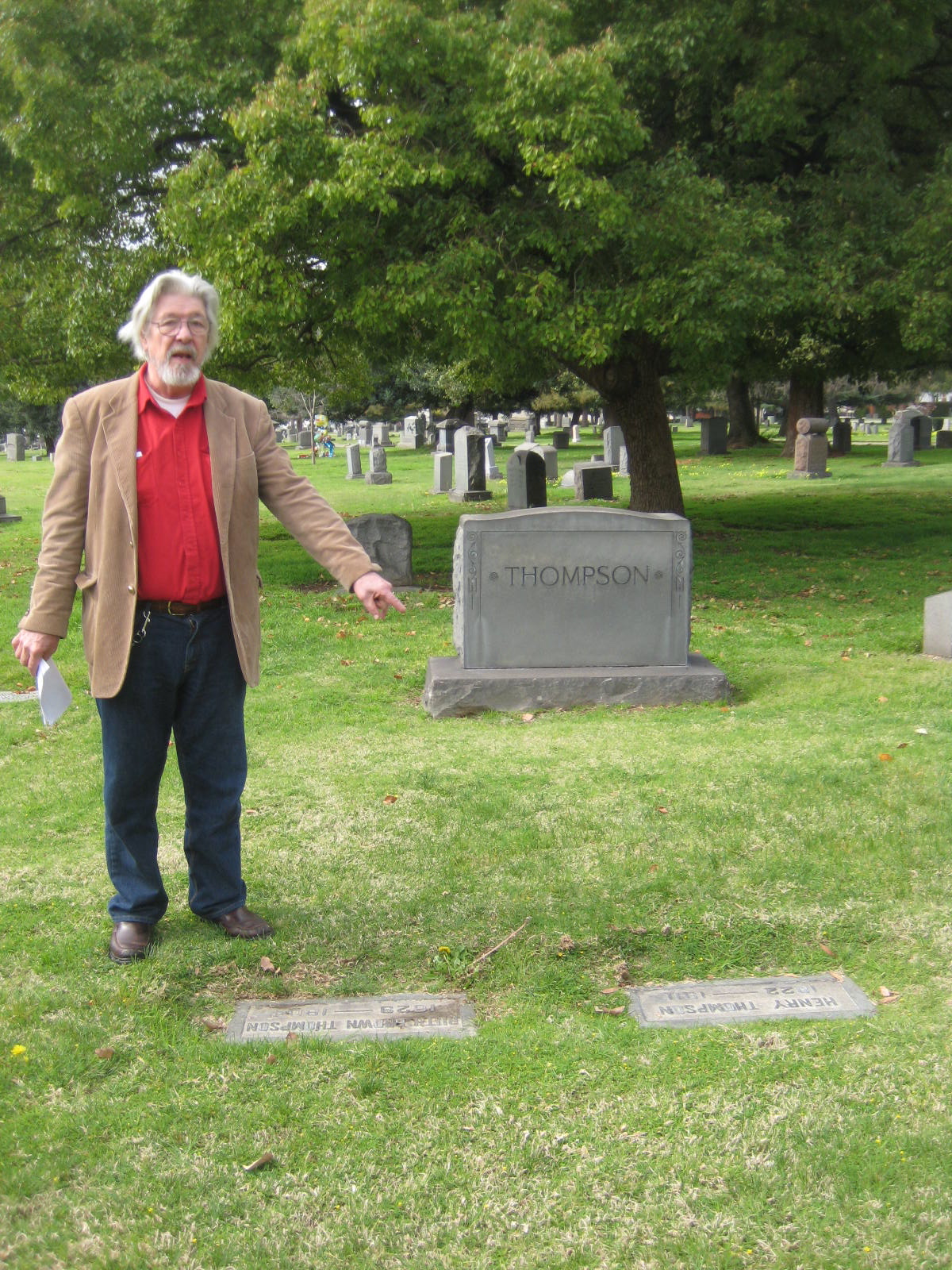
Henry & Ruth Brown Thompson

Norman Marshall, portrayer of John Brown, is currently visiting the west coast, and will be performing his one-man play, "John Brown: Trumpet of Freedom" at the University of LaVerne, LaVerne, Calif., on March 26th (see information below).  Norman made a point of searching out the resting place of Henry and Ruth Brown Thompson in Pasadena, and has provided some pictures of the grave markers.  Rather than simply post the pictures, I have endeavored to provide a short historical sketch--although I regret that I do not have the time to provide a more extensive overview.  Thanks to Norman and his lovely wife, Gwen Gunn, for sharing these pictures with me and the readers of this blog.--LD

Norman Marshall points to the resting place of
Henry and Ruth Brown Thompson
(photo courtesy of Gwen Gunn)

Ruth Brown Thompson was the eldest daughter of John Brown, born Feb. 18, 1829 in Richmond, near Meadville, Pa.  When her father moved the family to North Elba, N.Y. in the spring of 1849, she was a young woman of twenty years, described by Richard Henry Dana in retrospect as a "bonny, buxom young woman of some twenty summers, with fair skin and red hair."1  Around this time Ruth had taken a bad fall on the ice, hurting her back.  According to another family letter, she never fully recovered, and suffered with back problems throughout her life.2  I do not know about the courtship of Ruth by Henry Thompson, however they were married on Sept. 26, 1850, during the Browns' first stay in North Elba.  Upon the urging of his wealthy partner, Simon Perkins, Jr., John Brown returned to Akron, Ohio, in March 1851, in order to continue their business endeavors.3  Naturally, Brown left Ruth with her husband in North Elba, although the father remained close to his daughter.  His correspondence--especially in religious matters--shows that she, unlike most of her siblings--shared her father's evangelical faith, and shared also his concerns for the heterodoxy of her brothers.4   

Like any family, the Browns had some relational rough spots.  As far as the spouses of his adult children, neither John Brown nor the rest of the family seem to have been very impressed by Ellen Sherbondy Brown, the wife of his son Jason.  For whatever reason, Ellen "was not well liked by the Browns," in the words of John Brown aficionado, Boyd Stutler.5 Quite to the contrary, perhaps Brown's favorite "child"-in-law was Henry Thompson, Ruth's husband.  Like Ruth, Henry came from a large family, being the third of eleven children born to Roswell and Jane Thompson of North Elba.  Henry was born on Jan. 21, 1822, and was both a farmer and carpenter--and built John Brown's farm house, which still stands near Lake Placid, N.Y. as a  state historic site.   By arrangement with his father-in-law, Henry undertook to build the house for his father-in-law's return to North Elba from Ohio, in the spring of 1855.  However, Brown's return to the Adirondacks in May 1855 was more about settling his family in the home, since he shortly went to the Kansas territory to rescue his other family members from proslavery thugs, and never personally resided in North Elba again, except for short visits.  Of course, the rest is history--Brown went to Virginia and died as a result of his liberation efforts.  However, Henry Thompson figures importantly in Brown's story, insofar as he went to Kansas with his father-in-law, and proved a devoted and faithful son and warrior to the old man.  Thompson was one of the Pottawatomie killers, and until the day of his death held that the bloody act was a matter of necessity and survival. When Brown turned his focus to Harper's Ferry, however, neither Ruth nor Henry himself wanted to follow the old man into Virginia.  This was just as well for the dler Thompsons: they sacrificed two sons to John Brown's cause--Henry's younger brothers William and Dauphin.  Their sister, Isabella Thompson, was also married to Watson Brown in 1856, and was left a grieving widow when Watson was slain at Harper's Ferry.  Thus, the Thompson family paid dearly for their association with John Brown.6

      In June 1860, a month before the Brown's hosted a July 4th commemorative meeting at the family farm in Lake Placid, Ruth Brown Thompson wrote to Mary Stearns, the wife of one of her father's "Secret Six" supporters, George Luther Stearns.  The letter clearly shows that she carried on the legacy of her father and fallen brothers:
The very idea of slavery is so galling to my feelings that I can hardly endure the thought. How many times I have heard my dear sainted Father, say he "hoped to live to see the day when the slaves would all be free." What an awful sin is slavery, yet how quietly the people of this country sleep over it. How many sleepless nights Father used to pass, thinking of the poor slaves, years before he made an attempt to rescue them. His great kind heart was ever "awake to their wrongs.7
Ruth & Henry Thompson portrayed in celebration of their 50th wedding anniversary in The San Francisco Call (5 Oct. 1900, p. 4).  The article says the couple resided "in a humble cottage, on the banks of the Arroyo Seco, in Pasadena."

In 1884, the Thompsons moved west, settling in Pasadena, California.  They were joined by brother Jason Brown. Brother Owen also settled in the following year--the two Brown brothers settling in the Las Cacitas mountains, northeast of Pasadena.  In the later decades of the 19th century, the Browns were a noted presence and enjoyed the friendship and support of many black friends, especially clergymen.  According to a 1940 article in The California Eagle, the writer looked back to the time when the Thompsons and Browns hosted a number of black ministers, carrying on the tradition of John and Mary Brown, who enjoyed close relationships with many black leaders and lay people.  The author, the Reverend William Prince, even recalled a fund-raising picnic that African American friends sponsored in order to raise money to assist Grace Thompson, Ruth and Henry's daughter, with her college tuition.8

In the 1960s, Mary Mackenzie, a grassroots researcher on the Browns in North Elba, wrote to a direct descendant of Henry and Ruth Thompson, Adeline Bryant.  Drawing from memories of her own youth, Bryant provided a brief but poignant description of her grandparents in their last years:
. . . [Y]ou ask me to tell you something about Grandpa Henry Thompson.  He and grandma were always very devoted to each other.  I lived in their home for two years while I attended Pasadena High School and I never heard them say a cross word to each other.  Grandma had trouble with her back, so used to stay in bed until around ten o’clock at which time, before she dressed, grandpa would bring her a cup of coffee, always saying, “Here’s your coffee, mama.”  After that she would dress, have a little breakfast and then go to sit in her willow rocker in the living room where she could look out upon their orange trees, when she would raise her eyes from whatever book she happened to be reading.9  
Ruth Brown, the beloved daughter of the abolitionist leader, went to her rest in 1904.  Her faithful husband Henry lingered on the John Brown trail a little longer, finally departing in 1911.--LD

Photo courtesy of Norman Marshall

Notes

1 Richard Henry Dana, "How We Met John Brown," Atlantic Monthly (Jul. 1871), p. 5.
2 Transcription, Ruth Brown Thompson to Henry Thompson, 14 May 1856, in Edwin N. Cotter Jr. Papers, Letters, No. 2/68/10, Feinberg Library Collection, Plattsburgh State University, Plattsburgh, N.Y.
Photo courtesy of Norman Marshall
3 Louis A. DeCaro, Jr., "Fire from the Midst of You": A Religious Life of John Brown (NY: NYU Press, 2002), p. 206.
4 Ibid., p. 208.
5 Boyd B. Stutler to Clarence S. Gee, 25 July 1949, p. 1, in Hudson Library and Historical Society Collection, Hudson, Oh.
6 DeCaro, p. 214.
7 Ruth Brown Thompson to Mary Stearns, 13 Jun. 1860, MS05-0061 A-E, Boyd B. Stutler Collection, West Virginia Division of Culture and History.

         8 Dorothy Hassler, "Trail's End on Little Round Top," Westways Magazine (Sept. 1952), p. 25; Rev. William Prince, "Turning Back the Pages of Pasadena's Past," California Eagle (2 May 1940), in Pasadena Historical Society Collection.
9 Adeline Towne Bryant to Mary Mackenzie, 28 April 1966, in Box 2, file 68 (no. 22), Cotter Papers.


Thursday, March 14, 2013

From the Field:
“Sweet is the Memory of the Just”
Images of the Old Hudson Township Burying Ground, Amongst Other Recollections

by H. Scott Wolfe*

       Back…back…in the days of yore, I would customarily devote my vacation time to the active pursuit of John Brown and his men. For more years than I wish to admit, I would load the camper shell on the trusty Chevy pickup and hit the old lonesome highway in search of something excitingly new that was decidedly old. Stirring times, I must say they were.

***** 

Sometimes I would traverse the State of Iowa, following the long-forgotten track of the “Jim Lane Trail,” an overland route to Kansas once utilized by antislavery folk (including John Brown) in order to evade the proslaver’s blockade of the Missouri River. I would cross the prairies they crossed; encounter the streams they encountered; and camp in the villages in which they camped.

Beginning in Springdale, at the lonely spot where the Old Man’s recruits trained for the Harpers Ferry incursion…I would meander all the way to Tabor, in the southwest corner of the state. There I would be compelled to jackknife myself, to view the mud-walled cellar of the home of the Reverend John Todd…the very place where those Sharps rifles that made it to the Ferry were once stored. And, of course, there were many other sights to see on my journey…ranging from weed-clogged Mormon cemeteries, to the covered “Bridges of Madison County,” to elaborate country weddings…the field-tanned participants resplendent in pastel leisure suits.

Once Across the Wide Missouri, I would gorge on pancakes at the “John Brown Family Restaurant” in Nebraska City, Nebraska (Birthplace of Arbor Day!!). Close by was “John Brown’s Cave,” and the cabin of Allen and Barbara Ann Mayhew…the latter being the sister of the Old Man’s Secretary of War, John Henri Kagi. And then into northern Kansas, where I explored the Nemaha country and strolled the banks of Pony Creek, where William Leeman…that tragic victim in the Potomac…tried to make a go of it as a pioneer farmer.

And, finally, Free State Topeka, where I would spend a week at the old Kansas State Historical Society, sifting through the Richard Hinton and John Brown manuscript collections…overworking both their copy machines and their staff members, who sacrificed a considerable amount of shoe leather to my esoteric requests.

*****

"Days of driving. . . ."
And sometimes I would point that trusty Chevy toward the eastern regions…to places such as Charleston, West Virginia. It was there that I would set up housekeeping in a convenient Red Roof Inn on the banks of the Kanawha. Each morning, my lungs filled with the fragrant emissions of a multitude of oil refineries and chemical plants, I would “commute” to the West Virginia Department of Archives and History…to view the “Holy Grail,” the Boyd Stutler Collection.

Day after day…the beard growing to John Brown proportions…my overworked eyeballs bulging like the Old Man’s in the Curry painting…I would peruse more fascinating stuff than H.J. Heinz has pickles. Today, it all seems so quaint and old-fashioned. Days of driving…motel and food bills…damaged lungs…terminal eyestrain. Now one can simply bring up the Stutler Collection website in the comfort of one’s own home…pretzels and spinach avocado dip optional…and achieve the same exciting, illuminating results.
***** 

And yet another regular eastern destination was the steeped-in-John-Brown village of Hudson, Ohio. Despite its gentrification…its “bedroom community” aura…one can still loaf in the village green and imagine oneself back in Old Connecticut. (Believe it or not, the same feeling can be generated in the center of faraway Tabor, Fremont County, Iowa.)

Headquarters here was a Victorian bed and breakfast in the nearby, picturesque community of Peninsula. And my “commute,” less hectic and damaging to the respiratory system than in Charleston, was to the Hudson Library and Historical Society…to view the “secondary” Holy Grail, the Clarence Gee Collection. During that long ago, mist-shrouded era, the proprietors were Tom Vince and the late Jim Caccamo…and, like all archivists I seemed to encounter, these guys were good. I would spend the day scribbling illegible notes…organize them in the evening amidst Queen Anne splendor…and then regurgitate them at breakfast to my kind, unsuspecting hosts.
Hudson Library and Historical Society,
Hudson, Ohio
Peninsula is plopped within the confines of the Cuyahoga Valley National Park, a beautifully scenic area between Cleveland and Akron, and those beleaguered hosts (despite the names of a regiment of radical abolitionists still ringing in their ears) introduced me to sundry other historic sights nearby. I was transported to Akron to view the Simon Perkins Mansion…and the adjacent John Brown House. I was allowed to hike the towpath of the old Ohio & Eric Canal. And I was directed to the cemetery in Richfield, where the Old Man’s fever-ravaged children share a common grave. And then there was another graveyard…in Hudson itself…awash in memories of the family of John Brown.

***** 

Our grim correspondent, his hands freshly painted, 
poses betwixt the parents of John Brown, 
Owen and Ruth Mills Brown
(H. S. Wolfe photo)
I paused in Hudson this past April, and found it much the same…though increasingly yuppie-ized and more traffic-clogged than in the olden days. And, as during earlier sojourns, it seemed as if I were magnetically drawn to a spot on the south side of Chapel Street, hard upon the campus of the Western Reserve Academy. This particular parcel of real estate, as announced boldly upon the metal archway at its entrance, is the OLD HUDSON TOWNSHIP BURYING GROUND.

A modern stone, immediately within, reveals it as “the oldest existing cemetery in Hudson and Summit County,” established by David Hudson and Benjamin Whedon in the year 1808. Also engraved upon this marker is the fact that: “Ruth Mills Brown (1772-1808), wife of Owen Brown and mother of abolitionist leader John Brown (1800-1859) was the first burial here.” Yes, within lie the parents of ol’ Osawatomie. Thus the attraction. For here one may pay respects to the Old Man of the Old Man, et.al.

The cemetery is quite attractive in the springtime, with green grass and blooming fruit trees. Yours truly, intent upon such seasonal beauty…and eagerly anticipating yet another visit to the Brown family plot…seized the entrance gate with both paws…only to discover that it had been freshly anointed with a most persistent and malodorous type of black paint. My search for an effective solvent continued that entire day…success only coming with dinner, in the form of a mixture of vodka and sweet vermouth.

A short walk brings you to the stones of the Brown family, standing in a straight row as if for military inspection. From right to left, they include (accompanied by images from my humble camera):
Ruth Mills Brown
(H. S. Wolfe photo)

RUTH MILLS BROWN…Owen Brown’s first wife, her stone is definitely showing its age. The elements have obliterated the inscription, but a transcription of what once appeared is as follows:

Sacred to the Memory of Ruth, Wife of Owen Brown who died Dec. 10, 1808 in the 37th year of her age 
She was a dutiful child, a Sprightly youth, a loving wife, a Tender parent, a kind neighbor, and an Exemplary Christian. 
Owen Brown
(H. S. Wolfe photo)
Sweet is the memory of the Just.

OWEN BROWN…The father of the abolitionist John Brown, his stone retains a clearly legible:
Owen Brown   Died May 8, 1856  Aged 85 Years
SALLY ROOT BROWN…Owen Brown’s second wife, her inscription reads:

Sally   Wife of Owen Brown  Died Aug. 11, 1840  Aged 51 Years

Sally Root Brown
(H. S. Wolfe photo)
WATSON HUGH BROWN…Son of Owen and Sally Root Brown, his inscription remains bold despite the passage of the years:
Watson Brown
(H. S. Wolfe photo)

Beneath this stone lie buried the mortal remains of Watson, 7th son of Owen Brown & 1st son of Owen and Sally Brown, who was born at Hudson on the 22nd day of July 1813, and died on the 29th day of Jan. 1832  AE 18 Years
Additional lines praise him as "a kind hearted, generous, and manly youth, who by his mild and amiable character was endeared to his numerous friends."

and  LUCIEN BROWN…Son of Owen and Sally Root Brown, his stone reading:
Lucien Brown
(H. S. Wolfe photo)
Lucien Brown   Died Dec. 1, 1847   Aged 20 years
Amos Lusk
(H. S. Wolfe photo)
Nearby the Brown plot, and facing them in familial perpetuity, is the stone of AMOS LUSK, father of Dianthe, and first father-in-law of John Brown. A small, simple stone, it reads:

Capt Amos Lusk   1773-1813   War of 1812

***** 

The Brown family plot, Old Hudson Township Burying Ground,
Hudson, Ohio (H. S. Wolfe photo)


Hopefully, all of the John Brown researchers and enthusiasts who might pause to read this posting (assuming that they survive the ordeal), will be able to visit some of the historic sites mentioned in the foregoing. I have always been a strong proponent of WALKING THE GROUND where the dramatic events of the past have transpired. Yes, there may today be a Burger King astride a spot where heroes attempted to liberate a people…but in the mind’s eye, one can still visualize and appreciate such noble deeds.
So whether it be Springdale or Tabor…Nebraska City or Topeka…Charleston or Hudson…and utilizing a favorite word of a certain Dr. DeCaro: Leave the ACADEMY, and HIT THE ROAD!

* H. Scott Wolfe is the Historical Librarian of the Galena, Illinois, Public Library District and now a regular correspondent and contributor to this blog. He has devoted many years of grassroots research on John Brown, the Harper's Ferry raiders, and related themes.

Monday, February 25, 2013

A Controversial Review--
Christopher Benfey on The Tribunal

While a shift has taken place since the late 20th century showing greater appreciation of John Brown from a wide range of scholars, there is still no small segment of the academy that remains imbedded in a thought style of contempt toward the Old Man.
Christopher Benfey

We have recently seen this displayed in a review by Christopher Benfey of The Tribunal, the acclaimed Stauffer and Trodd reader recently published.  Benfey is the Mellon Professor of English and the Interim Dean of Faculty at Mount Holyoke College.  By all accounts, he is an accomplished and honored man of letters, with a Ph.D. from Harvard in Comparative Literature, a number of notable fellowships, and membership in The American Academy of Arts and Sciences.  His online vita says that he is also a "prolific journalist," with numerous contributions to major publications as a reviewer and art critic, including the The New York Review of Books, in which he has published his review of The Tribunal.  Benfey is an Emily Dickinson scholar and an award winning author of many books and poems.  He's even got a forthcoming memoir of his family, and from what I've seen, it is interesting and nicely written.  Unfortunately, I cannot commend his treatment of John Brown in his review, "Terrorist or Martyr?" (Mar. 7). 

The Hawthorne Trajectory

David Reynolds
Benfey begins with Nathaniel Hawthorne, who "was appalled by Emerson’s much-quoted remark about Brown’s martyrdom," Benfey writes.  In fact, Hawthorne concluded, "Nobody was ever more justly hanged" than John Brown--whom he considered a "blood-stained fanatic."  It is very clear from the onset that Prof. Benfey has chosen sides with the white conservatism of the 19th century in opening and closing his review according to Hawthorne, which tends to criminalize Brown.   This is in particular contrast to the approach taken by David Reynolds, which is why he so masterfully brought the reading of Emerson and Thoreau to bear in John Brown Abolitionist.  Reynolds is hardly second to Benfey in 19th century literature.  Were he to have begun with Benfey's presupposition, Reynolds might have begun his assessment of Brown with Mark Twain, for instance, who was not an admirer of Brown either.  But Reynolds did not do so, I suppose, because he understands that men like Twain and Hawthorne did not understand John Brown, whatever else their admirable qualities may have been.  Clearly, Hawthorne could not transcend his own racialist provincialism.  In contrast, Emerson and Thoreau manifested a "reading" of Brown that was more reliable and meaningful in light of the moral and ideological crisis of slavery in the 19th century--a reading that Benfey obviously rejects.  Thus, a question about Benfey's understanding of U.S. history must be raised from the onset.  The trajectory of thought established by his choice of Hawthorne actually defines the direction of his thesis, which is quite disappointing--especially at a point when scholarship on the abolitionist has put many of the older, problematic charges aside, or at least demonstrated a greater need for care in making judgments about Brown.

Tony's Terrorist Option

Benfey's problematic perception is unpacked when he, of all things, quotes Tony Horwitz's unfortunate New York Times Op-ed piece of December 2, 2009, sadly entitleld, “The 9/11 of 1859.”  In that review, Tony drew the inappropriate parallel between Brown and the Muslim fanatics behind the destruction of the World Trade Center towers in 2001.  Benfey thus samples Tony's problematic "bearded fundamentalist" comparison, which--as I recall--brought quite a reaction from a number of us.  One may not agree with all of Tony's conclusions, but certainly he did not carry this blatant language into his more seasoned writing in Midnight Rising.  However, the professor grabs a hold of Tony's words to set up the provocative question he intends to use to Brown's detriment--was Brown a terrorist?

Preemptory, not Retaliatory

I should note, in responding to Benfey's evaluation, that I do not always agree with the reading of Brown in The Tribunal.  While Stauffer is an exceptional scholar and has presented some interesting insights in his own work, I would not agree with his view of the Pottawatomie killings as "retaliatory" (which is Benfey's characterization of Stauffer's view).  In my estimation--and I think a solid case can be made for it--the killings at Pottawatomie in May 1856 were preemptory, and inherently defensive with respect to a known plot (in which the "victims" had participated) to turn the Browns and others into the hands of murderous pro-slavery invaders in the area.   Essentially, what Brown and his men did in slaying the Doyles, Wilkinson, and Sherman was what they were planning to do to the Browns.  Pottawatomie evidenced a wartime struggle amidst a total breakdown of territorial law and order, and was a situation where Brown, his family, and allies had no recourse to the rule of law within the United States.  Given my view, I will not defend Stauffer's reading; still, Benfey cannot properly evaluate the Pottawatomie killings except as a "hideous crime," a conclusion that I think is worse than simplistic.  

Some Old, Hackneyed Assumptions

In another part of the review, Benfey writes:
Despite his family history of mental illness and the testimony of his own men regarding his “monomania,” Stauffer and Trodd stave off suggestions that Brown might have been mentally unstable with the bullying assertion that they arise from “the power of racism in America.”
This single sentence is loaded with problematic assumptions.   Without weighing evidence or making qualifications necessary in speaking of mental illness in 19th century terms, the professor simply cites Brown's "family history of mental illness" and "monomania."  Perhaps he is somewhat encouraged by Tony Horwitz, who pushes the issue close enough to the edge in Midnight Rising so that anyone so predisposed could fall headlong into the mistaken notion of Brown's mental instability.  But Benfey is probably also drawing from the old, poisoned well of his academic forebears, who constantly used "insanity" as a cudgel on the head of Brown's historical legacy.  It would be advisable for him to read Robert McGlone's bio-study, John Brown's War Against Slavery (2009), wherein the author makes an exhaustive consideration of the "insanity" angle, showing its lack of substance.

There are other points that illustrate his reliance upon old, hackneyed assumptions, such as the apparent mystery behind Brown's intentions in Virginia ("It remains unclear what precisely Brown hoped to accomplish by the attack") or his supposed failure to communicate with the black community in advance of the raid ("Brown. . .alerted none of the slaves in the region of his intentions").  These are erroneous notions that unfortunately are still conveyed in contemporary writing.  There is sufficient scholarship to show that Brown had contacted some of Virginia blacks in advance, that many more blacks knew about his intentions through networks of black communication, and that he generally intended to render slavery unstable throughout the South. A good dose of Osborne Anderson's testimony in A Voice from Harper's Ferry would have helped Benfey here, but apparently he relies on contemporary writers, particularly those with a decidedly cynical view of Brown's effort.

John Stauffer
"Bullying Assertion?"

At another point, the professor writes: "[Stauffer and Trodd's] admiration occasionally verges on sentimentality, as when they claim that 'Brown is a testament to ordinary individuals’ potential to transform themselves and their world' and stave off suggestions that Brown might have been mentally unstable with the bullying assertion that they arise from 'the power of racism in America.'"  This is a most unfortunate and unworthy statement, not only because Stauffer and Trodd are basically correct, but because Benfey reduces their evaluation to mere "sentimentality"--as if Brown cannot be appreciated upon the grounding facts of history.  This is human contempt disguised as academic critique, but it is certainly snobbish and condescending--like an adult belittling children for appreciating childish things.

To no surprise, then, Benfey makes the incredible charge against Stauffer and Trodd, that they are "bullying" readers by arguing that the "insanity" portrayal of Brown is linked to the ideology of white racism.  It seems that Benfey really is in denial.  Anyone who has studied the developments of history following the Civil War and leading into the 20th century would recognize that Brown's profile indeed suffered as a result of the powerful impulse of white racism following the demise of Reconstruction.  The prominent academic and narrative revisions of Brown in white America is clearly a corollary of the recalcitrant nature of white supremacy.   I wonder if Benfey would argue that African Americans, from 1859 until now, are simply being "sentimental" in appreciating Brown's role, or if he thinks blacks are "bullying" whites by insisting that Brown not be viewed as insane?

The Retrospective Appeal to Moderation

Finally, Benfey makes a deplorable argument, based upon the moral compromise of "measured reflections" (a euphemism for white men sidestepping history) put forth by Andrew Delbanco--another writer who would rather praise the conservative attitude of Hawthorne than the abolitionist attitude of Emerson and Thoreau.   In this light, Benfey has the audacity to write in a manner critical of abolitionist extremists who advocated "violent emancipation of all slaves" as representing "a recurring type in American society. . . . since there is always something that strikes a sizable part of the population as worthy of abolition, including alcohol, abortion, fossil fuels, guns, slaughterhouses, and so on."   To Benfey, abolitionists like Brown were just troublesome extremists making unrealistic demands upon society.  "Against such imperious demands," he concludes, "those who call for political process or votes or compromise or gradual solutions will always seem, to the abolitionists, spineless temporizers."
To Benfey, abolitionists like Brown were just troublesome extremists making unrealistic demands upon society.
The professor's argument is as clear as it is disturbing.   He writes as if standing with those in the 19th century who put "moderation" over black life and freedom--as if the nature of chattel slavery in the antebellum era, as well as the state of the political circumstances then reigning, rendered an attack upon slavery as worse than slavery itself.  One is tempted to conclude his rationalization is deeply rooted in racism. 

One must ask what kind of person would write these words in 2013.  For the most part, the old 20th century anti-Brown rhetoric no longer works.  The charge of "insanity" has largely been replaced by "terrorism," although Benfey neither abandons the former nor argues so specifically for the latter.  Instead, he takes a patently "moderate" viewpoint of slavery and the John Brown raid--the kind of view that one might have seen in The New York Herald or the The New York Times following the Harper's Ferry raid in 1859.  Many conservatives at that time claimed to dislike slavery, but argued that compromise and national stability (not to mention economic prosperity) required the preferential treatment of white nationalism--that is, that enslaved Africans were in the hands of white society to do with them what was first and best for white society.  This is the view of "moderation" to which Benfey's argument inevitably must appeal when he uplifts Hawthorne and his kind.

In the 21st century, anti-Brown rhetoric has become somewhat more subtle, usually coming along the lines of counter-factual appeals.  For instance, the argument that the Civil War might have been evaded had the nation been able to find another route to resolve the slavery issue--something made impossible by the likes of Brown and the radical abolitionists.  In the name of all that spilled white people's blood, they reason with regret that anti-slavery extremism encouraged slavery's demise at the barrel of a gun and the tip of a pike.  But this rationale necessitates that black suffering might have been extended in the name of compromise, so that a national blood -letting could be avoided.  This not only subordinates black humanity, but assumes that blacks at that time were wrong in supporting Brown and any form of anti-slavery radicalism.  It is further problematic in suggesting that we--150 years-plus afterward--can see more clearly how to have wiggled out of the problem of slavery, whereas people in that generation were blinded by "fanatical" ideals.  Quite to the contrary, Brown and others knew that there was no compromising with chattel slavery's agenda, and that any further compromise would only extend the oppression of four millions of blacks in the United States.  Were "moderation" and compromise viable alternatives, the leaders of that era would have found them ultimately useful.  In fact, moderation and compromise defined decades of North-South relations, and this only fed the lust of the pro-slavery leadership for more land and more slaves.   As Brown perceived, it was they who were preparing in advance for violent secession, and it was the violence of slavery that ultimately necessitated civil conflict.


Monday, February 18, 2013

Reflection and Response--
"He Who Endures to the End": The Play

Last evening I attended a play at the National Black Theater on 125th Street in Harlem, entitled, "He Who Endures to the End."  The play, written by Bill Harris, was part of The National Black Touring Circuit's 2013 Black History Month Play Festival, and starred Ralph McCain as Frederick Douglass, and my friend, Norman Marshall, as John Brown (Norman portrays JB in his own play, "Trumpet of Freedom," co-written by George Wolf Reily).  I was invited to participate in a post-play panel, along with Larry Lawrence of the John Brown Society (NYC), Herb Boyd, journalist and author of works relating to Brown and Malcolm X, and a Ms. Bailey, an activist and family researcher (whose first name I regretfully failed to obtain), who also happens to be the last descendant of Frederick Douglass in the Bailey family line.  The play was directed by Ajene Washington, and also featured Marcus Naylor as the black leader, Rev. Henry Highland Garnet, and Leopold Lowe as Shields Green, the Douglass associate who ultimately joined Brown at Harper's Ferry.
Ralph McCain portrays
Frederick Douglass

I'm no theater critic, but I can say that I enjoyed the play and thought the actors carried their roles effectively.  Lowe did a fine job as Green, and had the most strenuous role, which involved moving a lot of props while he spoke.  It was more than interesting to see the veteran Marshall as John Brown--that is, as John Brown in a different play.  The John Brown in "He Who Endures to the End" is fair, but the playwright has him spouting Bible verses like a frustrated preacher, and so tends to present a caricature within a caricature.  The other issue is that this Brown has a kind of messianic atonement complex that is not true of the man who lived.  The John Brown who lived nowhere spoke of his death as being for the sins of the nation, etc.  While this may have been applied to him after the fact (it certainly was applied to Lincoln after his assassination), Brown's only stated feeling about his own death was that it would help the anti-slavery cause.  Brown was self-consciously a martyr--that is, a witness.  But he never conveyed himself as anybody's messiah bearing the sins of the world.  

Norman Marshall portrays
John Brown
Biographically, "He Who Endures to the End" has two main flaws relating to the Brown-Douglass relationship.  First, it suggests that Douglass sort of led Brown on with respect to militancy--that Brown was looking to the encouragement of Douglass in pursuit of his militancy, indeed that he was something of Douglass' creation.   The theme of "what is necessary can be invented" did not apply to either man, but the younger Douglass certainly was in no position to make Brown after his ideas.  If anything, Douglass followed Brown--something which the play pointed out in showing that Douglass became more militant in his rhetoric by the 1850s, something that even Douglass in real life attributed to the John Brown factor.

Second, the play fails to show the depth of their friendship and the intimate and mutually admiring relationship that existed between Douglass and Brown.  They were not just political allies, but men whose families interacted, who were guests in each other's homes, and who had a personally comfortable rapport for more than a decade by the time of the Harper's Ferry raid in 1859.  While plays cannot nor should be thorough as histories, something more along these lines might have been added to deepen the drama of their final tensions.

In the end, Douglass walks away from Brown--the latter appearing more like a lovingly pitiable and ill-fated Don Quixotic, who tried and inevitably failed.  So while the play tends to portray Douglass as self-serving and ultimately evasive of Brown's expectations, it seems to justify his abandonment of Brown and allows him the "last word" by complimenting his dead friends who went to Harper's Ferry.  Yet at the same time, the play inherently promotes the notion that Brown was irresponsible and, to some degree, deluded, while Douglass was the realist.

In contrast, the more accurate portrayals of the play are the secondary figures of the Rev. Garnet and Shields Green, the self-liberated man who chose to join "the Old Man" in hopes of dealing a blow to slavery.  Garnet, who is often unsung in discussions of antebellum abolitionism, was a Presbyterian pastor in New York City.  In 1843, as the play shows from the onset, Garnet delivered a call to black militancy at a national black convention that finally was quashed through the influence of the moderate Frederick Douglass.  Garnet and Brown were on the same page from the beginning, and in a sense it is a shame that Brown could not have looked to Garnet to direct black men to his side in 1859.  But Douglass was the foremost black spokesman, the man who dominated black press and oratory, and the one whom Brown had most strategic reason to pursue.  In the long run, however, Douglass refused to throw his weight behind Brown's effort, a posture that substantially wounded Brown's recruitment efforts.   Likewise, Shields Green was warmly played as a faithful and zealous figure, who decided that taking action in following Brown was better than helping Douglass move ever higher in profile as a black leader who helped the anti-slavery cause by winning converts.

The truth about the Douglass-Brown story is widely unknown, and even the leading Douglass scholars have failed in large part to unpack this episode.  As it came out in the after-play panel, there is a general tendency to accept Douglass' autobiography uncritically, even though it has been shown (that is, I have shown this to some extent in John Brown--The Cost of Freedom) that Douglass knew about the Harper's Ferry raid much longer than he portrayed, and that he consistently refused to assist Brown.  The icing on the cake of Douglass' dissent was his rejecting the urging of a notable interest among blacks in Philadelphia to support Brown.  In retrospect, Douglass conflated a few meetings with Brown during 1859 into one meeting at Chambersburg.  While he was honest enough to portray himself "willing to live for the slave," Douglass probably could not comfortably portray the reality of their waning partnership, nor the extent to which he knew that he had disappointed both Brown and his family and followers.  

The Panel

The panel was a good complement to the play, or so feedback suggests.  The Douglass descendant shared of her experiences, including the incredulous manner in which her school teachers disdained her claim to being related to Frederick Douglass (she is a great-cousin, in effect, but I do not know how many generations removed).  Herb Boyd guided the conversation and notably raised the subject of Osborne Anderson's first-hand account of the raid, A Voice from Harper's Ferry, which he wrote in 1861 with the assistance of Canadian expatriate abolitionist, Mary Ann Shadd Cary.  Larry Lawrence raised key points concerning the need to expose the truth about Abraham Lincoln, pointing the audience to Lerone Bennett's Jr.'s political expose, Forced into Glory, which presents the reality of Lincoln's racism, and how it played out in his failure to lead the cause for justice--and ultimately how he was obligated by forces beyond himself to promote the end of slavery.  Brown is not the forerunner of Lincoln, he is the authentic liberating figure over against Lincoln's obligatory and racialist approach to black liberation.  

Annoying Amiri Baraka

An interesting discussion developed when the eminent poet and author, Amiri Baraka, expressed his "annoyance" at the centrality of the John Brown discussion, which he characterized as itself an expression of the influence of white racism.  I took issue with Baraka's comments, as did Larry Lawrence, who pointed out that--quite to the contrary--Brown is the lever that white society has manipulated so unfairly for over a century in order to keep the reality of slavery and white supremacy from being clearly discussed.  Baraka argued that a number of movies had been made about Brown, while not a single movie has been made about Douglass.  In fact, only three movies have centered upon Brown--Santa Fe Trail in 1940--a piece of latter day Lost Cause propaganda, Seven Angry Men (about a decade later), in which Raymond Massey reprised his role as Brown.  While the latter was more sympathetic, it failed to make an impact equal to Santa Fe Trail.  In the early 1980s, Johnny Cash portrayed Brown in the mini-series, North and South.  While he did so with more sympathy, this was not a film primarily focused upon the John Brown story.   While Douglass has not been portrayed in any major films, he has been portrayed in modest film efforts, and probably has been portrayed more positively in the media overall (he is portrayed in an awkwardly silent vignette, for instance, in Glory).    

As Baraka was insistent on this point, I countered that actually not a single film has been done that serves the story of John Brown fairly.  Not one.  Furthermore, I patently disagreed with his intention to circumvent the Brown story as if it were both immaterial to the struggle for justice, or even unworthy of being the central point of discussion in such a forum.   No human being born in privileged skin can excel what John Brown did for the struggle for black freedom.  To be sure, he did it imperfectly, but he yielded his life after subordinating even the needs of his own family, and did not, in my opinion, deserve to become the brunt of Mr. Baraka's expressed "annoyance."  
John Brown meant to do good, and died doing it.  Douglass meant to do good and did much good--but he also did very well for himself in the final reel. 
Frederick Douglass experienced indignities, violence, and loss that Brown could never approach in comparative human experience.  Yet Douglass also lived a longer life, and did so increasingly by moving along an upward trajectory that Brown never knew: the adoration of thousands if not millions, laudation and fame far exceeding the controversy and disdain he previously faced in the antebellum era; positions of influence and even a measure of prosperity; a long life, lionized and celebrated to the point that he was able to write three autobiographies; and, in the end, the ability to write the history of John Brown in a manner salutary but also self-serving.  John Brown meant to do good, and died doing it.  Douglass meant to do good and did much good--but he also did very well for himself in the final reel.  Douglass was a unique star--born in the darkness of slavery and degradation, he arose above his people as a guiding light, but rose much higher still, higher than most men of his generation, regardless of skin and "race."  His stardom, celebrity, and fame allowed him a palette of pleasure that he shared with only few men of his time.  This is not to begrudge him his stardom, for Douglass was the man needed for that hour and epoch.  Yet Douglass was a star if ever there was one.  The man seems to have been born to his greatness, and perhaps it was this sense of himself that became like a wedge between him and John Brown.   

Man for Man

Man for man--as men only live their lives within their own skins, skeletons, and skulls--Douglass escaped hell and mounted heaven, while Brown never went so high except to dangle by his neck a few feet from the earth.  Brown had spent his white privilege walking hills, valleys, and plains, often losing much and usually gaining little for himself or his children.  Most of his free time (double entendre intended) was spent worrying over slavery, or how to fix crooked conditions, or simply how to serve his God and feed his family.  He was hardly the supreme example of a privileged "white" man.   Douglass left Brown behind and ascended the stairway of contemporary renown and flattering historical memory.  Brown was left to ascend the steps of the gallows, where even today the rope of "mainstream" white opinion seeks to pull him downward, ever downward.  In the long run, then, it does seem a little misshapen--if not perverse--to express one's disgust that Brown, not Douglass, become the focus of a discussion about the Harper's Ferry raid.  After all, it was Brown who risked all and lost all there, while Douglass, by his admission, made no investment in it after so many years of projecting his support.

In his complaint, Amiri Baraka might better have considered statuary, memorials, and other cultural tributes that have been paid to Frederick Douglass.  Certainly, there is more recognition of Douglass in the common view of both the black and the so-called "white" communities today than there is for John Brown.  Every statue of Brown in existence is old and usually situated in a geographically and socially marginal place (one has now become inaccessible, essentially confined on the grounds of a zoo).  This is not the case with Douglass's tributes, including the elegant Frederick Douglass Circle statuary and memorial that stands at the end of my street in Manhattan.  For all of his annoyance, I wonder if Mr. Baraka can point me to the nearest John Brown statue.  Probably not.  (I can find two Frederick Douglass statues within fifty blocks of my apartment.)  Finally, from a purely political standpoint, I would conclude that when and if it comes to the place that John Brown's central role in U.S. history cannot be discussed without annoying certain friends with such gripes, then perhaps there is nothing more to be said in those circles.