The Research & Writing of Louis A. DeCaro Jr.


"The world needed John Brown and John Brown came, and time will do him justice." Frederick Douglass (1886)

Search This Blog & Links

Translate

Friday, January 24, 2014

Statuary--
Is Springfield's "Puritan" Statue John Brown in Disguise?

Stephen Jendrysik, an educator and historian of the town of Chicopee, Massachusetts, has an interesting piece on the news website, Mass Live, discussing some interesting local history and John Brown.  Readers will recall that John Brown lived in Springfield, Mass., from 1846-49, when he was engaged in business in that city.  
"The Puritan"

In his column, Jendrysik suggests that a famous local statuary, "The Puritan," by Augustus Saint-Gaudens, might actually have been modeled on Brown's face.

Previously, Jendrysik writes, he believed that "The Puritan" was based upon "a purely imaginary" figure of Chester W. Chapin, a wealthy resident of Chicopee, near Springfield.  This is commonly believed because "The Puritan" is a tribute to an early ancestor of the Chapin family.  However, he has reconsidered this belief.  Noting that the sculptor, Augustus Saint-Gaudens, "was an admirer of the violent abolitionist," he now believes that John Brown is the "hidden" image behind the tribute to Chapin.  "The Puritan," was unveiled in 1887, and has been relocated once within town to its present site in Springfield's Merrick Park. 

"The Puritan"
Jendrysik points out that for years, "experts have debated the possibility that Saint-Gaudens' image of one of Springfield's Founding Fathers was in fact a muted tribute" to Brown, who himself consciously identified with Puritan theology and militancy.  Apparently there is no definitive way to prove whether or not Saint-Gaudens modeled his statue from images of Brown, or whether he used a descendant of Chapin.
Brown

The rest of Jendrysik's column reflects upon John Brown vis-a-vis David Reynolds' biography, the author concluding that Brown was both a "saintly liberator" and a "bloodthirsty terrorist." Jendrysik is positive toward Brown and seems to understand that his reputation declined in this nation's history because society at large did not share his passion for racial justice.  However, his conclusion that Brown could be both a saintly man and a terrorist is nonsense.  If Brown's famous/infamous actions in Kansas were as they are commonly portrayed, it is hard to imagine he was also a saintly figure.  Rather, it is more likely that the "bloodthirsty terrorist" is a misrepresentation of the facts.  As I have argued in my biography, Brown was hardly perfect, and he was no saint in the Roman Catholic sense of the term.  But he was very much a saint according to the Protestant definition.

Still, Jendrysik's piece is certainly interesting.  It seems arguably possible that Brown was the "hidden" model and inspiration for "The Puritan."  Jendrysik concludes: "The bushy eyebrows, the chiseled features and the dominant nose belong to John Brown."  I don't know that Brown had "bushy eyebrows"; however, the face of the sculpture could very well be that of the old man.


Saturday, January 11, 2014

155 Years Ago Today--
John Brown's Last Letter from Kansas in 1859 Was a "Twin"

On January 11, 1859, one hundred fifty-five years ago today, John Brown wrote two brief, personal letters to his wife and to his adult son, John Brown, Jr., reflecting his last personal communication from Kansas to family members back east.  The half-page letters, written from Osawatomie, Kansas Territory, are essentially "twins," although not identical.

Background to the Letters

Brown had been in the Kansas Territory since the summer of 1858, mainly because his plan to invade Virginia had been jeopardized by the betrayal of the English mercenary, Hugh Forbes. Forbes, an antislavery man, was retained by Brown to train his men in Iowa, even as Brown was endeavoring to raise black support in the expatriate black community in Ontario, Canada.  After his optimistic "quiet convention" in Chatham, Ontario, in early May 1858, Brown was informed that Forbes--a whining, opportunistic, and disingenuous man--was threatening to expose his plans because he had not received the monies he was demanding from Brown's backers in the east. Most of his supporters immediately urged Brown to take a hiatus, in order to discredit Forbes claim of an imminent raid on Virginia.  Brown finally did so against his wishes.  Returning to the Territory, his presence energized the free state side in their struggle against proslavery thuggery. However, the Old Man ultimately disappointed free state settlers because his primary focus was on Virginia, not Kansas.

In fact, Brown had conducted a raid into Missouri on December 20, breaking his men into two parties and liberating eleven enslaved people from two different slave holders.  Brown and his men kept the party of liberated people in Kansas until early February, when he escorted them into Nebraska, then into Iowa.  Traveling across state and remaining at Springdale, Iowa until early March, the liberated party were then taken by railroad to Chicago, Ill., and then Detroit, Mich., where they finally were sent by ferry to Canadian freedom on March 12, 1859.  Prior to leaving Kansas in January, Brown wrote his famous "Parallels," which defended his actions against conservative critics.
Artist Jacob Lawrence recalled Brown's 1859
Missouri rescue in his series, The Legend of John Brown
Thus, the context for the January 11th notes is Brown's dangerous circumstances, living in hiding in Kansas while overseeing the people he had rescued with the intention of moving them out of the reach of the proslavery government of the United States.  He is a wanted man who has been parted from his family for months, and likely would not see them for months to come.  He wants them to know he is "midling well," a term Brown used often, reflecting his optimistic tendency to see the best in even the worse circumstances. Actually, he had been afflicted with sickness--"the Fever and the Ague"--while in Kansas, and was still struggling with his health--an affliction that generally affected his vision, sinuses, and hearing.  As Jean Libby has established, Brown had likely experienced another health crisis, probably Bell's palsy (or perhaps a small stroke), which caused the right side of his face to droop.  This probably encouraged him to grow his legendary beard as a disguise, although the beard was also cosmetic.  An Iowa friend from this period describes his afflictions as somewhat grossly affecting his eye as well.  Certainly, Brown was a sick man throughout the trek into Iowa, and had health concerns well into the Spring of 1859.

Location of Original Letters

The original letter to Mary Brown and children in North Elba, N.Y., is found in the Boyd B. Stutler Collection, #MS02-0034 (see an image of the original by clicking here).  A reliable transcription by Katherine Mayo is found in the John Brown - Oswald Garrison Villard Papers (Box 5, Letters through 1859 folder).  The original note to John Junior is in the John Brown Jr. Papers, Ohio Historical Society (Box 3, folder 2), and a "sanitized" transcription in F. B. Sanborn's Life and Letters of John Brown, p. 489.

Mary A. Brown
Going Home

The letters are both brief and convey the same basic message, except the one written to Mary Brown expresses his "anxiety" to hear about his wife and children, and directs them to send any inquiries to John Junior.As the notes reveal, he had not been able to write to his family since December 2 (a year to the day before his death). [His letter of December 2 is also found in the John Brown Jr. Papers]. Brown assumes they had all heard about his bold liberation raid in Missouri from the newspapers. In fact, he would only have two more brief periods at home in 1859, from mid-April to early May, and again, for about two weeks in June.  Bolstered by his successful liberation raid into Missouri, he finally left for Maryland and Virginia in the early summer, when he set up headquarters for the "grand rescue" he was planning in Virginia.  Of course, following the failure of the raid in October 1859, only his remains would return to his family.


Exact Transcriptions

Osawatomie, 11,th Jany, 1859.

Dear Wife & Children All

I have a spare moment barely
to tell you that I am in middling health but have not been able to
but have not been able to finish up my business as fast as I had hopes of doing when I wrote you
in Decem (2d) last.  You will I suppose get Kansas news through the
newspapers.  As to telling you where to write me I can only now
say as I said in my last "write John for me."  This I very much
regret: as I have great anxiety to hear from you.  I hope it will not
be so long.  May God Allmighty bless, & save you all.

Your Affectionate Husband & Father
John Brown


Osawatomie, Kans, 11,th Jany, 1859.

Dear Children all
I have but a moment on which to tell
you that I am in middling health; but have not been able to
tell you as yet where to write me.  This I hope will be dif
-ferent & soon.  I suppose you get Kansas news generally
through the papers. May God ever bless you all.
 Your Affectionate Father
John Brown

Sunday, January 05, 2014

Document--
"We Are Going Home and Soon Shall Be": Aaron Stevens Writes to John Brown's Daughter

By January 1860, all of John Brown's Harper's Ferry raiders held prisoner in Virginia had been executed except Aaron D. Stevens and Albert Hazlett, the latter having assumed the name, "William H. Harrison" at the time of his arrest. Historian Oswald Villard says he borrowed the name from abolitionist Richard Hinton (Brown's future biographer), who employed it as his nom de guerre in the battle against slavery.  Villard also gives some account of the hopeless effort to rescue the last surviving raiders in Virginia captivity, noting that Stevens and Hazlett were finally hanged on March 16, 1860.1
Aaron Dwight Stevens
During Stevens' incarceration, some interest was expressed to have handed Stevens over to the federal government for trial.  Brown's raid had been centered upon the federal armory and at first there was reason to believe that the Old Man and his raiders might be taken into the custody of the federal government and tried in a court of the United States.   According to the New York Tribune, President James Buchanan and Robert Ould, District Attorney for the District of Columbia, met on October 18, 1859, after Brown and his men had been taken by U.S. marines at Harper's Ferry.  The report notes the problem arising concerning jurisdiction, since Brown had invaded both the State of Virginia and federal property.  Ould was immediately dispatched to Harper's Ferry, where he met Governor Henry Wise, although he probably had a good idea of what to expect.  Even the Tribune reported: "Governor Wise will, it is said, claim the prisoners now held by the United States troops, to be dealt with according to the laws of Virginia."2
D.C. District Attorney, Robert Ould (left, closest to soldier)
stands with Governor Wise during the initial interrogation
of Brown and Stevens at Harper's Ferry on Oct. 18, 1859
(Frank Leslie's Illustrated News, 29 Oct. 1859)

Ould seems hardly to have put up a fight in the matter, for almost immediately Wise took complete control of matters, and Brown and his men--defeated on the grounds of a federal facility by federal troops, were summarily handed over to Virginia authorities as Ould humbly withdrew to Washington city.  According to another Tribune report, "Wise said to United States District Attorney Ould that he has no objection to the General Government proceeding against the prisoners--that is, what will be left of them by the time the Virginia authorities have done with them."3

Initially, some thought was given to handing over one of the raiders to federal jurisdiction.  According to Steven Lubet, raiders John Cook and Aaron Stevens were considered as possible offerings to the federal government.4  Some, like Alfred Barbour, the superintendent of the Harper's Ferry armory, were eager to see Cook hang on a Virginia noose, and so to let Stevens be handed over to the federal government.   Cook had lived in Virginia for nearly two years, married a local woman, and had won the trust of the entire community.  The revelation that he was one of the Harper's Ferry "insurrectionists" outraged local Virginians.  Barbour warned Governor Wise that the people of Harper's Ferry would “die” before seeing Cook removed from State jurisdiction, since he was “the greatest villain of the party.”5 
Governor Henry A. Wise
(Harper's Weekly, 20 Aug. 1859)

Ultimately, Cook was hanged in Virginia, leaving Aaron Stevens the only possible candidate for federal prosecution.  In December, following the executions of Brown and several of his men, Prosecutor Andrew Hunter was concerned after receiving a telegram from President Buchanan, asking if Stevens had been handed over to federal officers, or if he would be tried under Virginia law.   Hunter stalled, writing to the President that Stevens' case had not yet been determined.  Privately, Hunter informed Wise that he had refused to surrender Stevens to a federal marshal, but wanted the Governor and State Legislature to make a determination.  Wise responded to Hunter, stating that Stevens "definitively" should not be handed over to federal authorities, and expressed the belief that there was some political design to get Stevens' case moved to federal court.  "[Stevens] is the deepest felon in guilt of all," wrote Wise.  "He will not be delivered up with my consent."6  

In retrospect, it is clear that Governor Wise had no real intention of letting Brown and his captured raiders slip from the clutches of Virginia.  While he he may have entertained the possibility of placating President Buchanan and federal interests, Wise was more interested in using the raiders to find other accomplices and associates of Brown who might also be brought to slave master justice in Virginia.  Wise was clearly determined to see Stevens hang, and he was finally tried and executed in 1860.

On January 5, 1860, Stevens received a letter from Anne Brown, the daughter of his fallen leader.  Anne knew the raiders, having stayed with them and her father in their Maryland headquarters prior to the Harper's Ferry raid.  Later in life, Anne would remember Stevens as a "fine looking man" with a "fine soul within."  Besides having a fine voice for singing, she recalled that he was "an earnest good talker," cheerful, fun, and well-liked.  Stevens was, she wrote, "Happy himself in trying to make others happy."  Stevens' detractors have pointed out his insubordination as a soldier in the Mexican War, particularly the fact that he had attacked a superior officer and was sentenced to prison on the charge of mutiny.  Stevens must have told Anne the story from his perspective, telling her that he had struck an officer who was evil and abusive in temperament, and who was doing harm to another soldier.   This is probably true, since Stevens' record otherwise suggests, as Anne put it, he was "high minded, noble, and generous."7  Stevens was likely drawn to Brown's side precisely because they shared a common concern for the underdog, and shared a similar passion to intervene for the oppressed.

On January 5, 1860, Stevens wrote back to Anne:
Charlestown Jail, Va., Jan. 5/60   
My dear Sister Annie              
Your kind letter came to hand today and I will try and write you a few lines in return.  I am glad to see that you are so cheerful.  It is always best not to give up to sorrow and sadness.  I am quite cheerful and happy, never felt better in my life.  It made me feel rather sad to part with my companions, but I think they are in a better land and that is a great comfort to me.             
I was in the same room with your father.  He was very cheerful all the way through and appeared as happy on the morning of his execution as I ever saw him.  Watson was shot a half minute before me, this was Monday about eleven o'clock and he lived until Wednesday morning.  I had a very hard time of it for about four or five weeks, but I am as well as ever except my face is paralyzed [sic] on one side which prevents me from laughing on that Side and my jaw bone was thrown out of place and my teeth do not meet as they did before, which prevents me from chewing anything fine.             
The boys met their fate very cheerful.  I cannot tell when I shall be tried, but I think in two or three weeks.  I am very contented having plenty of reading matter through the kindness of Mrs. Spring and others.  Mr. Harrison is in the same room with me. We may never meet again here, but we will meet in the spirit land. Give my love to Martha and all the friends.             
Goodbye, yours for the good of all.  
A. D. Stevens8
As this letter shows, during Stevens' extended time in Charlestown jail, he had healed remarkably well from the five gunshot wounds he had sustained the previous October.   Writing in response to Anne's letter, Stevens notes that he had had "a very hard time of it" for several weeks following the defeat at Harper's Ferry.  Although he was much better, the wounds he sustained had left his face partially paralyzed and his jaw disjointed.

This letter also provides moving insights into Brown's final hours, which Stevens says were "cheerful" and "happy."  He also gives brief information about her brother Watson, who was mortally wounded at Harper's Ferry as well.  As far as the other raiders--Cook, Green, Coppoc, and Copeland, Stevens says it was sad to part with them, but anticipated seeing them "in a better land"--a reference to the spiritual realm.  Unlike Brown, Stevens was a Spiritualist and believed that he would meet Brown and the rest of his comrades in the "spirit land" following death.   Of course, the Old Man's ideas about the afterlife were evangelical by nature, including a resurrection hope.  Stevens' Spiritualism was more akin to the ancient Gnostics, who saw the spiritual realm as superior to and ultimately preferable as an afterlife existence. 

In the letter, Stevens also mentions fellow prisoner Hazlett ("Mr. Harrison"), who continued to use this pseudonym to no avail for his defense, and "Mrs. Spring."  The latter, Rebecca Buffum Spring, was the daughter of a famous Quaker antislavery figure and the wife of a New York businessman.  Spring had boldly ventured down to Charlestown in early November to minister to John Brown's needs; despite the hostility of local people, she persevered until gaining an audience with Brown and enjoyed two extended visits with him before returning to her estate in Perth Amboy, N.J.   After Brown's hanging, Spring became a kind of mother figure to Brown's incarcerated men, writing to them and encouraging them until their time of death.   (A considerable number of letters from Stevens to Spring are held in a number of archives.)

As his letter shows, finally, Stevens had not yet been tried in Virginia.  

At some point, Stevens (or so it seems) composed the following verse, which was kept along with a note that Brown had given him on the day of his execution.  It fairly well bespeaks the thoughts and beliefs of this noble twenty-eight-year-old antislavery soldier, the last of John Brown's men to die on a Virginia gallows.
We are going Home and soon shall be, 
Where the Sky is clear and all are free 
Where the long dark night of time is past 
And the Morn of Eternity dawns at last 
Where the weary Saint no more shall roam 
But dwell in a happy peaceful home 
Where the brow with sparkling gems is crowned 
And the waves of bliss are flowing around 
Oh! That Beautiful World 
Oh! That Beautiful World 9
-LD


Notes

     1 Oswald G. Villard, John Brown: A Biography 1800-1859 (Doubleday, Doran and; Company, 1929), 572-80.
     2  "The Question of Jurisdiction," New York Tribune, 19 Oct. 1859, p. 5. 
     3 "The Virginia Insurrection," New York Tribune, 20 Oct. 1859, p. 4.
     4 See Steven Lubet, John Brown's Spy: The Adventurous Life and Tragic Confession of John E. Cook (New Haven: Yale University Press, 2012), ch. 8.
     5 Alfred M. Barbour to Wise, 7 Nov. 1859, in Henry Alexander Wise Family Papers (#16,888), Library of Congress, Wash. D.C.
     6 Andrew Hunter to Henry Wise, 15 Dec. 1859; Wise to Hunter, 18 Dec. 1859, both in Henry Alexander Wise Family Papers.
     7 Anne Brown Adams to Garibaldi Ross, 15 Dec. 1887, GLC 3007.03, in Gilder Lehrman Collection, New York Historical Society.
     8 Aaron Stevens to Anne Brown (trans.), Clarence Gee Collection, Hudson Library and Historical Society, Hudson, Ohio.
     9 Unsigned poem, probably by Aaron D. Stevens, GLC 7230.02, accompanying note given by John Brown to Stevens [GLC 7230.01], Gilder Lehrman Collection.


Saturday, December 21, 2013

A Christmas Return--
Did John Brown Celebrate Christmas?

From the primary evidence, I have never seen Brown make direct reference to Christmas or the celebration of the holiday.  There are one or two extant John Brown letters dated close to December 25, and none of them have a Christmas greeting, nor any reference to the Christmas season at all.  Judging from John Brown's letters alone, it is almost as if there were no Christmas.

In the early 19th century,
Christmas was more like
Thanksgiving for Protestants
This is not a well-researched article, but from what I have been able to glean, the popular celebration of Christmas in the United States did not predominate until late in the 19th century. The reason for this is layered and extensive, but we can say that for Protestants, generally speaking, Christmas festivities and celebrations were associated with Roman Catholicism.  The earliest Christmas carols and Christmas celebrations were carried down through Roman Catholic worship and religious culture.  Since the Virgin Mary was venerated along with the newborn Jesus--and likewise with all of the pomp and festivity surrounding it--the Christmas "Baby" was typically thrown out with the "bath water" of Roman Catholicism by many traditional Protestants, especially those from England.

This anti-Christmas sentiment was particularly true of the Puritans, whose opposition to Christmas was part of their efforts to erase Roman Catholic doctrine and custom from English church and society. Oliver Cromwell, one of Brown's historical heros, outlawed Christmas during his time of influence; although England's Christmas observance was later restored, the anti-Christmas sentiment was carried to North America by the Puritans. In "New England," Puritans endeavored to found a pristine Protestant society sans Romish and papal practice, and for a brief time their little experiment worked. In time, however Puritan theology, including hostility toward Christmas celebration, tended toward compromise.
Puritan descendants like Brown
probably associated Christmas
celebration with Roman
Catholicism AND Southern slavery

John Brown was likely brought up in a religious culture with some disdain toward pronounced Christmas celebration, but not entirely exclusive of holy-day remembrance.  Based upon what historians of Christmas culture tell us, it seems that the revitalization and "Protestantization" of the holiday in the United States was just starting to kick into gear in the mid-19th century.  I read somewhere that "Jingle Bells" was copyrighted in 1857, the same year that John Brown was tramping around New England as a Kansas free state fundraiser.  Christmas trees, caroling, and decorations were simply not widespread among northern evangelicals yet.  Christmas was just not that big of a deal in Brown's antebellum era.

A Civil War era Christmas celebration
by enslaved blacks in the South
Furthermore, not only was Christmas still overcoming its waning association with Roman Catholicism in the Protestant mind, but it was more widely celebrated by Protestants in the South. According to one source I consulted, Christmas was first made a state holiday by several southern states in the 1830s, while Protestants in the North tended to favor Thanksgiving as the foremost Christian holiday because they believed that expressing humble thanks to the deity was more important than celebrations and parties.  Perhaps one reason for the flourishing of Christmas in the South was due to the predominance of Episcopalian and Methodist churches, over against the Puritan denominations in the northeast.  I cannot help but wonder too, whether one of the reasons that Christmas was more popular in the South was because slave masters commonly gave their enslaved people a "day off" and often encouraged drunken celebrations by the slaves.  Did slave masters also feel a little safer from slave revolts during the holiday? And does this association of Christmas with the South also explain the slower development of Christmas culture in the antebellum Protestant North?

Brown and his relatives likely had a
Christmas dinner like this--no
tree, no Santa, no gifting
On the other hand, there is one reference to Christmas that exists in the Brown family record that I am aware of, namely the Christmas dinner held in Hudson, Ohio, on December 25, 1856, at the home of Jeremiah and Abigail Brown.  We know about this family gathering based upon a letter by Wealthy Hotchkiss Brown, the wife of John Brown Jr., which is in the Clarence S. Gee Collection at Hudson Library and Historical Society.  This was clearly a Christmas dinner, although it may have been further prompted by the fact that John Brown had just returned to Ohio from war-torn Kansas territory. According to Wealthy, Brown and all of his sons were present except Oliver, who probably was back in North Elba, N.Y. with Mary and the children.  So at least we can place the Puritan-loving John Brown at Christmas dinner on December 25, 1856.  Of course, by the following Christmas, 1857, Brown was traveling through Iowa toward the east, once again far from his family.  On Christmas day in 1858, he was back out west, waiting to fight off a pro-slavery attack in Kansas in the midst of carrying a dozen fugitives from slavery across country to Canadian freedom.

Of course, by Christmas day 1859 his body was "moldering in the grave."

[Excerpted and revised from a previous entry--LD]

Merry Christmas to my Christmas-observant readers, and Happy Holidays and observances to all.  May your New Year be prosperous and healthy.

Monday, December 16, 2013

Side Note--
On Henry Louis Gates Jr.'s Article in The Root

Henry Louis Gates Jr.
Today's issue (Dec. 16, 2013) of the online publication, The Root, features an article by the esteemed scholar, Henry Louis Gates Jr., focusing on the Harper's Ferry raid and the death of the black railroad porter, Hayward (sometimes rendered Heywood) Shepherd.  The article is part of a series that Prof. Gates appears to do under the title, "100 Amazing Facts About the Negro," a title inspired by the 1934 classic by Joel Rogers by the same name.  Prof. Gates' interesting article has references to works by his colleague, John Stauffer, and to Midnight Rising by Tony Horwitz, and other contemporary sources.

Of course, writers working outside their area of specialization can only engage the sources as presented by the authorities consulted; so articles of this nature tend to be as "balanced" as they can be, given the information either provided to or sought by the writer.  Prof. Gates has drawn largely on Midnight Rising, but as commendable as this book may be in many respects, there's much more that needs to be considered, and certainly it would be a mistake to accept this narrative as definitive or exhaustive.  Sadly, after 150 years, the truth is that much of what is assumed about the raid is comprised of recirculated notions, some of which bear closer examination.
David Strother's sketch of
Heyward Shepherd (seated)

A case in point is the supposed great irony of the shooting of Heyward Shepherd by Brown's men. It has often been pointed out that Brown's first "victim" at Harper's Ferry was a black man, although the irony in the tragedy is hardly as breathtaking when one consider that Shepherd put himself in harm's way by the utter devotion he showed toward white slaveholders.   In short, the evidence points to Shepherd having been in that small number of blacks who were loyal to the slave master and willing to live as privileged exceptions amidst the oppressed.  Shepherd was a free black living in Virginia, which is itself a point to consider.  Virginia law prohibited residence of freed blacks; it took a special dispensation and support of the local white community to allow "Heywood" to live among them.  They really liked him, they greatly mourned him, and then they used him in death (they way they used him in life) to make a literal monument in his memory to flatter their own white supremacist narcissism.

You can read the article by Henry Louis Gates Jr. here:
http://www.theroot.com/articles/history/2013/12/john_brown_raid_s_first_victim_was_he_black.html

You will also find my comments below his article.  I have reproduced them below as well.
==========

As a biographer and student of John Brown, unfortunately I'd have to raise questions about some of the assumptions that Dr. Gates presents as a matter of fact.  He rests a great deal on Tony Horwitz's book, which although well done, is not without limitations and bias.  There is sufficient evidence, such as from one of the "bridge tenders" named Patrick Higgins, that the Heyward Shepherd was spoken to by Brown's men and warned to cooperate.  This was a free black man--who was able to remain in Virginia because he was sponsored by his former master, who essentially privileged him.  He was a "pink poodle" in the community, had property and money, and on that night was determined to resist even basic cooperation with Brown's men.  A journalist from a Baltimore paper who covered the raid firsthand later said that Shepherd actually had given Brown's men more trouble and then tried to sneak away to warn whites.  He was a well-loved black man by all the local whites and slave masters, so with all due respect, and if one looks at Shepherd through a political lens, he was more on the side of the slave master than he was on the side of the enslaved community.  
As to the notion that Brown came to the Ferry to seize the arms, the elephant in the room is the fact that there is no proof that any arms but a case were removed.  The whole "insurrection" notion was a slave master claim.  Brown explicitly denied that he came to plunder the armory--and the evidence is on his side of the claim since for all the talk about Brown taking the arms, there is no evidence that arms were removed by his men throughout his whole time of occupying Harper's Ferry.  As Brown pointed out to reporters, he didn't need the HF guns.  His Sharps rifles were better and he had two hundred of them.  A Sharps rifle was five times as effective because the guns manufactured and stored at HF were not as easy to reload.  And as I said, for all the hackneyed claims that he came for the guns, why weren't any removed and placed on his wagon?
Unfortunately, much of our assumed understanding about Brown and the Harper's Ferry raid is based upon the testimony of slaveholders and Virginia politicians relayed through the press--much of it the pro-slavery press like the NY Herald and southern papers.  This has resulted in a standard set of errors: (1) local black disinterest, which is a myth; (2) Brown was an insurrectionist, which is not true because Brown intended no massive program of killing slave masters, but rather intended to "rescue" slaves and lead as many as possible into the mountains.  As Brown always contended, all of his fighting at HF was self-defense oriented, and as long as he had the town under his control, he was extremely benign and sought for the safe keeping of all prisoners--not the actions of an insurrectionist; and (3) Brown wanted to seize the arsenal weapons--also false, as stated above.  There is no such evidence, and there is contrary testimony.  It is all the conjecture of Virginians relayed through the press and made "factual" by historians who have not roundly considered the raid.  One popular narrative, written from one perspective, is not enough to establish what happened in 1859 at Harper's Ferry.   
As far as Brother Heyward Shepherd goes, he is best remembered in that small circle of blacks who were loyal to their oppressors, informed on people like Denmark and Gabriel, or donned a Confederate uniform to fight against the Union.  Making so much of his death sort of misses the point.     Louis A. DeCaro, Jr., Ph.D. biographer of John Brown

Sunday, December 08, 2013

JB in the News--

Jack 'n John: An "Ethical" Blogger Says Mandela, Brown were Terrorists

Jack Marshall is an ethicist, lawyer, president of his own ethics organization, an editor, and theater professional.  He is also the blogger of Ethics Alarms, which is intended to highlight what he calls "the feelings in your gut, the twinges in your conscience, and the sense of caution in your brain when situations involving choices of right and wrong are beginning to develop, fast approaching, or unavoidable."
Jack is Alarmed

With the news of the death of South African hero, Nelson Mandela, apparently one of those alarms went off in Jack's gut.  His conscience began to twinge and he became extremely cautious. This resulted in his latest blog post, entitled, "Nelson Mandela, John Brown, and the Perils of Hagiography."  What set off Jack's inner ethics alarm is the pouring forth of so much selective praise of the late Mandela on the part of the media, and the criticism of those who have dared to question or even qualify the late South African leader's political identity.  Jack points out that a former TIME magazine journalist, Richard Stengel, drew fire, along with other of Mandela's critics, from the media.  Stengel reportedly had referred to Mandela as "a pragmatic politician,” not a visionary, philosopher, or a saint. Stengel concluded that Mandela had used violence and therefore should not be seen as a Santa Claus figure, since he was a revolutionist.

While these remarks are true enough, they will be understood differently, depending on which side of history one is standing.  Jack Marshall is apparently standing on the other side of history. Jack provides a series of quotations from Mandela in which he says other things that might offend the assumed orthodoxy of the west: Israel should stop oppressing the Palestinians and give back all the land they took in the 1967 war; the U.S. has a history of unspeakable atrocities; Pres. G. W. Bush's war was a quest for Iraqi oil; and other essentially valid points that go against the grain of the contemporary west. Clearly, Jack Marshall's inner alarm went off because he disagrees with Mandela's political assessments. In other words, doing ethics in his comfortable existence as a successful former lawyer, and a white man living in the wealthy subculture of the Washington beltway, he just doesn't see things the same as do the victims of apartheid and oppression.  
No Jack, Mandela wasn't
Santa Claus

This is no surprise.

It's also no surprise that he has a very different view of John Brown in the history of the United States.  In fact, it's notable that in seeking to diffuse Mandela's media glorifiers (he calls them "hagiographers"), Jack pulls out the old canard of John Brown the terrorist. Here is the specific quote:
Ah yes, the old “he’s a freedom fighter, not a terrorist” trick. This exact sentence has been uttered in support of, among others, Yassir Arafat, the Irish Republican Army, and Osama Bin Laden. In this country, the rhetorical device’s best application best fits fanatic abolitionist John Brown, whose objective was as equally unassailable as Mandela’s: the elimination of slavery. It is not hard to imagine a parallel history where Brown goes to prison before the Civil War, only to be released after U.S. slavery has been vanquished,and  to be universally praise as a visionary, a martyr and a hero. But Brown’s tactics killed innocent civilians, and so did Mandela’s. While in prison, he refused to expressly reject violence as a means of overthrowing the Botha regime.
In one fell swoop, Jack thus bunches Brown with Mandela, Arafat, the IRA, and even Osama Bin Laden.  From a purely historical point of view, it seems that such a sloppy, ham-handed treatment of history is itself quite unethical.  But after all, the issue here is not really truth in history, but what sets off Jack's inner alarm.

What bothers Jack more,
slavery or anti-slavery
violence?
I will not presume to defend everything that Arafat and others did in the course of their revolutionary actions.  Certainly, there is no sympathy here for the late Bin Laden, who truly was a terrorist.  The question is whether it is historically ethical for Jack to brand John Brown as a terrorist simply because his "tactics killed innocent victims"--as if this accurately portrays the record.  I will not go into an extensive discussion of either the Kansas territory or Harper's Ferry episodes; but I will say that there is sufficient evidence that in neither case did Brown intentionally intend to harm "innocent victims."  In fact, his "victims" in Kansas were not innocent; and the killings at Harper's Ferry were not premeditated; and most of the Virginia "victims" died in combat, while two died as a result of sheer recklessness.  In legal terms, there was nothing terroristic about Brown's actions, and if Jack does not believe me, he should consider the arguments of the eminent lawyer and historian, Paul Finkelman (who is hardly as warm an admirer of Brown as yours truly).  After looking at both the Kansas and Virginia episodes, Finkelman concludes: "If slaves could fight for their liberty," Finkelman concludes, "then surely a white man like Brown was not morally wrong for joining in the fight against bondage."1  Of course, this is precisely the question for Jack the Blogger--was it right for enslaved blacks and oppressed Africans to rise up violently against oppression, particularly when all recourse to legal appeal, reform, or peaceful means had been exhausted?  If Jack answers yes, then he is contradicting himself.  If he answers no, then his ethics must be dismissed as only a tool of white supremacy.

Indeed, it is always telling that "ethical" men like Jack Marshall are so big on the enemy having to "reject violence."  The hypocrisy in this outlook is grandiose, amounting to historical hubris. In Jack's evident view of history, white rule in North America and other parts of the world was apparently entitled to entail systems of racial segregation, slavery, apartheid, and militarism that amount to state terror.  This is not a "trick."  It is hardly a sleight-of-hand to say that enslaved blacks could rightly see slave revolts as wars of freedom.  Certainly, as Brown understood, chattel slavery was both terrorism and war declared upon an innocent and vulnerable population.  Yet white people's domination apparently does not set off any alarms in the gut of men like Jack Marshall, not even in the historical sense.  No, the only ethics alarms that go off for Jack Marshall pertain to the use of violence by people of a certain color and ideology.   Slavery might have been bad, but it just wasn't right to use violence to overthrow it!  I wonder if Jack would be so smug and condemnatory of the "Founding Fathers," who used violence and terrorism against the British.
It's plain enough.  Jack Marshall is not really bothered by "violence."  He's bothered by the violence of the "enemy"--even when the "enemy" is right.

      1Paul Finkelman, "John Brown: America's First Terrorist?" Prologue 23:11 (Spring 2011) [National Archives, Wash. D.C.].

Saturday, December 07, 2013

Side Note--
A Letter, 12 Years to the Day Before His Death

Twelve years before his death--to the very day, John Brown wrote to his father from Springfield, Massachusetts, where he was engaged in a wool commission operation.  The letter to his pious father, Owen Brown, reveals some family details, but reflects Brown's thinking on matters of spirit and faith.  
Brown ca. 1847

By December 1847, Brown and his family were well situated in Springfield; initially, he had moved to the industrial city without his wife and younger children, but eventually moved the entire family there, remaining as residents in Springfield until their departure for the Adirondacks in the spring of 1849. Popular notions of Brown's work in the wool commission operation are skewed, typically suggesting he was an outright business failure.  Actually, his efforts at creating an agency that represented the interests of the wool growers were promising and purposeful.  In this letter, Brown is not lying to his father when he writes that the operation was going "midling well" at this time.  The firm of Perkins & Brown was intended to represent and intervene on behalf of the wool growers in Ohio, western Virginia, and Pennsylvania, who were typically at the mercy of New England manufacturers.  While the wool growers were themselves slow in grasping the need to unify and collaborate, Perkins & Brown was also disadvantaged by manufacturers, which ultimately frustrated every effort to get some control on pricing and distribution for the growers.

Businessman

By 1849, Brown found himself caught between wool growers clamoring for quick cash returns and manufacturers picking around their lots, holding back purchases, and in one case, even planting a subversive agent in the firm.  Brown's later trip abroad to seek the European market was a last, desperate attempt to circumvent the New England market, although his venture has been trivialized by historians recounting one or two anecdotes that are typically used to belittle the sum total of his business effort.  The wool commission did fold in 1849, although Brown continued to manage and cultivate Perkins' notable flock and farm in Akron, Ohio.  In this 1847 letter, Brown speaks of a "greater press of business" and a "sudden change in money matters," which may be a reference to adverse influence on the market resulting from a panic that year in England, which probably impacted the wool trade.  However, it may refer to another situation that had begun to challenge the firm, such as trying to pay an increasing number of growers with the immediacy they demanded.  Whatever the case, there is no sense here that the firm was in trouble.
Youthful image of Owen
Brown, who died in 1856
at 85-years of age

Family and Faith

Besides a passing reference to the older son, John Jr. (26 years), and Watson (12 years), Brown also makes reference to his half-brother, Lucian Brown, the teenage son of his father's second wife, Sally Root Brown.  Eighteen-year-old Lucian was sickly, and his decline in health did not surprise John, who seems to have been expecting his condition to worsen. Lucian died before the end of the year.

Brown's remarks suggest he wanted to play down any notion that he was gripped with a desire to become rich, undoubtedly because of the admonitions of his pious father. It may be that the elder feared his son had begun to lose focus on spiritual matters, becoming increasingly caught up in the less spiritual concerns of money and business.  As this letter shows, Brown admits to as much, although he wants his father to realize that he has not forgotten the priorities of faith and spirit. His quotation, “A nobler toil may I sustain, A nobler satisfaction gain,” seems to be from a hymn by Isaac Watts entitled, “The Christian’s Noblest Resolution.”  The first stanza of that hymn declares: “Ah, wretched souls, who strive in vain, Slaves to the world and slaves to sin!  A nobler toil may I sustain.  A nobler satisfaction win.”1  Brown's remarks suggest a thorough Protestant and evangelical outlook concerning salvation, including the interesting use of "bankrupts," which is not a reference to his financial situation, but rather to the plight of sinful humanity as being bankrupt of righteousness before a Holy and Righteous God.  The only hope for such a condition was the perfect righteousness of "the Lord Jesus Christ," who fulfilled the Law in perfection and imputes his righteousness by faith to those who believe on him.  Thus, Brown reveals himself as a classic evangelical in the tradition of the Reformation.

Horizon

As noted, Brown wrote this letter precisely twelve years before his hanging in Virginia, although the road leading to his famous foray into the South was hardly on the horizon of his reality in 1847.  Of course, he was already nurturing a plan to act in some way on behalf of the slave. Yet this was three years before the infamous Fugitive Slave Law, and nine years before the Kansas territorial outrages that drew him there in order to protect his family and advance the free state cause in late 1855.

This letter is presently held by the Henry Huntington Library, in San Marino, Calif.  The transcription provided below is authentic, including some typical Brown misspellings.  The original letter was clipped of its greeting ("Dear Father") and Brown's signature, which are supplied here within brackets and italics.  Very likely, they were clipped by daughter Ruth Brown Thompson, or another sibling, and either given or sold as mementoes to Brown's admirers in later years.  The missing words were later replaced by Ruth, who gifted the letter to Brown's associate Horatio Rust in 1894.--LD 
====


Springfield Mass 2d Dec 1847

[Dear Father]
Yours of the 9th Nov was received a few

days since, but I have delayed writing on Two accounts

since receiving it.  One is the greater press of business

& increased anxiety on acount of the sudden change

in money matters; the other, that it is always hard

for me to make out a letter without some thing to make
    well
it out of.  We have been midling ^ since I returned ex

-cept John, & Watson.  John has had a short turn of

Fever, & Watson has seemed to have a number of complaints, but

both are better now.  Our business seems to be going on

midling well, & will not probably be any the worse for the

pinch in the money concerns.  I trust that getting, or looseing

money does not entirely engross our attention; but I am sen

-sible that it occupies quite too large a share in it.

To get a little property together to leave; as the world have

done; is really a low mark to be fireing at through life


“A nobler toil may I sustain, A nobler satisfaction

gain.”  You wrote us that Lucian seemed to decline

This is not verry unexpected, but we hope that a

life still lengthened, may not all be misspent; &

that the little duty to God, & mankind it may yet be

in his power to do, may be done with his might; & that
         will 
the Lord Jesus Christ ^ be the end of the law for right-

eousness, for that which must be left undone


[page 2]

This is the only hope for us; Bankrupts, as we may see

at once; if we will but look at our account.

We hope to hear how you all are again soon

Affectionately Yours,

[John Brown]


      1 See Isaac Watts, The Psalms of David Imitated in the Language of the New Testament and Adapted to the Christian Use and Worship.  Edited by Timothy Dwight (New Haven, Conn.: Samuel Wadsworth, 1821), 492.

Monday, December 02, 2013

154 Years Ago Today--

John Brown Wanted to Walk to the Gallows

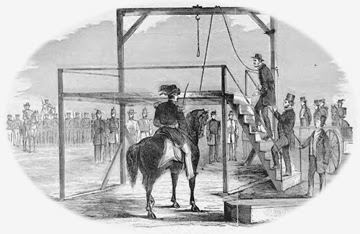
This account is excerpted from Crosby S. Noyes' report in The Washington Star, December 3, 1859.  John Brown aficionado, Boyd B. Stutler, considered Noyes' coverage to be the best single report on the hanging of the abolitionist.
Shortly before 11o’clock Brown was led forth from the jail.  He emerged with a firm step, ascended to the cart (arms pinioned), and seated himself coolly upon his own coffin, upon which he remained seated all the way to the gallows.  The cart was a yellow, rather clumsy vehicle, drawn by two white horses.  Brown was accompanied by Sheriff Campbell, Jailer Avis, and other guards; also, by a strong military escort.  He gazed with quiet scrutiny in every direction as if to take in the whole scene and all its surroundings.


Sheriff Campbell remarked, “Why, Mr. Brown, you don’t seem at all excited!”

“There is no occasion for excitement,” calmly answered John Brown.
It is understood that he begged hard to be allowed the privilege of walking to the gallows.  The distance from the jail to the gallows is perhaps 400 yards.
The various representatives of the press were conducted to the place assigned to them some two hours before the execution.  Their position, though somewhat more favorable for seeing what transpired than had seemed probable at one time, was of an unnecessary distance from the gallows, and we believe that it was the unanimous verdict of the “Fourth Estate”1 present that the reason assigned for this exclusion, viz. that John Brown might say something and the press report it, was too childishly puerile to do credit to the Executive of Virginia. 
The military within the field were located at points designated by white signal flags, bearing the names of the different companies.  Their lines formed two octagons, one within the other, and of which the gallows was the centre.  Drawn up beyond the rail fence of this field were long lines of cavalry; and the country in every direction as far as the eye could reach was dotted with squads of sentinel soldiers, their brilliant uniforms bringing their figures out in strong relief against the somber autumn brown of the landscape.  The number of spectators, aside from the military, was not large, perhaps a couple of hundred in all, and these, with the exception of the members of the press, and some half dozen privileged civilians seated upon the gallows steps, were excluded from the field. Not a female was to be seen by the naked eye in any direction, but by the aid of a glass some few were observed at the windows of distant dwellings.  A few colored people were seen along the road skirting the field, apparently slaves, sent by their masters to learn a salutary lesson.  Almost every tree in the vicinity was loaded down with boys.  The appearance of a single carriage upon the field, bearing a crippled man, attracted attention.  It proved to be Samuel C. Young, of Harper’s Ferry, one  of the citizens wounded by Brown’s men, and permitted, therefore, to enter the lines as a spectator.  Shortly before 11 o’clock Gen. Taliaferro, with a formidable staff, entered the field, and soon after the prisoner and cortege came up and halted in front of the gallows.
Brown descended from the cart and mounted the platform with the same imperturbable wooden composure which had distinguished him at every step of his progress.  He was dressed in a well worn suit of black cassimere—the same which he were on first entering Harper’s Ferry, --white woolen stockings; red, figured carpet slippers, (that he had, previously used in jail;) a colored cotton shirt; gray wool undershirt; no neck cloth of collar.  It was noticed that his neck and breast were as white as a woman’s.  The sheriff and jailor mounted the platform with Brown, and quickly adjusted the white cap over his head and the rope round his neck, and had tied his feet securely.  Then occurred another remarkable exhibition of nerve by Brown.  He was requested to take his place on the drop, (trap door,) “I can not find it blindfold[ed]; guide me to it,” he answered in the same even tone of voice as if asking for a chair.  He was placed in position, and then there was an unpleasant pause of some eighteen minutes while some companies at a distance were brought up.  The sheriff made some explanation to the prisoner about the delay.  “I don’t care,” he replied, “only don’t keep me waiting unnecessarily.” 
After some further moments of suspense, during which the prisoner stood without a tremor, at a quarter past 11, Col. Smith called out audibly, ‘All ready, Mr. Campbell.”  The sheriff touched the spring, the flooring dropped beneath the prisoner’s feet; down he shot through the trap, then up, then down; there was quick, convulsive movement of the hands; a slight muscular tension of the limbs, then they straightened, and the body swung perpendicular, turning slowly round and round—this motion, with the fluttering of the coat skirts in the breeze, giving it singularly the appearance of a corn-field scarecrow, and the more that his gaunt frame and limbs bore apparently not an ounce of surplus flesh, and thus did not fill out his clothes.  Yet he had positively gained in weight while in jail.  As Gov. Wise said, he must have been a bundle of nerves—and nothing else!  It was a relief to turn from the ghastly  spectacle to the tranquil beauty of the neighboring landscape—the mountains of the Blue Ridge bathed in soft purple haze, and the green, undulating wheat fields on the opposite horizon. 


The body hung 20 minutes or more, and then Drs. Starry, Cook, and Straith, with blue ribbons at their buttons, ascended the platform, felt the hanged man’s pulse, examined his neck, and applied their ears to his heart.  Then they withdrew, and four Regimental Surgeons went through the same programme.  Then they too retired, (as the platform was not deemed strong enough to bear more than half a dozen persons at a time,) and so on, (including several slips of boy-surgeons) to the number of twenty.  Then “Porte Crayon,” Strother, the artist, a thin, sickly looking young man, with others, visited the platform for  a moment, and at the end of 36 minutes the body was cut down.  The neck was not broken, and the medical examiners declined certifying to death having taken place until after a further examination to be held at the jail at 3 p.m.  Dr. Mason held to the opinion that it was possible in such a case to restore life by galvanic action.3  It was supposed, however, that strangulation took place after less than four minutes suspension. 
The rope left no mark of abrasion on the neck.2  The eyes of the corpse were open, but not staringly so.  The mouth also was open and would not close.  The face was not unnaturally distorted, though the blood vessels were somewhat distended, as occurs in death by strangulation. 
The body was placed in the coffin (of black walnut) and this again in its “shell” of white pine.  This exterior casing bore the penciled lettering “John Brown, Esq.,” doubtless an achievement of the undertakers.  At 6 o’clock in the evening the corpse was taken from the jail and conveyed by an extra train to Harper’s Ferry, where Mrs. Brown was awaiting it.  She stopped at the Wager House, and in the morning she proceeded North by the three o’clock train, proposing to take the most direct route and with the least publicity to their home at North Elba, N.Y.  She was accompanied by a gentleman by the name of McKim.
Notes

        1 The Fourth Estate was a publication for newspaper publishers and advertisers.
       2 Based on other eyewitness accounts, this is doubtful.  The deep rope mark around Brown’s neck was quite visible to others, so Noyes either did not get a good look or he intentionally played down the appearance of Brown’s body.
    3 According to the New York Herald, 6 Dec., some of the doctors mentioned were not convinced that Brown was dead after his body was cut down from the gallows.  The remains actually were left in the jail and re-examined later in the day before being released to Brown's widow.  One source says that one of the examining physicians wanted to administer poison to the corpse in order to make certain of his death.