The Research & Writing of Louis A. DeCaro Jr.


"The world needed John Brown and John Brown came, and time will do him justice." Frederick Douglass (1886)

Search This Blog & Links

Translate

Thursday, August 15, 2013

A Novel Approach--
The Color of Historical Fiction: James McBride Spoofs the John Brown Story in The Good Lord Bird

I'm never really sure of how I feel about historical fiction in general, especially when it takes on themes that are dear to me.  The only work of fiction about the Old Man that I have both enjoyed and actually read from cover to cover is Terry Bisson's Fire on the Mountain, which is an amazingly thoughtful effort that engages counter-factual history (which is fiction) in a manner that is moving and multi-perspectival.   I would recommend Fire to anyone and everyone, and I keep it with my John Brown books.  While Russell Banks' widely praised Cloudsplitter (which I keep behind my John Brown books) illustrates the author's great ability as a novelist, I never read it all the way through.  I just got tired of watching the author telling me a story that was not the story I knew to be true, period.  Like the late Boyd Stutler, the godfather of John Brown studies, I'm just not that fond of historical fiction--and frankly there's already too much to read in terms of history to spend more time reading someone else's fictive portrayal of the Old Man. (Still, I have promised to read Marilynne Robinson's Gilead, which has been fervently recommended to me.) Now there's James McBride's The Good Lord Bird.
. . . it seems a lot of people think that they can engage in meaningful historical reflection by reading novels about real people.  

Before noting The Good Lord Bird, let me add: what annoys me about historical fiction is that it seems a lot of people think that they can engage in meaningful historical reflection by reading novels about real people.  And I think that reflects both error and laziness.  We already live in a culture and generation that is virtually ahistorical and intellectually lazy when it comes to history.  In John Brown's case, it's worse, because lots of people are already grossly misinformed and prejudiced in their thinking due to terrible high school texts, bad TV documentaries, and lots of prejudiced talking heads.  A work of fiction about Brown (even if it is basically friendly) is absolutely the last place that one ought to start thinking about Brown in historical terms.  Yet, inevitably, many will do so, as the following comment reveals from a reader on Goodreads:
Was John Brown a terrorist, martyr, hero, lunatic, saint or deluded fool? After reading The Good Lord Bird I would still hesitate to give a straight answer, although James McBride does appear to be leaning toward a heroic, almost saint-like depiction of the raider of Harper’s Ferry toward the end of this rollicking ride through the latter part of Brown’s life.
I would hope you would hesitate, lady.  I wonder how many biographies of Brown she's read?  Now, this may be something that just happens to John Brown, especially among whites, too many of which presume he is "complicated" and "troubling," and have this big historical problem in their minds about the Old Man that drives them to the latest novel.  Maybe it happens to Lincoln or Henry Ford or Richard Nixon, too, but I doubt it.  It seems to me that whenever someone writes fictional work about John Brown, it is forced to carry water for historical inquiry. Nevertheless, why the *&%! did this reader think she was going to get "a straight answer" about a historical figure from someone's fictional rendition?  Frankly, it's kind of stupid, yet this is the issue that always comes up with another work of historical fiction about John Brown.

As I said, I am a biographer and historian, and I teach history and theology.  I can never read enough across the disciplines in which I teach and research, so the idea of reading novels is pretty much out of the question.  Furthermore, to unwind by reading a novel completely misses the point for me.  That's what movies are for.  However, the fact that I have little use for fiction (yes, I know there are good arguments for "the power of story," etc.), I know many others love novels and sometimes historical fiction is a starting point for people who want to read history.  To each his own.

Now that I've done my song and dance about fiction, here's some info on The Good Lord Bird, and you can decide for yourself whether you want to read it:

Publishers Weekly

"Musician and author McBride offers a fresh perspective on abolitionist firebrand John Brown in this novel disguised as the memoir of a slave boy who pretends to be a girl in order to escape pre–Civil War turmoil, only to find himself riding with John Brown’s retinue of rabble-rousers from Bloody Kansas to Harpers Ferry. “I was born a colored man and don’t you forget it,” reminisces Henry Shackleford in a manuscript discovered after a church fire in the 1960s. Speaking in his own savvy yet naïve voice, Henry recounts how, at age 10, his curly hair, soft features, and potato-sack dress cause him to be mistaken for a girl—a mistake he embraces for safety’s sake, even as he is reluctantly swept up by Brown’s violent, chaotic, determined, frustrated, and frustrating efforts to oppose slavery. A mix-up over the meaning of the word “trim” temporarily lands Henry/Henrietta in a brothel before he rejoins Brown and sons, who call him “Onion,” their good-luck charm. Onion eventually meets Frederick Douglass, a great man but a flawed human being, Harriet Tubman, silent, terrible, and strong. Even more memorable is the slave girl Sibonia, who courageously dies for freedom. At Harpers Ferry, Onion is given the futile task of rousting up slaves (“hiving bees”) to participate in the great armed insurrection that Brown envisions but never sees. Outrageously funny, sad, and consistently unflattering, McBride puts a human face on a nation at its most divided."
James McBride

New York Times Book Review

"A MAGNIFICANT NEW NOVEL by the best-selling author James McBride…a brilliant romp of a novel…McBride—with the same flair for historical mining, musicality of voice and outsize characterization that made his memoir 'The Color of Water,' an instant classic -- pulls off his portrait masterfully, like a modern-day Mark Twain: evoking sheer glee with every page."


Library Journal

"McBride continues exploring the long history of America's color line, begun in his landmark memoir, The Color of Water. A young slave in the Kansas Territory, Henry Shackleford must flee with abolitionist John Brown after Brown clashes with Henry's master. Complicating matters: Brown thinks Henry is a girl, a disguise Henry maintains up to the bold raid on Harpers Ferry."

Kirkus Reviews

"In McBride's version of events, John Brown's body doesn't lie a-mouldering in the grave--he's alive and vigorous and fanatical and doomed, so one could say his soul does indeed go marching on. The unlikely narrator of the events leading up to Brown's quixotic raid at Harper's Ferry is Henry Shackleford, aka Little Onion, whose father is killed when Brown comes in to liberate some slaves. Brown whisks the 12-year-old away thinking he's a girl, and Onion keeps up the disguise for the next few years. This fluidity of gender identity allows Onion a certain leeway in his life, for example, he gets taken in by Pie, a beautiful prostitute, where he witnesses some activity almost more unseemly than a 12-year-old can stand. The interlude with Pie occurs during a two-year period where Brown disappears from Onion's life, but they're reunited a few months before the debacle at Harper's Ferry. In that time, Brown visits Frederick Douglass, and, in the most implausible scene in the novel, Douglass gets tight and chases after the nubile Onion. The stakes are raised as Brown approaches October 1859, for even Onion recognizes the futility of the raid, where Brown expects hundreds of slaves to rise in revolt and gets only a handful. Onion notes that Brown's fanaticism increasingly approaches "lunacy" as the time for the raid gets closer, and Brown never loses that obsessive glint in his eye that tells him he's doing the Lord's work. At the end, Onion reasserts his identity as a male and escapes just before Brown's execution. McBride presents an interesting experiment in point of view here, as all of Brown's activities are filtered through the eyes of a young adolescent who wavers between innocence and cynicism."

Goodreads (four stars)

"Henry Shackleford is a young slave living in the Kansas Territory in 1857, when the region is a battleground between anti- and pro-slavery forces. When John Brown, the legendary abolitionist, arrives in the area, an argument between Brown and Henry’s master quickly turns violent. Henry is forced to leave town—with Brown, who believes he’s a girl.

Over the ensuing months, Henry—whom Brown nicknames Little Onion—conceals his true identity as he struggles to stay alive. Eventually Little Onion finds himself with Brown at the historic raid on Harpers Ferry in 1859—one of the great catalysts for the Civil War.

An absorbing mixture of history and imagination, and told with McBride’s meticulous eye for detail and character, The Good Lord Bird is both a rousing adventure and a moving exploration of identity and survival."

Metro

James McBride’s new novel, “The Good Lord Bird,” is his second in a row to explore the issue of slavery in the years just prior to the Civil War. It was while researching his last book, “Song Yet Sung,” that he became fascinated with the story of the abolitionist John Brown, who led the violent slave insurrection at Harpers Ferry, West Virgina.

“I’d heard John Brown’s name many times in the past but never really quite knew who he was,” McBride says. “When I started to research him, I became fascinated with his story. The challenge was to find a way to write about him that was interesting and funny.”

Given the dark subject matter of the time period and of Brown’s tragic final days, the humor is the most surprising element of “The Good Lord Bird.” The story is told through the eyes of Onion, a young slave boy who becomes a part of Brown’s crew under the mistaken assumption that he’s a girl. Over the next few years, he crosses paths with luminaries
like Harriet Tubman and Frederick Douglass, the latter depicted making drunken advances on the disguised Onion.
“My approach is to make fun of everybody,” McBride explains. “In real life, I admire Frederick Douglass. He was a great man, but he was flawed as well. The people who built this country weren’t gods. They were flawed people, and you often wonder if the women in their lives
had the chance to write the stories of these men, how their account would read.”

McBride himself was surprised at the opportunities for satire afforded by Onion’s disguise. “The business of identity – self identity, inner identity – always drives the outer story,” he says. “I wanted Onion’s identity issues to be strong enough to push him to freedom at the end
of the book. I really didn’t consider all of the factors that would go into this character playing a girl at the outset; I just thought it was funny. Then as the book evolved and he got into these situations where he had to pretend to be a girl, it thickened the plot and just became delicious.”

In the end, McBride came to admire his subject, despite the misguided violence of some of his actions. “I think John Brown was one of the greatest Americans that ever set foot in this land,” he says. “John Brown was a man who represented an ideal and was willing to die for
it. He was way ahead of his time. I admire his sense of religion, his sense of purpose, and his unwillingness to compromise on the issue of human rights.”

Source: Shaun Brady, "Forging a 'delicious' tale out of difficult history," Metro (15 Aug. 2013)

Review by Christine Brunkhorst in the Minneapolis Star Tribune, 17 Aug.
Review by Margaret Quamme in the Columbus Dispatch, 18 Aug.
Review by Kevin Nance in USA Today, 18 Aug.
Review by Joel Lyons, in New York Daily News, 21 Aug.

Tuesday, August 06, 2013

"Grandeur in a Degenerate Age": William F. M. Arny, New Mexico’s Link to John Brown

Here I am in the land of big sky and no humidity, New Mexico.  I love NM—it’s about as “far away” as you can travel without leaving the continental U.S.  There’s lots of history here, too.  And while the Old Man never made it this far to the southwest, there is a NM connection to the John Brown story, in the person of William Frederick Milton Arny.  Now, since I’m working on another project and writing in-between family and vacation time, what follows is a series of pasted items about Arny.
W. F. M. Arny
www.territorialkansasonline.org

William E. Connelley, A Standard History of Kansas and Kansans.  Chicago: Lewis Publishing Company, 1918.

“Kansas has produced no more eccentric, generous or beloved character than William F. M. Arny. Although not a native of the state, he was a son in all that stands for its independence and humanity. He was born in the District of Columbia, March 6, 1813, and after graduating from Bethany College, West Virginia, acted for a time as secretary for Alexander Campbell, the famous Disciple preacher. At the age of twenty eight he was on intimate terms with all of the leading men of the nation, especially with such as Abraham Lincoln and others of force and originality. In 1850 Mr. Arny settled in McLean County, Illinois; was active in the organization of the republican party, and in 1856 was a committeeman in that state appointed to raise money to settle Free State men in Kansas. In that year he made a trip of investigation to the territory, and its condition so appealed to him that in the spring of 1857 he settled in Anderson County. 

The people of Kansas, who had come thither to stay and build a real commonwealth of equals, accepted William F. M. Arny as a valuable accession to their forces, electing him both to the Leavenworth constitutional convention of 1858 and the House of Representatives of the First State Legislature, which assembled with the outbreak of the Civil war. At that time he was also closing his faithful stewardship of the relief fund and the goods entrusted to him in behalf of the sufferers from the grasshopper plague of 1857. He had been elected a delegate to the Grasshopper Falls convention soon after coming to Kansas, had handled thousands of dollars and over 9,000,000 pounds of relief goods. In 1861 President Lincoln appointed him secretary of the Territory of New Mexico. He was a great favorite with the Indians in that region, and, in the prosecution of his official duties, accomplished much in exploiting the mineral resources of New Mexico. But in that matter, as in all other measures with which he was identified and prominent, he did not profit financially; in fact, seemed always careless of personal gain. Naturally he died poor, albeit honored and deeply loved  which is better than to have died financially prosperous. On his return from a trip East he stopped off at Topeka, was taken ill and died suddenly September 18, 1881. A short time before, at the theater, he had been robbed of his money and passes, and a collection of $125 was taken up among his old Kansas friends to pay the expenses of his burial. His body was forwarded to Santa Fe, where funeral services were held in the palace.”

Arny's gravestone at the
Santa Fe National Cemetary

“New Mexico Territorial Secretary. He was well educated for the day, and notably religious. He was converted from the Baptist to the Disciples of Christ Church and formed a lifelong relationship with that church to the point of traveling widely and conducting revival meetings. In 1848 a split over church matters developed and he moved to Bloomington, Illinois where he became interested in scientific agriculture, printing, and teaching. A new dispute occurred and in 1856 he moved to Kansas, settling first in Lawrence and then in Hyatt. Again he became heavily involved in political turmoil and when his friend Abraham Lincoln was elected president in 1860 Arny sought a political appointment. He was named Indian Agent to the Utes and Jicarilla Apache of northern New Mexico, succeeding Kit Carson. He found the problems immense and the resources scarce and accomplished what was possible with the means at hand. In 1862 he was appointed Territorial Secretary of New Mexico, holding that position until 1867 and serving occasionally as acting governor. In 1867 he was appointed agent for two years for the mountain Utes in Abiquiu, New Mexico and for the Pueblos along the Rio Grande. In 1870 he became Special Agent for the Indians of New Mexico and he extended his concerns to the Mimbres and Mescalero Apaches, conferring with Victorio, Cochise and other noted Apache chiefs. In seven months he made a visit to every tribe in New Mexico, southern Colorado, and southeastern Arizona, took Indian census, evaluated their condition, and made a full report. His reappointment by President Ulysses S. Grant was strongly disputed in the 1872 Senate, but he was eventually confirmed. In the summer of 1873 he was named the Navajo agent where, again, disputes and complications hampered his efforts. In 1874 he took a large contingent of Navajos to Washington, DC but his difficulties could not be overcome and he submitted his resignation on July 22, 1875. His last six years in New Mexico were lived in financial impoverishment. In 1879 he learned that he had inherited a large fortune in England, but he arrived there too late to collect.”


William F. M. Arny examined by the Senate Investigation Committee on the Harper’s Ferry Raid (Washington, D.C.: 1860)  

Excerpts only

January 16, 1860.

William F. M. Arny affirmed and examined.

. . . .

Question. Were you acquainted with John Brown, who was mixed up with the troubles and difficulties in Kansas, and who has been recently executed in Virginia?

Answer. I was. With reference to that, I should like to say a few words.

The Chairman. Certainly; any explanation you please.

The Witness. As a member and general agent of the National Kansas Aid Committee, I became acquainted with some matters pertaining to John Brown's operations in Kansas, which may throw some light on his operations at Harper's Ferry; but before I give testimony in regard to it, I would prefer to be sent home for my books and papers, so that I can give a full and accurate statement of the amount placed in my hands by individuals and committees, and how it was appropriated, so as to show definitely what was given to John Brown as far as I know, by whose order, and for what purpose. If this investigation is designed for a full exhibition of the relation of other parties to John Brown, it will be impossible for me to testify accurately, and so as not to do injustice to persons who are absent, unless I can have access to my memoranda, records, and books kept at the time, in which were recorded the events, to some extent, as they transpired.

Question. Will you state when your acquaintance with John Brown commenced?

Answer. Between twenty and twenty-two years ago.

Question. When did you first see him in Kansas ; when was your acquaintance with him resumed there?

Answer. My first personal connection with him in Kansas was after the beginning of 1857. I saw him previous to that, however, but not in Kansas. . . . I last saw him in the fall of 1858. . . . During the summer and fall of 1858, I saw him some half dozen times.

Question. Where was he then; where did you see him?

Answer. I saw him in Lawrence, Kansas. I saw him at my own house once or twice; he spent a day or two with me there. I saw him down on the borders of Missouri while I was engaged in surveying a railroad there. I think these are all the places where I saw him in the Territory during that year.

Question. Did he tell you then, in any of those interviews, of any plans that he had in contemplation to make a descent on any of the Southern States with a view to incite insurrection amongst the slaves? 

Answer. In my conversation with him, growing out of a communication that I was requested to make to him by Mr. Richard Realf, he said some things in regard to a plan that he had, but gave me no details in regard to it.

Question. What was the character of the plan? You may give that without going into details. What sort of a plan was it?
. . . .

The Witness. It may be as well to state here that in all my conversations with Brown I opposed any project of even carrying off slaves, and my connection with him was more interposing to prevent him from getting means to accomplish anything of that kind.
. . . .
The Chairman. Well, you returned to Kansas. Now, you can go on.

The Witness. I think the first time I saw Brown after I got into the Territory was while I was engaged in surveying a road through Missouri and from Missouri to the Neosho valley, and during the time of the troubles in Linn county, Kansas. It was directly after what were termed the Marias-des-Cygnes murders, when Hamilton came over from Missouri and killed a lot of men, taking them from their farms in Linn county, on the borders of Linn. After speaking to Brown in regard to the position of things in the Territory at the time, I said to him that I understood that an organization was established in that county and neighborhood in which I was very glad to learn they had decided that no invasion should take place of the territory of the State of Missouri ; I then remarked to him that I had seen [Richard] Realf in New York. He was standing a little way off. He immediately came close up to me. He said, "I am glad to hear that, for I thought Realf was gone to England and had not attended to what we had appointed him." I then told him that Realf asked me to say to him that he did not know where to write to him, and that if I fell in with him to say to him that he had been engaged in the matter to which he was appointed, and that he could not learn definitely what Forbes was after, but that he had gone to Washington; that was about the substance of the message that Realf gave me. Brown then asked me if I knew who Forbes saw in Washington. I told him, no. Well, said he, you were in Washington. I said, yes. I then immediately remarked to Brown that I thought it very strange that he would be engaged in an enterprise such as Realf had intimated to me they were engaged in. ''Why strange,"' said he. Why, said I, "Brown, when I knew you twenty years ago over in Virginia, you professed to be an abolitionist, and an abolitionist of that class that are termed non-resistants, and you refused to use arms in any shape or form; even when you were opposed, you would not resist, and you were considered ultra on that subject at that time; how is it that you have changed?" He then referred to the fact that he had sent his sons into the Territory of Kansas in 1853 or 1854 with a lot of blooded cattle and other stock with the intention of settling. “You know they did settle on the Pottawatomie, and that after they settled there, part of their cattle was stolen; they were
notified to leave the country, and they had to sacrifice their cattle."

The Chairman. I do not think it important to know Brown's reasons for this thing. We want to get at the facts.

The Witness. I am only detailing the conversation I had with him. There were three conversations with him; he was at my house two days. 
. . . .

Question. You have said, as I understand, that Brown, in speaking of his plan, referred to some action taken by that committee, and that you were present when that action was taken. Now state what the action was that was taken, to which Brown referred?

Answer. Mr. Brown applied to that committee

Mr. Collamer. State when and where.

Answer. He applied sometime in the month of January, 1857, at a meeting of that committee, at the Astor House, in New York, for some arms, and other assistance, to organize a company of men and equip them, to repel the invasion in Kansas by Missourians. The action of the committee, to be short about it, was a refusal at that time to let him have the arms, and an agreement to let him have some other matters that would assist him in a peaceable settlement in the Territory of Kansas.

By Mr. Collamer:
Question. What were they? 

Answer. Clothing and other things.

By the Chairman:
Question. What do you mean by a peaceable settlement?

Answer. That he should settle there in the Territory of Kansas, and not go out. The policy of this committee was a policy of self-defense, and opposed to any attempt to invade the States or any Territory.

By Mr. Davis:
Question. Do you mean clothing for himself or for others?

Answer. Clothing for himself and others.

Question. For distribution?

Answer. Yes, sir; for persons that he was acquainted with and that he represented were in a destitute condition. 

By the Chairman:
Question. Was that the action that Brown referred to?

Answer. Yes, sir; he referred to that action, and 1 think I can give the exact words, after speaking of that action.

By Mr. Doolittle:
Question. Was this an application for the arms which were in Iowa at that time?

By the Chairman:
Question. You say that Brown told you of some plans that he had to arm a party of men for the purpose of stampeding slaves from the slave States, and in telling you of that plan he referred to the action taken by this committee at Buffalo, and you now tell us what that action was. That action was an application of Brown for certain arms for certain purposes, and a refusal of the committee to let him have those arms for those purposes, and a proposition by that committee to aid him in a peaceable settlement. I want to know how Brown referred to that action in connection with any plan of running off slaves. What had that to do with running off slaves?

Answer. In my conversation with him, I was finding fault with him for proposing a plan of that kind; and, in finding fault with him in regard to that matter, he classed me with the abolitionists, with the republican party, and with this committee, and he said we were all alike a set of cravens, that we all refused to give him assistance to carry the war into Africa.

Question. You spoke of applications he had made to some people in the East. What applications did he speak of there that he had made? 

Answer. After his application to the committee at the Astor House, in New York, in 1857, and a refusal by all who were there to do anything for him at that time, and after the settlement of the ownership of these arms, which was made afterwards at the same meeting, he then addressed a letter, a copy of which I have and can furnish to the committee if I have my papers, to the people of the States. 

Question. What States?

Answer. Of the free States, asking for aid.
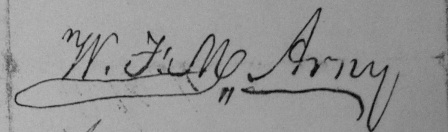
Arny's signature from a John Brown document
excerpted from Gilder Lehrman image 


William Arny's Reminiscence at Brown’s grave, July 4, 1860

“I have known John Brown to give the last dollar from his scanty purse in Kansas to Free State men whom he met in a worse condition.  The life of him whose remains rest before us, is full and brimming with such deeds.  The record of that life he has left us, a solitary mark of grandeur in an otherwise degenerate age."  

Source: "Celebration at North Elba; The Fourth of July Among the Adirondacks," Liberator (27 July 1860): 1

Wednesday, July 31, 2013

Film--
Paul Giamatti, FX, will make "Midnight Rising" into a TV Mini-Series

According to Deadline Hollywood blogger, Dominic Patten, "Paul Giamatti and FX are in the early stages of a limited series on the spark that started the fire of the Civil War."  According to Patten, the yet untitled project on John Brown is based on Tony Horwitz’s 2011 book, Midnight Rising, which is centered upon the Harper's Ferry raid.  Patten says that Horwitz will serve as a consultant on the project, which is expected to be from six to eight hours total--which I guess is about three or four episodes.  Patten says that Gabriel Range, who helmed the faux documentary "Death Of A President" in 2006, is adapting Midnight Rising into a screenplay. Range will also serves as co-executive producer on the project.
Paul Giamatti

The John Brown community, particularly those scholars who have invested ourselves deeply into the study of the man and his legacy, are naturally excited as well as concerned by this news.  Over the past decade there have been rumors of John Brown films, from the never produced film version of Russell Banks' fiction, Cloudsplitter, to the apparently back-burnered American Film Company's proposed movie on the Harper's Ferry raid, as well as talk from Quentin Tarantino that he wanted to do a John Brown film.  There are currently other screenplay efforts underway, and it seems that sooner or later, some feature film will bring the Old Man to the screen.  Perhaps this time, it is far more likely that some interpretation of the John Brown story will finally reach the screen, albeit the television screen.  This is obvious good news for Tony Horwitz, although even he probably cannot predict how his work will be spun by Gabriel Range as a screenplay.  While I have considerable differences with Tony Horwitz on aspects of the John Brown story, the larger point of concern, however, is what "Hollywood" will do with the John Brown story vis-a-vis Midnight Rising.
Tony Horwitz
 
Time will tell, although we certainly hope that we do not have the image of a violent religious fanatic John Brown, or a mentally disturbed terrorist John Brown brought to the screen.  Since too many people in this nation are too lazy to actually read history in a serious manner, they will take their history from film, just as they did in 1940, when "Santa Fe Trail" was released.  While there will be no more spinning of the Brown story to suit the whims of Southern romancers and "Lost Cause" types, it is possible that the themes of terrorism and religious fanaticism will be overdone by Hollywood.  It is hard enough for a post-Christian, secular writer to appreciate Brown's religious ideas, non-non-violence, and antislavery zeal.  It will be almost impossible for entertainment types to see Brown in a balanced light.

This is a story worthy of following and we'll do so.  At best, we hope that a television mini-series will get more attention for the John Brown story in schools and forums of real historical discussion and education.  We have good reason to believe that Mr. Giamatti, having shown respectable interest in early U.S. history, will likewise approach this theme with respect and consideration.  On the other hand, should our worst fears be raised, and this film lends itself to the lower appetites of popular culture, then most assuredly there will be, as Brown once put it, "all hell stirred from beneath" from our part.  We have come too far to see our 21st century understanding of Brown reduced to some misanthropic figure, whether on TV or in the movies.

Tuesday, July 30, 2013

Sidenote--

I'm Laughing AT YOU, not with You: Quick Review of Methodist Minister's Eyewitness Account, and a Lazy, Arrogant Amazon Reviewer

Samuel Vanderlip Leech was a Methodist minister who had occasion to meet John Brown during the incarceration of the abolitionist in 1859.  Fifty years later, Leech wrote a reminiscence of of the raid and an assessment of John Brown, entitled The Raid of John Brown at Harper's Ferry as I Saw It.  In my opinion, the work offers little of value except a brief vignette of the abolitionist's rejection of some pro-slavery ministers while in jail.  Unfortunately, he doesn't even date or sufficiently develop the more important episode of his little book.  Otherwise the work offers little of value to historians, except an old conservative compromiser's assessment after the fact, written at a time when white supremacy had been revised in 20th century terms.

At any rate, I made a brief comment on the book on Amazon, which you can read here.
http://www.amazon.com/Raid-Brown-Harpers-Ferry-ebook/dp/B004UJ12CC/ref=cm_rdp_product

What cracked me up, however, was the following Amazon "review" by a fellow named Geoffrey Sebesta, who gives this work four stars and writes:

"I read the pamphlet in the evening and found it lucid, revelatory, and delightful. The author is a cautious, cowardly liberal of the kind we all know and love, and his admiration for Brown is mixed with his horror at the sheer madness of the man and the impossibility of what he wanted. I learned a tremendous amount about the raid with very little expenditure of effort thanks to this book."

While I bear no malice toward Mr. Sebesta, I had to laugh at his "review" and let him know that I was laughing too.  But it's worth reporting here because it is very telling.  First he writes, with the typical arrogant presumption of many people in this nation, of "the sheer madness" of Brown and "the impossibility of what he wanted."   I need not go at length to say that, notwithstanding Tony Horwitz's baseless flirtation with alleged bipolar or manic disorder, there is no evidential basis for concluding that Brown suffered from mental illness.  The point is that Mr. Sebesta assumes Brown's madness with the same assurance that Mr. Sebesta assumes himself human, not a monkey.  This kind of assurance of truth regarding Brown is what typifies so many ignorant and arrogant people who typically bash Brown online.   The same applies for "the impossibility of what he wanted."  Very likely, Mr. Sebesta, like so many other Brown bashers out there, don't even really know what Brown "wanted."  And why should they, when no few number of historians and authors have so misrepresented Brown's goals?    Unfortunately, Mr. Sebesta is the product of an educational system and a historical prejudice, and his brief "review" is graphic in exposing the point.

The same applies for his grateful comment, that he had "learned a tremendous amount about the raid with very little expenditure of effort"!   Wow, this guy is a living illustration of the problems that John Brown studies face.  People who delight in putting forth little effort in studying, people who are historically lazy, so to speak, but want to have a "John Brown for Dummies" experience, and then walk away feeling he is both educated and qualified to speak on the subject.  He knows neither facts, context, or historiography, but he's absolutely delighted that he found a pamphlet that has taught him a "tremendous amount" without him having to expend very much effort.   This underscores the larger problem, that many people are too lazy to work hard at history, and to some degree history as a discipline suffers because of this laziness.  But John Brown--who is wrongly characterized so traditionally in white society and the mainstream media--especially suffers from lazy people who think this way.

Like I commented on his review, as a biographer of John Brown, I'm laughing.

:

Monday, July 15, 2013

From the Field--
Iowa and John Brown: A Road Trip Report from H. S. Wolfe


Greetings:

Mix your "From the Field"-man and a warm, July Saturday and what do you get? Why, a John Brown Road Trip...that's what!
Plaster from the Maxson Farm House (H. S. Wolfe)
My principal destination was the Herbert Hoover Presidential Library in West Branch, Iowa, where a special exhibit dealing with Iowa's role in the Civil War was my objective. But, lo and behold, the display began with John Brown himself. Besides a number of images and broadsides, a display case contained three artifacts: 1) a "John Brown Sharps" rifle, of the type stored in Iowa and carried to Harpers Ferry; 2) a faux "John Brown pike," which (this particular object has been floating around the Springdale, Iowa vicinity since the 19th century) shows not the least resemblance to the pikes carried to the Ferry; and 3) something new!  If you recall my epic article about Brown's soldiers at Springdale (see "Farmer Maxson's Newel Post"), I believe I mentioned that the men, before departing in April of 1858 for the Constitutional Convention in Chatham, C.W., signed their names on a wall of their winter quarters, the Maxson farmhouse. Here, today, I viewed a piece of plaster inscribed with the following: "Taken from wall where John Brown's men wrote their name in 1859    Springda  Io." Besides having the year wrong and cutting off the location, it provided me much excitement...for I had never seen such a souvenir before. 
Townsend's Traveler's Rest (H. S. Wolfe)

When departing West Branch, I paused to photograph the structure which once housed James Townsend's "Traveler's Rest." This roadside "inn/tavern" was, in 1856, patronized by John Brown...and described in a much published story popularized by Irving B. Richman's "John Brown Among the Quakers" (1894). An image is attached. Appreciate it...for I risked my life in oncoming traffic.

Upon arriving in Springdale, for a tour of the John Brown sites there, yours truly, the From the Fielder, was compelled (by issues of vanity) to pose beside the village sign on its western limits (see final image). Please note the red and white bib overalls. These were obtained by barter from Bozo the Clown...I get his pants and he gets an original pair of John Brown's leg irons.
DAR Maxson Family Monument (H. S. Wolfe)
Finally, I paused at the site of the Maxson farmhouse...in order to evaluate the condition of the 1924 DAR monument marking the same. Sadly, it still remains much neglected...although someone has cut a bit of the long grass masking its roadside face...and, perhaps the same someone, has placed three small American flags to honor the spot. Heavily shaded by a towering sycamore...and backed by corn already shoulder high...one requires a licensed guide, such as myself, to even locate the spot. But the stone remains...which we can claim as progress. 
Our correspondent marks the site,
as always, with panache  (H.S. Wolfe)

When one includes the pork and pepper sandwich at "Reid's Beans Cafe" in West Branch, it turned out to be a most interesting and enjoyable day. Perhaps, someday, the esteemed Dr. DeCaro himself will travel to the provinces for a personal tour. Nothing better than breathing Iowa dust while listening to the call of the dickcissel.

Yr obt srvt,

H.S. Wolfe...From the Field

We are grateful for yet another refreshing infusion of word and scene from Correspondent Wolfe, whose historical adventures range from deep in the archives to the breadth of the nation's plains and rolling hills.  Under the watchful survey of Mr. Wolfe, no rock is left unturned, no tome is too faded to be studied, no road is too dusty to be traveled, and no Civil War cannon too rusty to be fired off!  Of course, one burning question remains: What is a "dickcissel"?--LD  

Happily, we learn from a subsequent communication from Mr. Wolfe, concerning the aforesaid dickcissel:


"I take it as a symptom of an overextended exposure to concrete and urbanization that you are unfamiliar with the dickcissel. This glorious, avian forager of the fields of the hinterland...a member of the genus Spiza and family Cardinalidae...can be heard performing his musical lyrics along any country road in Ioway. Any John Brown research visit to the Maxson farm is accompanied by such melodious background music."

Monday, June 24, 2013

Two reasons why John Brown would not tolerate Paula Deen:

1. John Brown absolutely loathed butter.
2. John Brown absolutely loathed racism.

Saturday, June 22, 2013

Chain, chain, chain--
John Brown's Alleged Leg Irons Sell at Auction

Today (Sat. Jun. 22) a set of leg irons allegedly worn by John Brown while imprisoned in Virginia in 1859 were sold today for $13,145 by Heritage Auctions in Dallas, Texas.  A number of internet news sources announced the sale with a report from The Associated Press:

DALLAS -- The leg irons used on abolitionist John Brown after his failed 1859 raid on the federal arsenal in Harpers Ferry, W.Va., sold at auction for $13,145 Saturday. The winning bidder declined to be identified at the Heritage Auctions event. 
Many scholars believe Brown and his raid hastened the start of the Civil War. The Connecticut native and some followers seized the arsenal, hoping to provide 100,000 weapons to slaves who never rose up as envisioned to join them. Brown later was hanged for treason, murder and inciting a rebellion.
Typically, reports of this nature convey one or more conventional errors based upon generations of misinformation and skewed representation.  In this case, the AP report erroneously says that Brown "seized the arsenal," which is at least imprecise.  Actually, Brown and his small army of raiders seized the town of Harper's Ferry and the entire government armory, which included the arsenal.

Second, the notion that Brown wanted to convey the "100,000 weapons" to enslaved blacks is also mistaken.  There is no evidence whatsoever that Brown attacked Harper's Ferry with the intention of seizing the arsenal weapons.  Yet is almost impossible to uproot this error because it has been repeated so often by so many different people that it has become accepted as a fact.  To the contrary, one or two people in Harper's Ferry, and some Virginia politicians said it after the fact.  But it is interesting to point out that Brown posted raiders at the arsenal--although it seems likely that they were placed there to prevent others from getting the weapons during their occupation of the town.  There is no evidence that Brown's men removed these weapons, even after staying so long (too long!) overnight on October 16-17, 1859.  Brown's men may have looked at a case or two of the weapons, but there were no guns removed from the arsenal and, as Brown said afterward, he brought better guns (Sharps repeating rifles) with him.  Of course, I don't expect too many people to believe me.  There are so many questionable "givens" about Harper's Ferry that I'm convinced only the minority of people who actually are willing to read are going to have their assumptions challenged.
If you believe this image is historically accurate, I have another pair of leg irons to sell you.  David H. Strother's propaganda cartoon in Harper's Weekly, Nov. 1859, pictured loyal enslaved men rallying behind the paternal slaveholder, ready to fight off John Brown and his men.  It was either this, or portray black men as fearful, lazy, simpletons.  This was all part of the lie that the "slaves never rose up to support John Brown."
Third, the AP's biggest fallacy is that the slaves "never rose up as envisioned to join" Brown.  Once more, the notion that local blacks did not respond is the version of the raid ingrained in the "American mind."  Few seem to realize that the notion that few or no enslaved people responded to John Brown is based upon the reports of southern newspapers and politicians, which had a vested interest in promoting the lie that enslaved blacks either were: (1) afraid and cowardly; (2) fiercely loyal to their masters; or (3) lazy and indifferent.  The "no response" nonsense was conveyed to the northern press and completely accepted in a bipartisan fashion--assumed as true by the Republicans as much as the Democrats.   Not only do we have evidence that local blacks were responsive (and would have been even more so had Brown not gotten bogged down in the town of Harper's Ferry), but we know that many local slave masters were quietly terrified and some didn't even sleep at their homes following the raid until they were assured there was no insurrection afoot.  The politicians' braggadocio claims of slave loyalty was disproved by the deep southern fear of insurrections as a reality.  It was also disproved by the contradictory claim that enslaved black men were afraid and terrified even to pick up a weapon, but would fight like lions in defense of their slave masters.  That the majority of whites still believe John Brown had no impact on the enslaved community is simply evidence that the great majority has an unrealistic, apolitical, and often ahistorical view of the past--especially as it involves chattel slavery.

Fear of What?

By the way, the auction description also includes this problematic statement:
The actions at Harper's Ferry, in contrast, raised the fear of servile insurrection and was viewed by slave-holders as the logical outcome to abolitionist agitation. It was this fear, beyond all others, that prompted southern states to withdraw from the Union following Lincoln's election in 1860. 
In retrospect, it is true that the raid (and the consequent number of enslaved people who actually fled Jefferson county and other parts of the South as a result) created great consternation among the supposedly self-assured slavemasters.  But to say that their fear of slave insurrection, "beyond all others," is what prompted the Southern rebellion is just utter nonsense.  The Southern states were not scared into secession.  They dove headfirst into their mad rebellion because they were intent on keeping 4 millions of black people in slavery's chains.  They were not afraid that Lincoln's election would lead to servile insurrection.  They were afraid that Lincoln's party would at least keep the slavemasters from expanding slave territory.  They only fear they had was fear of losing their precious "peculiar institution."   The truth is, the slavemasters rebelled against the Union for the same reason they rushed John Brown to the gallows.

Now, About those Leg Irons

As far as the well-sold "leg irons" go, I'm going to remain skeptical--or to put it another way, I'm not so sure that $13,145 was well spent.

The auction description says that these leg irons were in the same family from the 19th century, but admits that the history behind them is "murky" and fraught with "family lore and faulty, contradictory information posted online."  I'm not suggesting the auction house is deceptive, and I'm sure they did their homework.  But I am suggesting there simply isn't enough basis to be certain that these well sold leg irons were John Brown's leg irons.  While the Rickard marking certainly attests to the leg irons being a genuine specimen of that time and vicinity, there just is not enough proof that these were the ones worn by Brown.  Even if the leg irons were associated with the Charlestown jail, they may have been worn by Brown's raiders, or other prisoners, including enslaved people, who were kept in that jail when they were sold.  By the way, it is not at all clear from the evidence that "Brown's shackles were only removed when his wife came for one last visit and once again when he was escorted from the jail to the place of execution."   For now I'll just say, Brown and his jailer got along well.

Of course, it is true that during the Civil War and afterward, people collected relics of John Brown, and there is no question that Union soldiers might have looked for Brown's chains.  But no one would have been trying to grab John Brown's leg irons for months, if not years, following his death in December 1859.  So unless it can be proved that his leg irons were "retired" after he wore them, stories about a "red flannel" marking and an "elderly black lady" just aren't sufficient.

For the record, I'm not saying these leg irons are not Brown's leg irons.  I cannot disprove it, and really have no desire to do so.  I'm only saying the auction house cannot say with real certainty that these were the Old Man's leg irons based upon their description, and the person who spent $13,145 to buy them was very trusting indeed.  Certainly, if I had $13,000 to spend on Browniana, I would have bought one of his letters, with handwriting that could be analyzed.  Still, for some people, I guess, $13,000 is "fun money," and certainly buying "John Brown's leg irons" sounds like quite an experience.


Wednesday, June 19, 2013

Link--
"When the Park was a Battlefield"

"The importance of the Battle of Osawatomie is that John Brown’s stand worked to bolster morale for Free State advocates in Kansas Territory, and John Brown earned the nickname 'Osawatomie Brown' for his courage leading Free State forces during the battle. In addition, the Battle of Osawatomie was the largest battle during the Bleeding Kansas era of the state’s and nation’s history." 


Read the entire article at The Osawatomie Graphic, 19 June 2013!

Sunday, June 09, 2013

Source & notes--

"John Brown As A Farmer"
[From the New York Observer, Nov. 3 (1859)]

The late strange and thrilling events at Harper's Ferry, which have startled the public mind and revealed such hidden dangers to the country, excite a natural curiosity in respect to the prominent actor in the scene.  I have no knowledge of the origin or early career of Brown.  It was about ten years ago that he made his appearance as a farmer or cattle breeder in north Elba, and of the interior and most secluded towns of Essex county, and verging upon the vast wilderness of northern New York.  The humble farm of Brown is situated on an elevated and broad plateau, embosomed in the giant arms of the Adirondacs [sic].  No district of the State is more impressive by the grandeur of its physical features or its natural beauties.  The town is separated from the outer world by a barrier of dark and lofty mountains.  Although embracing a territory equal to that of some counties, its population does not exceed four hundred souls.

North Elba was the scene of Gerrit Smith's abortive attempts at negro colonization.  The scheme may have been suggested by honest and sincere philanthropy, but its issue was an utter failure, entailing upon the author disappointment, and sorrow and suffering on the recipients of his bounty.  Scarcely a vestige now remains of this colony, although at one time so numerous that it seemed probable the anomalous political aspect would be exhibited of a town in New York controlled by negro suffrages, and represented in the country board by a colored supervisor.  Only two or three of the colonists remain.  They have either abandoned their farms or the lands have been sold for taxes.  Nothing remain of this vaunted city of refuge.

Brown made his appearance in North Elba near the advent of the negro immigration.  I do not know, however, that he had any connection with the movement, or any agency in promoting the eccentric vagaries of Mr. Smith.  Recent occurrences seem to warrant the conclusion that even at this period an association of sentiment and action existed between these infatuated enthusiasts.  In a political speech in Essex county last autumn, Smith referred to Brown with high eulogium, and while he denounced all parties for their course in Kansas, he asserted that John Brown has done for Kansas more than all other men combined."

At the Agricultural Fair of Essex county for 1850, a great senstation was created by the unlooked for appearance on the grounds of a beautiful herd of Devon cattle.  They were the first that had been exhibited at the county festival, and every one was surprised and delighted by the incident.  The inquiry was universal, Whose are these cattle, and from whence do they come?  The surprise and excitement was not diminished when it was understood that a certain John Brown was the owner and that he resided in the town of North Elba.  The report of the society for that year contains the following reference to this event--"The appearance upon the grounds of a number of very choice and beautiful Devons, from the herd of Mr. John Brown, residing in one of our most remote and secluded towns, attracted great attention, and added much to the interest of the fair.  The interest and admiration they excited have attracted public attention to the subject, and has already resulted in the introduction of several choice animals into this region.  We have no doubt but that this influence upon the character of the stock of our county will be permanent and decisive."  (Trans. 1850, page 229.)

The writer of this article soon after opened a correspondence with Brown in relation to these cattle.  His reply is now before me.  The letter is written in a strong and vigorous hand, and by its orthography, accurate punctuation and careful arrangement of paragraphs, evinces far more than ordinary taste and scholarship.  I consider it remarkable, not only for the force and precision of the language for a business letter, and for the distinctness of the statements, but equally for its sound sense and honesty of representation.  I think I am not wrong in the impression that in extract will interest your readers, as illustrating the former habits and pursuits of a man who has impressed an ill terms[?] episode upon our national history--
Your favor of the 30th of September came on seasonably; but it was during my absence in Ohio, so that I could not reply sooner.  In the first place, none of my cattle are pure Devons, but are a mixture of that and a particular favorite stock from Connecticut, a cross of which I much prefer to any pure English cattle, after many years experience of different breeds of imported stock. . . .  I was several months in England last season, and saw no one stock on any farm that would average better than my own, and would like to have you see them all together.
Such were the habits and tastes of the man while engaged in the pursuits of husbandry.  What a contrast is presented, by the intelligence and zeal here displayed in a worthy and useful occupation, which was leading him along the  pleasant paths of peace, contentment and prosperity, to the career of violence he has since been impelled less perhaps by his own insane fanaticism than by stimulations applied by the profligate designs of others to his ardent and fearless temperament.  The natural impulses of Brown, those who knew him well affirm, were honorable and just, and his education and abilities of a superior order; but his mind has been distorted and his passions inflamed by a mad delusion.  The evil influence of others, who shrunk from the perils on which they precipitated him, has betrayed him into deeds of blood and treason, and consigned a band of gallant sons to bloody shrouds, and himself to an ignominious death.  Whilst every well constituted mind must denounce his course, the bold and heroic bearing of the man, his inflexible zeal and devotion, and the appalling end of his schemes, assert a claim that we scarcely can resist to our pity and commiseration.

Brown was at North Elba during a large part of the last summer, engaged everywhere in disseminating his fanatical opinions.  The small remnant of his family which have escaped his fatal schemes still remain on the farm at that place, clustering around the hearth that has become so fearfully bereaved and desolated.

Source:  Reprinted in The New York Herald, 6 November 1859, p. 1, col. 3


Neither the New York Observer or The New York Herald  were friendly to the antislavery cause, both being publications of a right-wing nature, especially the latter, which is remembered in history for publishing the most outright racist vulgarities along with its wide-ranging and often valuable reportage.   The article above, published first in the former New York paper, is written anonymously by someone likely resident in Essex County, N.Y., whose association with Brown dated back to 1849-51, when Brown had moved his family up to the Adirondack community of North Elba, N.Y. after spending a few years in Springfield, Mass.  The Browns lived in North Elba in a rented farm throughout this stage of residence, then removed to Akron, Ohio, to complete a partnership with Simon Perkins, Jr.   After successfully fulfilling his work with Perkins as overseer of the magnate's flocks and farms, the Browns returned to the Adirondacks in the spring of 1855, moving into their newly constructed but humble dwelling, which is the present John Brown Farm in Lake Placid, N.Y., a state historical site.

Clearly the author of this reminiscence knew and liked Brown, but parted ways with him over his strongly abolitionist and militant attitude toward slavery.  The conservative author was typical of a lot of "anti-slavery" people in the North who disliked slavery but were not willing to take any political action and preferred to let enslaved blacks languish in chains until the nation somehow worked out a peaceful way of resolving the "peculiar institution" to the satisfaction of all whites.  It is understandable that this piece would appear in conservative publications at the time of the Harper's Ferry raid, since the overwhelming attitude among so-called free state or anti-slavery northerners was one of compromise and gradualism, and certainly no willful position in opposing slavery by use of force.

The author of the article thus suggests that John Brown once was a civil and decent man of great ability and talent, but sadly had gone astray into fanaticism.  Interestingly, however, the author does not blame Brown, but rather insinuates that he was driven to such fanaticism by exploitative abolitionists, who exploited and drove him to desperate acts in Virginia.  Of course, such an apologist might as well have been Brown's enemy, and certainly the Old Man--still incarcerated in Virginia at the time this was published, could not have been pleased by the piece, and probably knew its author.  While in jail in Charlestown, Brown had little access to the press, with the possible exception of the Herald, which was a racist journal, sympathetic toward the South and slave masters, and certainly far more interested in preserving the union of white people than even the basic human needs of enslaved and repressed blacks.  Yet if Brown saw this article while in jail, he seems to have made no effort to respond by letter.

Besides its function as a right-wing political commentary, the reminiscence offers two positive aspects.  First, it rightly provides a vignette of Brown's expertise and notable abilities in animal husbandry--something that he almost has never been credited with by historians and biographers.  In fact, John Brown was a learned and successful breeder of livestock and one of the foremost experts on fine sheep and wool in the northeast prior to the Civil War.  Those interested in this otherwise unexciting aspect of his biography may consult my little book, John Brown--The Cost of Freedom, which actually provides a little more insight into this aspect of his life than other writers.  Second, the article provides a portion of a John Brown letter that is otherwise out of reach.  I have not seen this letter extant in any source, so the article inadvertently preserves an interesting slice of Brown's life in the less than dramatic days circa 1850.  Internal evidence suggests it was written in late October or November 1850, as he was answering the writer's letter of late September.  He also mentions having been in England "last season," or the previous fall.   Brown was abroad in England and the European continent for wool matters in the late summer and fall of 1849, so most likely he wrote the letter excerpted above in the fall of 1850.  There are not many extant letters of John Brown from 1850, and the only one that I have not seen is one he wrote to a "G. Watson" on 11 November 1850--a letter held in The Newport Historical Society, Newport, R.I. (if anyone chances to visit there and can obtain a copy or transcript of their John Brown materials, I'd be most grateful for the favor!).   At this point, I can only speculate that the Watson letter held in that institution may have the same author as this November 1859 piece.

Of course, I would hardly take the author's political view or assessment of Brown as truth.  His thinking is reflective of the conservative mind of the 19th century--indifferent to the cause of black freedom, hostile toward any demand that fighting slavery was morally necessary, and oriented toward blaming and stigmatizing the abolitionists.  Unfortunately, Brown was swimming against the tide of white northern opinion, a fact that the paranoid and reactionary Southern states could not see at the time.

Still, in the end, the author pitied Brown and believed him a heroic figure.  This kind of sideways sympathy is common in northern conservative and Republican writing from this period.  On one hand, conservative whites condemned Brown's extreme actions and dismissed his political position as "mad"; but on the other hand, they could not overlook the bravery, boldness, and devotion that he showed to his convictions.  In the end, the North could not hold its John Brown cake and eat it too--the North either would have to dismiss Brown or embrace his vision, and this came about steadily as the South moved more and more toward rebellion.  While the conservative spirit would later return to attack Brown's legacy with the demise of Reconstruction, during the Civil War era, selfish white conservatism was forced into submission by the unprecedented historical and spiritual power unleashed by Brown's last witness and death--a power that steadily overcame the North and forced even the most hesitant compromisers, including President Lincoln, to accept the final necessity of abolishing slavery.


Wednesday, June 05, 2013

Side note--
The Rock as Monument


After visiting John Brown's grave in 1867, a correspondent of the New York Times was struck by the profound setting of Adirondack glory that surrounds his last resting place, especially the large boulder that marks the site of the grave.   Thus he momentarily considered whether the great natural wonders were themselves intended as monuments to Brown: 

"Was this rock placed here purposely as a monument for the one who alone and silently lies at its base?  Was this mountain chain designedly reared to wall this spot around?"

Source: "John Brown's Grave," The Independent, 22 Aug. 1867, p. 4.


Thursday, May 23, 2013

Noteworthy--
Walt Whitman Didn't Understand John Brown

I will leave it to the literary scholars to address this one, but I thought it an interesting observation that the celebrated poet Walt Whitman, not only disdained John Brown, but evidently held to his stubborn prejudice again the abolitionist for years.  According to the diary of Horace Traubel, published in With Walt Whitman in Camden, Brown was one of Whitman's "weak spots."  It is probably the case that race and black equality were also points of weakness with Whitman, as it was with other 19th century literary figures--including those upheld recently in the deplorable response to David Reynolds by Christopher Benfey in The New York Review of Books.  Regardless, here is the segment from Traubel's reminiscence:
W[alt Whitman] instanced the case of Emerson's acceptance of John Brown. "When Emerson did come out it was with the power, the overwhelmingness, of an avalanche: I, for my part, could never see in Brown himself, merely of himself, the evidence of great human quality: yet Emerson said when they killed Brown: 'Now you have made the gallows as holy as the cross.' That was sublime, ultimate, everlasting: yet they will not permit us to say Emerson was extreme." I said to W[alt]: "You have a few very weak spots: John Brown is one of them: you never show that you understand Brown." "That's what William used to say: he would sometimes say to me: 'Walt, you let off the God damnedest drivel on some subjects!' Brown was one of these subjects: I don't seem to like him any better now than I did then." I said: "Emerson and you are alike in one remarkable respect: you both resent argument: you simply take your positions and stay there." W[alt] said: "That would be a great virtue were it so: is it so?"

Source: Scully Bradley, editor.  Horace Traubel, With Walt Whitman in Camden, January 21 to April 7, 1889 Vol. 4 (Philadelphia: Univ. of Pennsylvania Press, 1953), 293,  Journal entry for Thursday, March 7, 1889.


. . .But Dick Gregory Understands
"'This man John Brown is real,' said the comedian and social critic Dick Gregory addressing the nearly 300 people attending John Brown Day 2013 commemoration held at the State Historic Site on Saturday, May 11. 
'Every year on my birthday October 12th I go to Harper's Ferry, and every 2nd of December I go to Charles Town, West Virginia and hug the tree next to where John Brown was hung. I hug the tree for the white man who gave up his life for a black man. John Brown took his two sons with him. Then the whole world changed thanks to John Brown. I came here to say thank you. On the ride up from Albany my driver pointed out all the trees you have here, this vast forest that surrounds us. There are trees all over the world. Lots of other places have trees. What they do not have that you have here is John Brown.'"
Source: Naj Wikoff, "On the Scene: John Brown 2013," Lake Placid News  [Lake Placid, N.Y.], 23 May 2013. 

Sunday, May 12, 2013

In the News--
Jean Libby on Quarles' Black Abolitionists; Kate Clifford Larson, Tubman Biographer

Jean Libby
Jean Libby is the radio interview guest on Lesley Gist's American History through Black Literature series, The Gist of Freedom, on May 9 at 8 p.m. EDT.  The program will reprise the reading of the last chapter of Benjamin Quarles' Black Abolitionists discussing John Brown beginning at 7:30 p.m.  Libby will describe how Professor Quarles research and encouragement was formative in her John Brown studies beginning in 1977 and continuing with naming the ad hoc group which wrote and published John Brown Mysteries in 1999 "Allies for Freedom" in his honor. http://www.blogtalkradio.com/thegistoffreedom

Kate Clifford Larson

The John Brown Farm in Lake Placid, New York, is holding its annual commemorations on May 10 and 11, 2013.  Of particular interest to John Brown scholarship, Kate Clifford Larson, a biographer of Harriet Tubman, will discuss the Tubman-Brown friendship.  That program begins at 2 p.m. at the John Brown Farm.  For further information call 518-962-4798.  

The Spring 2013 newsletter at the John Brown Farm has Jean Libby's article, "Recent Discoveries Relating to the John Brown Raid," detailing the Dauphin Thompson rifle acquired by Mick Konowal of Washington State and the photograph of John Brown with a pasted signature that is inscribed on the back by John Brown's daughter Ruth (probably) to Dauphin:  "I would not speak of love even to (or tho) my father ..."  The photograph was found in the collection of artist Louis Ransom and documented with essays by archivist Warren F. Broderick.  The writing was identified by Marcel Matley, handwriting expert of San Francisco and librarian for the American Handwriting Analysts Foundation.

Thursday, May 02, 2013

From the Field--

“His Then Present Dwelling Place”: THAT CHAMBERSBURG STONE QUARRY
H. Scott Wolfe

Every April I find it a personal necessity to visit the Gettysburg National Military Park. This is not only to satisfy my innate interest in the American Civil War, but also to serve as my annual physical examination. This aged veteran of the Truman administration devotes an entire day to a seventeen mile saunter about the battlefield. And if I survive, I feel that I am good for another year.  But if, perchance, I neglect to sojourn in Gettysburg, I begin to exhibit bizarre behavioral symptoms such as: 1) making a special effort to obey my wife; 2) gnawing on granite paving stones; and 3) deriving keen enjoyment from broadcasts of the Fox News Channel. Needless to say, I was there this April past.

My customary itinerary is from the west, following US Highway 30 (aka, the “Lincoln Highway”). It is not the quickest of routes, there being many ups and downs and, in some places, it is as crooked as a Chicago election. But in this way I am able to approach Gettysburg as did the Confederates of long ago. And twenty-five miles short of my destination, I roll through Chambersburg, Pennsylvania.

Now I would swear on a tall stack of John Brown biographies that if you grabbed your copy of Webster’s and looked up the words “urban sprawl,” you would find a colored picture of Chambersburg, Pennsylvania. It is not a tremendously large city, but it seems you encounter its western outskirts just east of Toledo, Ohio. Shopping malls, fast food outlets and stoplights abound. Alas, while navigating its streets, it seems that the community embraces about nine hundred square miles.

Still Standing: the site of Mary Ritner's
boarding house in Chambersburg
But wait! Let us set the present aside and consider Chambersburg’s past. Not only did General Robert E. Lee’s legions occupy the place on the way to Gettysburg…Not only did a vindictive General Jubal Early burn the town the following year…But, as we all know, antebellum Chambersburg possesses tremendous import for those tracing the career of John Brown. The physical connections are twofold:
First, on East King Street can be found a simple, two-story frame dwelling (suitably designated with a historical marker) that once comprised the boarding house of Mrs. Mary Ritner. This location served as a staging area for the Harpers Ferry incursion, and from its confines both men and materiel were forwarded to John Brown’s hideaway, the Kennedy farm in Washington County, Maryland.

And second, on the southwest side of Chambersburg, where Highway 30 (now called West Loudon Street) crosses a creek known as Conococheague, was once a stone quarry…where the Old Man, “disguised” as a fisherman, attempted to convince a notable companion to assist in hiving the swarming bees. A historical marker, set at the eastern end of the bridge, provides the background of the meeting:
FREDERICK DOUGLAS AND JOHN BROWN

The two abolitionists met at a stone quarry here, Aug. 19-21, 1859, and discussed Brown’s plans to raid the federal arsenal at Harpers Ferry. He urged Douglass to join an armed demonstration against slavery. Douglass refused, warning the raid would fail; the Oct. 16, 1859 attack confirmed his fears. Brown was captured with his surviving followers and was executed Dec. 2, 1859.
Douglass himself, in his autobiographical Life and Times (1882), interestingly describes his approach to the quarry:
I  called upon Mr. Henry Watson, a simple-minded and warm-hearted man, to whom Capt. Brown had imparted the secret of my visit, to show me the road to the appointed rendezvous…I approached the old quarry very cautiously, for John Brown was generally well-armed, and regarded strangers with suspicion. He was then under the ban of the government, and heavy rewards were offered for his arrest, for offences said to have been committed in Kansas. He was passing under the name of John Smith. As I came near, he regarded me rather suspiciously, but soon recognized me, and received me cordially. He had in his hand when I met him a fishing tackle, with which he had apparently been fishing in a stream hard by; but I saw no fish, and did not suppose that he cared much for his ‘fisherman’s luck.’ The fishing was simply a disguise, and was certainly a good one. He looked every way like a man of the neighborhood, and as much at home as any of the farmers around there. His hat was old and storm-beaten, and his clothing was about the color of the stone quarry itself – his then present dwelling place.
Douglass was accompanied by his friend Shields Green, the Old Man by his “Secretary of War,” John H. Kagi. Seated amidst the rocks, Brown revealed his “settled purpose” to capture Harpers Ferry, and inquired as to Douglass’s opinion of the scheme. The latter continues:
I at once opposed the measure with all the arguments at my command. To me, such a measure would be fatal to running off slaves... and fatal to all engaged in doing so. It would be an attack upon the federal government, and would array the whole country against us…I told him, and these were my words, that all his arguments…convinced me that he was going into a perfect steel trap, and that once in he would never get out alive; that he would be surrounded at once and escape would be impossible. He was not to be shaken by anything I could say, but treated my views respectfully, replying that even if surrounded he would find means for cutting his way out; but that would not be forced upon him; he should have a number of the best citizens of the neighborhood as his prisoners at the start, and that holding them as hostages, he should be able, if worse came to worse, to dictate terms of egress from the town. I looked at him with some astonishment, that he could rest upon a reed so weak and broken, and told him that Virginia would blow him and his hostages sky high, rather than that he should hold Harpers Ferry an hour.
This humble observer, at the risk of censure, has always taken this last account with a healthy grain of salt. It is too perfect. If true, Frederick Douglass should have received the Congressional Medal of Prescience. Written long after the Old Man was a-mouldering (by the meeting’s sole survivor), it essentially tells the story of the Harpers Ferry raid…that “perfect steel trap;” being “surrounded at once;” and taking “the best citizens of the neighborhood” as hostages “to dictate egress from the town.” Was it 20/20 hindsight? Or could it have been justification for his non-presence?

In years past, while interviewing the descendants of those of Brown’s recruits who evaded the steel trap, I picked up a consistent thread. These men, in later life, did not want to talk about their association with the Old Man.

“Why not?” I would inquire.

“We don’t know,” the families often responded, “perhaps they still feared arrest.”

Perhaps…but I always adhered to another theory…and it consisted of a five-letter word which starts with G and ends in T. That word would be GUILT.  While their beloved comrades had either been shot to pieces in the streets of Harpers Ferry…or suspended from gibbets at Charles Town…these men had been allowed to reach a ripe old age and die upon crisp sheets and fluffy pillows. How or why had they escaped from such a fate? Were they cowards to have lived long, happy lives with their families? There were certainly psychic consequences.

Yes, Frederick Douglass minutely described his visit with John Brown at the Chambersburg stone quarry. Perhaps his warnings of impending doom at Harpers Ferry were literally true. But one solid fact is indisputable: Douglass declined to accompany the Old Man and his Provisional Army. And I would surmise that, in 1895, Frederick Douglass died on crisp sheets and fluffy pillows.

*****

I passed over the West Loudon Street bridge on a hazy, balmy (at least for us warmth-starved Midwesterners) April 7th.  While my eye was fixed upon the blue and yellow plaque of the Douglass/Brown monument…the attention of my nuptial companion was upon the large CVS Pharmacy looming in the distance. So while she purchased sundry sundries meant to enhance her natural beauty, I wandered down the hill to take a closer look at the old quarry site.

The scene I witnessed cannot be termed bucolic. Urbanization has virtually consumed the Chambersburg stone quarry. While still swiftly flowing beneath the cement bridge, Conococheague Creek seems to be channeled more through a drainage ditch than through any natural, free-flowing meanderings.

And a quick look about reveals not just the CVS. The vista now reveals the  “Southgate Shopping Center;” the “Minute Car Wash;” the garage of “Expert Tire,” offering “everyday discount prices” on brakes, alignments and shocks; and the “Rent-A-Center,” a popular source of furniture, appliances, electronics and computers.

Perhaps if I slid down to the stream bank I could picture the Old Man with his fishing tackle. So there, among the jumbled rocks where the famous conference is said to have occurred, I noted the following objects: a crumpled package of Newport cigarettes; a large plastic cup (with straw) from a Sheetz convenience store; a green bottle of Sprite (half full); a colorful package which once harbored “Reese’s Peanut Butter Eggs;” and a small canister of “Grab and Go” Pringles potato chips. Not exactly relics to conjure up visions of Shields Green saying: “I b’leve I’ll go wid de old man.”

But I had visited the spot…and, as I scrambled up the bank amidst last year’s shaggy weeds, I spotted a small patch of color…pink and pale lavender. There, peering from beneath a chipped cement sidewalk, was a cluster of freshly blooming blossoms of the spring beauty. Nature’s last bastion along Conococheague Creek. And with that simple floral tribute in mind, I found myself smiling as I headed down the road toward Gettysburg.

H. Scott Wolfe

* H. Scott Wolfe is the Historical Librarian of the Galena, Illinois, Public Library District.  He is a regular correspondent of this blog, and considering his many years of grassroots research on John Brown, the Harper's Ferry raiders, and related themes, I am most grateful for his  contributions.--LD