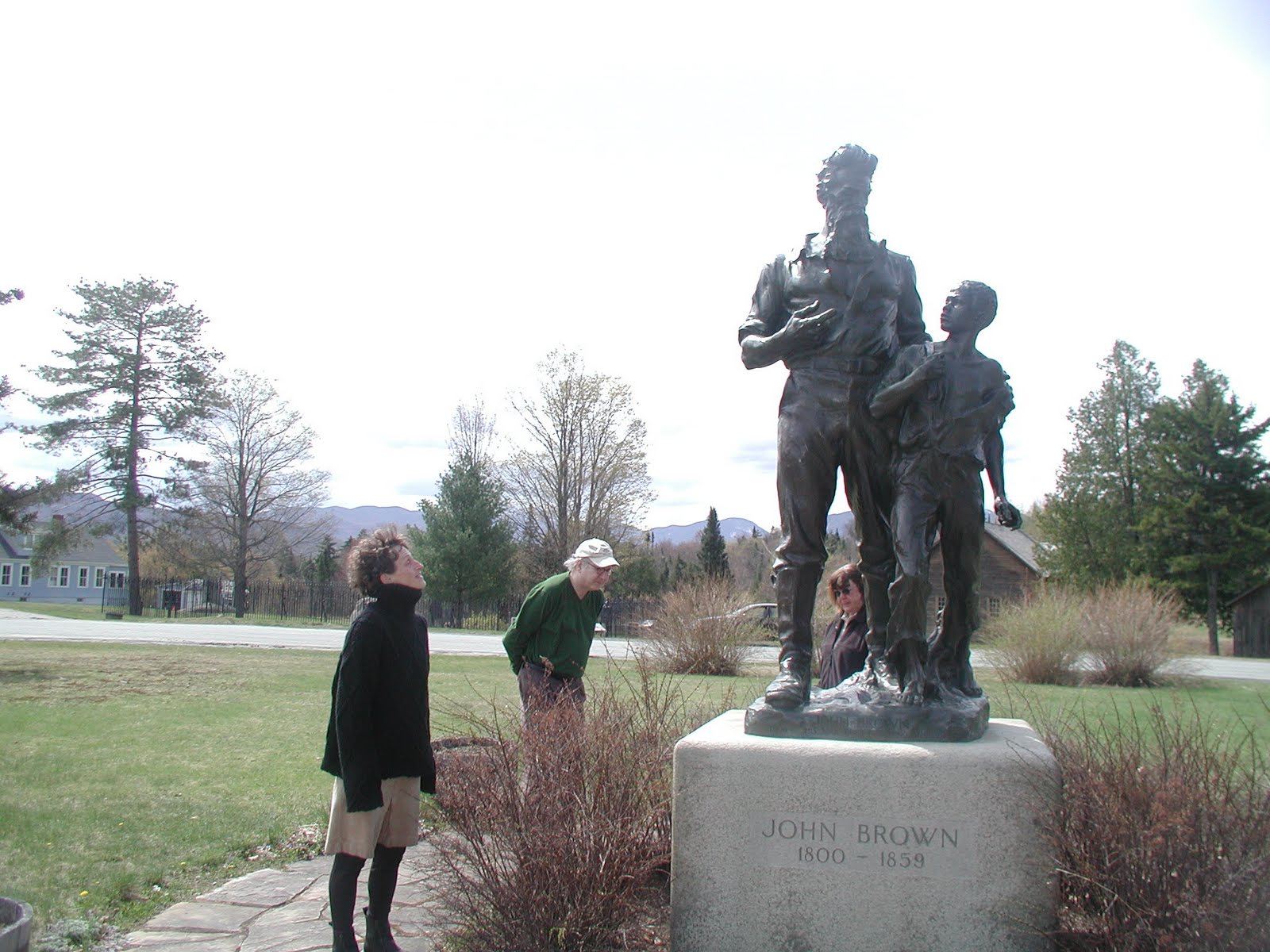
The Bodies of John & Mary Brown's Fallen Sons Were Withheld by the State of Virginia
Communications from Jean Libby and Yours Truly
In Spring 2010 the Historical Society of Pennsylvania (HSP) published an online exhibition of John Brown materials in cooperation with The Library Company of Philadelphia. The letters exchanged between Mary A. Brown (21 November 1859. 109) and Governor Henry A. Wise (26 November 1859 115 ½ ) are digitally reproduced.
The historical significance of these letters cannot be overstated. Mary, in her own handwriting and, as HSP states, apparently on her own initiative, asks that the “mortal remains of my husband & his sons may be delivered to me for decent & tender internment among their kindred.” Wise replies, “Sympathizing [the HSP has mistranscribed this word as ‘Sympathy’ in their exhibition text] as I as do with your affliction, you shall have the ‘exertion of my authority and personal influence to assist you in ‘gathering up the bones of your sons and your husband’ in Virginia…” The letter states there is an order enclosed “to Maj. Gen. Taliaferro, in command at Charlestown, Va., to deliver to your order the mortal remains of your husband “when all shall be over” to be delivered to your agent at Harper’s Ferry, and, if you attend the reception in person, to guard you securely in your solemn mission.” The problem is that the HSP states that [Brown’s] “His body and the bodies of his sons were released to his wife for internment on the family homestead.”
Many of the documents in the Dreer Collection were published in the Calendar of Virginia State Papers in 1893. They were used in John Brown’s trial. Some had been published in the Baltimore papers just after John Brown’s raid. These are the famous carpetbag documents. Both Governor Wise and Andrew Hunter put out a call for their return to Virginia authorities for use in the trial while they were appearing in the newspapers.
Eric Ledell Smith, Associate Historian at the Pennsylvania State Museum and a member of the Board of Directors at HSP, researched and wrote “Finding the Carpetbag: Documents in the Dreer Collection at HSP” John Brown’s Family in California, which I edited and published as Allies for Freedom publishers in 2006. Eric correlated the publication of the documents in the Dreer Collection with the Baltimore newspapers and the Calendar of Virginia State Papers. The list and notes you see here are from his original manuscript. He added the other locations for the published version. My friend Eric Ledell Smith died in Harrisburg in June, 2008.
Louis A. DeCaro, Jr., a John Brown biographer and a recent guest speaker for HSP, has contacted the people there with recommendation for revision of their online history. Another person who could be someone who works with HSP in a diplomatic way and organize the history is Hannah Geffert, who is from Philadelphia and visits there regularly. Hannah lives in Martinsburg and is a retired research professor. She can access the people and archives in West Virginia and even Richmond. I would ask you, Hannah, if you are willing to organize the HSP education project.
The letter exchange that is published online for the first time is very important to understanding Mary Brown as well as the events of John Brown’s execution. Please notice from the attached listing that the Mary Brown – Governor Wise exchange are #109 and #115-115 ½ on the list. Numbers 116 – 119 in the Dreer Collection list are letters from Governor Wise to Maj. General Taliaferro, in Charles Town enforcing martial law since November 24, 1859. Mary’s letter is dated November 26, the letters to Taliaferro are November 26 and 27. To understand the history, we need to know the content of all the letters noted here. I will order photocopies immediately. I believe that Taliaferro was chosen because he put down an insurrection of enslaved and free African Americans in his home in Gloucester County, Virginia, in the 1830s.
There is a relationship between Taliaferro and one of the Allies for Freedom authors, Judith Grevious Cephas. “Old Man Tolliver” was mentioned as the slaveholder in a family history. That is the pronunciation of Taliaferro by local people even to the present day in Virginia, both black and white. I hope that Judie will be willing to contribute your family history to this study, as well as your thoughts about the meaning of the letters between Mary Brown and Governor Wise.
I believe that Lou DeCaro’s characterization of the Virginia authorities (Governor Wise and Maj. Gen. Taliaferro, local sheriff, judges) as hostile to the request of Mary Brown for permission to claim the bodies of her sons Watson and Oliver as well as her husband after his execution – no matter what the language of the letters to her – is correct. As further evidence, in the transcription of her interview with the New York Tribune reporters following her meeting with John Brown in prison on December 1, 1859 (published on December 3, in John Brown’s Family in California, pages 15-16): “I learn from Captain Moore that she rather repelled all attempts on his part to express sympathy with her under her affliction. She resented the idea that Capt. Brown had done anything to deserve death, or to attaint his name with dishonor…”
In other words, Mary didn’t buy into Governor Wise’s expressions of “tenderness” toward her.
Thank you all for your attention to this complex situation. The Network to Freedom nomination of Mary Brown’s gravesite is planned for July 15, 2010. The sponsoring organization is Allies for Freedom.
Jean Libby
Allies for Freedom
1222 Fulton St.
Palo Alto, CA 94301
415-505-5131 cell
650-618-8603 fax
===============
My email to the Historical Society of Pennsylvania:
It was my great pleasure to have been a guest speaker at the Historical Society of Pennsylvania this past December in conjunction with your John Brown program, and to have been the recipient of your kind hospitality in doing some research as well. In light of our collaboration, perhaps you will not mind me calling something to your attention regarding your website exhibit.
Jean Libby, one of our foremost John Brown scholars, has recently pointed out something that is historically inaccurate, and had I noted it earlier myself, I would have felt obliged to mention it. The problem pertains to the narration provided in regard to your on-line display of the correspondence between Mary Brown and Gov. Henry Wise of Virginia. Your website exhibit reads the following:
True to his word, arrangements were made for Mary Brown to meet the body of her sons and husband at Harpers Ferry. In another letter from the collection, Governor Wise sent orders to Maj. General William Booth Taliaferro to protect John Brown’s mortal remains from mutilation while en route from Charles Town to Harpers Ferry.
As to accuracy, the first sentence in this excerpt is incorrect; the second sentence, which states that Brown's remains were protected from mutilation, further highlights the error of the previous statement. In fact, it is not the case that the bodies of Brown's sons were returned to Mary Brown when she and her companions came to Virginia at the time of his hanging. Oliver Brown's body was interred with the bodies of other of Brown's slain raiders and was not returned North until these remains were found and disinterred decades later, and then reinterred at the Brown farm in North Elba, Lake Placid, N.Y. The body of Brown's other slain son, Watson, was taken by Virginians and used by medical school students, quite contemptuously, for experimentation and display. Watson's displayed remains were later seized by a Union officer during the Civil War, taken to Indiana, and subsequently taken by the family for interment at the Brown farm.
Finally, based on the letter from Wise that you have displayed on line, the Virginia governor acknowledged Mary's request to have the bodies of her husband and sons, but only consented to order the body of her husband handed over. So while he was "true to his word," he did not fully grant Mary Brown her request and gave no explanation as to why. As we may observe with regard to Brown's shabby trial and rush to the noose, the "gallant" Virginia treatment that he received had only the veneer of civility and Christianity. Wise feels he cannot deny Mary absolutely, so he hands over the Old Man's body; but he deliberately denies her the motherly comfort of burying her sons. This was neither a Christian nor a gentleman. I find slight satisfaction in knowing that Wise and his family were run out of their Virginia home during the Civil War, and that a portrait of Brown was placed on the wall of his former parlor by some thoughtful abolitionists.
Thank you for your consideration.
Yours truly,
Rev. Louis A. DeCaro Jr., Ph.D.
Student and biographer of John Brown the abolitionist