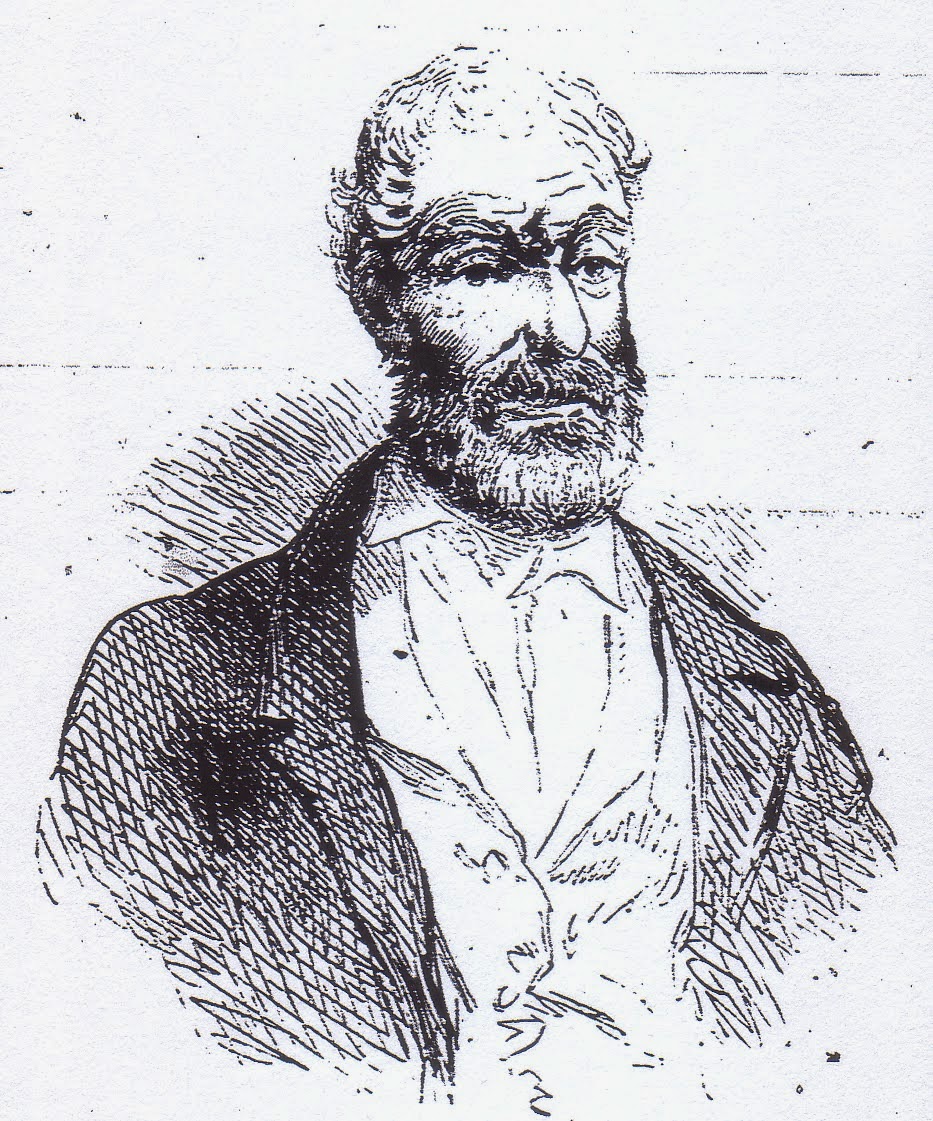
A 19th Century Painting of John Brown Recovered, or Nearly So!
 |
| Researcher Judy Sweets |
Actual link: http://www.portals2history.com/p/images-in-questions.html
|
| Researcher Judy Sweets |
 Yesterday's edition (May 15) of The Daily Beast featured an excerpt from Michael Korda's book, Clouds of Glory: The Life and Legend of Robert E. Lee, about the famous Confederate military leader. The excerpt reportedly "describes how as a U.S. Army officer, Lee adroitly quelled John Brown’s 1859 insurrection at Harper’s Ferry." The excerpt is fairly well done and Korda is fair to Brown for the most part, although the title of the article, "When Robert E. Lee Met John Brown and Saved the Union," doesn't make much historical sense. Lee indeed met Brown as the commanding officer of the marines who defeated the abolitionist at Harper's Ferry in 1859. Beyond that, Lee lent his considerable abilities to the slaveholders' rebellion, helping to worsen civil conflict as a military leader.
 |
| Unidentified artist's rendering of Brown in Kansas, 1856 |
For three years, from 1855 through 1858, a group of Free Soilers under the “command” of “Captain” Brown (or “Osawatomie Brown,” as he was called after his heavily fortified Free Soil settlement) fought pitched battles against “Border Ruffians” (as the pro-slavery forces were known by their enemies), in one of which his son Frederick was killed.
Harpers Ferry, Sunday, October 16, 1859
Sketch of Brown, Oct. 1859, in
Frank Leslie's Illustrated News
Shortly after eight o’clock at night, having completed his preparations and his prayers, a broad-brimmed hat pulled low over his eyes, his full white beard bristling like that of Moses. . .
Brown now had thirty-five hostages and possession of the armory, but the slave uprising on which he was counting did not take place, and during the night, one by one, things started to go wrong.
[J.E.B.] Stuart got along well enough with his old opponent from Kansas— except for their difference of opinion about the legitimacy of slavery, they were the same kind of man: courageous, active, bold, exceedingly polite, and dangerous.
 |
| Artist's rendering of the Stuart-Brown parley at Harper's Ferry |
Green took the bent weapon in both hands and beat Brown around the head with it until the old man collapsed, blood pouring from his wounds.
 |
| Marine Israel Green, who tried to kill John Brown and later revised the story as a "capture" |

 Korda says that twelve of Brown's men died at Harper's Ferry. The actual number was ten. Seven more were hanged and five escaped.
 |
| Margaret Washington, author of Sojourner Truth's America |
 |
| Bonnie Laughlin-Schultz |
 Birthday Greetings--
 |
| LouMike & Norman Strike a Pose |
 |
| Yours truly with JB Smokehouse Owner and JB enthusiast, Josh Bowen |

 |
| Courtesy of Allies for Freedom |
There are 12 previously known portraits of John Brown, 5 of which are daguerreotypes. This particular daguerreotype has been analyzed by noted Brown scholars Jean Libby, and Louis A. DeCaro, Jr., in collaboration with Hudson Library archivist Gwen Mayer and Brown illustrator John Hendrix. All have concluded that this is the 13th portrait of the militant abolitionist.
The identification is based on specific physical attributes that correspond to Brown's physical demeanor (his hairline, forehead creases, and nose). Libby, a John Brown scholar, specifically cites "the significant marker of a chevron hair loss near the middle of his right forehead" as a telling identifier. Libby also indicates that Brown's suit appears to be the same item of clothing he wore in two other portraits.
 |
| Brown's gold stud (Harvard University) |
 Some have expressed skepticism due to the evident wear-and-tear of the man's face. In some respects, the man in the new daguerreotype appears older than a man in his early fifties, as Brown would have been at this time. However, some of the facial features follow the same lines that are evident in known Brown daguerreotypes. Furthermore, it may be that this image reveals stress and fatigue, which would have been the case for Brown at this time of seemingly endless legal disputes, tiring travel, and frustrating loose ends of litigation.
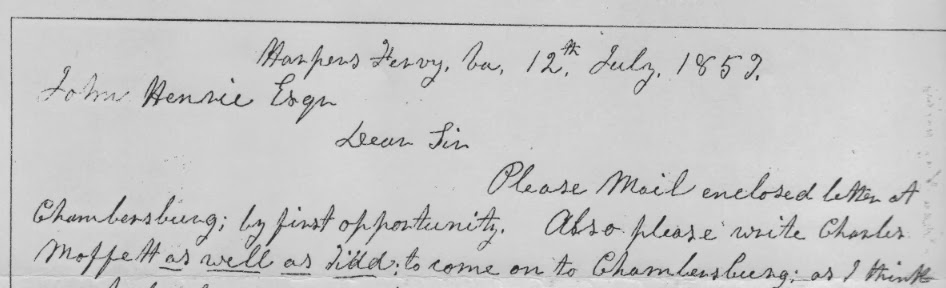 |
| Excerpt, Isaac Smith [John Brown] to John H. Kagi, 12 July 1859 (Historical Society of Penn.) |
"Please write Charles Moffett as well as Tidd, to come on to Chambersburg, as I think we shall be ready for them as soon as they get on. . . ." John Brown
 |
Murry Moffett, Jr. holding court at the Moffett homestead
(Collection of H. Scott Wolfe)
|
“Grandpa built this here house about 1879, a year after he lost his entire herd of hogs to cholera. Every stick of lumber had to be hauled by horse and wagon from Iowa City, for there was not a tree to be found out here on the prairie. It replaced the log house that he and Grandma built in 1860, right after they got married. . . .”
 |
| Portrait of a Young Researcher |
 |
Charles Wesley Moffett (seated at center) with his
surviving Kansas comrades, Topeka, 1882 (Kansas St. Hist. Soc.)
|
 |
Carousing at Rube's in Montour, Iowa (l to r)
Murry Moffett, Jr. & wife Carole,
Alice Olds Wolcott and the author
(Collection of H. Scott Wolfe)
|
 |
The Moffett homestead, ca. 1905; Emma Manfull (holding the horse),
the widow of Charles Wesley Moffett; next to her is her son,
Murry Moffett, Sr., the father of "my" Murry
(Collection of H. Scott Wolfe)
|
 |
The wallet of Charles Wesley Moffett
(Collection of H. Scott Wolfe)
|
 |
"John Brown, Right or Wrong?"
clipping from Moffett's wallet
(Collection of H. Scott Wolfe)
|
 |
"Old John Brown" clipping
from Moffett's wallet
(Collection of H. Scott Wolfe)
|
War again threatens Kansas and we expect every day to bee [sic] warned out to meet its call. All we have say is god Speed the day. there is now about 30 or 40 thousand inhabitants in kansas of probably 2000 would turn out to fight, the rest would be peace men, money lovers, fence riders proslavery men.2
 The young man's analysis of Kansas affairs was precise. Not only was the proslavery faction determined to force slavery upon the majority of "free state" settlers, but the majority of "free state" people were largely passive, fearful, or unwilling to take a strong stand against slavery. It is historically false to assume that "free state" people were the equivalent of abolitionists, and later it was clear that many "free state" people wanted Kansas to enter the union as a "free state" without slaveholders or black people! Young Brown was optimistic about fighting the proslavery forces, but knew that the majority of "free state" people could not be counted on, something that his father clearly observed with frustration.

 |
| "The Puritan" |
 |
| "The Puritan" |
 |
| Brown |

 |
| Artist Jacob Lawrence recalled Brown's 1859 Missouri rescue in his series, The Legend of John Brown |
 |
| Mary A. Brown |