The Research & Writing of Louis A. DeCaro Jr.


"The world needed John Brown and John Brown came, and time will do him justice." Frederick Douglass (1886)

Search This Blog & Links

Translate

Friday, August 15, 2014


Checking in--
Sorry to Neglect You. . .

I apologize to the friends of this blog for my absence, which was supposed to be brief, but unfortunately has proven far longer.  Just so you have a pulse from me, I thought I'd post a few small items, and hope that I can get back to you with something a bit more substantive over the next week or two.

"Hell on Wheels"--A Brief Homage to the Old Man

Perhaps you caught the most recent installment of "Hell on Wheels," the dramatic series on AMC based upon the development of the transcontinental railroad following the Civil War (now in its fourth season).   The series annoyed me from the start, when one of its first season characters was a lunatic preacher, Reverend Cole (played by Tom Noonan) who rode with John Brown, and who ultimately acted just like the mythical John Brown that white people like to put forth in popular narratives.   Fortunately, Reverend Cole was killed off in the series, although his daughter Ruth (played by Kasha Kropinski) continues to keep a church amidst so many wild, godless railroad men.

This is a snippet, passingly recalling the fictional Cole's association with the Old Man. (Sorry it was recorded with an iPod, handy but the sound is hollow.)  However, it's different, perhaps due to the scriptwriter, who presents this conversation between Ruth and Psalms (played by Dohn Norwood), one of the leading railroad workers among the freemen.  It's interesting, especially the subtle smile in Psalms' expression when he invokes her father's association with John Brown.  Even six degrees of separation between Brown and a freeman in the 1860s would suggest a warm undercurrent.  The admiration for Brown that Norwood so skillfully conveys in Psalms' expression is probably the most authentic reference to the Old Man as portrayed yet on "Hell on Wheels."  Ruth's response is interesting too, but I'll leave you to debate that amongst yourselves.


West Virginia's Big Story

On another note, here's a link to an article by our friend, Naj Wikoff, in today's (Aug. 15) Lake Placid News, about a documentary maker with an interest in West Virginia history.  Lemuel Muniz's documentary about West Virginia necessarily includes an interest in John Brown, and I look forward to talking to him in the near future.

Bookwise

Keep your eyes open for Steven Lubet's next big offering on the John Brown story, namely a book about the raider, John Anthony Copeland, that will be published by Cambridge University Press. No spoilers here, folks.  But I can tell you that it will be a first for John Brown students as Lubet brings his strong research and wonderful writing to give us yet another monumental work on the often overlooked raiders (his first being John Brown's Spy, a biography of John Cook)--especially the black raiders.   Save some of your weekly allowance so you can buy it when it comes to press, I hope in early 2015.

Speaking of books, yes, that's what's kept me away from this blog a lot (besides other teaching obligations).  I'm making good progress on my narrative of John Brown's last days in Virginia.  It is going to be published by Rowman & Littlefield, and likewise will be the first of its kind.  All of Brown's biographers, including me,  have only sampled from Brown's last days in our books. This book is about John Brown's last days.  BTW, I've got another book on Brown following on its heels by the same publisher, but more about that later. . . .

Okay, that's it for now, friends.  As the Old Man would say (quoting Oliver Cromwell), trust in God and keep your powder dry. 


Sunday, June 01, 2014

Take Note--
Alice Keesey Mecoy, John Brown's 3x Great Granddaughter

For three days in June 2014 Alice Keesey Mecoy, great-great-great

Grand Daughter of abolitionist John Brown will walk at the same places as did her ancestor. Mecoy will speak at Peterboro Civil War Living History Day on Friday, June 13. On Saturday, June 14 at 11:30 a.m., Mecoy will present New York to Harper's Ferry - John Brown's Journey, the historical account of John Brown's resolve to end slavery. On Sunday, June 15 at 11:30 a.m. Mecoy will share Life after the Hanging of John Brown - A Family's Legacy, the history of his wife and children, especially the women, after Brown's hanging and the war. Mecoy has researched her family history since 1976 focusing primarily on the women in John Brown's life, whose dedication and sacrifices contributed greatly to the war against slavery. Mecoy has compiled a comprehensive Brown family genealogy of 4000 names in a database from John Brown's father Owen to descendants born in the current year. It was Mecoy who chaired the reunion of the Brown family for the Sesquicentennial of the Raid at Harpers Ferry. 


The National Abolition Hall of Fame and Museum will host Mecoy's programs at its home in the Smithfield Community Center, 5255 Pleasant Valley Road, Peterboro NY during the 22nd Annual Peterboro Civil War Weekend June 14 & 15, 2014. John Brown was selected by abolition scholars to be inducted into the Hall of Fame in 2009. Mecoy spoke during Brown's Hall of Fame commemoration in 2010.

Source: Civil War Weekend 2014 bulletin.  See http://civilwarweekend.sca-peterboro.org/
Also see The website of the National Abolition Hall of Fame

Alice Keesey Mecoy Interviewed on Extreme Genes

Alice Keesey Mecoy, our friend and associate in the John Brown community, happens to be one of the Old Man's direct descendants (through the line of John Brown and Mary Day Brown's daughter Anne Brown Adams).  She reports on her blog, John Brown Kin, that she was recently interviewed on the podcast, Extreme Genes Family History Radio.  Here is a link to the interview, which starts at 23:00.

Saturday, May 24, 2014

Reference--
A 19th Century Painting of John Brown Recovered, or Nearly So!

Researcher Judy Sweets
Judy Sweets is a researcher, historian, and genealogist, and has found two interviews from the early 20th century with an artist named Jeremiah Greene.  According to these interviews in the Cleveland Leader, "Jerry" Greene made a portrait of the Abolitionist based on a daguerreotype--the likely one being identified in the same feature with the assistance of Jean Libby.  I am once again appreciative of Libby for introducing me to Sweets, who has written about Greene on her blog, Portals2History.   Sweet's article, along with images of Greene and his portrait of John Brown, are found under the category, "Images in Question." Unfortunately, the actual portrait by Greene has not yet been recovered, although we hope it may yet turn up.

Actual link: http://www.portals2history.com/p/images-in-questions.html

Friday, May 16, 2014

Take Note--
John Brown in Clouds of Glory

Yesterday's edition (May 15) of The Daily Beast featured an excerpt from Michael Korda's book, Clouds of Glory: The Life and Legend of Robert E. Lee, about the famous Confederate military leader.  The excerpt reportedly "describes how as a U.S. Army officer, Lee adroitly quelled John Brown’s 1859 insurrection at Harper’s Ferry."  The excerpt is fairly well done and Korda is fair to Brown for the most part, although the title of the article, "When Robert E. Lee Met John Brown and Saved the Union," doesn't make much historical sense.  Lee indeed met Brown as the commanding officer of the marines who defeated the abolitionist at Harper's Ferry in 1859.  Beyond that, Lee lent his considerable abilities to the slaveholders' rebellion, helping to worsen civil conflict as a military leader.
Unidentified artist's rendering
of Brown in Kansas, 1856

The excerpt from Korda's book has several errors that should be corrected:
For three years, from 1855 through 1858, a group of Free Soilers under the “command” of “Captain” Brown (or “Osawatomie Brown,” as he was called after his heavily fortified Free Soil settlement) fought pitched battles against “Border Ruffians” (as the pro-slavery forces were known by their enemies), in one of which his son Frederick was killed.

This tends to distort the basic facts of the narrative.  Brown arrived in Kansas in October 1855 and did not become involved in any militant action until the spring of 1856, when it was clear that proslavery forces would not honor the democratic process, but had increasingly turned to the use of terrorism.  Nor did Brown consistently command men for the three-year period described by Korda.  After significant crises and conflict in the field, Brown left the territory in late 1856 with the reputation of a Kansas freedom fighter.  He was absent from Kansas throughout almost the entire year of 1857, and spent only about one month there from November to December.  After his Virginia plan was nearly betrayed, he returned to Kansas in June 1858 in order to throw off any notion that he was planning his attack in Virginia.  Back in the territory, he interacted with free state leaders, sought to support free state settlers, and evaded capture.  Brown remained in the territory until rescuing eleven enslaved people in December, and escorting them across country to Canadian freedom (Dec. 1858-Mar. 1859).  Brown's son Frederick was not killed in a battle or skirmish, but was murdered near his home by some proslavery scouts in August 1856.
Harpers Ferry, Sunday, October 16, 1859
Sketch of Brown, Oct. 1859, in
Frank Leslie's Illustrated News

Shortly after eight o’clock at night, having completed his preparations and his prayers, a broad-brimmed hat pulled low over his eyes, his full white beard bristling like that of Moses. . .
This is Korda's description of Brown at Harper's Ferry in October 1859.  By way of description, Brown did not wear a "broad-brimmed hat."  One witness says he was wearing a soft fur cap, probably the same cap that has been described in accounts of Brown from Kansas.   More important, Brown's beard at Harper's Ferry was closely cropped.  He had grown his famous beard long as late as the spring of 1859, as visible in his most famous daguerreotype.  But in the South, he cut his beard short, as can be seen in the contemporary newspaper sketch of Brown that was made after the raid.
Brown now had thirty-five hostages and possession of the armory, but the slave uprising on which he was counting did not take place, and during the night, one by one, things started to go wrong.
 Following conventional notions of the raid, he mistakenly writes that Brown was counting on some sort of "slave uprising" to take place.  This was the claim of slaveholders, but in actuality, Brown had no intention of sparking an uprising.  Historically, uprisings typically involved insurrectionary violence and the killing of slave masters and their families.  Brown had no such idea.  There is ample evidence that he intended to draw away enslaved people from their masters, retreat to the mountains, and fight only in self-defense when pursued or attacked.  His plan was not insurrection or uprising, but to destabilize slavery and upset the economy of slavery sufficiently to allow for enslaved people to establish a guerilla nation out of reach of slave patrols and U.S. military acting on behalf of slave holders.
[J.E.B.] Stuart got along well enough with his old opponent from Kansas— except for their difference of opinion about the legitimacy of slavery, they were     the same kind of man: courageous, active, bold, exceedingly polite, and dangerous.
Artist's rendering of the
Stuart-Brown parley at
Harper's Ferry


Korda describes how Stuart was present at Brown's defeat at Harper's Ferry and had delivered Robert E. Lee's demand for surrender.  To the contrary, Stuart did not get along with Brown.  At the time of the raid, there was no significant exchange between Brown and the future proslavery rebel leader.  After Brown's defeat and capture, Stuart proved to be a sniping, sarcastic, vindictive, and verbally abusive captor.  He insulted Brown repeatedly, rudely harangued him during an interview with Senator James Mason, and cursed him.  As the record shows, Stuart may have been courageous, but he was only polite to his ilk, and he was only valiant in the cause of preserving slavery.  Hardly John Brown's counterpart, let alone his equal in any sense.
Green took the bent weapon in both hands and beat Brown around the head with it until the old man collapsed, blood pouring from his wounds.
Marine Israel Green, who tried to kill
John Brown and later revised the
story as a "capture"
As Korda describes the role of Lieut. Israel Green, the marine who allegedly "captured" John Brown at the Harper's Ferry engine house.  It is true that Green beat Brown with his bent dress sword, but the evidence shows that he did not stop when "the old man collapsed."  The evidence shows that Green continued beating Brown after he fell to the ground.  In other words, Green tried to bludgeon Brown to death on the floor of the engine house.  Even Korda points out that Green at first thought he had killed Brown.  According to a letter from Stuart to his mother following the raid, Green afterward was upset that he had not been successful in killing Brown. Historians have relied on Green's revisionist version of his "capture" of Brown, written decades afterward.  However, at the time, it did not go unnoticed by journalists and abolitionists in the North how Green had brutalized the old man.

As noted, the excerpt overall is not bad, especially compared to many things written about Brown. Still, for the sake of the historical record, I point out these issues since there is a great deal of misinformation in popular thinking about the Harper's Ferry raid.  My forthcoming book on the last days of John Brown, which will be published by Rowman & Littlefield, will address these and other hackneyed assumptions that unfortunately have become part of the popular narrative of John Brown.--LD

Addendum
Some Additional Corrections from Historian Steven Lubet 

I am pleased to include input from the notable historian, Steven Lubet, author of a number of books, including John Brown's Spy: The Adventurous Life and Tragic Confession of John E. Cook, and a forthcoming work on Brown's black raiders at Harper's Ferry.  Lubet writes:

As long as we are pointing out minor mistakes, here are two more:

Korda says that twelve of Brown's men died at Harper's Ferry.  The actual number was ten. Seven more were hanged and five escaped.

He also says that Colonel Washington was "delivered to Brown in his own carriage, along with a pair of pistols that Lafayette had given George Washington."  Moving now from the unimportant to the truly trivial, the Lafayette pistols were not delivered to Brown.  John E. Cook had taken only one of the pistols, which he secretly kept for himself.  The other pistol of the pair was left behind, and it was included in Washington's estate and later sold to the New York State Library.  

Saturday, May 03, 2014

Events--

John Brown Day in Lake Placid, May 10

Margaret Washington, author of
Sojourner Truth's America
John Brown Day 2014 is scheduled for Saturday, May 10, from 2 to 4 p.m.  Events will take place at the John Brown Farm State Historic Site in Lake Placid.  Special features include the lecture, "Women and Abolition," by Dr. Margaret Washington of Cornell University. Washington is a leading authority on the abolitionist movement, and the foremost biographer of Sojourner Truth.  Also featured is Dr. Bonnie Laughlin-Schultz [see below], who will lecture on the women in John Brown's family. Admission is free.

Biographer of Brown Family Women to Speak at Lake Placid

Bonnie Laughlin-Schultz
Bonnie Laughlin-Schultz, author of  The Ties That Bound Us: The Women of John Brown’s Family and the Legacy of Radical Abolitionism, was interviewed by Robin Caudell of the Plattsburgh, N.Y. Press-Republican, in regard to her scheduled lecture in Lake Placid for John Brown Day 2014.  “There are a lot of new books on John Brown that always mention the women in his family in passing,” she said.  “You can teach classes about him but the question is what was it like to live with this guy? I have just long been interested in the antislavery movement in the 1830s and 1840s and how they were trying to live out their radical beliefs about racial equality.”

Caudell writes that Laughlin-Schultz tracked the Brown women across the country, from coast to coast, and found one of her important sources the papers of the late Edwin N. Cotter, now held at the State University of New York at Plattsburgh.  “There were a lot of archives to cover,” she said.  Laughlin-Schultz did not end her study at the hanging of Brown in 1859, but continued to trace the lives of Mary Brown and her daughter Anne, long afterward.  Mary Brown and some of her family migrated westward during the Civil War, and the abolitionist's widow died on the west coast as did several of the Brown's adult children.  "Their lives forever were affected by their relation to him, in good ways and bad.”

See Robin Caudell, "The Women Behind John Brown," Press-Republican [Plattsburgh, NY], 1 May 2014

Brown and Tubman Descendants to Speak at
Peterboro, June 14 & 15

Among the events scheduled for the upcoming Civil War Weekend in Peterboro, N.Y., Brown students should note that Alice Keesey Mecoy, great-great-great-granddaughter of the abolitionist will speak at the National Abolition Hall of Fame and Museum in Peterboro. Also featured will be the great-great-grandniece of Harriet Tubman, who will be reading about her Great Aunt's historic role during the Civil War.  The lectures will be presented twice, on Saturday and Sunday, June 14 & 15, at 11:00 a.m.

An entire program of Civil War remembrance is scheduled for both days, from 10 a.m. until 5 p.m.
 
To learn more about this event and the National Abolition Hall of Fame, click on this link.

Monday, April 28, 2014

Birthday Greetings--

Actor Norman Marshall, Portrayer of John Brown


On Sunday, April 27, 2014, veteran actor and John Brown enthusiast, Norman Marshall, celebrated his 75th birthday with family and friends at John Brown Smokehouse in Long Island City, N.Y. As he notes in this short excerpt from his remarks, Marshall has devoted many years to portraying Brown in a one-man play, "John Brown: Trumpet of Freedom," written by George Wolf Reily. Marshall acknowledges Reily in these remarks, along with one of his guests, the activist Lynne Stewart.   Happy Birthday, Norman!

LouMike & Norman
Strike a Pose
Yours truly with JB Smokehouse
Owner and JB enthusiast,
Josh Bowen


Saturday, April 26, 2014

Remembrance--
John Brown Day 2014 at Lake Placid, NY


Events begin on the evening May 6 with a book discussion of "Twelve Years a Slave" at the Lake Placid Library.

The film is shown for high school students with discussion at schools; selected screening and discussion for the general public led by Dr. J. W. Wiley on Friday evening.

Historian Bonnie Laughlin-Schultz, author of The Tie That Bound Us: The Women of John Brown's Family and the Legacy of Radical Abolition, leads a full John Brown Day May 10 with "Engaging Students in Historical Inquiry: Bringing Brown's Raid (and the Raiders) Alive in the Classroom Educator Workshop" at the Heaven Hill Farm from 10 a.m. - 12 noon; at the John Brown Farm from 2 to 4 p.m. historians Laughlin-Schultz and Margaret Washington on "Women and Abolition" followed by Greg Grandin "Brown, Meliville and the Problem of American Slavery."  Other readings and performances will be at the John Brown Farm State Historic Site on Saturday afternoon, May 10--John Brown Day 2014.

John Brown Day 2014 is sponsored by John Brown Lives! a freedom education and human rights project and others; for further information call 518-744-7112 or email info@johnbrownlives.org.

Submitted by Jean Libby, Allies for Freedom
For more information, including the published schedule of events, see the John Brown Lives! facebook page

Friday, April 18, 2014

Image and History--
A New Contender Faces Close Scrutiny

Courtesy of Allies for Freedom
The internet has its share of bogus John Brown daguerreotypes for sale.  Recently, however, one surfaced that has won serious attention from Brown scholars and others with an interest in the Old Man.  The image has recently come to auction by Swann Galleries in New York, picturing a man with a strong resemblance to Brown, well-dressed, with dark sideburns, and even a stud in his collar.  If it is Brown, and there is some reason to believe it is, then this daguerreotype is most unusual, representing a view of the Old Man from a period of his life in between the famous Smithsonian "vow" portrait of the 1840s and the more familiar daguerreotypes made after he had become a prominent Kansas freedom fighter in the late 1850s.

Jean Libby, a John Brown documentary scholar and daguerreotype expert, privately brought this image to my attention some months ago; however, propriety obligated us to say nothing of it until the owner was able to bring the image to auction.  My first response to the image was admittedly skeptical.  The dark sideburns had no precedent and seemed alien.  However, the longer I pondered over the image, the more I thought perhaps the daguerreotype might be a worthy contender.  The more I looked at it, the harder it was for me to dismiss it, although at the same time I had retained uncertainty.

Under these circumstances, I thought I might quietly share it with someone else who has paid a great deal of attention to Brown's image.  So I sent a digital copy to the illustrator, John Hendrix, whose young people's book, John Brown: His Fight for Freedom, entails an extensive and brilliant rendering of Brown's images.  Hendrix greeted it positively, particularly noting the hairline as being consistent with other known images of Brown. Heartened by Hendrix's comments, I relayed a positive response to Libby--although I had no idea that the three of us would be "scooped" by Swann's Gallery.  Last month, an associate called my attention to a notice of the image being auctioned on the website Auction Zip, the posting of which even surprised Libby.

As noted, Swann presented the following description, reflective of the feedback relayed through interaction with Jean Libby and her discussions with me and Gwen Mayer, archivist at the Hudson Library and Historical Society, as well as what I relayed from Hendrix:
There are 12 previously known portraits of John Brown, 5 of which are daguerreotypes. This particular daguerreotype has been analyzed by noted Brown scholars Jean Libby, and Louis A. DeCaro, Jr., in collaboration with Hudson Library archivist Gwen Mayer and Brown illustrator John Hendrix. All have concluded that this is the 13th portrait of the militant abolitionist.

The identification is based on specific physical attributes that correspond to Brown's physical demeanor (his hairline, forehead creases, and nose). Libby, a John Brown scholar, specifically cites "the significant marker of a chevron hair loss near the middle of his right forehead" as a telling identifier. Libby also indicates that Brown's suit appears to be the same item of clothing he wore in two other portraits. 
I would have preferred if Swann had written "tentatively concluded," since there are a number of issues to be addressed before taking a firm stance on this being a long-lost image of John Brown the abolitionist.  Certainly I disagree with those who have dismissed this image outright.  If this image is not of John Brown, then one would say the man in the daguerreotype highly resembles him.  This is more so the case if, as Libby first suggested, the photographer has provided a "real life" view of Brown by reversing the original daguerreotype (since daguerreotypes present a reverse image).

While I am not prepared to die for this new image being that of John Brown, I believe that it cannot be easily waved off, as has been the manner of some skeptics.  There are bogus images that merit immediate dismissal--for example, the seller on eBay hawking a supposed collection of Brown family daguerreotypes, and the Kaplan Collection's supposed daguerreotype of Brown. Neither of these is genuine despite the owners' claims, and it doesn't take a forensic specialist to see that they are not true Brown images.  I do not think the same easy conclusion can be made of the Swann image.

On the other hand, the image should only hold a tentative place alongside the "canon" of extant Brown daguerreotypes until or unless some criteria can be satisfied.  While it is not a bogus image, it is a questionable image, and that status will not change unless the owner, in conjunction with a reasonable number of Brown scholars and researchers, (1) can prove some provenance for the image, and (2) the original image has been examined and evaluated by professional forensic specialists.  We all would like to believe that we have an eye for such things, and it is reasonable to trust your own eye.  But since there are a number of approving and disapproving eyes in this case, the scale needs to be tipped by more weighty evidence.

Jean Libby has already begun to take action on the matter of provenance.  We anticipate that her research over the next six months will continue to provide greater insight into the origin of the image.  As it stands, it is certainly an original daguerreotype, circa 1850, made by an unknown photographer, with the imprint of Martin M. Lawrence on the mat.  Libby says the daguerreotype can be traced to Albany and/or Troy, New York.

Brown's gold stud (Harvard University)
While this information is skeletal, it may show some promise. In the early 1850s, Brown had relocated his family to the Adirondacks, but he was still frequently occupied downstate regarding lawsuits involving his former wool commission house operation in partnership with Simon Perkins Jr.  Libby says the suit of the subject in the daguerreotype resembles the clothing worn by Brown in known daguerreotypes.  I have added that the subject of the new daguerreotype is wearing a stud in his collar, and interestingly John Brown owned a gold stud with a "B" set with chip diamonds, now in the Lincoln Collection at the Harvard University Library.

The man in the daguerreotype is well dressed and looks more like a businessman than a Kansas guerilla, and rightly so.  In the early 1850s, Brown was a "suit and tie guy," and although his efforts on the wool market had failed, he had tasted some success.  Historians have short-changed him on this front.  I have demonstrated in John Brown--The Cost of Freedom that in the later 1840s, he had established a national reputation for his knowledge of fine sheep and wool; he certainly was considered a respected and honest businessman wherever he worked.  Practically speaking, he would hardly have gone to court dressed like a farmer, and in the more hopeful years of his wool commission operation in Springfield, Mass., Brown acquired a few trappings of bourgeois success--like a walking stick and a gold stud, both of which are recorded in history.

Some have expressed skepticism due to the evident wear-and-tear of the man's face.  In some respects, the man in the new daguerreotype appears older than a man in his early fifties, as Brown would have been at this time.  However, some of the facial features follow the same lines that are evident in known Brown daguerreotypes.  Furthermore, it may be that this image reveals stress and fatigue, which would have been the case for Brown at this time of seemingly endless legal disputes, tiring travel, and frustrating loose ends of litigation.

Then there is the question of whether we are not used to seeing him in digital reproductions rather than studying original images, so that perhaps our perception of his face has been shaped more by derivative image.  Certainly, we are used to seeing Brown's face in reverse, as this is the case with all daguerreotypes.  Secondly, we have no image of Brown facing the lens at this angle.  His sons facetiously referred to him as resembling both a "meat-ax" and a "bird of prey," and this image certainly presents this effect.   On the other hand, I'm a little doubtful about the ear of the man in the daguerreotype. I'm not entirely sure the shell of the subject's ear is sufficiently similar to Brown's ear in other images.   However, all of this speaks to the need to have this image evaluated by forensics specialists.

The image came under the hammer the other day at Swann's, although I understand it was not sold.  I have little knowledge of such matters, but it might be that the right buyer simply was not present, or more likely that there is not sufficient certainty among collectors that this is indeed a John Brown image.

If there is doubt, it is reasonable.  The canon of Brown images is well known.  According to Jean Libby there are twelve daguerreotypes of Brown ranging from the late 1840s to 1859, the last being the most famous and only image of him with a beard.  She is perhaps more confident, but I have no doubt that she retains sufficient objectivity in searching out the background of the image. Readers can visit her website, Allies for Freedom, in further consideration of what is known so far.

If this daguerreotype is John Brown, then it is reasonable to ask, "Why hasn't it been included in the canon of images over 150 years?"  Were we dealing with textual documents, we would be similarly skeptical as to how such an important item had evaded the attention of scholars, collectors, and researchers over a century-and-a-half.  Still, it is not impossible for this to happen with documents too.  In 2013, a long overlooked and unknown letter by Brown to a newspaper editor in Charlestown, dating from November 1859, surfaced on auction. It is not only authentic but has added insight into the story of Brown's incarceration in Virginia.  The same might be true of this daguerreotype.  It may be the only image we have of John Brown linking the 1840s with the later 1850s.   On the other hand, it may simply be the image of a contemporary who looked a great deal like him.  I am inclined to believe the former, but as I've said, I choose to remain tentatively positive with regard to this image.

The owner would do well to undertake the expense of having this image evaluated, even by more than one specialist.  Along with further research by Libby and others, this "new" image may yet find its way into the daguerreotype canon of John Brown images.  For now, it must be taken seriously.

Postscript, 30 April 2014


Study is taking shape as public history with documentary research and workshops.  There are pointers to the original sitting ca. 1851 moving from southwestern New York (Syracuse) across the Western Reserve from Erie and Meadville to Cleveland.  You can follow progress at the Allies for Freedom website, www.alliesforfreedom.org.  Participants and opinions welcome.  Please contact Jean Libby, editor@alliesforfreedom.org 

Sunday, March 09, 2014

An Exclusive--
Picking the Pocket of Charles Wesley Moffett: 
A Cherished Reminiscence

by H. Scott Wolfe

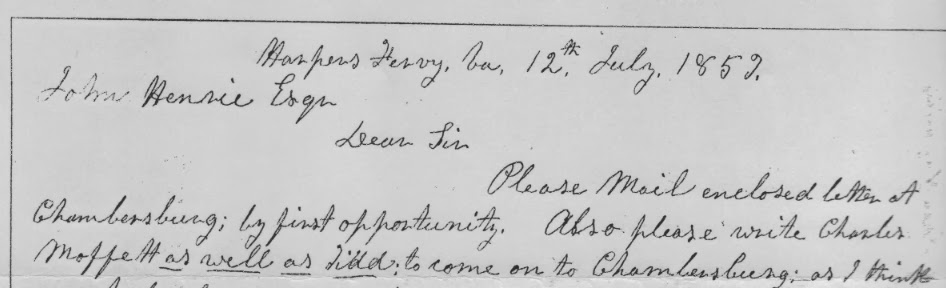
Excerpt, Isaac Smith [John Brown] to John H. Kagi, 12 July 1859
(Historical Society of Penn.)
"Please write Charles Moffett as well as Tidd, to come on to Chambersburg, as I think we shall be ready for them as soon as they get on. . . ."  John Brown 
South of Montour, Tama County, Iowa, Murry and I sat at a table in his farmhouse kitchen, coffee cups filled, an old shelf clock ticking, ticking. A jovial, red-faced man, his bright eyes peering through the tinted lenses of monstrous 1980s eyeglasses, he had the singular appearance of a benevolent owl. His hands, bent and calloused with years of outdoor labor, plucked at his ever-present black suspenders...while he told me the story of the traveling salesman:
Murry Moffett, Jr. holding court at the Moffett homestead 
(Collection of H. Scott Wolfe)
“Grandpa built this here house about 1879, a year after he lost his entire herd of hogs to cholera. Every stick of lumber had to be hauled by horse and wagon from Iowa City, for there was not a tree to be found out here on the prairie. It replaced the log house that he and Grandma built in 1860, right after they got married. . . .” 
“I have to tell you a story,” an impish grin crossing Murry’s face. “Grandpa had a neighbor whose boy was going to medical school. He’d come home summers, and he’d bring with him a cadaver to study on. Well, it come to be that the boy had finished with all the muscles and nerves, and he needed to take off the flesh so as to study the bones.”

“So Grandpa offered him his iron cauldron, which he used to boil hogs during butchering time. So they stoked up a big fire out in our yard, and tossed in the body to loosen things up a bit. There was an arm draped over this way...a leg draped over that way.”

“As Grandpa and everybody stood around watching, lo and behold a traveling salesman came trotting up the lane with his wagon full of wares. Now that salesman took one look at that there cauldron and they say it took an hour for the dust to settle! Never saw a horse run so fast!”

Every time Murry told me this story, he would literally explode with mirth. Tears ran from his eyes, as he vigorously slapped his knees with those calloused hands.   
And before he died in April of 1998, I heard many stories from that Iowa farmer, Murry J. Moffett, Jr. But those I cherish the most were those that dealt with “Grandpa,” Charles Wesley Moffett...who rode with John Brown.

******

Portrait of a
Young
Researcher
In the days of yore, my John Brown research trips and personal vacations were synonymous. I would traverse the country in search of any obscure facts concerning the Old Man and his men.  I would cross the State of Iowa, following the old “Jim Lane Trail,” tarrying at the Free State way station of Tabor, exploring the Nemaha country of eastern Kansas and, finally, taking a hard, wooden chair at the Kansas State Historical Society in Topeka, in order to sift through the John Brown and Richard J. Hinton manuscript collections.
I would sometimes devote a week in the Western Reserve, at Hudson, Ohio, (where John Brown the tanner grew to maturity), exploring the rich Clarence Gee Collection at the local historical society (where Tom Vince and Jim Caccamo then reigned).

Or I might find myself in Lake Placid, New York, sitting over lunch with the late, great Edwin Cotter, Jr., the beloved Superintendent of John Brown’s farm and gravesite. In Ed’s office, beneath the penetrating gaze of de Blezer’s sculpture of the Old Man, we would talk for hours of Brown’s “Provisional Army,” and the story of their exhumation and reburial in what was then Ed’s front yard.

But one journey, to the West Virginia Department of Archives and History in Charleston, lingers in my mind as one that led to a series of unforgettable and cherished experiences. In those prehistoric times, the indispensable Boyd B. Stutler Collection was not available, as it is now, on the ubiquitous internet. In those simple days, when computers were as large as Murry’s chicken coop, I was compelled to drive to West Virginia to examine this, the richest lode of John Brown lore.

I lived for a week out of a Red Roof Inn, taking my meals at a local pancake house. I would commute to the library, past the innumerable refineries spewing who knows what into the foggy atmosphere, and my days were spent in an expansive reading room, poring over cartloads of primary source materials. At that time, my principal interest was raider William Henry Leeman...but anything in regard to Brown’s soldiers would catch my eye. And one morning, such an item suddenly appeared:

Charles Wesley Moffett (seated at center) with his 
surviving Kansas comrades, Topeka, 1882 (Kansas St. Hist. Soc.)
It was a newspaper clipping, taken from the Topeka Capital in 1882. Headed “John Brown: A Reunion of His Surviving Associates,” it told of a meeting held in the rooms of the State Historical Society...a meeting which added “much to the knowledge of the old hero’s character and achievements for freedom.” But what set my alarm bells ringing was the following notation: “The prime mover in the matter was Mr. C.W. Moffett, of Montour, Iowa, who is for a time visiting relatives near this city.”

The article also included what was termed “Mr. Moffett’s Narrative,” which told the fascinating tale of his association with, and recruitment by, John Brown...the winter of military training at Springdale, Iowa...his presence at Brown’s Constitutional Convention at Chatham, Canada West...and his personal explanation as to why he DID NOT join his comrades at Harpers Ferry.

I knew of Charles Wesley Moffett...but I knew very little. Montour, Iowa was immediately circled on an Iowa highway map. And did I hear someone say ROAD TRIP?

****** 

A crisp April morning found me roaming Maple Hill Cemetery, the shiny Montour water tower looming in the distance. My search was, happily, shorter than most. For I soon espied a substantial red granite monument, its summit crested with a block letter “M,” a bold MOFFETT at its base. Surrounding it were a number of individual  headstones, and my eye was immediately drawn to the inscription: CHARLES W. MOFFETT...JUNE 20, 1827...AUG. 19, 1904.  My inner voice proudly announced: “Well, you’ve found another of Brown’s boys!” But then, suddenly, the heart rate accelerated all the more. For before the Moffett stone were strewn clusters of plastic flowers! Now, I am no fan of plastic flowers. But their presence led to two rock-solid conclusions: 1) Someone cares, and 2) That someone may be living close by.

Montour, Iowa, on the edge of the Meskwaki Indian Settlement, will not soon grace the cover of “House Beautiful.” It’s “commercial” district, as I drove down Elm Street, was a strange amalgam of wild west village and auto salvage yard. To this day, the principal industry is “Rube’s Steak House and Lounge,” where one can “grill your own steak and Texas toast.” Actually, the Boston Globe once called Rube’s one of their “eight favorite places in the world.” Unbeknownst to me, I would soon gain an intimate familiarity with that institution.

But I was seeking the United States Post Office, and I soon stood before a squat, red brick building, strongly resembling a Depression-era bank. I almost expected Dillinger to burst through the front door...guns blazing. The postal clerk could not speak. So through a combination of frantic hand signals and hastily scrawled notes, I inquired if any residents of Montour and vicinity carried the surname of Moffett. Again, the stars were aligned...and I received a name and a postal box number. The name was Murry Moffett.

Upon my return home, I penned a polite letter to Mr. Moffett...describing my experiences in the cemetery and the post office...and revealing my fascination with all of those who rode with John Brown. I invited his response, and then returned to such mundane tasks as making a living. And I waited...and waited. At the one-month mark my hopes were rather unsteady but, by exhibiting good behavior and eating my vegetables, I was rewarded with a letter. It did not come from Murry Moffett but, rather, from one Alice Olds Wolcott of Toledo, Iowa.

Alice apologized for her cousin Murry, for he just wasn’t a letter writer. But she introduced herself as the “family historian,” and welcomed my interest in their GRANDFATHER, Charles Wesley Moffett. I know that this intelligence excited me greatly...for the footprints are still visible on the ceiling.
Carousing at Rube's in Montour, Iowa (l to r)  
Murry Moffett, Jr. & wife Carole, 
Alice Olds Wolcott and the author  
(Collection of H. Scott Wolfe)
So did I mention the words ROAD TRIP? 

******

Toledo, Iowa. On that Saturday when I knocked on the door of the modest house on South School Street, I really didn’t know what to expect. But meeting Alice Wolcott exceeded whatever expectations I could have contemplated. If one could design and build the prototype of the dearest, sweetest female mortal on the planet...might I suggest Alice? A slight, silver-haired dynamo of eighty-five, her perpetual smile could be considered the principal factor in creating global warming. 

Before I could open my mouth, lunch was served. We then retired to the living room, where a huge stack of books and manila folders reposed. Within the hour I was aware of the ancestry of Charles Wesley Moffett...of his father Hoshea and his mother Polly Porter...of his birth in Genesee County, New York and his upbringing in Bristolville, Trumbull County, Ohio (where his childhood friend was John Henrie Kagi, John Brown’s future “Secretary of War”)...of his wandering life as a farmer and lead miner (the latter right in my own bailiwick)...and finally, in the spring of 1855, his removal to Kansas with his brothers Erastus and Orlando.
I sat agape, as the Moffett saga rolled off her tongue...until, of course, it was time for her to prepare supper. 

“Alice,” I insisted, “I really should be heading home. I have already taken up too much of your time.”
“Fiddlesticks,” she answered. “I will show you your bedroom.”
“But I...,” is all I could murmur before being shown my accommodations.
“And what can I get you to drink before dinner?” she chirped.

I awoke, sun streaming into the bedroom, the atmosphere redolent of bacon and eggs. The coffee cup was kept perpetually full, while Alice proudly told me how her paternal grandfather...just TWO generations back...had been born in 1776. And then back to the books. She told me of Charles in the Free State militia under Jim Lane...of his service as an election judge in the Shawnee Precinct...and how he barely escaped imprisonment with Kagi and brother Erastus at Lecompton.
The Moffett homestead, ca. 1905; Emma Manfull (holding the horse), 
the widow of Charles Wesley Moffett; next to her is her son, 
Murry Moffett, Sr., the father of "my" Murry  
(Collection of H. Scott Wolfe)
Then I took over, telling her of her grandfather’s activity, or as he called it, “running,” on the Underground Railroad...of his recruitment by John Brown in the autumn of 1857...of his experiences at Springdale and Chatham...and his life in Ashtabula County, Ohio, waiting for the call to Harpers Ferry.  But then I had to go. Leaving Alice with a parting gift of an original copy of Villard’s classic 1910 biography of John Brown, we made tentative arrangements to visit her cousin Murry and the Moffett homeplace. As I drove away, I could only pity those misguided souls who say that history is a boring occupation.

******
The Moffett house, now bereft of its Victorian ornamentation, stood on an east-facing rise, undulating fields of waving corn in every direction. Much, no doubt, the same vista as when that traveling salesman trotted up the lane. It was far from serene, for the honking of geese and snorting of hogs kept you in mind that this isn’t heaven...it’s Iowa.

Murry and his wife Carole ushered Alice and I into their home and we soon surrounded the kitchen table for a serious family talk. Being a former Boy Scout, I had made sure that I came prepared...so a video camera was perched upon my shoulder to record the grandchildren’s commentary upon their notable ancestor. And talk they did...for nearly an hour, recounting much of the family history I had learned during my visit with Alice.  And I had my own questions. For instance: “Was Charles Moffett’s association with John Brown known within the family?” “Oh yes,” was the answer...”but our Grandpa apparently never talked about it much.” 

“And why do you think he was reluctant to speak of his activities with Brown?,” I asked. “Well, the family always thought he feared being prosecuted like some of his friends,” was the response.
I’ve always had my own theory on this topic. I don’t believe that Charles Wesley Moffett feared prosecution. I think he suffered from guilt. For this Provisional Army recruit...one who had joined his comrades throughout the preliminaries in Kansas, Iowa, Canada and Ohio...had succumbed not only to doubts of the wisdom of Brown’s Virginia incursion (He was one of several suspected of writing the “Floyd Letter,” which delayed the Harpers Ferry raid for a year.), he had also succumbed to that most dangerous of emotions...love.

During the winter at Springdale, Iowa, Moffett had met the pretty and vivacious Emma Manfull. And in March of 1859, stranded in Ohio with little news from the Virginia front, Charles, along with fellow defector Luke F. Parsons, headed west...the former to Springdale (where he was eventually to be among the protectors of the fugitive raider Barclay Coppoc), and the latter to test his luck at Pike’s Peak. On the 28th of March, 1860, Charles Wesley Moffett traveled to Tama County, Iowa to marry Emma at her family home. And upon an adjacent property, they were to reside for the rest of their lives.
The wallet of Charles Wesley Moffett   
(Collection of H. Scott Wolfe)

Why was Moffett reticent about his association with John Brown and his men?  Because they went. . . and died . . . and he did not.

The day ended with a trip to Montour’s principal attraction . . . Rube’s Steak House and Lounge. There I joined the family in choosing gargantuan sirloins from the coolers lining the walls...and then grilling our own on a huge charcoal pit in the center of the restaurant. I can assure you, we did it justice. And I distinctly remember a toast...directed to the memory of Charles Wesley Moffett.

******

"John Brown, Right or Wrong?"
clipping from Moffett's wallet   
(Collection of H. Scott Wolfe)
It was during what turned out to be my final visit to the Moffett homeplace that the most touching moment occurred. We had again gathered about the kitchen table...and were again preparing for dinner at Rube’s. Murry had just completed the latest version of the traveling salesman story when Alice approached me with a small package, covered in holiday wrap. “The family would like you to have this,” her face aglow, “we are so happy to see your interest in our ancestor.”  Tearing the paper, a 19th century leather wallet was revealed.  “It was Grandpa’s,” said Alice.

"Old John Brown" clipping 
from Moffett's wallet  
(Collection of H. Scott Wolfe)
When I returned home with my treasure, and began to closely examine it, I found an internal pocket which contained three yellowing newspaper clippings. One was entitled: “Reed an Anti-Imperialist,” which dealt with the war in the Philippines; another was headed “Of Old John Brown, His Son Talks of His Father’s Struggles and Work;” and the third: “John Brown: Right or Wrong?”

One can only speculate on whether Charles Wesley Moffett contemplated this final question, as he worked his farm on the rolling plains of Tama County, Iowa.

This article is affectionately dedicated to my friend Alice Olds Wolcott, born 4 September 1905...died 8 September 1998. Alice, let’s eat.

H. Scott Wolfe

H. Scott Wolfe is the Historical Librarian of the Galena, Illinois, Public Library District and now a regular correspondent and contributor to this blog. As this wonderful piece reveals, he has devoted many years of grassroots research on John Brown, the Harper's Ferry raiders, and related themes.

Thursday, February 20, 2014

Monday, February 17, 2014

The Trolling Incident--
A Cessation of Hostilities

You may have read an earlier notice of an extremely hostile neo-con who was desecrating John Brown's virtual burial site at Find A Grave.   I am happy to report that after some personal exchanges, heated words and vitriol, the troll in question has consented to stop harassing Brown's grave.  It seems all he wanted was some respect, although it seems funny to me that he would demand that after having been so abusive of a dead man's resting place.  Notwithstanding our inability to agree and the blunt differences between us, he proved less a troll and more of neo-con with political gripes stretching from 1855 to the present.  Still, he wasn't beyond reason and so we parted, not as friends, but in something approximating a cease fire.

As Brown would put it, "so we go."

Postscript 19 Feb.--Happily, a subsequent and final round of correspondence allowed for us to enjoy an even more humane conversation and end our exchange in a salutary manner.  There may be hope that this enthusiastic Southern soldier will revisit the John Brown theme in the future with reconsideration.  In the meantime, I am instructed that I have more to learn about negotiation.--LD

Wednesday, February 12, 2014

Brown Family History--
Oliver Brown, John Brown's Favorite Son

Oliver Brown was the youngest son of John and Mary Brown, born March 9, 1839, when the Browns resided in Franklin, Ohio. John Brown's biographer and associate, Franklin B. Sanborn, recalled that the Old Man himself referred to Oliver as "perhaps dearer" to him than any of his other children.1

Kansas!

At sixteen years of age, Oliver arrived at the troubled Kansas territory with his father in late 1855. In February 1856, he wrote home to his mother:
War again threatens Kansas and we expect every day to bee [sic] warned out to meet its call.  All we have say is god Speed the day.  there is now about 30 or 40 thousand inhabitants in kansas of probably 2000 would turn out to fight, the rest would be peace men, money lovers, fence riders proslavery men.2
The young man's analysis of Kansas affairs was precise.  Not only was the proslavery faction determined to force slavery upon the majority of "free state" settlers, but the majority of "free state" people were largely passive, fearful, or unwilling to take a strong stand against slavery.  It is historically false to assume that "free state" people were the equivalent of abolitionists, and later it was clear that many "free state" people wanted Kansas to enter the union as a "free state" without slaveholders or black people!  Young Brown was optimistic about fighting the proslavery forces, but knew that the majority of "free state" people could not be counted on, something that his father clearly observed with frustration.

In late May, 1856, when the onslaught of proslavery thuggery and imminent assault became unavoidable, especially for avowed abolitionists like the Browns, the Old Man struck at key proslavery conspirators in the area of Ossawatomie, resulting in the deaths of five plotters.  This incident has been simplistically reduced to a "massacre" by many historians, although it has all the earmarks of a preemptive strike, particularly in a context where there was no appeal to governmental protection for the Browns and their associates.  Oliver supported his brothers Frederick and Owen in this attack, although he was not one of the killers.  

Connecticut

Oliver returned to the family's homestead in North Elba, NY in October 1856, when the rest of the family also abandoned the territory.   However, unlike his beloved father, Oliver disliked Essex County and did not want to remain there.  The young critic objected to the Adirondack community because its inhabitants were not "a growing, progressive people."3

Following the Kansas episode, then, he sought work in Connecticut, in his family's home state.
Writing from Hartford, the young critic revealed a discerning eye.  In New England, he wrote to his family, there were "two high roads to popularity."  One was "to get rich," while  the other was "through the portals of the church."  Oliver concluded sardonically, that "those who have not wit enough to get rich are usually eminently pious."4  Oliver preferred Connecticut to less developed areas, and found some comfort in being around relatives and extended family.  In a manner reflecting his uneven schooling, he wrote to his family: "I find a great many Cousens [sic] about this town and other friends   Just as good owing to the reputation of the family in Kansas, which serves to make it an agreeable place."5

While working in Connecticut, Oliver found employment with Charles Blair, a blacksmith and forge master in Collinsville.  Blair gave Oliver a one year contract, paying him $200, a "very liberal" salary in that day.  Blair was the foreman of the Collins Company, which produced axes and other tools.  Blair also owned the village of Collinsville, which Oliver described as "a Small place of 50 acres which place I have mostly the charge of".6  Evidently, Oliver had undertaken the general supervision of Blair's farm and property, an undertaking similar to the arrangement that his father formerly had with the Akron magnate, Simon Perkins, Jr. following the demise of their wool venture in 1849.

Furthermore, it seems that Oliver's job was enabled through his father's business arrangement with Blair, in which the blacksmith was to make one thousand pikes, now famously remembered as the weapons he intended to give to liberated blacks in the South.  At the time, of course, Brown conveyed the notion that the pikes were "free state" settlers in Kansas.  "Mr. Blair is now at work making 1000 Kansas butter knifes for Father," Oliver playfully wrote to his mother.7  Assuming that Brown got Oliver got his job with Blair, the appointment probably dated to early March, after Brown gave an antislavery speech and happened to meet the blacksmith.  Brown contracted for the production of the pikes on March 1, 1857.   Meanwhile, Oliver had probably grown edgy and unhappy in North Elba.  According to Sanborn, Brown "regretted that the wild life of the Kansas border had begun to unsettle" Oliver's mind, and he had even inquired about having him enrolled in a military school.8   When this apparently failed, Brown evidently helped Oliver move to Connecticut anyway, at least hoping to satisfy his son's desire to get out of Essex County in the land of his fathers.  But there was another reason that the father sought to help his son.


Martha, with the Blue-Gray Eyes

Despite his contempt for Essex County, Oliver had found one attraction in North Elba that gave him even greater motivation to find gainful employment.  Upon returning from Kansas, he had met Martha Evelyn Brewster, an attractive young woman with blue-gray eyes and light brown hair.  Martha, described as "sedate and dignified," was the teenage daughter of a farmer with a large family and the wrong politics.  Oliver fell deeply in love with "pretty" Martha, and evidently had her move in with his family while he went off to Connecticut to earn money.  Their "love match" was fully realized upon his return from New England, when the two young people married on April 7, 1858.  He was nineteen and she was sixteen years old.9

Evidently, settling into marriage was good for Oliver, who continued working in Essex, caring for his young wife, and increasingly becoming bookish and contemplative.  His sister Sarah later recalled that Oliver was "always preoccupied, absent-minded, always reading."  In these latter years of his short-lived life, he had blossomed.  Sarah believed that Oliver had lost his awkwardness, and now tended to err on the side of "over study."  Mary Brown later remembered her son as being "in advance of his years--a deep thinker--much like his father."10


Farewells Prevailed

In the summer of 1859, John Brown relocated to Maryland under the guise of "Isaac Smith," a farmer and entrepreneur, and rented a farmhouse, which became the headquarters for his planned raid in nearby Virginia.  Since his wife Mary refused to come South, Brown asked his teenage daughter Anne to come and keep house until the fall of the year.  Annie also brought Martha, who joined her husband and father-in-law, along with the gathering raiders in the tight quarters of their Maryland farm.  Anne and Martha remained in Maryland, cooking and housekeeping; the young couple were thus reunited until the young ladies returned to North Elba at the end of September. When they left, Oliver rode the train with his them as far north as Troy, N.Y., and then returned to the South.  When she finally parted from Oliver, Martha was about fourth months pregnant, although sadly he would never again see his wife, nor meet his infant child.11

On the evening of October 16, 1859, Brown invaded Harper's Ferry and failed to move sufficiently in time, becoming bogged down until he was forced to retreat into the armory's fire engine house, a small structure on the margin of the facility.  During the standoff, Oliver was shot and killed, dying in a short time, while his wounded brother Watson lingered in dying.  Separated by hundreds of miles, the imprisoned John Brown and his heartbroken wife would quietly grieve for their lost sons.  However, one of Brown's jail guards remembered the Old Man expressing regret that Oliver had been “so unnecessarily exposed in the battle at the engine house.”12

In February 1860, Martha Brewster Brown gave birth to a girl child, naming her Olive, in memory of her fallen husband.  But farewells prevailed even here.  After three days, the fatherless Olive slipped away.  In March, the sorrowed young widow, left to mourn alone for her young husband and infant daughter, followed them into the shade of mortality.13


Notes

    1 Excerpt from F. B. Sanborn, "Oliver Brown," from Kansas Magazine [Kansas State Historical Society], p. 68, in Oliver Brown folder, Box 6, Oswald Garrison Villard Collection, Columbia University Rare Book and Manuscript Library.  Hereinafter, OGV.
    2  Oliver Brown to Mary Brown, 4 Feb. 1856, trans. in Oliver Brown folder, Box 6, OGV.
    3  Oliver Brown to Martha Brewster Brown, 26 Jun. 1858?, trans.,  Oliver Brown file, Box 6, OGV.
    4  Excerpt letter of Oliver Brown to family, 5 May 1857, trans., in Oliver Brown file, Box 6, OGV.
    5  Excerpt from Oliver to "Dear Folks," 16 May 1857, trans., in Oliver Brown file, Box 6, OGV.
    6  Ibid.
    7  Ibid.
    8  Sanborn, "Oliver Brown."
    9  Katherine Mayo's notes on Martha Evelyn Brewster Brown, from Annie Brown Adams, in Hinton Papers, Kansas Historical Society, Oliver Brown file, Box 6, OGV; Sanborn, "Oliver Brown."
   10 Oswald G. Villard, John Brown (Doubleday, 1910, 1929), p. 683; [James M. McKim], "Mrs. Brown and Her Family," National Antislavery Standard, 12 Dec. 1859, p. 3.
   11 Mayo's notes on Martha Evelyn Brewster Brown.
   12 William Fellows, “Saw John Brown Hanged,” New York Sun, 13 Feb. 1898, p. 2.  
   13 Mayo's notes on Martha Evelyn Brewster Brown.

Thursday, February 06, 2014

"Ready for Another Field of Action"--

Marna Becker, A John Brown Student in Akron, Ohio


Marna Lilliedale Becker, 83, activist, feminist, amateur John Brown historian, Akron-phile and renegade gardener, died Saturday, Feb. 1, 2014. Her interests and activisim were wide ranging and pursued with passion. A short list of her activism interests included work with the National Organization for Women, League of Women Voters, Friends of the Crooked River, Preservation Alliance of Greater Akron, Summit County Historical Society, National Women's Political Caucus, the Sierra Club, the American Association of University Women and others.

She was a 1964 graduate of Heidelberg College with a bachelor of science degree in mathematics and physical sciences. Her employment outside of the home included work with the United Mine Workers, the Census Bureau and the Department of Defense.

Marna worked to make a contribution for a better world. She was much loved and will be greatly missed.

Her life will be celebrated with a memorial service at 3 p.m. Saturday, March 1, 2014, St. Andrew's Episcopal Church, 765 Thayer St., Akron.

Donation to the Preservation of the Abolitionist Movement Fund of the Akron Community Foundation, the Summit County Historical Society or Friends of the Crooked River is a fitting memorial.

Adams Mason Funeral Home and Crematory, (330) 535-9186, is handling arrangements.