The Research & Writing of Louis A. DeCaro Jr.


"The world needed John Brown and John Brown came, and time will do him justice." Frederick Douglass (1886)

Search This Blog & Links

Translate

Saturday, April 07, 2012

Essay--
The Fool as Biographer

(John Hendrix illustration)
John Brown was hated in his life time, especially by pro-slavery southerners and others who resented him for trying to uproot and destroy the status quo of black servitude and exploitation.  While widespread prejudice against Brown is familiar in U.S. culture today, I've become convinced that many of Brown’s critics actually “love” to hate him, which is to say that there is some kind of fascination with him that adheres to popular discourse.  Typically this fascination with Brown is negative—quite the opposite of the Jesse James legend, which is quite unworthily positive.   Meanwhile, the internet is full of random knuckleheads self-assuredly opining about John Brown despite knowing little or nothing about him.  This common contempt for Brown is shallow and reactionary, evidence that many people have been propagandized more than educated.

In contrast, a smaller number of people actually hate John Brown for reasons consciously grounded in an ideological, experiential, and existential commitment to the “values” that typified the advocates of slavery in the antebellum era.  In other words, these critics truly manifest the enmity of the historical white supremacist that John Brown faced in his own lifetime—the same mentality that ultimately required his death.  Such was his most vitriolic enemy of the late 20th century, whose contempt drove him to write a hostile biography.

Otto Scott was born Otto Joseph Scott-Estrella in 1919 and died in 2006, but his writings and videos are still quite influential.  He is widely known and loved by neo-Confederates and ultra right-wing Christians.  Although he is a hero of contemporary Confederate loyalists, Scott also labored greatly on behalf of the interests of the wealthy and powerful in the western world.  It was no exaggeration for the Southern Partisan, the premiere neo-Confederate magazine, to eulogize him as “one of the greatest” conservative writers and thinkers of the Cold War era.1  This was not a man who cared for the plight of the poor and the oppressed, especially in the non-white world, nor could he have cared for those who were their sworn allies like John Brown.

Background

Scott in younger days
Scott served in the United States Merchant Marines during World War II, afterward working in advertising and journalism, although a Wikipedia entry says he worked in journalism in Virginia and California prior to entering the Merchant Marines. Regardless, this path led him to embark on a long career as a published author of various themes as diverse as the histories of the Ashland Oil and Black & Decker Companies, and the stories of Robespierre, James I, and John Brown the abolitionist.  All told, Scott published ten books along with numerous articles in many publications including the Los Angeles Times, San Diego Union, San Diego Tribune, Salisbury Review (London), Conservative Digest, and Human Events.  However, among conservatives, Scott was known for his own monthly publication, Otto Scott’s Compass, a “journal of contemporary culture.”  The latter had a considerable run of fifteen years, ending the year before his death.  One of Scott’s relatives aptly observed that he was “one of a great many Americans who are well-known to a special audience, but unknown to the nation at large.”2  In Scott’s case, his “special audience” was predominantly one of ultra conservative “Caucasians” with interests in the maintenance of the present order of the western world.

Capitalist Ideologue

Throughout his professional life, Scott made a living as both a businessman and as the chronicler of big business.  The anonymous author of the article Wikipedia about Scott notes that between 1954 and 1963, he held three vice-president posts in Globaltronix de Venezuala, Mohr Associates, and Becker, Scott & Associates.  He was also “assistant to the chair” at Ashland Oil Incorporated in the year 1968-69.  Even Scott’s family member acknowledges that he largely made a living “from his corporate biographies.”3  As a bona fide gatekeeper of the status quo, Scott was extremely critical of any real or perceived radicalism and liberal or left-oriented ideas, and was also opposed to any liberation movement that challenged what he upheld as the supremacy of the Christian west.  He was highly critical of the anti-Apartheid movement in the 20th century and bitterly attacked the abolitionist movement of the 19th century in historical terms.

Although Scott became a major didactic figure for ultra-conservatives in later decades, he had already influenced the conservative movement as an ideologue by the later 1960s.  Most notably, he is credited for inventing the phrase, “The Silent Majority,” a term made popular by Republican President Richard Nixon.  According to Wikipedia, Nixon apparently appropriated this phrase from a speech that Scott wrote for the CEO of Ashland Oil entitled, "The Silent Majority" (which was delivered to the Chicago Men's Club on May 23, 1968). 

Alliance with Rousas J. Rushdoony

J. R. Rushdoony
No doubt, Scott’s cachet was further enhanced when he allied himself with the ultra conservative Reformed theologian, Rousas J. Rushdoony, a marginal Calvinist intellectual who similarly influenced President Ronald Reagan’s political ideology.  The two ultra conservative thinkers chaired a radio program and Scott published regularly in Rushdoony’s magazine, The Chalcedon Report.4  Scott’s alliance with Rushdoony was significant for his future lionization among extreme Southern conservative Protestants, some of them neo-secessionists.  Scott, Rushdoony and their type despised the secular North as the vector of liberal abolitionist ideology, the forerunner—in their thinking—of present day liberalism and Left oriented politics and religion.  Scott is said to have had some kind of conversion experience after reading the four New Testament gospels in one night.  However, it is not clear if Scott ever had church affiliation until his final role as “scholar in residence" at the Tri-City Covenant Church in Somersworth, New Hampshire (1998-2004), “where he provided historical insight to the school and church staff and assisted in Sunday School instruction, high-school history, and Bible and economics courses.”5 

Scott and Reconstructionism

Tri-City Covenant Church is a congregation that follows the so-called Reconstructionist (also known as Theonomy or Dominionism) teachings of Rushdoony, Gary North, and others.6  Reconstructionists are like Libertarians with a Calvinistic theological and philosophical orientation, and are hostile toward liberal and Leftist politics.  Reconstructionists are generally distinguished by their belief that the Mosaic Law should be enforced as the law of the land.  For this reason, even conservative evangelicals find Reconstructionists problematic.  In 1996, the conservative Christian activist Ralph Reed wrote, "Reconstructionism is an authoritarian ideology that threatens the most basic civil liberties of a free and democratic society.”7  Richard J. Neuhaus thus appropriately describes Reconstructionism as a “bastard form of Calvinism contending that the American constitutional order must be replaced by a new order based on ‘Bible Law.’” Church historian Carl Trueman concludes that Rushdoony “was historically incompetent, probably racist” and—based upon his use of questionable sources, “probably unhinged” too.8
. . .one can understand why Scott was so embraced by Reconstructionists, especially since he shared their core white supremacist values.
In this light, one can understand why Scott was so embraced by Reconstructionists, especially since he shared their core white supremacist values.  Like Scott, Rushdoony and his colleagues have proven extremely sympathetic to the Confederacy in historical retrospect, just as they defended racist South Africa at the peak of the anti-Apartheid movement.  Anything that smacks of egalitarian or liberationist ideas is understood as rooted in godless ideology to Reconstructionists, and this was well suited to Otto Scott.  Rushdoony and his Chalcedon Foundation proved to be extremely supportive of white Southern nationalism, especially showing proud devotion to antebellum pro-slavery theology.  The Chalcedon Foundation allied with the Alabama-based League of the South in the 1990s, and Scott himself was the featured speaker at the League’s 1995 convention.  He even produced videos for the League dealing with their historical and political reinterpretations of the Civil War and slavery.9 According to the insightful Christian blog, Racist Churches, Scott allegedly pronounced regret over the increasing number of non-whites in congress and also supported racial profiling by authorities.  He uplifted the so-called Caucasian race as the most “essential to the continued progress of world humanity,” and disdained the removal of an interracial marriage ban in post-Apartheid South Africa.  It is also reported that Scott once stood at the grave of Thomas “Stonewall” Jackson in Virginia and declared that it marked “the end of southern civilization.”10 This depraved orientation clearly provides the basis for Scott’s malignant interpretation of John Brown.

A Word About Conservatives and John Brown

Whatever one’s political orientation, it is not a “given” of history that conservatives have categorically despised John Brown.  In fact, he has always had admirers along a range of conservative views.  Certainly John Brown studies was largely carried in the 20th century by two conservative researchers, Boyd Stutler and the Rev. Clarence Gee.  While Gee was probably the more socially thoughtful of the two, Stutler was a hard-nosed right-winger who disparaged the Civil Rights movement of the 1960s as being too extreme.   Notwithstanding this backwards view, Stutler recognized the essential rightness of Brown’s antislavery effort and admired his willingness to die to end human bondage in the United States.  Even “tricky” Richard Nixon, coming from a Quaker background, apparently held a soft spot in his heart for Old Brown. At the time of the United States Bicentennial in 1976, Nixon even made reference to Brown’s words.11  My point is not that the politics of men like Stutler were correct, or that their brand of conservatism was identical to Brown’s political outlook.  However, when it comes to John Brown, conservatism has never been represented by one opinion, and certainly not the opinion of right-wing neo-Confederates.  Furthermore, Stutler would hardly have approved of Scott’s narrative, so replete with political contempt and mean-spirited accusations of Brown and the abolitionist movement.

Scott, Malin, and John Brown

James C. Malin
(Kansas State Historical
Society
)
Scott’s primary source in his own writing is the work of James C. Malin, a Kansas scholar whose book, John Brown and the Legend of ’56, was probably the last significant scholarly effort to flagrantly discredit Brown. Louis Ruchames, editor of the quintessential collection, A John Brown Reader, called Malin “the foremost anti-Brown historian, who seems unable to forgive the North for having used force against Southern secession, or the Abolitionists for having taught that the abolition of slavery would be a step forward for American society, or the Negro for having believed that his welfare would be furthered by the forceful elimination of slavery.”12  Ruchames’ evaluation of Malin sounds quite similar to Otto Scott:

To Malin, minor errors of date or place committed by writers who have a high regard for Brown are frequently labeled deliberate falsehoods, while the errors of Brown-haters are simply unintentional blunders.  Very few anti-slavery leaders and writers emerge unscathed under Malin’s furious onslaught.  Typical of his method are his comments on Emerson, Thoreau, Parker and the other leaders of New England opinion, whom he contemptuously refers to as the “New England Transcendental Hierarchy, the self-appointed keepers not only of New England culture, but, according to their own estimates, of national civilization.”13

In retrospect, Scott not only appropriated Malin’s prejudiced hypothesis, but sought to extend it beyond Brown’s story in antebellum Kansas.  Meanwhile, serious scholars across the board, from conservative Stutler to left-leaning Louis Ruchames, had exposed Malin’s book as flawed and untrustworthy. While Malin’s effort had general value in presenting the hellish mayhem of the Kansas territory, his one-sided, ham-handed treatment of Brown and the anti-slavery side was warped and untrustworthy.14   Yet Scott saw Malin only as “a truly great American historian” and uncritically accepted his problematic book—which he lauded as “a classic of historic investigation and analysis”—because it suited his base politics.  Retrospectively, Scott continued to praised Malin for portraying Brown simply as a “multiple murderer and robber in the Kansas Territory,” even though these allegations were intentionally based upon a selective reading of pro-slavery sources.  In the short term, Malin’s John Brown and the Legend of ’56 gave ammunition to anti-Brown scholars, but soon the author was exposed, his work was discredited, and his scholarly reputation was duly diminished. Scott whined about this too, claiming that Malin’s only crime was that he had “outraged the Academy”—a ridiculous assertion, particularly because prominent historians in the mid-20th century were hardly warm toward abolitionism and John Brown.  To Otto Scott, Malin and his fetid book were the victims of academic “obloquy.”15  In reality, Malin’s work simply was too tainted and biased to be trustworthy.   To this day, no credible historian would use it without exercising extreme care—something that Scott definitely did not do.  In fact, he went on quite uncritically to make the greatest use of Malin’s propaganda for his own anti-Brown screed, The Secret Six: The Fool as Martyr.16  The identity of the “fool,” in Scott’s mind, is easy to surmise.

Scott’s “Sacred Fool Quartet”

Scott’s own treatment of John Brown the “fool as martyr” actually was third in his series known as “The Sacred Fool Quartet”—critical biographies about “extraordinary fools whose follies influenced the course of all our lives,” goes Scott’s claim.  “Without them, history would have been different, and our lives would today be lived along patterns beyond our powers to imagine.”17    Besides John Brown, Scott’s historical fool hunt targeted King James I of England, Maximilien Robespierre and the French Revolution, and President Woodrow Wilson.  Scott thought these historical figures were “sacred” in that society had supposedly conferred a “form of immortality” upon them “irrespective of character.”18  Having fed from Malin’s poisoned plate, Scott’s anti-Brown work thus extended the theme in blanket condemnation of the abolitionist movement, with the particular intention of blaming them for the ruin that befell the South in the Civil War.  Scott thus opined: “The costs of Abolitionist virtue ran high.  Officially the record is 621,000 dead,” he concluded of the Civil War death toll.19 It is difficult to imagine anyone attributing the expansive deaths resulting from the Civil War to the abolition movement without thinking the writer must be a revivified slave master.  But this represents the kind of mind and spirit that animated Otto Scott.

A Publishing Disappointment

Interestingly, the first edition of Scott’s anti-Brown book was published by Times Books, the publishing arm of the New York Times, in 1979.  Although the book was smuggled to press, Scott’s Secret Six nearly proved a Trojan horse to the “Old Gray Lady.”  Certainly, Times Books was an unlikely home for Otto Scott’s anti-liberal screed, except that he had an inside connection with Tom Lipscomb, a business associate who had become the head of the press.  The book was hesitantly published, but it grated upon the legendary Times executive, Sidney Gruson, who rightly observed that it “lowered the tone” of the company.  Fearing that his opus would get buried, Scott pulled the rights of his book, bought back the remaining copies, and donated them to his friend Rushdoony.  Fortunately for Scott, there was sufficient interest and money in the South, and the book was republished eight years later by the Foundation for American Education in South Carolina, possibly a Klan-related organization.  Although Scott lamented that his book had nearly been “murdered” by the “Establishment,” The Secret Six was much more viable than he portrayed.20  Scott may not have had liberal money behind him, but he had right-wing support, especially in a willing audience among neo-Confederates and Reconstructionists.  The book was finally published under another label in 1993, which seems to have been Scott’s own imprint.21

The Legacy of Scott’s Secret Six

Otto Scott died in 2006, but his book continues to feed the same counter-establishment of radical right-wingers, neo-Confederates, and Reconstructionists.  For this audience, The Secret Six is taken as definitive and quoted by unknowing bigots as if it were the last word in historical terms.  Scott undoubtedly knew that he had made a niche for himself with his anti-Brown book; his other “fool” books are extant but rarely mentioned.  In The Secret Six, Scott took the Southern screed to a sophisticated and polished level of argument.  By cynically portraying Brown as a deluded killer in collaboration with liberal New England elites and other subversive figures, Scott affirms the foundational sentiments of neo-Confederates and ultra-conservatives who deeply despise liberalism in government and society, and who resent the national and global changes that are challenging traditional white supremacy in state and church.

It is not my intention to do a book review and in this piece I have preferred to use Scott’s subsequent reflections as published in Southern Partisan, which present his essential argument about Brown and abolitionism as well as background to his research and the publication of the book.  However, there are a couple of points that need to be made in highlighting the fundamental errors of his interpretation. 
Scott demonizes Brown over against the opinion of every credible biographer over the past century.
First, Scott’s bibliography belies the lack of fairness that defines his work, particularly regarding Brown.  Scott demonizes Brown over against the opinion of every credible biographer over the past century.  His narrative not only impugns Brown, but inherently accuses every scholar (including myself) of being a liar and false propagandist by our presentations vis a vis the historical record.  If Scott is correct in his profile of Brown, then Villard, Oates, Stavis, Boyer, Yours Truly, Reynolds, Carton, McGlone, and Horwitz have misread the facts to a significant degree.  Not that all of us agree on every point, and some of us have considerable differences about the Old Man.  Yet none of us have presented Brown and the abolitionist movement in the manner insisted upon by Otto Scott. 

Equally important if not more so, Scott’s work is both selective and derivative.  Like Robert Penn Warren before him, Scott only mined the most negative assertions of Oswald Villard, and otherwise ignored the more positive and balanced aspects of biographers like Villard, Boyer, and Oates.  Otherwise, his work offers nothing new, original, or based on primary research.  From Stutler, Gee, Edwin Cotter, and Tom Vince to Jean Libby, Scott Wolfe, and others (including me), those who have studied Brown extensively over time and in great depth simply do not recognize the John Brown of Scott’s rendering.   Far from being a historical portrayal, Scott’s “fool” is a straw man, a self-serving caricature that suits his prejudices and privileges his political agenda.

Third, Scott diminishes people of integrity who were Brown’s allies and supporters during and after his death.  Besides his obvious criticisms of the “Secret Six” and other “liberal” abolitionist clergymen, Scott essentially calls Frederick Douglass a liar—“disingenuous”—in his testimony about Brown.22

Fourth, Scott’s argument paints the crisis between abolitionists and the South with such broad brushstrokes that he obscures the fact that Christians across the theological spectrum were opposed to chattel slavery and saw it as a great sin.  While it is true that many leading abolitionists were “liberal” clergymen, there was no lack of stridently evangelical and even Calvinistic anti-slavery people in the North too.  The abolition movement may have had a preponderance of “liberals” in Scott’s terms, but the anti-slavery and abolitionist premises were not essentially based upon heterodoxy.  For instance, the counterparts of Reformed Presbyterian slaveholders in the South were the Covenanted Reformed Presbyterians, a movement descended from the Scottish Protestant Reformation.  The “Covenanters” were fervent antislavery people and argued against slavery explicitly from the Bible and the Calvinist tradition.  John Brown himself was a traditional Calvinist, a point that Scott never properly or fairly assessed because his only interest was in presenting him as a murderous “fool” in cahoots with Northern liberal heretics. Brown was “religious,” Scott says, but certainly not Christian.  Even in his death, Brown died like every dark pagan “selected for holy execution” in places like the “Orient, Pacific, Africa, India and other parts, because the gods demanded sacrifices—for the good of the majority.”23

Finally, Scott’s viewpoint necessarily plays down and denies the evil of chattel slavery and makes the slaveholding South a victim of Northern aggression.  In his understanding, it was antislavery people who were acting out “with raging demonstrations against the Fugitive Slave Act” in the North, just as it was the “initial exertions of old John Brown” that caused Kansas rhetoric to shift into violence.  The Northern heresy “led to the Civil War” while noble Christian Southerners “watched the Northern paroxysms with fear and horror,” increasingly convinced they were to be massacred.24  There is no sense of the aggression and determination of the South to expand slavery by any means necessary.  There is no admission that Southern terrorism was already underway in Kansas before John Brown came in answer to a distress call from his family in the territory.  There is no acknowledgment that black people in the North, free and fugitive, were outraged and terrorized by the Fugitive Slave Law, and that many patient Northerners felt violated and abused by its requirements.  Nor is there any sense of the guilt and hypocrisy of the Christian South, feeding off the sweat and blood of their hapless black chattel.  All Scott understood of the antebellum drama of abolition was that it was a grand liberal heresy foisted upon the South that “resulted in a long, terrible [and avoidable] war and punitive peace.”  All that mattered to him was that abolitionists had so skewed the world by their doctrines that even future whites, such as white Afrikaners during South African Apartheid, would suffer as a result, just as anti-white terrorism was descending upon the world because of the “boomeranging back” of the abolitionist heresy.25

Epilogue: “Eternal Reality”?

After Scott’s death, one of his family members recalled that although “his work has proceeded without fanfare, it had not gone unnoticed.” This is true enough.  His influence remains real in the marginal subcultures of neo-Confederacy and reactionary right-wing Christianity.  His work on John Brown has not gone unnoticed either, since it remains authoritative and usable for these audiences.  However, Scott’s work lacks the substance of truth and integrity.  He not only writes from a standpoint of error, but also from one of tragic self-deception.  Scott was a man who gave the whole of his life to twisting history to benefit corporations, slaveholders, and alleged white racial superiority.  Gifted with doubtless ability and intelligence, yet his intelligence was wasted on the pride of a fallen slave empire, and every gesture of accusation he pointed at others will come back to rest upon his legacy. 
Otto Scott lived on the wrong side of history and left a legacy of white racist pride and denial.
Otto Scott lived on the wrong side of history and left a legacy of white racist pride and denial. As a historian, he had real ability and sensibility, even a sense of obligation to time and eternity.  Yet often these make the worst kinds of people when they align themselves to the side of oppression.  Were he merely a stupid reactionary or a paid literary assassin, Scott would have been easy to ignore.  He once remarked, “I do not regard the past as dead. On the contrary, I regard the past and the present and even the future as part of an eternal reality.”  He concluded that his generation faced the same tests encountered by former generations.  “All I do is remind my contemporaries that Eternity watches us forever,” Scott concluded.26  It is unfortunate that a man with such a broad scope did not learn from the failure of preceding generations.  John Brown was himself quite aware of that “eternal reality,” and could have taught Otto Scott a few lessons had he been willing to learn from history.  But instead of deploring those sins, he personified them as an apologist, and even magnified them by making wrong into right, and right into wrong.  Like Haman of old, the fool who erects a gallows for the just may find himself hanged on a scaffold of his own error. 

So hangs Otto Scott, the fool as biographer.

* I would like to thank the scholar Edward H. Sebesta, who provided me with some copies of Scott’s contributions to neo-Confederate publications, especially the Southern Partisan.  Sebesta’s blog, Anti-Neo-Confederate is found on the web at: http://newtknight.blogspot.com/.  He is also the co-editor of Neo-Confederacy: A Critical Introduction (University of Texas Press, 2008) http://www.utexas.edu/utpress/excerpts/exhagneo.html and co-editor of The Confederate and Neo-Confederate Reader (University of Mississippi Press) http://www.upress.state.ms.us/books/1338.

Notes

     1 “A Giant is Gone,” Southern Partisan xxv:i (May 2006): 11.
     2 “Otto Joseph Scott,” Wikipedia.  Retrieved on 12 Mar. 2012 from: http://en.wikipedia.org/wiki/Otto_Scott#cite_note-1; Phillipa Scott-Girardi, “Otto Scott,1919–2006,” Sobran’s Forum on line [originally published in Sobran’s, Apr.-May 2012, p. 12].  Retrieved on 12 Mar. 2012 from: http://www.sobran.com/articles/forum/otto_scott.shtml.  Also see “Otto Joseph Scott, May 26, 1918 – May 5, 2006” (Obituary).  Bonney-Watson (Seattle, Wash.).  Retrieved on 12 Mar. 2012 from: http://bonneywatson.com/obituaries/detail.html?id=1857.
     3 Ibid.
     4 “Otto Joseph Scott”; “A Giant is Gone.” Also see, Scott-Girardi, “Otto Scott, 1919-2006.”
     5 Scott-Girardi, “Otto Scott,1919–2006.”
     6 See Tri-City Covenant Church website (Somersworth, NH) at: http://www.tccc-tcca.org/.  Note that the sources of the church’s position paper on “Dominion & Work” are all renowned Reconstructionist scholars.
     7 Richard John Neuhaus, “Ralph Reed’s Real Agenda,” First Things (Oct. 1996).  Retrieved on 12 Mar. 2012 from: http://www.firstthings.com/article/2007/11/006-ralph-reeds-real-agenda-5.
     8 Neuhaus, “Ralph Reed’s Real Agenda”; Carl Trueman, “Rushdoony once again—for the last time,” Reformation 21 blog [Alliance for Confessing Evangelicals], 31 Dec. 2006.  Retrieved on 15 Mar. 2012 from: http://www.reformation21.org/blog/2006/12/rushdoony-once-again-for-the-l.php.
     9 Edward H. Sebesta and Euan Hague, “The U.S. Civil War as a Theological War: Confederate Christian Nationalism and the League of the South,” Canadian Review of American Studies 32:3 (2002).
     10 “Otto Scott,” Racist Churches blog.  Retrieved on 12 Mar. 2012 from: http://racistchurches.wordpress.com/2007/06/13/otto-scott/.
     11  See Louis A. DeCaro, Jr., John Brown: The Man Who Lived; Essays in Honor of the Harper’s Ferry Raid Sesquicentennial 1859-2009 (New York: Lulu, 2009), pp. 15-16.
     12  Louis Ruchames, ed.  A John Brown Reader (New York: Abelard-Schuman, 1959), pp. 14-15.
     13  Ibid.
     14 “Malin took much of his source material from the anti-Brown papers and records.”  Boyd B. Stutler to Clarence S. Gee, 10 July 1953, p. 2, in Stutler-Gee correspondence, Hudson Library and Historical Society, Hudson, Ohio; “The book contains a lot of good material—but it also contains too much of biased opinion. . . .  I think [Malin] violated every rule of historical method in his zeal to establish his legend, and that there are strained interpretations of some of the material he used.” Stutler to Gee, 25 Aug. 1951, p. 1, idem. 
     15 Otto Scott, “The Return of John Brown and the Secret Six,” Southern Partisan (Spring 1988), pp. 21 and 23.
     16 The final version of the book is published under the title, The Secret Six: John Brown and the Abolitionist Movement. See note 20 below.
     17 Per the book’s description on Amazon.com.  Retrieved on 16 Mar. 2012 from: http://www.amazon.com/James-I-Fool-as-King/dp/0884051234.
     18 Scott, “The Return of John Brown and the Secret Six,” p. 23.
     19 Ibid., 22.
     20 Ibid., 23-24.
     21 A routine search on the internet for Uncommon Books shows no other author or book published by Uncommon Books, except for another essay by Scott called “The Church and Modern Culture” (1992).
     22 Scott, The Secret Six, n. 10, p. 345.
     23 Otto J. Scott, “Transcendentalism: The New England Heresy,” Southern Partisan (Spring 1982), p. 20.
     24 Ibid., 19 and 20.
     25 Ibid., 21.
     26 Scott-Girardi, “Otto Scott, 1919-2006.”

Monday, April 02, 2012

From the Field:
“I Consecrate My Life…"
ENOCH LONG, ELIJAH LOVEJOY…AND JOHN BROWN

by H. Scott Wolfe  
“This monument commemorates the valor, devotion and sacrifice of the noble Defenders of the Press, who, in this city, on Nov. 7, 1837, made the first armed resistance to the aggressions of the slave power in America.”  Inscription, Lovejoy Monument, Alton, Illinois  
“Lovejoy’s tragic death for freedom in every sense marked his sad ending as the most important single event that ever happened in the new world.” Abraham Lincoln, 1857

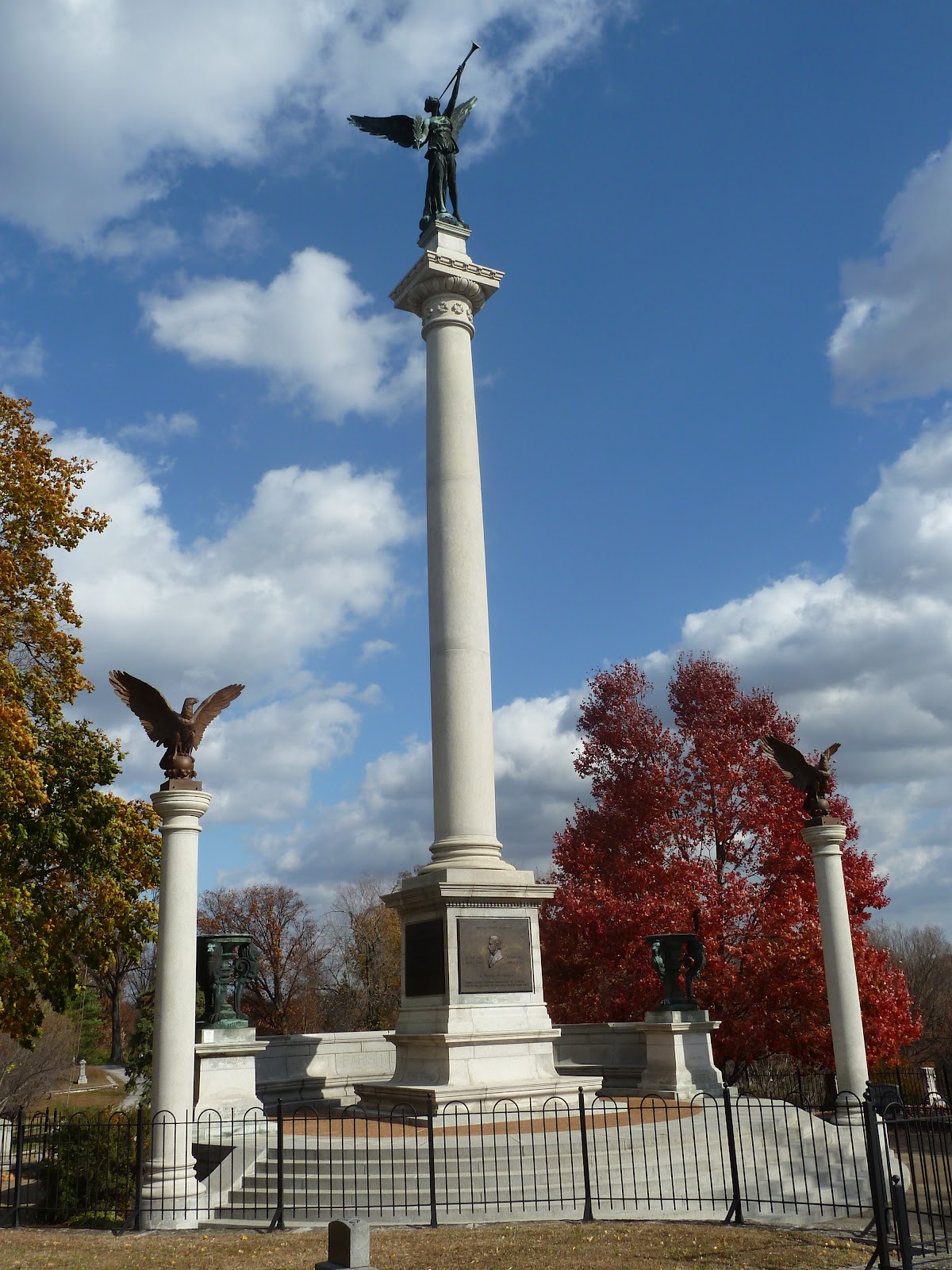
Elijah Lovejoy Monument, Alton, Ill. Cemetery
Photo by H. Scott Wolfe
            During my ascent of the Mississippi River last November, I paused in Alton, Illinois to once again view the Elijah Lovejoy Monument. Perched upon a blufftop at the margin of the Alton Cemetery, this imposing memorial to the antislavery struggle never fails to spur me toward the contemplation of the sacrifices made by those engaged in that noble cause.
            In its center is a towering 93-foot granite shaft, topped by a 17-foot bronze statue of “Winged Victory.” The square pedestal at its base displays tablets bearing apt quotations of the martyred Lovejoy. This central shaft is flanked by a pair of “sentinel columns,” crowned by bronze eagles representing “the idea of a triumphant goal or consummation,” along with a pair of “chalices,” in the form of sculpted lions.
            The grave of Lovejoy is to be found about 100 yards within the cemetery proper. Surrounded by an iron fence, its marker consists of a substantial block of New England granite beneath a marble scroll…whose Latin inscription translates to: “Here lies Lovejoy—Spare him now the grave.”
            On the plaza of the Lovejoy Monument is a simple granite stone, inscribed with the names of the men who defended his printing press on that momentous November night in 1837. Among those names can be found that of Enoch Long.

******

            Thirty miles south of where I now tap the keys, reposes the tiny community of Sabula, Iowa. The promotional signboards call it Iowa’s only “Island City,” for the creation of the lock and dam system has surrounded the town with Mississippi River backwaters…thereby allowing vehicle access only by bridge and causeway.
Gravestone of Enoch Long
Photo by H. Scott Wolfe
            Meandering north of Sabula along the incongruously named 607th Avenue, one reaches a remote cemetery named “Evergreen”…tightly squeezed between the murky waters of Joe Day Lake and the tracks of the Iowa, Chicago & Eastern Railroad. Within its coniferous bounds is a plain grave marker…a flat slab of marble blackened by the elements and beset with a coating of bright orange lichens. This stone marks the final resting place of Deacon Enoch Long, who died in Sabula on July 19, 1881 at the ripe old age of 91 years.
            Few people have heard of Enoch Long. The fame of his family is commonly reserved for his older brother, Major Stephen Harriman Long…the U.S. Army officer and explorer…whose expeditions through the Great Plains and upper Mississippi valley were crucial to American expansionism. Longs Peak, the 14,000 foot Colorado landmark, is named for him. But no lofty mountain bears the name of Enoch Long…just a simple stone set amidst the Iowa marshes.

            My first encounter with Enoch Long came while researching the pioneers of my own community: Galena, Illinois. Though a native New Hampshireman, Long had come early to frontier Illinois. During the late 1820s, he had spent several summers in this vicinity…mining lead. (“Galena” is the Latin word for lead sulfide, the principal ore of that heavy metal.) Miners of those bygone times would ascend the Mississippi in the spring and depart in the fall…this annual migration corresponding to that of the spawning sucker fish. (Thus the origin of the once prevalent nickname for Illinois: “The Sucker State.”) So many Missourians made this yearly trip that it was said that that State had taken an emetic…and these miners became known as “Pukes.” They were later to carry that appellation to the plains of “Bleeding” Kansas.
            Enoch Long became a permanent resident of Galena in the 1840s. City directories show him engaged in the lumber trade, both as a hired clerk and the owner of his own firm. Local sources also list him as a pillar of the Presbyterian Church, an Elder described as an honest and upright citizen who “never wronged any man out of a cent.”
            During the Civil War, Long moved his business across the big river to Sabula. And there, in my own mind anyway, the story ended. But then I encountered a local obituary for this esteemed citizen…and found the following, previously unsuspected, aspect of his colorful biography:
“Deacon Long was a very ardent antislavery man, and when Illinois was admitted into the Union as a State, he exerted all the influence he could command to make it a Free State. At the time of the great riot in Alton, in 1837, when Elijah P. Lovejoy was murdered on account of his antislavery proclivities, Deacon Long was one of the parties who defended Lovejoy’s printing office… .
            My immediate reaction to this bit of intelligence can be summed up, simply, as: “shock and awe.”  It was time to hit the old historical trail for the full story of this “ardent antislavery man.”

            Upon his arrival in the infant State of Illinois, Enoch Long had settled in the community of Upper Alton, where he soon established himself in the grocery and coopering trades. Considered by his neighbors as “a man of considerable culture, a member of the Presbyterian church, (and) a Christian gentleman,” he quickly began to labor “on the side of morality and religion.” In May of 1820 he organized the second Sunday School ever to be established in Illinois, conducting it “almost alone” as both its superintendent and principal teacher. He also established Alton’s first temperance society, his support of such institutions always “constant and zealous.”
            But the“magnum opus” was his role in the construction of Upper Alton’s Presbyterian church. As a generous subscriber, trustee and member of the building committee, Deacon Long accomplished much “by direct labors and godly influence.” When the substantial stone edifice was completed, he donated “one of the finest bells ever made,” much remembered for its “remarkably pure tone and sweetness.” And, though deeply affected himself by the financial panic of 1837, Long assumed the payments for those church subscribers who could not meet their obligations. The grateful parishioners considered him “the one Christian who gave all that his Master called for.”
            Long also became a close friend of a young preacher who often led services in this Upper Alton church…and was a frequent guest in the Deacon’s home. His name was the Reverend Elijah Parish Lovejoy.

Elijah P. Lovejoy in
Appleton's Cyclopaedia of
American Biography
            A native of Maine, Elijah P. Lovejoy had graduated from Waterville (now Colby) College and removed to St. Louis, where he taught school and edited an anti-Jacksonian newspaper. Following a religious conversion, he returned to the East and enrolled in the Princeton Theological Seminary. Once licensed to preach, he returned to Missouri and was placed in charge of the St. Louis Observer, a reform organ of the Presbyterian church. He began to produce antislavery articles which elicited “great excitement and bitter feelings,” despite the fact that they were moderate in tone…calling for gradual emancipation and the colonization of the freed blacks.
            Reverend Lovejoy also antagonized Catholic St. Louis with angry tirades against “papists,” whose church he called the “Mother of Abominations.” He wrote that the Catholic church “was approaching the Fountain of Protestant Liberty” with “stealthy cat-like step” and “hyena grin,” seeking to “cast into it the poison of her incantations.”
            Under great public pressure to cease the publication of his antislavery beliefs (particularly after he protested the public immolation of a mulatto resident of St. Louis), Lovejoy prophetically declared: “I am ready, not to fight, but to suffer, and, if need be, to die for them.”  He chose to stand upon the platform of freedom of speech and the press, writing:
“I deem it, therefore, my duty to take my stand upon the Constitution…We have slaves it is true, but I am not one…I do, therefore, as an American citizen and Christian patriot, and in the name of Liberty and law and religion, solemnly protest against all of these attempts to frown down the liberty of the press and forbid the free expression of public opinions. Under a deep sense of my obligations to my country, the church, and my God, I declare it to be my fixed purpose to submit to no such dictation. And I am prepared to abide the consequences.”
           
The “consequences” were the destruction of his Observer office and its printing press. Soon thereafter, the Reverend Lovejoy removed across the river to “free state” Illinois and, in September of 1836, the first issue of the Alton Observer was printed. But his experiences in St. Louis had altered his philosophy to a more “ultra” position. Lovejoy now advocated the Garrisonian view of immediate, unconditional emancipation of the slaves.
            In July of 1837 he issued a public call for the creation of an Illinois Antislavery Society. His old adversaries in St. Louis declared: “Something must be done, and speedily.” In August, a mob attempted to assault Lovejoy…and again destroyed his press. In September, a replacement press was also cast into the Mississippi River.  “Frown down the liberty of the press,” indeed.

            In response to Lovejoy’s call for a State Antislavery Society, delegates met in Enoch Long’s Upper Alton Presbyterian Church in late October. To prevent the intrusion of proslavery men, forty constables, “good men and true,” were deputized…and among them was Deacon Long. Besides the creation of the Society, the delegates debated the future of Lovejoy’s Observer. They decided to order a new press, to be safely stored in the riverside warehouse of Godfrey, Gilman & Co. They also discussed, with the Mayor of Alton, the organization of a company “to resist by force, if necessary, any further efforts of mobs to destroy property or molest peaceful citizens.” About sixty men were enrolled, including once more, Enoch Long.
           
On November 6, 1837, the new printing press arrived and was placed on the third floor of the stone warehouse. The following day, twenty men gathered to protect the building. A vote was taken, and Enoch Long was chosen “Captain,” an honor due mainly to his prior military experience. (He had served briefly on the Niagara frontier during the War of 1812.)  The Captain immediately “assumed charge,” the doors of the warehouse were barricaded and defensive measures initiated. (Note: Can we not consider this fortress a harbinger of the armory engine house at Harper’s Ferry?)
Attack upon the Godfrey, Gilman & Co. Warehouse
in which Lovejoy was killed defending his printing press
            At 10 P.M. the mob, “with arms and hootings, with tin horns blowing, and plenty of liquor flowing among them,” had gathered to demand the surrender of the press. When denied, a shower of stones and bullets struck the warehouse…shattering its windows. A request to return fire was denied by Captain Long, who thought the sacrifice of life “unjustifiable and useless.” One of the mob was, indeed, later killed…and this infuriated the attackers all the more.
            They returned with a ladder, which was carried to the river side of the building, and flaming tar balls were prepared to set the roof on fire. Several of the guards, including the Reverend Lovejoy, were compelled to leave the warehouse to prevent men from ascending the ladder. A volley exploded from behind stacks of lumber on the levee, and Lovejoy was mortally wounded (“five balls entered his body”). He managed to make his way back to the warehouse “counting room,” where he soon died…his friend Enoch Long at his side.
            The roof flaming, and the mob threatening to blow up the building with a keg of powder, the defenders were offered safe passage if the press was relinquished. All resistance being useless, the offer was accepted…and another printing press (the fourth) was consigned to the Mississippi River. (Note: Enoch Long and his compatriots were later INDICTED for “unlawfully, riotously, and in a violent and tumultuous manner”…acting “against the peace and dignity of the People of the State of Illinois.” Mercifully, they were found not guilty.)
            Two days later, on what would have been his 35th birthday, the Reverend Elijah Lovejoy was buried in an unmarked grave…after a “sad, almost silent funeral.” It was a simple service, where “no flowers were strewn upon his coffin” and “no remarks were made lest the mob should disturb the last rites.”  It was said “that the silence of death, under such circumstances, well became the burial of liberty.”
Yes, liberty hung in the balance…but there was not to be silence. The events in Alton were to reverberate far and wide…and, across the North, Elijah Lovejoy was mourned as a martyr of the antislavery cause….
Grave of Elijah P. Lovejoy (Photo by H. Scott Wolfe)

            In Boston, citizens gathered at Faneuil Hall to discuss the momentous events at Alton. One of the speakers, Massachusetts attorney general James T. Austin, defended the proslavery mob…comparing their actions to those of the patriots of 1776. A rebuttal was promptly given by Wendell Phillips, a son of privilege, who praised the actions of Lovejoy as a warranted defense of the principles of liberty. His eloquent response shocked his conservative peers…and horrified his relatives, who contemplated sending him to a sanitarium.

            In Springfield, Illinois, a young member of the State Assembly, Abraham Lincoln, spoke before the Young Men’s Lyceum upon the topic of “the perpetuation of our political institutions.” He decried “the ravages of mob law,” as demonstrated by “the increasing disregard for law which pervades the country.” Despite standing before an audience by no means sympathetic to Elijah Lovejoy, Lincoln warned that “whenever the vicious portion of the population shall be permitted to gather in bands of hundreds and thousands, and burn churches, ravage and rob provision-stores, throw printing presses into rivers, shoot editors, and hang and burn obnoxious persons at pleasure and with impunity, depend upon it, THIS GOVERNMENT CANNOT LAST!”
Photo by H. Scott Wolfe

            And in Hudson, Ohio, Laurens P. Hickok, professor of theology at Western Reserve College, excitedly called for a meeting in the “old chapel-room,” where he related an account of the Lovejoy incident to the assembled faculty and students.
            The following day, the professor “rode all over the township,” inviting citizens to another meeting…to be held at Hudson’s Congregational church. There, in an eloquent speech, Hickok declared: “The crisis has come. The question now before the American citizens is no longer alone, ‘Can the slaves be made free?’ but, ‘Are we free or are we slaves under Southern mob law?’”
            Prior to the close of this meeting, a man “who had sat silent in the back part of the room, rose, lifting up his right hand, saying, ‘Here, before God, in the presence of these witnesses, from this time, I consecrate my life to the destruction of slavery!’”
            The name of this man was John Brown. And this prophecy was every bit as prescient as that which was handed to the jailer of Charles Town.

H. Scott Wolfe is the Historical Librarian of the Galena, Illinois, Public Library District and now a regular correspondent and contributor to this blog. He has devoted many years of grassroots research on John Brown, the Harper's Ferry raiders, and related themes.

Friday, March 30, 2012

John Brown News

California Teenage John Brown Scholar in National History Day Competition

On Friday, March 9, 2012, Keegan McLean, a seventh grader in California, won the National History Day competition for his division. This year's theme is "Revolution, Reaction, and Reform," and Keegan's topic is John Brown. I was happy to be one of his resources for his project, a website that won him first place in his division.  Keegan will be competing in the State History Day competition in Riverside, California this month.  Congratulations Keegan!  Best wishes for the state and national competitions ahead.


Yesterday John Brown's Trial, Today Videoconferencing

CHARLES TOWN, W.Va. (AP) — Court officials from eight states and the District of Columbia will observe two mock trials in Charles Town next week to see how West Virginia provides language interpreters from afar.

A demonstration of the state's multi-cast videoconferencing unit is set for Thursday at the Jefferson County Courthouse in Charles Town. The historic building where abolitionist John Brown was convicted of treason in 1859 was chosen to show the system can work in any kind of facility.

Excerpted from Associated Press, "W. Va. Courts to Showcase Remote Interpreter System."  The Northwestern.org [Oshkosh, Wis.], 30 Mar. 2012


Harper's Ferry Raider Aaron Stevens Remembered

Lisbon Connecticut Historical Society
Aaron D. Stevens, who preferred his middle name, Dwight, was born on a farm on Route 169 in Lisbon in 1831. He worked on the family farm, becoming a passionate antislavery advocate in his youth. His cousin and close friend was Charles Whipple, whose name Stevens used by an alias later, during the conflict over the Kansas territory. His first departure from Connecticut was to fight in the Mexican War.  After returning home, Stevens again enlisted in the army, going west in 1851.  Following a conflict with an officer, Stevens was court-martialed and jailed in 1855.  Stevens shortly escaped and joined the free state forces in Kansas under Jim Lane, through which he--as Capt. Charles Whipple--made connections with John Brown.  Stevens later participated in Brown's famous Missouri raid in late 1858, in which eleven enslaved people were liberated and escorted across country and into Canada.  Stevens finally followed John Brown to Harper's Ferry in October 1859, where he was seriously wounded when the effort failed.  Stevens was jailed, tried, and convicted in the same Virginia court that condemned Brown.  Brown was hanged in December 1859 and Stevens followed him on the gallows in March 1860.  In his last letter to Jenny Dunbar, a young woman that he admired, Stevens wrote: “Slavery demands that we should hang for its protection. I regret nothing except I will not live to see this country free.”  He is buried near Brown in North Elba, N.Y., nearby Lake Placid.

Inspired by a somewhat flawed article by Richard Curland, "Historically Speaking: Lisbon man aided famed abolitionist."  The Bulletin [Norwich, Conn.], 24 Mar. 2012

Tuesday, March 13, 2012

Ashtabula County History Program--
They Hid John Brown's Weapons in Ohio

According to a report in the Tribune Chronicle of Warren, Ohio, a descendant of John Brown’s associates in Ashtabula County made a presentation about the abolitionist last week.  The descendant is Linda Lipps, a great grand niece of Alexander Fobes, a brother-in-law of John Brown Jr.   The Fobes-Brown connection was based on the fact that Fobes and John Jr. married sisters, Eunicia and Wealthy Hotchkiss.  John Jr. and Wealthy were settlers in the Kansas territory in 1854, along with his brother Jason and family, and other sons of John Brown.  It was John Jr.’s letter of appeal for help in the spring of 1855 that brought his father to the territory with a wagon full of weapons.

According to Mrs. Lipps, her forebear, Esther Fobes, a sister of Alexander Fobes, was a lifetime resident of Ashtabula County, and died at age ninety-five.  She dictated many of her memories of Brown to her family members.  Inspired by these stories and knowledge of this connection to John Brown, Lipps has done research in local history about Brown and the raid.

This is an interesting story, coming as it does through the Fobes family line.  The Fobes not only had a connection to the Brown family through marriage, but some actually helped him by hiding his weapons in Ashtabula County in the months prior to the Harper’s Ferry raid in 1859.  According to Oswald Garrison Villard, Kansas rifles, pistols, and ammunition were shipped through Iowa to Ohio, where they were shuttled around a number of places in Ashtabula County, including a hiding space on the farm of E. Alexander Fobes in Lindenville, Ohio.  In 1909, Oswald Garrison Villard’s field researcher, Katherine Mayo, visited Ashtabula County and interviewed a number of surviving contemporaries of Brown.  One person, A. B. Noxon (a Fobes son-in-law) also recalled that E. Alexander Fobes and his cousin Franklin Fobes later helped John Brown Jr. move the weapons into Pennsylvania, where they were then shipped by canal to Brown.  The latter Fobes was a cooper by profession, and was the one who packaged the weapons in wooden containers, marking them, “Isaac Smith,” Brown’s pseudonym in Maryland and Virginia.  The weapons were finally freighted to Brown in Chambersburg, Pa., and moved by wagon to Brown’s Maryland headquarters. 

Apparently, Lipps’ attitude toward Brown is not new in her family.  According to the Mayo’s interview notes, Eunicia Fobes, John Brown Jr.’s sister-in-law, lived long enough to recount her family’s involvement with the Harper’s Ferry raiders. According to Mayo, Fobes recalled that the guns were hidden in a sugarhouse in the woods.  Fobes herself disliked John Brown, thinking of him as conceited because he seemed to think “himself capable of doing anything.”  Looking back over the years, the elderly Fobes thus recalled the famous Brown self-assurance and stubborn self-determination, a characteristic that we know about from other sources.  However, Fobes also resented Brown because he never paid them for holding the guns.  Apparently, she did not share the same convictions as the Browns.  "He seemed to think it our duty to contribute that to the cause,” she told Mayo. “It made me angry."   

Over one hundred years after that interview, her descendant has mixed feelings about John Brown too.  Although she believes him to have been “courageous,” she finds “his methods questionable.”  It is quite possible that her ambivalent attitude toward John Brown is part of the family’s legacy passed down over the generations:  When the Fobes family heard about the Harper’s Ferry attack, they did not support the idea.  Fobes relative A. B. Noxon told Mayo in 1909 that when news of the raid reached them in Ashtabula County, they thought Brown "injudicious and wrong." But they knew he would be hanged, and they were sympathetic. 

See Bob Coupland, “Gustavus couple share history,” Tribune Chronicle [Warren, Oh.], 11 Mar. 2012.  


And a Really Super
Postscript from Our Expert in the Field, Scott Wolfe


Just a note to comment upon the interesting posting in regard to E. A. Fobes of Lindenville, Ohio. It should be remembered that the Fobes farm was not merely the place that weaponry and other supplies were clandestinely kept....but also a rendezvous point for a number of the members of Brown's Provisional Army. In particular, William Leeman (who was to die at Harpers Ferry), Charles Wesley Moffett and Luke Francis Parsons spent a good deal of time at the Fobes place during late 1858 and early 1859. It was at this time (after the Chatham Convention) that the indiscretions of "drillmaster" Hugh Forbes necessitated a delay in Brown's plans...and the men had scattered about northeastern Ohio to find work. 

     Leeman was employed by Fobes for a significant portion of the summer, and the latter is mentioned frequently in his letters.  For example, in one dated 7/4/1858 to his sister Mattie, Leeman explains the tardy receipt of an epistle by writing: "...it was not directed to the care of E.A. Fobes which accounts for it not being forwarded to me...."

     Moffett also was employed in the vicinity.  In a letter from Luke Parsons to William Leeman dated 11/14/1858, the former writes: "...started for home a going by C. Moffatt...to see if he had heard from any of the boys. I stoped out in the road in front of his house and hollered, he came out and told me to go in. I would not, but he took holde of my hoarse and led him in the barn. So I went in and found E.A. Foabs and wife, Martha and Louisa there eating a roasted turkey...."

     Parsons also assisted Fobes. In two diary entries of 4 and 7 March 1859, Parsons writes: "A.E. Foabs and I gathered about sixteen barrels of sap. Charlie (Moffett) boiled all down in one day." And: "Helped Foabs gather sap and boiled it in the evening. Charlie and I went up to John Brown Jr's."

     All in all, E.A. Fobes is an exceedingly important character in the events leading up to the Harpers Ferry incursion. I'm glad you recognized him in the blog entry.

Best wishes,
Scott W.

* H. Scott Wolfe is the Historical Librarian of the Galena, Illinois, Public Library District and now a regular correspondent and contributor to this blog. He has devoted many years of grassroots research on John Brown, the Harper's Ferry raiders, and related themes.

Bloated Bloggers--
Blustering Al Benson versus John Brown

I used to get annoyed, even angry, at bloggers and other internet trollers who wrote malicious things about the Old Man.  The truth is that one could waste a lot of time sniping and fighting with self-assured idiots and racists over their remarks about John Brown because they frequently appear on line.  Of course I've learned that these people are speaking from their hearts first, not their intelligence.  They are hateful, prejudiced, and malicious in intent.  They are not people of reason or learning, so they do not merit engagement.  I've learned to ignore them.  Indeed, only a handful of anti-Brown critics bear any kind of notice, mainly because they write from positions of influence and intelligence, and for the most part they are academics who throw out insinuations and half-truths.  Right now I'm working on a piece about Otto Scott, a rabid anti-Brown author now deceased, that I'll be posting shortly.  Scott was malicious in intent, but he was a thoughtful and able writer despite his gross errors and racism, and should at least be dismissed at the intellectual level because his clever volume on Brown and the "Secret Six" is treated as the definitive work by neo-Confederates, crypto-racist Southern Calvinists, and other right-wingers with an agenda that includes bashing the Old Man.

Then there are people like Al Benson Jr., a man that I do not know and do not wish to know.  Benson has a blog called Revisedhistory and is currently on a rant against the Old Man that reveals a depth of ignorance and hatred that could only come from a neo-Confederate or someone who thinks like one.  I find it hilarious--a comedy of errors composed by someone intelligent enough to read, write, and keep a blog, but little more than that.

"Goop"

Benson's bluster is probably provoked by Tony Horwitz's recent publication, Midnight Rising, which has garnered more media attention on the Subject than anything we've seen in this era.  Whether or not Midnight Rising will have the impact upon scholars and historians that David Reynold's John Brown Abolitionist is another question.  Tony's book is written for a wider and more popular readership and has been marketed and promoted in an unprecedented manner, and although I have significant differences with him over key themes in the John Brown story, his reading of the Old Man is much closer to mine in comparison to people like Benson.  The latter's reaction suggests that extreme right-wing neo-Confederates just can't stand the amount of attention that Brown has gotten lately, and apparently Midnight Rising has Benson's prejudiced blood rising too.  This is what makes his harangue so hilarious, so entertaining. Benson's multi-part rant (which is still in process) has thus far two segments under the title, "John Brown-from business failure to terrorist and media hero."  He begins his diatribe with this profound declaration: "Much has been written about John Brown of Harpers Ferry, Virginia fame over the years.  And much of  it is historical and political goop."  Goop?

Re: Obama, of Course

After recounting some inane anecdote about how Kansans love John Brown (which is a generalization, by the way), he writes: "Why do you suppose that Obama went to Osawatomie, Kansas to give that speech awhile back?  That's John Brown territory and Obama knows it.  He was identifying with the crowd that thinks John Brown was the greatest thing since sliced bread."  This pretty much establishes the trajectory of Benson's writing: he doesn't know history and he's a reactionary bigot.  Actually, President Obama went to Osawatomie to speak because that's where Teddy Roosevelt spoke in 1910, fairly well exploiting the John Brown historic site to make a speech about his political objectives, and did so virtually without mentioning Brown in his speech!  Afterward, Roosevelt wrote an article diminishing Brown in favor of Lincoln to avoid being associated too closely with Brown.  President Obama never once mentioned John Brown either, which shows he was following Roosevelt's strategy more than identifying with the Old Man.

Consider the Source(s)

Benson fairly well seals it in the rest of the first entry, citing his two main sources: Otto Scott's twice published assault on Brown and the "Secret Six" and J. C. Furnas', The Road to Harper's Ferry.  In fact, both books are anti-Brown, and neither is based upon original research, nor does either have any value to John Brown scholarship.  To no surprise, these are the works that Benson cites for his information on Brown, although he clearly is aware of other published efforts.   But this kind of narrow prejudice and selective reading is what defines conservative and right-wing historical treatments, allowing people like Benson to scream "historical revision"--as if their narration of history is truth and everyone else's is just "goop."

The second installment of Benson's right-wing tirade is more of the same.  He starts with a reference to a review of David Reynold's book (I suppose Benson wouldn't want to dirty his Sadducee hands by actually picking it up and reading it), in which he laments that all "progressive" treatments of John Brown are "socialist," then some gratuitous references to "terrorists" like Che Guevara and Bill Ayres versus the noble Tea Party, with the conclusion, "You can see why John Brown looks so much better when socialists are running the country."

Benson's Bitterness

Benson's bitterness is seething and it is really evident that he's using his hatred of John Brown to vent his own warped hatred of the current Presidential administration and all things not right-wing.  The fact that right-wingers cannot distinguish between liberal capitalism and socialism is itself a sign that most of the anti-Obama "socialist" claptrap reflects the political and historical ignorance of the Right.  Benson is just too ignorant to reason with, but his blogging extravaganza is at least illustrative, which is why I'm spending time on it here.   While I'm hardly a spokesman for liberal politics, I cannot help but point out that it is liberals who have contributed the most intelligent, thoughtful, and reasoned political discourse, and without liberal scholars, there would have been no explosion of in depth research on slavery, abolition, and the histories of people of color that has taken place over the past forty years.  Benson fairly well highlights just how politically and historically stupid so many self-proclaimed conservatives happen to be.

Calvinism

Yet the heart of Benson's second segment is his vituperations against John Brown's Calvinist faith and Puritan legacy.  He writes:
I have also read, over the years, some comments by writers who actually considered people like John Brown and Thaddeus Stevens to be Calvinists! Where they came up with such flights of fancy I have no idea–maybe from the same people who blithely inform us that Abraham Lincoln was a Bible-believing Christian. One is as equally ludicrous as the other. But that seems to be the trend today. Demonize Christian Southerners and try to make agnostic and apostate Northerners look like Christian crusaders.
I don't know if Benson has read my religious life of John Brown.  I doubt his reading on Brown has gone beyond the Southern partisanship that he evidences in such words.  While I would agree that Lincoln has often been made far more a Christian than he was in reality, it is not "equally ludicrous" to say that Brown was a devout evangelical Christian and Calvinist.   By all accounts, Brown was as much an advocate of the Reformed doctrines of grace as was the errant Southern general, Thomas Jackson.  In fact, I have often said that apart from their view of slavery and "race," Brown and Jackson were cut from very similar cloth, and they have similar profiles as devout Christian men in the reminiscences of their followers and associates.  

Brown's upbringing in the Reformed Congregational church, with its deep roots in the English Reformation and the Great Awakening is a matter of history.  Nor was he a creature of the New Side and experimental evangelical movements of his era as some historians like to claim.  Brown was fairly conventional if not backward looking in his Reformed theology, so much so that liberal Christians like Franklin Sanborn and Thomas Higginson were the ones who recognized that Brown's religion was wed to the historic evangelicalism of the Protestant Reformation.  Brown made profession of faith in Christ at sixteen years of age and joined the First Congregational Church of Hudson, Ohio, although he was reared in a home as replete with evangelicalism as it was with anti-slavery doctrine.  He never withdrew his membership as a Congregationalist officially, although he widened his practice of worship to include other evangelical churches during his lifetime.  He was a voracious Bible student throughout his life, a constant gadfly to his sons' liberal and spiritualist tendencies, and even fairly good apologist for Calvinism over against advocates of Wesleyan-Arminianism.   His letters, while largely personal and occasionally motivated, reflect many personal references to his faith in Christ, his belief in Scripture, and his devout belief in the singular claims of Christianity upon humanity.  To deny this as does Benson is, frankly and flatly, prejudice. 

Bearded Fundamentalists

After making a mess of Brown's religion, Benson brings part two to a close by noting that Tony Horwitz  "noted that Brown was a terrorist," which probably is more a reference to a piece in the New York Times that Tony did a year prior to the publication of his book.  To be sure, Tony seems to believe that Brown was a religiously oriented terrorist, although he is more careful in how he frames his presentation in Midnight Rising, somewhat setting up the reader to draw that conclusion without proclaiming it himself.  Yet Benson objects to Tony's reference to Brown as a "bearded fundamentalist," concluding: "Let’s don’t try to tar the Fundamentalists with John Brown’s brush. That’s grossly unfair to them. Otto Scott’s comments about Brown’s theology, or lack thereof, show that Horwitz was off base on this point."

This is hilarious stuff.  It reveals nothing about Brown, but a great deal about Benson and his ilk, the ultimate historical revisionists.  These are the folks who are bent on making the antebellum South--so full of cruelty, rape, theft of labor, and heart-rending injustice--as if it were a land of godliness, piety, and biblical orthodoxy.  It is comical that a man with so little understanding of the historical facts, and one so dependent upon discredited and useless narratives, should enter such trash under the heading of historical revision without realizing his own role in the perpetuation of the slave master's revision.

I have no intention of reading Benson's next installment, nor will I revisit his blog.  But highlighting his folly should not only give us a good laugh.  Afterward it serves also as a sober reminder that John Brown is hated because what he represented challenged the forces of evil in places high and low.  As the gospel writer put it, "men love darkness rather than light" (John 3:19), and this romancing of the Old South is darkness.  Indeed, as Jesus said to the enemies of righteousness in his day, 'If you were blind, you would have no guilt; but now that you say, 'We see,' your guilt remains" (John 9:41).

Saturday, March 10, 2012

West Coast Update--
Jean Libby Writes

Much gratitude to all who made the program “Santa Clara County Connections to the Civil War” at the Sunnyvale Public Library on March 7 a public history event.

African welcome was created by Keisha and Peter Evans, the proprietors of Pan African City Alive!  in Sunnyvale (www.panafricancity.com), a community resource for all things Africentric that was appreciated by the audience of more than 100 people.

The welcome was notable for the sharing of an artefact of the John Brown raid, an 1853 Sharps rifle, by Mick Konowal, who is a senior attorney for Microsoft Corporation at their Washington state headquarters.  It had been owned (his name hand-engraved on the stock) by Dauphin Thompson.  It was taken from his hands at the time he was bayoneted to death by the U.S. Marines in the enginehouse at Harpers Ferry on October 18, 1859.  For 152 years the carbine was in the family of Major William Worthington Russell, as well as a pike that was identified by serial number as taken from the raid.

Many thanks to Tony Horwitz, the author of Midnight Rising; John Brown and the Raid that Sparked the Civil War (Henry Holt, 2011) for recommending me to Mick Konowal, and especially to the new owner of the artefacts for sharing his treasures in public history spirit.  Mick has a Certificate in Museum Studies from the University of Washington and is a member of the Manuscript Society.  He can be reached at mkonowal@hotmail.com

Members of the South Bay and San Francisco Civil War Round Tables assisted with viewing the rifle.  (www.sbcwrt.org)  Larry Gonzalez of SBCWRT and Debbie Grace, re-enactor and cannon specialist, did the honors posts.

The John Brown Photo Chronology, authored and curated by Jean Libby is on view at the Sunnyvale Public Library until March 17.  I am very grateful to Bill Noyes and these organizations for workshops and installation.

John William Templeton spoke about the Underground Railroad in California, documentation for which begins in 1850 in San Jose.  John’s style is always interactive, and this program is no exception.  He spoke about Rev. Peter Williams Cassey, the first ordained Episcopal deacon of color in the West, connected with the Trinity Episcopal Cathedral in San Jose, founded in 1863.   His interests and publications on black technology innovators in Silicon Valley (another name for the heart of Santa Clara County ) and jazz are welcome as well.  (www.Californiablackhistory.com)

‘Am I Not John Brown’s Daughter?’ Annie Brown in the Civil War, took on new meaning with the discovery of “ANNIE” etched secretly behind the sling bar on Dauphin Thompson’s rifle.  Annie was fifteen when she was with her father’s army at the Kennedy Farm in Maryland in the summer of 1859.  Dauphin and his brother William Thompson as well as Annie’s brothers Oliver and Watson Brown were all killed in the raid.  Her grief was alleviated a bit by becoming a teacher among freedmen at Fortress Monroe in Hampton Roads, Virginia in 1863, at Rolleston, the confiscated mansion of the former governor, Henry A. Wise.  Documentation grows to support this part of Annie Brown’s story.  Sources:  “Living Legacies of Harpers Ferry” by Sandra Weber of Pennsylvania in Civil War Times Illustrated, February 2005 and Robert F. Engs, Freedom’s First Generation: Black Hampton, Virginia 1861-1890 (Fordham University Press, 2004). Thank you, Sandra, for your warm and excellent work (longtime John Brown Scholar).

Members of the Santa Clara County Historical and Genealogical Society, who also came to Mary Brown’s birthday party at the Saratoga Community Library on April 15, 2011, were back in Sunnyvale.  Special thanks to Mary Hanel at the Santa Clara City Library.  We look forward to including your presentation about Sarah Brown at Mary Brown and Her Daughters’ Homecoming in Saratoga at Hakone Gardens on September 25, 2012 (www.alliesforfreedom.org/Mary_Anne_Day_Brown_birthday.html).

Alice Mecoy, descendant of Annie Brown Adams, is scheduled to keynote the Saratoga Homecoming event in September.

The community audience included Mattie Tinsley from African American Heritage House in San Jose.

Journalism coverage is under the auspices of Create TV, who will have a broadcast on Channel 15 Comcast that includes interviews at Pan African City Alive! and the library event.  Thomas Libby, history columnist at California Lawyer Magazine, will follow up with the legal side of the New Almaden Quicksilver Mines and attempted seizure by President Abraham Lincoln in May, 1863, presented by Bill Noyes as the third portion of the program.   Bill's presentation is based on the work of R. Larry Comstock for SBCWRT.

Susan Denniston, administrative librarian at the Sunnyvale Public Library, and the staff made it all happen.  Thank you, Susan, for your flexibility and  making guns and elephants and even a giraffe right at home.

With gratitude and smiles,

Jean Libby
Allies for Freedom
www.alliesforfreedom.org
editor@alliesforfreedom.org

Wednesday, February 29, 2012

Take Note--
Most of What You've Heard about John Brown is Wrong

The John Brown that many people imagine is frankly wrong because they've been misinformed by years of prejudiced, poorly researched, and willfully deceptive accounts--virtual gossip.  After years of studying Brown close up, I can sketch the following list challenging twelve mistaken notions that typify Brown's popularly misrepresented legacy.  Remember, this is just a sketch.  There's more in depth and material substance if you wanted to expand many of these biographical items.

1.  Brown was "mad," insane, or mentally ill.

There is no documentation, evidence, or reason to conclude that Brown had any mental illness.  Unfortunately, Tony Horwitz somewhat graces the notion of Brown suffering from a manic or bipolar condition in his recent publication, Midnight Rising.  Although he recognizes the unreliability of posthumous psycho-historical analyses, it didn't stop him from trying to keep this useless discussion alive.  He even fictionalizes a bit when he says that Brown's letters show bipolar like swings--a claim that he does not prove and cannot prove because it just isn't so.  I've been collecting and studying Brown's letters for years and nothing of that sort can be seen in his writings.  Tony makes much of a few poorly contextualized references to insanity and monomania, but none of these references hold up under normal scrutiny.  There just isn't sufficient evidence that Brown was mentally troubled: Yet it seems many people will continue to hold Brown to an unfair standard--He is mentally ill, "wild eyed," and "crazy" because people want him to be, nothing more.  The real question is why do they continue to insist on this issue despite the lack of evidence?

2.  John Brown was a terrible businessman.

John Brown had misfortune in most of his business attempts.  This doesn't entirely mean he was a bad businessman.  Typically popular narratives isolate him from among other businessmen and from the economic context of the antebellum era.  It is assumed that Brown had the same opportunities and circumstances that businessmen do in our era.  Most popular narratives make no mention that there was no national currency, and from state to state monies differed; there were no limited liability corporations, no safety nets, etc. that business people enjoy today.  Then the economy itself was fractured, and the effect of the 1837 economic downturn ricocheted westward, so they hit Brown's region a couple of years later, further weighing upon him and many others with devastating impact.   In the sheep and wool business, most people never consider that his partner Simon Perkins was actually responsible too, and in fact he was probably a worse businessman.  Perkins inherited lots of money and lost most of it--and not with John Brown.  His brothers had to bail him out.  He blamed Brown after the fact since it was convenient to do so, but Perkins was really the weaker link in the firm despite being the investor.  Brown brought the "sweat" equity and management, and while he might have done better, he wasn't incompetent.   Historians tend to tell anecdotes about episodes suggesting Brown's business failings but they never examine the business history itself.  They seem unaware of the challenge Brown had taken on in opposing powerful wool manufacturers, and how they were determined to undermine his operations on behalf of the wool growers.  I'd venture to say that, all things being even, John Brown was a fairly decent businessman and would have probably done alright were it not for always having to face challenges beyond his power.  Bottom line, few if any have seriously studied his business history but they keep repeating the hackneyed claim that "John Brown was a terrible businessman."

3.  Failure in business drove Brown into radical antislavery action.

Nonsense.  Failure in business may have convinced him that he was never going to be a wealthy antislavery tycoon like Gerrit Smith, but he had a lifetime goal of laboring to undermine slavery.  The trajectory of his approach became more militant over the years, but the basis of this change was not his business history.  It is the history of the growing power of slavery, especially the virtual closing of all doors to possible antislavery reform in government following the Fugitive Slave Law and Dred Scott Decision in the 1850s.  Brown became more militant because proslavery power was becoming more and more bold and demanding.  Meanwhile the possibility of legal resolution of the problem increasingly declined.  It was the political and moral trajectory that one must follow to understand his increasing militancy, not any notion of personal failure.

4.  Brown went to Kansas to settle.

Wrong.  He only went to Kansas because his sons asked for help.  Although he became somewhat involved in the developments of Kansas, the reality is he was never a major player in Kansas free state leadership and really acted as a catalyst for abolitionism among a largely passive, moderate free state population.  Brown essentially went to Kansas to support his sons and was drawn into defense of the free state cause from terroristic invasion.  He never intended to stay in Kansas and--much to the dismay of some free state Kansans--by 1858, he had pretty much abandoned them for his own plans back east.  Brown's role in Kansas is famous and memorable, but it was a detour in his own intentions.

5.  Brown's plan to invade Virginia was a later development, born in the 1850s.

Some scholars have diminished the claim that Brown had planned on invading Virginia in some way from the late 1830s.  There is certainly solid evidence that he had some plan in mind in the late 1840s--even Frederick Douglass verifies that.  But there is reasonably good evidence that he had some idea of tampering with slavery in the South going back to the late 1830s and early 1840s.

6.  The Pottawatomie Killings of 1856 were terroristic.

This is probably one of the biggest, most ill conceived notions relating to Brown, but has been highly popularized.  While it is true that the Kansas material is hard to work through and questions may fairly well remain, it is interesting that many people jump to hard and fast conclusions.   My understanding of the killing of five pro-slavery men by Brown's men in 1856 is that these "victims" were collaborating with invading terrorists and had specific intentions to lead an assault on the Browns and their allies.  This is not speculation; there is sufficient evidence to argue confidently that the Pottawatomie killings were a preemptive strike.  Certainly the men killed were not simply killed because they were pro-slavery.  Brown interacted a lot with proslavery people in Missouri and Kansas territory without incident.  These five men (Wilkinson, Sherman, and three Doyles) were known as activists, collaborators, and conspirators.  Frankly, the Pottawatomie killings were a wartime matter and more a matter of counter-terrorism since the Browns had no resort to protection from the law.

7.  The Pottawatomie killings led to "Bleeding Kansas."

Nonsense.  The problem of violence in Kansas was introduced and sustained by proslavery thuggery.  Proslavery people started it, instigated it, and benefited from it until free state people began to fight back.  The invasions of 1856 by southern thugs and terrorists were not brought upon free state people because of John Brown.  While their rage may have been heightened by antislavery resistance, they were going to attack regardless, as the assault on Lawrence in May 1856 shows.  The proslavery force was intent on forcing Kansas into the Union as a slave state and since they were defeated in democratic terms, they were determined to use violence.  Proslavery militancy started the civil war in Kansas, which was also the unofficial start of the Civil War.  Don't blame Brown.  Blame your slave-owning great-great-great grandfather.  The slave power was expansionist and aggressive--spare us all the crap about "the war of Northern aggression."  Proslavery power was running roughshod over the nation long before 1861, and Kansas proves it.

8.  The Harper's Ferry raid and John Brown's plan.

Brown added the HF invasion later in his life.  His overall plan, which was supported by a wide range of people including Frederick Douglass, was to invade the south, used small bands of armed men operating from the mountains, and to make forays to gather enslaved people and lead them away.  It was not insurrectionary in the proper sense of the term since it was not based upon the idea of killing slave masters necessarily.  Brown's plan was a kind of moral via media--he wanted to destroy slavery by throwing the economic structure of slavery into a panic; he was willing to use force as it was necessary, but he had no intention of widespread killing or insurrectionary murder of slave masters as was done by Nat Turner, for instance.  Brown was targeting the system.  It seems he was looking for a kind of domino effect across the South--the more runaways there were, the more slaves would be sold deeper into the South, and the system would end in chaos.  This is what Brown inferred in his last written statement when he said that he had hoped that his plan could be accomplished "without very much bloodshed."

9.  The Harper's Ferry invasion was quixotic.

Although the HF raid was risky, it was not a hopeless plan as many continue to presume.  Brown studied antebellum armories (there were only two) and knew how easily they'd be taken.  HF was easily taken.  He knew when to strike HF the town and how to hold it effectively for a brief period of time.  While it seems he intended for it as a kind of political declaration of his movement, he also saw it as a rallying spot.  He held HF effectively until the morning after he invaded it.  Regardless of the reason, he made tactical errors in remaining too long in the town and in letting a train go through.  Had he simply moved with expedience, his resort to the mountains would have made it highly difficult for local militia and the yet meager U.S. army to apprehend his movement as a whole.  His campaign would have potentially gone on for months and even years, launched with notoriety from HF.  But his failure there in no wise dismisses the validity of his plan.  Contrary to Frederick Douglass, who did not know HF like Brown, it need not have been a "steel trap."  As Brown told Gov. Wise of Virginia, even with the presence of militia, he managed to resist for two days.  Had he sustained a means of escape, the whole story would have been different.

10.  Blacks did not respond to Brown.

This is nonsense.  Even moderate opinions based upon careful reconsideration of the evidence suggest that scores of blacks were already involved with Brown or present in/around the town at the time of the raid.  Brown's raider, Osborn Anderson, who was on the ground and an eyewitness, says local blacks were enthused and supported Brown and would have come out in great numbers.  Other evidence suggests many blacks had indeed come to join Brown but backed off when he got bogged down in fighting in HF.  Let us be clear: the fiction of black fear, indifference, or unwillingness is based upon slave masters.  It was the slave master version that was fed into the northern press, and the North embraced this view.  Many historians did too and continue to do so.  Yet none can offer a justification for ignoring Osborn Anderson, the eyewitness.  Jean Libby has shown that even in the wake of Brown's defeat, many blacks fled the county.  Whether they fled out of fear of retaliation (which I doubt) or frustration that the plan had gone awry, blacks were highly responsive to Brown.  Some set fires and poisoned livestock of the jurors in Brown's trial.   One of Brown's surviving raiders (Tidd) even said frankly that Brown was both pleased and surprised at the response, which means it was probably better than even he had expected.

11.  Brown received a fair trial.

Only superficially.  Brown was rushed to judgment in a trial presided, conducted by, and decided by slaveowners.  Brown's life was spared on a technicality of time and law, but there is no doubt that the Virginians wanted to kill him.  As Brian McGinty has shown, although Brown paid respect to the trial, his actual experience as a man seeking legal justice while on trial, he was constantly deprived of reasonable appeals and options that should have been afforded him--that would have been afforded him, had he been tried by the federal government instead of Virginia.

12.  Brown didn't kiss a black baby.

On the day of his execution, he probably kissed a white baby, possibly in the arms of an enslaved woman.  But he probably did kiss a black baby during his incarceration at Charlestown.  Don't ask me about this now because it's part of what I'm writing about.  But there's some truth in the legend.  Revision: Six years ago when I made this blog entry, I was still doing research for my book on John Brown's last days, which was published in 2015.  Based on what I found in doing this book, I would now say that Brown definitely kissed a white baby--the infant daughter of jailer John Avis, who probably was in the arms of his wife, Mary.  There was no black enslaved woman in the household.  However, I am still convinced that there is more to the "black baby kiss" than what has been allowed, even though Brown certainly kissed no black baby on the day of his execution as the legend portrays.  I would refer the reader to my book, Freedom's Dawn: The Last Days of John Brown in Virginia for my take on what likely happened.--LD  14 July 2018

Saturday, February 25, 2012

From the Field--
History for Sale: A Note from Scott Wolfe
Photo courtesy of H. Scott Wolfe

Interested in purchasing a Provisional Army shrine? Seeking to enjoy this snowless winter, I meandered over into an adjacent state today, to photograph the home and grave of Charles Wesley Moffett....Kansas freestate partisan...trainee at Springdale....delegate to the Chatham convention....and a Provisional Army member who ultimately chose love, not war.  Lo and behold, the place is for sale. You can have the farmhouse (built of lumber shipped by wagon from Iowa City) fashioned by Moffett's own hands....along with six acres of ground, for only a little over 75 grand. Not exactly New York prices, eh? I wish I were rich, and not merely good looking. It would be a grand base from which to study the boys.

From the field,

H. Scott Wolfe

* H. Scott Wolfe is the Historical Librarian of the Galena, Illinois, Public Library District and now a regular correspondent and contributor to this blog. He has devoted many years of grassroots research on John Brown, the Harper's Ferry raiders, and related themes.

Photo courtesy of H. Scott Wolfe
History Notes on Charles W. Moffett

"There were a good many colored men from Canada in the convention, and a good many from the United States in the convention. Fred Douglas[s] was expected, but finally at the last moment Fred backed down and didn't come. If any man has any idea that it was planned to go into the South for robbery and murder, or for treason against the United States, I would ask him to study that provisional government and see how we intended to govern the men that went in there."  Charles W. Moffett, Montour, Iowa, interviewed in "John Brown: A Reunion of his Surviving Associates," Topeka Capital (24 Oct. 1882), trans. in BBS RP02-0196 


Charles Moffett was born in 1827 in New York, and went to Kansas in 1855.  He was among those drilled in Iowa in John Brown's group.  He was heavily criticized for not joining JB at Harper's Ferry, but was prevented by "obligations from which he could not be released."* Notes from a letter of Amanda M. Sturtevant [Moffett's sister], to James Redpath, April 17, 1860, in Moffett, Chas. W. file, Box 12, Oswald Garrison Villard - John Brown Papers, Columbia University Rare Books and Manuscript Collection.


* Scott Wolfe informs me that these obligations pertained to Moffett having fallen in love with one Emma Manfull, whom he had met at Springdale, Iowa, while training with Brown's men.

Tuesday, February 21, 2012

A Little Leaven Leavens the Whole Leavenworth--
Kansas History Professor Remembers John Brown and Abe Lincoln

According to the Leavenworth [Kansas] Times online, Jonathan Earle, associate professor of history at the University of Kansas, spoke on the subject of Lincoln and John Brown yesterday (Feb. 20), addressing the University of Saint Mary's annual Lincoln program.

Earle recalled how candidate Lincoln visited Kansas in December 1859, at the very time that Brown was hanged in Virginia for his effort to liberate enslaved people.  Earle told how Lincoln spoke at Atchison on December 1, the day before Brown's hanging.  Earle reportedly declared: “I’ll come out and say it — if it weren’t for Kansas and a wild-eyed abolitionist named John Brown, Abraham Lincoln would never have been president."  There we go again with that "wild-eyed abolitionist" rhetoric.   I think I'm going to start prefacing every reference to Lincoln with, "that manic depressive."

According to Earle, Lincoln's political career had been doubtful until the Kansas-Nebraska Act of 1854 brought him to the public eye as an outspoken critic of Illinois Sen. Stephen Douglas.  Recall that it was Douglas’ plan to apply the ballot in decided the future of Kansas and Nebraska entering the Union as either free or slave states.  Lincoln's voice arose in objecting to the continuance of slavery's expansion. According to the Leavenworth Times, Earle said that following Brown's attack of Harper's Ferry, "anti-slavery Republican Party faced a political upheaval, with pro-slavery Democrats drawing comparisons between Republicans and John Brown. . . .Though not thought to be a major contender, Lincoln ascended in part because of the turmoil within the party following Brown’s actions. Earle also argued that Lincoln's speech in the town of Leavenworth, Kansas, "were the most forceful, morally grounded and provocatively delivered since his debates with (Stephen) Douglas in 1858.” 

In an amazing stunt of academic acrobatics, Earle admitted that Lincoln's "views on race, by most modern standards, would not likely to be considered 'enlightened,'" but yet "he was well ahead of the vast majority of Americans in his racial thinking, and showed a capacity to grow."

This is pretty predictable stuff coming from obeisant American historians, particularly those enlisted to blow hot air into the grandiose Lincoln blimp that is constantly flown overhead in this nation.   Notwithstanding Dr. Earle's competence in addressing Kansas themes, including John Brown's role in the territorial days of that great state, his little Lincoln trick is quite unconvincing.

Dr. Earle cannot have it both ways.  Either Lincoln's views on race were inadequate or they were "well ahead," and the fact is they were at best benignly racist.  Lincoln might be a lot of things, but "well ahead of the vast majority of Americans in his racial thinking" is not one of them.  Lincoln was certainly no racist ogre, the kind of which would hang a black man from a lamp post in Manhattan.  But there were a lot of benign white racists like Lincoln in his day--white men who indulged in racist jokes, enjoyed black-face minstrel shows, and referred to elderly black women as "auntie."  Yes, Lincoln was a nice guy--even John Brown's black Springfield friend Thomas Thomas knew Lincoln at one point and spoke kindly of him.  Frederick Douglass did the same.  But just because he was a nice guy and didn't express his racism in mean-spirited ways does not make him "well ahead."  

There were few white men who were "well ahead" of their countrymen when it came to race in the mid-19th century, and Lincoln wasn't in that circle.   But John Brown was at the center of it.  

Incidentally, Dr. Earle is the author of a nice little book about Brown, John Brown's Raid on Harpers Ferry: A Brief History with Documents, which he did in conjunction with the Bedford Series in History and Culture (edited by, among others, David Blight, our kind host at Yale University in 2009).  Earle's book is more than adequate, including a fairly written essay with notes, primary documents culled from published sources, a brief timeline and a bibliography.  As to the latter, I found it interesting--and a little disappointing--that Dr. Earle completely omitted any of my works from his bibliography, which suggests either that he slighted my work or that he knows nothing of my work--and in either case, he would look somewhat poorly for an American historian presenting himself as something of a John Brown authority.  However, I've been slighted before, both by John Brown "scholars" and Malcolm X "scholars," respectively, despite the real dearth of substantial, in depth scholarship on either biographical shelf.   However, I will turn the other cheek and salute Dr. Earle for bringing us a quality scholarly aid that will be useful for students and scholars for years to come.  I am happy to own one and have not stuck it behind on the shelf, as I have done with a number of "John Brown books" that do little but take up shelf space.