The Research & Writing of Louis A. DeCaro Jr.


"The world needed John Brown and John Brown came, and time will do him justice." Frederick Douglass (1886)

Search This Blog & Links

Translate

Saturday, September 17, 2022

Don Pedro, John Brown, and Black Enslavemen

The sketch below is of the "big daddy" of the sheep world in the 19th century United States, Don Pedro. Don Pedro was brought to the US by a Frenchman, E. I. DuPont de Nemours, who initially settled in New York in 1801.
Don Pedro Hagley Museum and Library
Once in New York, Du Pont arranged to have Don Pedro “tupped” (copulate with) nine ewes, and thereafter became a major influence in sheep breeding. At the time, there was a kind of "craze" among sheep farmers in the U.S. over acquiring Merino sheep, a breed (or group of breeds) that include Saxony and Rambouillet, and others. Even the slaveholder President Thomas Jefferson wanted some Merinos for his flocks in Virginia.
After a lot of breeding and even selling off of the feisty Don Pedro, DuPont reacquired him and moved the busy sheep to a new farm in Delaware, near Wilmington. To preserve and propagate the breed, he even offered Don Pedro to neighboring farmers for free, although initially few farmers valued the offer enough to use him. Eventually, however, farmers caught the Merino "fever" and Don Pedro was at it again.
At ten years old, Don Pedro was described as “very strong and active,” “stout, short, and wooly,” with large, spiraled horns, short legs, and a weight of 138 pounds, with fine fleece, 1 3/4 long, thick, and close to his body. Don Pedro died in 1811, but his pedigree lived on, well into the time when an abolitionist named John Brown was pursuing excellence in the fine sheep and wool trade.
In his 1839 sheep-buying sojourn, Brown thus purchased some of the sires of Don Pedro and mentions it in his memorandum book (I), held by the Boston Public Library (also shown).

Now, as historical detail goes, this is perhaps no more than interesting trivia, but it adds color to the John Brown story, getting beyond the standard "drive-by" biographies offered.
MORE IMPORTANTLY, let us not forget that while John Brown was buying Don Pedro's kids from farms in Connecticut in 1839, African children were being sold away like livestock in the South, African people were in general treated like living property (our nation practiced "chattel slavery," not just slavery), African men were used to "breed," African women were routinely reduced to breeders as well as raped by white masters and their family members, and black children were sexually molested and violently abused.
It's not an exaggeration to say that many African men and women, boys and girls, were treated with far less kindness than Don Pedro was treated in his busy "ovis aries" existence.
White society then, and largely today, went on with its daily business with little regard to the vast and horrible nature of black enslavement in this nation, and today many white people do not want to talk about the realities of slavery, do not want to talk about what this nation owes the descendants of African slavery in this nation, and do not want to admit that their ancestors were slaveholding thieves of stolen black labor and stolen black bodies.
Say what you want about the Germans, but they've done far better in facing the atrocities of their history than have white folks in this nation, especially the ones whose forebears benefitted from black enslavement, and even more especially among the white evangelicals with slaveholder and "Confederate" pedigrees.
As for John Brown, I'm glad that his successes as a specialist in fine sheep and wool in the 1840s are only a biographical subtext, and that, when the South was on the edge of striking out on its own as a slave republic, he made a desperate, radical effort to liberate the oppressed. And although he failed, his example and his words put a light on the true spirit of the South, and his spirit forced a minimalist Republican effort to maintain slavery into a war to end slavery, despite Lincoln's slow-minded and slow-hearted intentions in 1860.
As he waited to hang in his Virginia jail cell in 1859, I wonder if John Brown thought about the long trail that led him from Don Pedro sheep in 1839 to Harper's Ferry twenty years later, especially when he took his quill pen and marked off Revelation 18:13 in his Bible:
"And cinnamon, and odors, and ointments, and frankincense, and wine, and oil, and fine flour, and wheat, and beasts, and sheep, and horses, and chariots, and slaves, and souls of men."


Wednesday, August 24, 2022

A Douglass Descendant, W.E.B. DuBois, and the John Brown Memorial Association


This is taken from a letter written on stationary used by Fredericka D. Perry, a granddaughter of abolitionist Frederick Douglass, dated March 31, 1930. The letter was written to W.E.B. DuBois and can be found in the DuBois Papers at the University of Massachusetts, Amherst.
There are various points of interest presented here. The first point is the John Brown Memorial Association (JBMA), an African American group that was founded in 1922 by members of the National Association for the Advancement of Colored People (NAACP). Starting in 1922, the JBMA had begun to conduct annual pilgrimages to Brown’s gravesite at North Elba, near Lake Placid, New York, to celebrate the abolitionist's birthday on May 9. The founder and leading spirits of the JBMA were J. Max Barber, a leader in the Philadelphia chapter of the NAACP, who had led the first pilgrimage to Brown’s grave in 1922. Other leaders were T. Spotuas Burwell and William Lloyd Imes. The latter, a clergyman, was still advancing the JBMA well into the 1960s. According to a note in the papers of the late Edwin N. Cotter, Jr., a supervisor of the John Brown Farm and gravesite, the JBMA continued until about 1981.
Secondly, Fredericka Perry is shown here as the "organizer of Chapters [of the JBMA] in the Western and Southwestern parts of the United States." This is not only interesting in showing that there was interest in the black community sufficiently to have chapters in other parts of the country besides New York and Pennsylvania, but also because the woman advancing the JBMA was a direct descendant of Frederick Douglass. Interestingly, only months before the JBMA's 1930 pilgrimage, a letter from Perry to W.E.B. DuBois, editor of the NAACP's publication, The Crisis, was published. Perry informed DuBois that she had finally obtained a copy of his 1909 biography of John Brown and had read it with much interest.
Its eloquent tribute to John Brown transcends anything on the subject I have thus far read--and I have been fortunate in securing much good material. The interpretation of the Soul of John Brown--the thought behind the act--could come only from a man of the race with real understanding.
Perry further opined:
I have for some time been convinced, Dr. DuBois, that the Negro has not done justice to the memory of John Brown and whatever his excuses may have been in the past, they can no longer remain in the face of his boasted intellectual and cultural advancement. (see letters in The Crisis, May 1930, p. 160)

These are rigorous words, especially coming from one who might more easily have given herself to the memorializing of her own great forebear, Frederick Douglass. It also suggests that well into the first half of the twentieth century, many African Americans sustained a robust appreciation of Brown, something that is born out in the work of certain contemporary writers, poets, artists, and scholars in that era. At any rate, Perry felt strongly about John Brown and her reading of DuBois' 1909 biography further steeled her conviction about the abolitionist. To no surprise, that May, she traveled to Lake Placid, N.Y., to join in the JBMA's annual pilgrimage to the gravesite of John Brown. Interestingly, that same year of 1930, Boyd B. Stutler, the foremost John Brown aficionado, was invited to speak for the JBMA program at Lake Placid. The primary speaker for the event was A. Philip Randolph, founder of the Brotherhood of Sleeping Car Porters, the first black-led labor union. On his way home, traveling by train, Stutler later wrote that he had occasion to travel with Fredericka Perry. As Stutler recounted it, during the train ride home, Perry showed him a package that had been sent to her from Ethel Chamberlain, a granddaughter of John Brown (through Brown's son Salmon). She had evidently received the package at the John Brown Farm and opened it the first time during the train ride. When Perry opened the package, Stutler observed, she found a lock of John Brown’s hair and a piece of the scaffold upon which he was hanged. (Stutler to Fred Lockley, Jan. 9, 1938, p. 2, RP02-0156C, Stutler Papers) The rich banner illustration on the JBMA stationary, featuring the heading, "Lest We Forget," portrays Brown's trial before a court of Virginia slaveholders and includes a portion of his spontaneous "statement to the court" at the time his guilty verdict was read. Brown is pictured as lying down, although he actually was tried while lying on a cot that was carried back and forth from his jail cell, Brown walking behind when entering and leaving the courthouse. The Virginians were in such haste to hang Brown and his men that they refused to grant adequate time for the preparation of their legal cases and likewise insisted that wounded men like Brown and his raider, Aaron Stevens, appear in court without the opportunity to recuperate from their wounds. The judge and the prosecutor would later write accounts of Brown's trial, portraying their conduct as fair. But it is evident that Brown was rushed through, as were his men, and was it not for their own State code restricting instant executions to the time of "insurrection," Brown would have been hanged almost immediately. Those with an interest in this phase of Brown's story should read Brian McGinty's John Brown's Trial and my book, Freedom's Dawn: The Last Days of John Brown in Virginia.
Lastly, as noted, W.E.B. DuBois is remembered for his enduring and impacting biography, John Brown, published in 1909 and republished in 1962, the year before his death. I am not aware that DuBois ever spoke at the JBMA's annual event, although Oswald G. Villard, his associate in the NAACP was invited to speak. Villard, whose influential biography of Brown was published in 1910, was not kind toward DuBois' biography when it appeared, the year before his own book was published. Villard, who had ownership of influential publications in New York City, had his editor chasten DuBois because his book had many small factual errors and slips. DuBois was an academic and his biography of Brown was undertaken without great resources of time and money, so it is understandable that his reliance on older published sources would result in republishing errors. To be sure, Villard financed and published a great deal of important research on Brown in his biography, which won great praise in the papers while DuBois' biography was largely overlooked. However, a century-plus after the publication of his John Brown, DuBois' work has been reprinted and appreciated widely, despite its flaws in historical detail, yet for its profound reflection upon and interpretation of the abolitionist. Quite in contrast, Villard's much-lauded book has rarely been republished and has served mainly as a reference work for scholars. His writing is dense, dry, and uninspired. Worse, his vision of Brown is conflicted, the product of rarefied liberalism--a blend of his own personal and ideological biases. Indeed, Villard's biography often has been more useful to Brown's enemies in the long run of history than it has been to the cause of justice. Even with its historical flaws in detail, it is rather DuBois' biography of Brown that has captured the minds and hearts of generations, especially for its grasp of the man himself:
Was John Brown simply an episode, or was he an eternal truth?" DuBois writes. "And if a truth, how speaks that truth today? John Brown loved his neighbor as himself. He could not endure therefore to see his neighbor, poor, unfortunate or oppressed. . . . From this he concluded--and acted on that conclusion--that all men are created free and equal, and that the cost of liberty is less than the price of repression.
DuBois first wrote these words in the midst of the ruthless tyranny of Jim Crow segregation and racist terrorism being perpetrated upon black people in the South, and at a time when de facto segregation also defined life in the North. By the time his biography of Brown was republished in 1962 by International Publishers in commemoration of the centennial of the Emancipation Proclamation, it had only grown more precious--the fermentation of history having made his lyrical and insightful interpretation of the abolitionist all the more relevant for the Civil Rights era. So Fredericka Perry was quite correct in her 1930 assessment: "The interpretation of the Soul of John Brown--the thought behind the act--could come only from a man of the race with real understanding."
"The cost of liberty is less than the price of repression."

Sunday, August 14, 2022

Side Note: She Got Him Right--Prof. Stephanie Coontz's Op-Ed in the Los Angeles Times

The Los Angeles Times (Aug. 14, 2022) features an op-ed by Prof. Stephanie Coontz entitled, "Op-Ed: American History is a Parade of Horrors — and Also Heroes."

Coontz, who is professor emerita of history at Evergreen State College in Washington, makes this sound and robust assessment of Brown.

And then, of course, there was John Brown, the devout Reformed Evangelical whose militia battled slavery proponents in the Kansas territory and who led an attack on a federal armory in Virginia in 1859 in an attempt to arm slaves for an uprising. He was tried for insurrection and hanged. Yet his stand against slavery inspired later Union troops to march into battle singing “John Brown’s body lies a-mouldering in the grave, but his soul goes marching on.”

Of course, I take issue with the familiar but flawed claim that Brown raided the armory "to arm slaves," something contradicted by the evidence, including Brown's words and tactics while at Harper's Ferry. Still, I greatly appreciate Coontz identifying Brown as a "Reformed Evangelical," which is precise and all too rare when he is described, particularly as a radical religious reformer.--LD


Saturday, July 23, 2022

To No Surprise, Sam Negus in The National Review Has Gotten John Brown All Wrong

I'm glad that my piece in Christianity Today a few weeks ago, arguing that John Brown is a model for white Christians, has upset Sam Negus, a contributor to The National Review. It was just called to my attention that Negus attempted to write a high-brow-top-down conservative response entitled, "John Brown is No Model For Christians," published in the TNR on July 3. By the way, I'm also identified in TNR as "Luis" DeCaro. Of course, as a "Mediterranean Latino" (Italians are Latinate too), I'm fine with being "Luis." But I'm tempted to read that snafu between the lines, as I suspect Negus himself made that slip. I wonder if it suggests something--like I must be a Latino to have these very "subversive" ideas about "American" history? lol
(I don't have a subscription to that rightwing apparatus but the audio is available). At any rate, I will publish my short response here and on some other platforms, just for the record:
---
Sam Negus has published a rejoinder in The National Review to my piece in Christianity Today, arguing that John Brown is a model for white Christians. Of course, he's preaching to the choir. Of course, also, Negus is greatly mistaken in both his argument and his assessment of Brown. Certainly, his argument is only theoretical as to what was accessible to Brown vis-a-vis the Constitution. In reality--contra Negus--the South was already contemplating secession and was not accepting of the so-called "middle course" that Negus suggests. Brown knew that if the Dems did not win the '60 election, they were going to secede and take 4 million victims with them and then expand slavery, which was their real agenda. The other problem is that Negus' reading of Pottawatomie is unsurprisingly flawed. The five men killed were aiding proslavery terrorists & the "bogus court" (historians agree it was foisted upon Kansas) was using the law and proslavery thugs to enforce it. The Browns, targeted and without protection as abolitionists, struck first. Negus’ ignorance of the real politics of Kansas, reliance upon hackneyed readings of Brown, and his glorification of antebellum Republican moderates are flawed. Negus salutes Fred. Douglass, and yet Douglass' own assessment of Brown contradicts his questionable reading. He clearly knew nothing of Negus' malign and mistaken assessment. And mirrored in Negus' treatment, too, is Douglass' own contention that Lincoln was primarily driven by white people's interests.--LD

Tuesday, September 07, 2021

On the Road in Kansas, July '21: Sharing Some Pictures

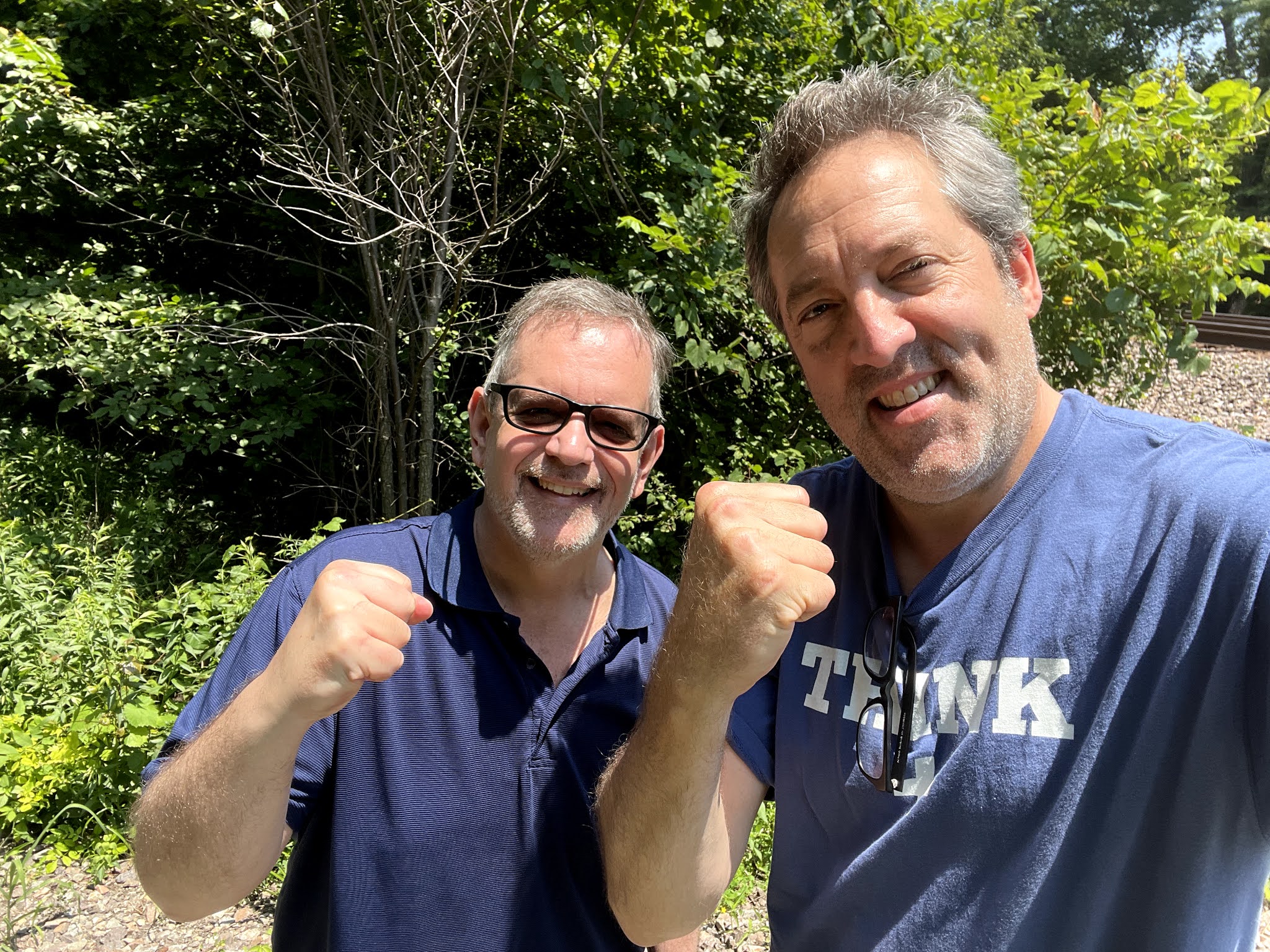
 This summer I was able to make a long anticipated trip to Kansas to do some touring and finally get to the beautiful Kansas State Historical Society to do some serious research on the Old Man.  Happily, I was able to meet up with my old friend, Ian Barford, an actor-scholar whom I've known for a good many years, and who shares a passion for John Brown with me.  (Here's a link to Ian's page on the website of Steppenwolf Theater Company.) We did as much touring as we could do in a day-and-a-half, and then spent the rest of the time researching in the archives. It was an ideal sojourn, fruitful and inspiring, and I wanted to share some pictures with my readers and podcast listeners.  

Black Jack

Here are some pictures from the site of the Battle of Black Jack (in present day Baldwin City, Kan.) which took place on June 2, 1856, when our man Brown faced off against the pompous editor-turned-soldier, Henry Clay Pate.  Outnumbered and outgunned, Brown and his men nevertheless got the better of Pate and took him prisoner.  In 1859, after Brown was defeated and jailed in Virginia, Pate made sure to visit Brown in Charlestown jail and gloat. But Brown was not easily intimidated. Pate the loser went on to try to capitalize on the Brown story by publishing a little book about him and then tried to go on tour, but he was as successful an author as he was a military leader (see my book, Freedom's Dawn: The Last Days of John Brown in Virginia, pp. 202-03).


Below, left, is our friend and guide at Black Jack, Kerry Altenbernd, who has devoted years, dollars, and devotion to preserving the Battle Jack grounds and the legacy of John Brown in Kansas.  (Click here to visit Kerry's website, "John Brown Speaks."Below, right, Ian Barford poses by marker #7, the site where Brown took Pate's surrender.


Kerry Altenbernd
Photo by L DeCaro, Jr. (2021)
Ian Barford
Photo by L DeCaro, Jr. (2021)


Osawatomie

Next we drove over to Osawatomie (OH-sawatomie) to see the Osawatomie Museum which houses the Adair Cabin, and is situated on site of the Battle of Osawatomie, which took place on August 30, 1856.  Nearby also is the monument to the free state fallen (below), especially being the resting place of Brown's son, Frederick, murdered by the Rev. Martin White, who led the proslavery invasion, and the murders sparking the battle. (Reliable evidence states that Frederick's holster was still snapped, so he had no time to draw his gun before being gunned down by the murdering Baptist minister White. Another free state man named David Garrison was murdered at the same time, and is also interred at the same site.) As I recall from doing my research, a shotgun was put to his mouth by his proslavery killers.

Photo by L DeCaro, Jr. (2021)


Below is a display of the Battle of Osawatomie and my pan shot of the grounds taken from the entrance. To the upper left at the top of the hill is the museum which houses the Adair Cabin.


Photo by L DeCaro, Jr. (2021)


 Post-John Brown, Osawatomie has an interesting history as a memorial ground. In 1877, the "soldier's monument" above was dedicated in remembrance of John Brown and those who fought in the Battle of Osawatomie, especially those who died that day in 1856. In 1910, the John Brown Park was dedicated on the site of the battle, and the ceremony was presided over by Theodore Roosevelt, by then former President of the USA. In 1935, the statue of John Brown, sculpted in Paris by George Fite Waters, was dedicated.

Undoubtedly, the John Brown statue by Waters is one of the highlights of the Osawatomie grounds.  It is strikingly lifelike, without any stylization or "larger than life" intention, as can be found in the other statues and paintings of Brown. Although Brown did not wear a beard in 1856, he was wearing a beard when he returned to the territory in 1858.  

Photo by L DeCaro, Jr. (2021)


Photo by L DeCaro, Jr. (2021)


. . . And the inevitable pose with the Old Man
Photo by Ian Barford (2021)

We were happily hosted by Grady Atwater (below, right), the site administrator of the museum and John Brown aficionado, who gave us a walking tour of the battleground (below, left) and then the Adair Cabin, sometimes (mistakenly) known as the John Brown Cabin.  Grady is a veteran researcher and historian and can talk extemporaneously on the subject of Brown in Kansas, so the tour was rich and is highly recommended.  Grady is a community educator as well, and one aspect of his work is contributing incisive and informative articles to the local press to keep John Brown before the public--always in a clear and authoritative manner, something that Brown often has not received over the decades.  In fact, not long after our visit, Grady published a great piece on the Pottawatomie killings of 1856 in The Miami County Republic online (17 July 2021), highly recommended.

Photo by L DeCaro, Jr. (2021)

Photo by L DeCaro, Jr. (2021)


Samuel Adair was a Congregational minister and missionary who preceded John Brown's sons by moving to the Kansas territory. His wife, Florella Brown Adair, was John Brown's younger half-sister. When Brown arrived in the territory in late 1855, one of the construction projects he undertook was to install a loft in the cabin, which Atwater explains provided a measure of security for the Adair children since free state settlers were subject to attack by proslavery terrorists.  

These rough-hewn beams supporting
the loftbear the marks of Brown
and his sons' labor

Photo by L DeCaro, Jr. (2021)


Over the years, the Osawatomie museum acquired a number of important items that belonged to Brown or directly relate to his life in Kansas and elsewhere. My favorite is his hat--something rarely portrayed in pictures, and a most unique. According to Atwater, the hat was made by the Native American free state ally, "Taway" Jones, who held property in Osawatomie and was a friend of the Adairs and Browns. The hat is worn and faded but still intact, and it doesn't take much imagination to picture it upon Brown's head, the brim just above his "meat-axe" shaped nose (as characterized by his sons). Frankly, it is no exaggeration to say that seeing this hat was one of the goals of my trip.  

THE Harper's Ferry Hat
Photo by L DeCaro, Jr. (2021)

Most interestingly, this was the hat that Brown wore at Harper's Ferry, although he has often been portrayed wearing "cowboy" styled hats, he wore this unique style of hat against the cold night air of October 16, 1859. The hat apparently was restored to him after his defeat in the Harper's Ferry engine house and then given to his wife Mary in a small trunk with other items the day before his execution. It was eventually passed into the hands of the Kansas Historical Society, and finally found its way to the Adair Cabin museum.  This appears to be the hat portrayed in the sketch below which shows Brown, riding his mule "Dolly," in an 1877 article by L. Witherell ("Old John Brown," Weekly Gazette [Davenport, Ia.], 21 Nov. 1877)
Photo by L DeCaro, Jr. (2021)


Pottawatomie

Before heading for the archives in Topeka, Ian and I had one more important stop: Pottawatomie Creek, the site of Brown's bold and bloody strike in May 1856 that left five local proslavery men dead.  We somewhat awkwardly found our way down to Pottawatomie Creek in Lane, Kansas, and drove down as close as we could to Mosquito Creek, where the Browns camped before making the strike. We walked down, across some railroad tracks and got a glimpse of the area where the Browns set out for their bloody raid on the night of May 24.  Quite pleased with ourselves, we brandished our fists in solidarity, but were shortly driven away from the creek by a band of violent mosquitos.  As Ian quipped, "Brown is probably smiling and saying, 'So you wanted to see Mosquito Creek, eh?'"  Yep, bites for days.

Photo by L DeCaro, Jr. (2021)
Some are quick to point out that none of the men killed (three Doyles, Wilkinson, and Sherman) were not slaveholders. But Brown did not target them because they were slaveholders, or even because they were proslavery men. Rather, Brown and other free state men ascertained and confirmed that these men were acting local proslavery provocateurs and guides for an invading (and illegal) army of proslavery terrorists, and that they themselves had targeted the Browns for attack.  In the absence of protection from law enforcement in the territory, Brown and his men agreed to take action by eliminating five terrorist enablers.  For all of the noise that Brown's critics have made about this so-called "massacre," the reality is that it was a preemptive strike, that the men killed were prevented from very shortly doing the same thing to the Browns, and--really--the killings showed a lot of restraint and targeted discipline.  Had Brown wished to rampage and kill (like the proslavery men had done and would do again and again in the territory), he could easily have killed many more proslavery men.  But Pottawatomie was simply a decisive guerrilla strike that threw the enemy into confusion and probably bought the free side three more months before another attack was organized. 

To put it another way, we feel no need to apologize on Brown's behalf in the retrospect of history.  In fact, to turn a phrase from the late Boyd B. Stutler, the Pottawatomie five were more or less some "bad eggs in need of killing."  At least two of us tend to agree.--LD

Photo by Ian Barford (2021)

Saturday, July 31, 2021

Special Submission: "Quest for Richard Parker"


I'm very pleased to publish this special submission on Judge Richard Parker, who presided over the trial of John Brown and his raiders in 1859.  In this particularly busy season, I am especially grateful to Trish Ridgeway for sharing her rich and expert research on this important figure in the John Brown story! --LD

-------

I began my quest for the story of Judge Richard Parker in a courtroom where he practiced. As a docent at the Shenandoah Valley Civil War Museum, located in the 1840 Frederick County (Virginia) Courthouse, I often faced the question, “Were there famous trials here?” 

Richard Parker (Wikipedia)

I told them that there were no outstanding trials, but Judge Richard Parker held court here and explained that he was the judge in the 1859 trial of John Brown in Charles Town, Virginia (now West Virginia). Fortunately, museum visitors did not ask for more details about Parker because I did not know much more about him.

Sources of Information about Parker

Noted John Brown collector Boyd B. Stutler (1889-1970) wrote the longest biography of Parker—a 1953 article in the Magazine of the Jefferson County Historical Society. Authors writing about the John Brown trial, who want to provide background information on Parker, cite this article. It is full of details about Parker’s life, drawn from his daily journals and other sources but provides no documentation. As a retired librarian and amateur genealogist, I was offended by this. Surely, I could locate more information.

Therefore, I began my search for primary sources relating to Parker. I discovered Stutler did not document his sources because he owned most of them. After Stutler’s death, the West Virginia State Archives acquired his massive John Brown holdings. In 1999, on the 140th Anniversary of Brown’s hanging, the Archives placed the majority of the John Brown/Boyd B. Stutler Collection Database online, and it is a phenomenal resource. The University of Virginia, the Library of Congress, and the Chicago Historical Society also have important Parker documents, and there are minor holdings in other institutions. Parker’s wife, Evalina Moss Parker (1821-1887), preceded him in death, and they had no children. His estate went to two nieces, who sold everything, and what items were not destroyed, either by Parker or the nieces, were widely dispersed among collectors. It was just the kind of challenge a librarian enjoys.

Richard Parker Discoveries

What have I discovered about Judge Parker? I knew that his father and grandfather were also prominent lawyers. Until I put together a complete genealogy of Parker and his wife, I did not realize how enmeshed into Virginia aristocracy he was. His ancestors married into prominent families. His sisters married into the noteworthy Milson, McCormick, and Crenshaw families. When it came time for Richard Parker to marry, he married Evalina Moss. Her great-uncle, Hugh Holmes (1768-1825), was a notable Winchester judge. Evalina’s aunts on the Holmes side married into the McGuire, Conrad, and Boyd families—all leaders in the community. Her sisters also married into prominent families. When Parker presided at Brown’s trial, Virginia Governor Henry Wise, U.S. Senator James Murray Mason, and prosecuting attorney Andrew Hunter were his peers.

Richard Parker, Harpers Ferry Paymaster—Some Shady Practices?

Rarely mentioned is that Parker served as paymaster and military storekeeper at the United States Armory and Arsenal at Harpers Ferry from 1838 to 1847. The job was a political appointment that brought many perks. According to Merritt Roe Smith’s work on the armory, many irregularities occurred in the administration of the paymaster’s office. Richard Parker was no different: 

One of the most mischievous practices consisted of paying armorers with depreciated currency. . .  While every incumbent from Lloyd Beall to Richard Parker practiced this ruse, it became especially prevalent during the 1830s. In November 1839, for instance, Parker exchanged two treasury drafts on New York banks for discounted bank notes and realized a profit of $1700. This sum exceeded his annual salary by more than four hundred dollars.1

Smith cites records of the Chief of Ordnance in the National Archives, which I have not had the opportunity to examine.

Parker: Undated gilt portrait,
Shenandoah Valley
Battlefields Foundation

When Parker left the armory, he strongly recommended his paternal aunt’s son, John Richard Parker Daingerfield (1817-1889), for the post of paymaster. I have not found any research that notes that the men were cousins. Daingerfield was appointed paymaster. On his way to work on October 17, 1859, he was taken by John Brown’s men and held with the other hostages. Daingerfield was a witness in Brown’s trial.  Current Virginia law does not require that a judge recuse himself when a cousin is involved in a trial. However, I think that today this relationship and Parker’s previous connection to the armory would lead a judge to recuse himself. In 1859, ruling-class members were tightly bound by family, political, and other ties. Therefore, Parker’s affiliations were probably of no concern.

U.S. Congressman Richard Parker 

Parker was active in politics during his time at the armory, attending Democratic Party conventions and coercing employees to vote for the party of the armory superintendent—another common practice. He practiced law for a time after leaving Harpers Ferry. In 1849, Parker won the nomination by the Democratic Party in Winchester for a seat in the U.S. Congress. It took sixteen ballots, but he was nominated, and subsequently won. 

One item that survives from his Congressional term is a February 23, 1850, speech he delivered on whether California should be admitted to the Union as a free or slave-holding state. He staunchly defended the right of Southern states to own slaves and to retrieve slaves from the North and stated that the North had no right to exclude slavery from the territories. He warned, “should aggression be accumulated upon aggression, and wrong upon wrong—it is not for me to predict what line of conduct Virginia will pursue.”2 He gave the speech nine years before the John Brown raid.

Judge Richard Parker

Parker resigned from Congress in January 1851 when he was appointed to be a judge of the General Court and soon after was appointed to the Virginia 13th Circuit Court. Ironically, he was following in the footsteps of his father, Richard Elliott Parker (1783-1840), who resigned from the U.S. Senate when appointed in 1837 to what is now called the Virginia Supreme Court. 

Judge Richard Parker, the arraignment of Brown and his men, 
and the Charlestown Court House as portrayed in contemporary
illustrated newspapers (Nov. 1859)

The district that Judge Parker served included Harpers Ferry. He was not selected to be the judge at the John Brown trial because of his political connections. By happenstance, Parker was the judge assigned to hear cases in the Jefferson County circuit court that opened at the county seat of Charles Town on October 20, 1859, two days after Brown and his men were captured. The November 2, 1859, New York Weekly Tribune described Parker at the trial:

"On an elevated platform at the rear sat the Judge, comfortably reclining in his chair, his legs resting upon the table before him, amid the chaos of law-books, papers, and inkstands, and holding upon his knees a volume bigger than all the rest. Judge Parker is a man of middle age, short and stoutish, and with a countenance singularly stern, by reason of the sharp lines about the mouth. His manner is mild and quiet, and there is dignity in his presence, notwithstanding the aspiring legs."

Parker’s handling of the John Brown trial is much debated. The trial proceeded at great speed, and Parker’s rulings have received much scrutiny; however, it is too full a topic to cover adequately here. 

Parker, a Traitor to the Confederacy?

Parker kept a journal during the Civil War. He does mention the war, but the journal is more centered on personal matters and trips to visit relatives. I was surprised that he was able to travel during the war. He mentioned that on July 10, 1863, he had difficulty returning from Richmond to Winchester, a distance of about 136 miles, when, “Found all public means of conveyances taken up by Conf. Govt.” He had left Winchester on June 29, two weeks after the 2nd Battle of Winchester. The Battle of Gettysburg occurred in his absence. By July 10, every possible means of transport had been commandeered to evacuate the Confederate wounded. 

Parker's Parole of Honor, Nov. 2, 1864 (see note 6)

Incidentally, he notes in his journal that while in Richmond, he called upon Governor John Letcher, Secretary of War James Alexander Seddon, Auditor of Virginia Jonathan McCally Bennett, State Treasurer Major John Strother Calvert, and Secretary of the Commonwealth George Wythe Munford.3

Those wartime trips to Richmond did not work out well. When he returned from a trip to Richmond on April 22, 1864, he was stopped at a Confederate outpost. He told the outpost commander, Captain Thomas Davis, a Maryland native, that Davis must not know who he was. Davis replied that he did, and that is why they stopped Parker. The episode is recorded in detail in a six-page letter Parker sent several days later to General John Imboden, the commander of the troops at the outpost. There had been many questions about Parker’s loyalty during the war, and Captain Davis seemed to know all of them. Imboden’s troops at the outpost appeared to lose interest in the affair. However, Parker would not let the matter rest and brought supporters from Winchester. He interrogated them about his fealty to the cause in front of another officer and was sent through to Winchester two days after he was stopped. Winchester saw over fifty different occupations of the city during the war by the belligerents.  Times were perilous for Winchester civilians since some supported the South and others, the North. Every action and word were scrutinized, and every previous wrong remembered.4

Parker after the War

Before the war, Parker was a friend of Francis Harrison Pierpont (1814-1899). Pierpont was an enemy of Virginia during the conflict because he was governor of the loyal (the Union) portions of Virginia and was instrumental in the formation of the state of West Virginia. After the war, Pierpont went to Richmond to serve as governor of Virginia. He appointed Parker to reorganize the courts in Parker’s old circuit. Both Pierpont and Parker were removed from office when the government in Virginia came under military rule in 1867.

Parker then returned to private practice and also accepted a small number of students to his law school in Winchester.  He had no public comment on the John Brown trial until he agreed to be interviewed for an article in the April 1888 St. Louis Globe-Democrat. The article described the 77-year-old Parker:

Judge Parker is not a large man. He is a little below the average height. He has a strong, compactly-built frame, a dignified bearing and a kindly manner. There is none of the tremor of age about him. His hair is thick, long and iron-gray. He combs it back over the crown. The stature, the massive head, the broad forehead, the square chin and the high complexion suggest in some degree portraits of Stephen A. Douglas. . . .

Parker stated that his main reason for allowing the interview was to set straight criticism of the trial, “that John Brown had a fair and impartial trial, just such as should be granted to all persons.” He made the assertion but provided little evidence.5

Parker obituary notices, 1893

In 1893, Parker died at his home in Winchester at the age of 84. I have located obituaries on Judge Parker from newspapers around the country. Except for local coverage, most of the stories were short and said in one way or another, “Judge Richard Parker, the man who tried John Brown, has died.”

My quest for Parker continues. I am working on a book that will discuss Parker’s life and reproduce primary documents about him. I hope it will become a reference work for those who seek information on Parker when writing about the John Brown trials.

----------
Author's Biographical Information

Trish Ridgeway is a resident of Winchester, Virginia, although she has the good sense to winter in Florida. She retired in 2013 after twenty years as director of the Handley Regional Library that is headquartered in Winchester. She has written and spoken on many library and Civil War topics. Recently, she presented “Remember Me, Union Officer Graffiti from the Gettysburg Campaign” to several area Civil War roundtables. In 2001, with her husband, Harry, she helped establish a museum in Winchester, the Shenandoah Valley Civil War Museum. Her current projects include creating a library for the Shenandoah Valley Battlefield Foundation and writing a book on Judge Parker.  She is also working on an annotated copy of Boyd Stutler’s article about Parker, to be published in the Magazine of the Jefferson County Historical Society on the 70th anniversary of the article’s first appearance.
----------

Notes

     1 Merritt Roe Smith, Harpers Ferry Armory and the New Technology, the Challenge of Change (Ithaca: Cornell University Press, 1977), 265.


     3 Trish Ridgeway, “Judge Richard Parker’s Civil War Diary, 1862-1864,” Winchester-Frederick County Historical Society Journal, 29 (2018), 24.

     4 Trish Ridgeway, “Judge Richard Parker’s Loyalty, the Parker-Imboden Correspondence, Spring 1864,” Journal of the Shenandoah Valley during the Civil War Era, 3 (2010), 107-122.

     5 “John Browns Raid, Important Additions to the History of the Harper’s Ferry Affair. Judge Parker, of this City. who Sentenced the Liberators, Reveals Some Long Kept Secrets,” St. Louis Globe Democrat, April 8, 1888, 26-27

     6 Richard Parker Parole of Honor, Nov. 2, 1864, to Brig. Gen. J.B. Imboden, Judge Richard Parker Papers. Richard Parker, 1810-1893, Folder 3. Chicago History Museum, Chicago, Ill.


Thursday, June 17, 2021

The John Brown Portrait by Selden Woodman


The Woodman Portrait
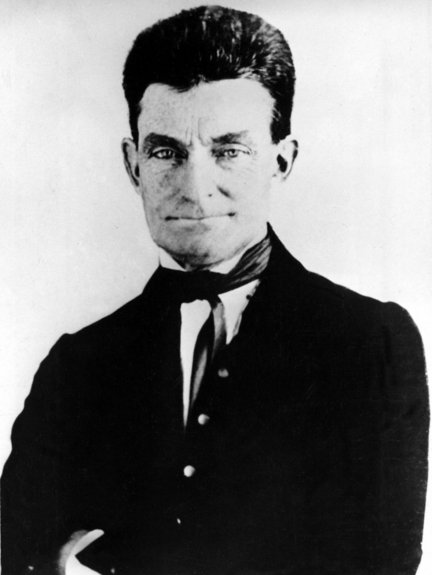
Sometime in early 1858, probably the week of February 28, John Brown was in New York City amidst a busy schedule of meetings, but took time to visit the Great Hall of the Cooper Union, which had opened a year in advance of the completion of this famous Manhattan structure (now the home of the Cooper Union Institute, near Astor Place in Greenwich Village's east side). Perhaps Brown was in attendance to hear an abolitionist or women's suffrage presentation. Regardless, his visit to the famous site would have been lost to history were it not for Selden J. Woodman, an artist who, as a young man, met Brown and enjoyed a "very animated conversation in the hallway" of the Cooper Union.

In the early 1880s, Woodman met A. G. Hawes, formerly a Kansas associate of Brown, who complained that none of the portraits he had seen were pleasing to his memory of the abolitionist. Afterward, Woodman stopped at the Kansas State Historical Society (KSHS), in Topeka, and examined a number of images of Brown in that collection, none of which impressed him until his eyes fell upon "an old photograph." This image had been sent to the KSHS from Boston. 

Winnie Tintype 
Kansas State Historical Society


According to Francis Adams, then Secretary of the KSHS, the image had been sent along with a collection of materials compiled by Thomas H. Webb of Boston, formerly Secretary of the Kansas Emigrant Aid Company. Woodman later recalled that it was this image, along with his own memory of Brown from 1858 from which he made his portrait. According to John Brown documentary expert Jean Libby, the KSHS image from which Woodman worked is a "copy tintype" (attributed to Winnie of Topeka, Kansas)--one of three images that Brown had made while in Boston in January 1857. Based on Libby's essential work on the John Brown images, we know that Brown's associate James Redpath remembered these images being made, and that Brown had given one of them to Webb in Boston. Libby finds that all three images are attributed to Hawes (or John A. Whipple) in that city. 

The Cole Engraving of
Woodman's Portrait
When Woodman's illustration appeared on the cover of The Century Magazine in July 1883, it was highly regarded—including by Brown's widow, Mary, who saw it in Kansas and afterward wrote that "the more I see it, the more I like it."  In more recent years, however, Alice Keesey Mecoy, a direct descendant of John Brown (through Anne Brown Adams), made an investigation, noting that what The Century Magazine actually featured was an engraving by Timothy Cole, a notable woodcut engraver at the time. As Alice has observed, we have mistakenly attributed the Century image of Brown to Woodman, but should distinguish the engraving in Century from the original portrait done by Woodman based on the tintype in KSHS.  You may read Alice's extensive article about her analysis and conclusions on her blog, John Brown Kin.  See "A Mystery About an Engraving of John Brown," Sept. 17, 2017.  


Saturday, March 27, 2021

Responding to a "1619" critic who says, "Don't create resentment"

A letter to the editor appeared yesterday in the Quad City Times, published in Davenport, Iowa, under the title, "Don't create resentment."  It reveals the thinking of a conservative who considers truth-telling about racial injustice in US history as being unnecessarily divisive and "creating resentment."  In particular, the writer is critical of the controversial New York Times "1619 Project."  I am quite aware that the 1619 Project has faced some legitimate historical criticism, and that while many of these criticisms have been answered, there remains disagreement among historians, some of the harshest criticism coming -- to no surprise -- from some historians who represent the "top-down" reading of US history, including the Lincoln priesthood.

As Leslie Harris of Northwestern University has written in Politico (6 Mar. 20), the best-known of the scholarly critics of the 1619 Project actually "built their careers on an older style of American history—one that largely ignored the new currents that had begun to bubble up among their contemporaries."  Harris acknowledges that one of the central claims of the Project is questionable--that the American Revolution was driven by proslavery interest.  However, Harris is concerned that in challenging the errors of the 1619 Project, a flawed perspective will find opportunity to persist among historians "that consistently ignores and distorts the role of African Americans and race in our history." In other words, the fault-finding critics are still invested in presenting "white people as all powerful and solely in possession to the keys of equality, freedom and democracy."  At least, "the corrective history" of the Project may be imperfect, Harris concludes, but it is moving in the right direction--a direction that its dignified opponents refuse to take.

As a John Brown biographer, I cannot help but sympathize with the 1619 Project, even though it is apparently flawed in some of its notable claims.  Like Harris, I have no problem scoring the journalists of the Project for their errors.  As historians, we need criticism and critical evaluation if we are indeed interested in truth-telling about history.  However, I have seen how some of these same critics of the 1619 Project have misrepresented and maligned John Brown, revealing to me that even dignified Princeton historians can be grossly incorrect, and even use their "gatekeeper" status in order to embed bias and error in the historical record. 

Worse, hostility toward the 1619 Project has become associated with the right-wing and reactionary MAGA mentality toward "American history." It is bad enough that critics in the academy cannot separate the wheat from the chaff when it comes to the Project, but as objections trickle down to the larger population, it further depreciates the important direction that the 1619 Project has taken in order to reinforce simplistic, rightwing notions of history that exist in the public, such as the following letter to the Quad City editor charging that the 1619 Project creates "resentment."

I am writing to voice concerns about treating the 1619 Project as "history." It is based on the premise that American prosperity was built on the back of slavery. The historical record states differently.

Early in the formation of the United States, slavery was rejected by the northern states. For decades, Congress tried to maintain a delicate balance between free and slave states. The balance was so tight that a free state could not come into the union without a slave state. This is evidenced by the Missouri Compromise of 1820 and the Kansas-Nebraska Act. The Mason-Dixon line divided these two ideologies. Bloody Kansas and John Brown’s attack on Harpers Ferry unraveled the political balancing act.

What has this to do with the 1619 Project? By the start of the American Civil War the free North held overwhelming advantages in population, industrial capacity and railroads. Investment and immigration favored the North because there opportunity was to be found. The North used these advantages to march into the South and crush the Confederacy. With this advantage the North invaded the South with an edge in warships, cannon, logistics, troops, and the ability to move them. Had slavery been the foundation of American prosperity, these conditions would have been reversed.

We can enhance the history of Americans of color without fabrication. There are great heroes from before the Revolution to our astronaut corps today. Let’s add examples that we should all look up to rather than creating resentment and division.

The author of this letter probably thinks he is saying something of a corrective nature, but unfortunately he is reflecting how resistance to the 1619 Project is more than just a matter of historical criticism, but rather is reactionary and determined to sustain a view of US history that does not offend his sensibilities.  This is what he means by saying, "don't create resentment."  This is very typical of rightwing and conservative complaints, which accuse anyone who is critical of the political and social status quo as being divisive or as creating resentment.  It does not seem to occur to such people that for many years, the narrative of history that they embraced has created a great deal of resentment for people of color and for any people wishing to tell the truth about the racist priorities of the US in historical terms.

The writer's objection to the idea that the US was built upon slavery is an incredible denial.  It is a matter of great historical consideration, for instance, that the US in the antebellum era was built upon the backs of slaves.  As Eugene Dattel writes in Cotton and Race in the Making of America, cotton--picked by enslaved Africans from 1803 until the end of slavery, "stimulated economic growth more decisively than any other single industry or crop." Even setting aside the fact that the cheap, oppressed labor of black people after Reconstruction further enriched the US, the point is that cotton was the foundation of the industrial revolution.  In other words, contrary to the letter writer, "American prosperity" was indeed built "on the back of slavery." The centrality of slavery in the building of the US is not a point missed by the 1619 Project, but it is a point that will not be widely appreciated if its opponents are given the final word.

The letter-writer goes on, in retrospective Pollyanna, appreciating "the delicate balance" that existed between free and slave states, and then blames John Brown for "unraveling" the "political balancing act." This is a revealing statement.  The writer seems to credit the compromise that prevailed in this nation, which kept four millions of Africans enslaved, as "delicate balance."  Conversely, the writer is resentful of Old John Brown, for allegedly destroying that "delicate balance." The question is, what kind of mind would have such a retrospective view of the US, to speak of the hellish compromise of the antebellum era in such precious terms?

The letter-writer clearly is dealing in a kind of self-serving naivete, writing about the contrasting economies of the North and South as if they were competing--the strong industrial North versus the inferior slave-based South.  But this is simply not true.  The truth is far more complicated and unpleasant because while the North was based on industrial growth, that growth was premised on cotton and other "slave crops."  Northern factories produced cotton goods and northern banks and insurance companies grew prosperous on slaveholder wealth.  The wealthy sons of the South came North for education and specialized training. In the antebellum era, the North had deep connections to the South, and when John Brown did strike, it was the business community and their workers who protested most loudly against him because they understood what this letter-writer does not.  They understood that the economic condition of the North was bound to the operations of the South.  Indeed, this was one of the features of northern conservatism before the Civil War.

The letter-writer reflects an insular mentality, one that prefers to believe that US history is about "delicate balances" and "great heroes."  To suggest anything else is to--as he concludes--"create resentment and division."  But the division has been there all along--the division between white supremacy and its victims; the division between "top down" readings of US history and grassroots narratives that reveal a nation steeped in racism and injustice; the division between privileged white people and those who see this nation's history as anything but exceptional and "great."