The Research & Writing of Louis A. DeCaro Jr.


"The world needed John Brown and John Brown came, and time will do him justice." Frederick Douglass (1886)

Search This Blog & Links

Translate

Sunday, November 03, 2013

Brown Family News--
There's Something About Mary


In recent years, the growth of interest in John Brown has happily sparked interest in the abolitionist's faithful second wife, Mary Ann (Day) Brown. Certainly, Jean Libby has once again led the way in exploring the Brown family's westward sojourn and later years in California, and has focused research on Mary Brown and her daughters for quite some time.  More recently is the publication of The Ties That Bound Us: The Women of John Brown's Family and the Legacy of Radical Abolitionism (Cornell University Press, 2013) by Bonnie Laughlin-Schultz, Professor of History at Eastern Illinois University.  Laughlin-Schultz had evidently made a notable contribution to the study by producing the first extensive study of Mary Brown, who was an antislavery figure in her own beliefs.  The author also provides material on Anne Brown Adams, perhaps the most colorful of the abolitionists' daughters.  I look forward to reading The Ties That Bound Us, although I am sorry that Laughlin-Schultz chose to emphasize Anne's later years to the exclusion of the later years of Brown's eldest daughter, Ruth Brown Thompson.  It would seem to me that Ruth, being the eldest daughter, bears far closer examination.  Laughlin-Schultz is reasonable in focusing on Anne, since she did spend some months in Maryland, keeping house for her father prior to the Harper's Ferry raid.  In contrast, Ruth was not present with her father in the famous episodes of his antislavery activity, Kansas and Virginia.  Yet she was the eldest, and was married to Brown's favorite son-in-law, Henry Thompson, who was in Kansas with the Old Man.  An expansive study of Ruth's life would have made a study of "the women of John Brown's family" truly complete. Notwithstanding this gap, this book appears to be well-researched and documented, and will stand as a major contribution to the literature.  As to her reading of the Old Man both personally (including religion) as well as politically, I hope to provide a more helpful review in the near future.

Mary Brown en route to meet
her husband for the last time
(Frank Leslie's Illustrated News, 
Dec. 12, 1859)

Mary Brown, "A Bastion of Strength," Says Atwater

Osawatomie, Kan.--John Brown’s widow, Mary Day Brown, had the daunting task of caring for her family after John Brown’s hanging at Charlestown, Va. (now West Virginia), and John Brown’s supporters came to her aid.

Mary was a strong woman who took up the challenge of being a widow and a single mom amid the glare of publicity that came with being the widow of John Brown in the 1860s.
Mrs. George Stearns was one of John Brown’s supporters, and Mary related her gratitude for Stearns’ support for her family and John Brown’s abolitionist crusade in a March 13, 1863, letter. She wrote:
I saw the same account in the Liberater [sic] of the meeting of some the most noble souls that our country contains at your beautifull [sic] home and I must say that my soul leaped for joy when I read it. I was indeed and truly with you in spirit on that most glorious and long to be rememberd [sic] day. I saw that a committee of the same noble spirits visited the Presidend [sic] soon after I was much rejoiced at hopeing [sic] that some great good might result from it. My mind has been much with you ever since I knew the bust of my dear beloved husband was in your house. It was truly a place that he delited [sic] to visit when he was in the body. Oh I am so glad that he never made any move that you have to reflect on him for but that you rather rejoice over he done. It has been a great comfort to me to know that his own personal friends have never condemed [sic] his movements. It is only those that are capable of appreatiating his motives that can see any beauty in them.
Mary's last meeting with Brown, Dec. 1, 1859
Her faced obscured, this artist's rendering reminds
us that the devoted wife of the Abolitionist has
often been overlooked by historians
(Frank Leslie's Illustrated News, 17 Dec. 1859)
Mrs. George Stearns had helped John Brown’s daughters, Sarah and Annie, attend school, and Mary gave Mrs. Stearns a report on how Sarah and Annie were faring at school:
Sarah is realy [sic] doing well and Annie is doing quite well. I shall have them stay at school another term. I think that if you ever feel like doing any more for Sarah you will find it more satisfactory than you did before. She is capable of more improvement. I will send your love to them when I write.
Mary also thanked Mrs. George Stearns for story books that Mrs. Stearns had sent her daughter, Ellen, and wrote, “Ellen is a learning a great deal at home this winter. She begins to read the story books you sent her. She is a good girl.”

Mary Day Brown was a bastion of strength for the Brown family when John Brown was alive and engaged in his abolitionist crusade and stood stronger after John Brown’s death in 1859. She worked to provide for her family’s support and education in difficult times and is an unsung heroine in the John Brown saga in American history.

— Grady Atwater is administrator of the John Brown State Historic Site

Source: Grady Atwater, "John Brown' widow an unsung heroine," Osawatomie Graphic, 30 Oct. 2013

Saturday, October 26, 2013

News and Views--

Historic Trail for John Brown’s Connecticut Birthplace

The Torrington Historical Society is teaming up with the Northwest Connecticut YMCA’s Torrington Trails Network to create a hiking trail at the birth site of the city’s most famous native.  The two groups are coordinating volunteers to clear a new hiking trail of three-fourths of a mile at the John Brown Birthplace site on Saturday. The work is being done as part of the group’s efforts to make the historic site more accessible to the public. The site has been owned by the Torrington Historical Society since 2000.

New Daguerreotype of John Brown Emerges

John Brown documentary scholar and image expert, Jean Libby, contacted me earlier this month to examine a daguerreotype that has surfaced recently, the owner evidently intending to sell it at auction.   The dag is not characteristic of images of Brown that are more familiar to historians and students, and so it required closer examination.   My own inclination upon first hearing of the image was skepticism.  After all, in 150 years, it seemed logical to me that there were no surviving images of Brown that we have not seen. However, the longer that I examined it, studying the particulars of the face, it seemed harder and harder to deny that it is indeed the face of John Brown.  Jean Libby, the leading authority on Brown daguerreotypes and derivative images, pointed out that the photographer likely prepared the daguerreotype in two phases.  Since daguerreotypes are reverse images, he then made a daguerreotype of the first daguerreotype, thus effectively producing a real-life image of Brown.

The reversal correction on the part of the photographer probably accounts for some of the initial unfamiliarity evoked by the image.  However, the image is also unfamiliar in certain details because of Brown's appearance--especially his long, dark sideburns and a frontal view of his face, which provides a slightly different perspective on his nose.  Brown's sons humorously described their father's nose alternatively as resembling a "meat axe" or a "bird of prey."  These descriptions are better appreciated in this new daguerreotype.

Another unusual feature of the image is that he is very well attired, and even has a stud in his shirt collar.  However, this is probably explainable by the fact that it seems to have been taken in the early 1850s, at the point when Brown was still collaborating with the wealthy Simon Perkins, Jr.  Although the wool commission house of Perkins & Brown had folded in 1849, Brown actually continued a fairly successful partnership with Perkins, who had his own flocks and wool business.  Brown was also entangled in a number of law suits and legal demands that stretched through the early 1850s, requiring him to travel from Akron, Ohio throughout the northeast.  The image of Brown is perhaps the most "bourgeois," and this seems consistent with his profile as a businessman and wool expert in that era.   Too many have been poisoned by half-baked historical presentations and unfounded exaggerations of Brown's rocky business life prior to 1855, so this will surprise many who think he was just an abject failure.  However, notwithstanding his financial difficulties in the late 1830s and 1840s, Brown had somewhat improved through his highly successful work in sheep and wool in the later 1840s, and by his association with notable Ohio names like Oviatt and Perkins.   Most narrators in popular culture are clueless as to Brown's great success and reputation as an expert in "fine sheep and wool."  At any rate, Harvard University archives possesses a stud with small diamonds in the shape of a "B" that was owned by Brown, probably in this period.  (It was later gifted to Abraham Lincoln.)   So despite the novelty of seeing Brown attired like a prosperous businessman, there is nothing untenable about the dag in this regard.

I shared the dag with a prominent illustrator who has worked extensively in portraying Brown, and he too was stunned at the familiarity of important details, especially the hairline, which he found to be the same as in other dags of Brown.  There are other notable facial features--the shape of his closed mouth, the lines and shaped of the flesh near his nose, and the "wear-and-tear" around his eyes, all of which suggest Brown's aged appearance was already starting before he went off to Kansas in 1855.  While his hair was already starting to show signs of gray in the first part of the 1850s, he was obviously far more grayed in the late 1850s.

For evident reasons, I cannot post the image made accessible to me.  However, the image will probably be generally available once the dag is placed on auction.  Assuming its authenticity  and the general nod of approval from Brown scholars and others associated with his image, there is no doubt that this dag will bring a lot of money to the owner.   The appearance of this dag reminds us that just because we had not seen it, does not mean there wasn't more history to uncover.  This is true both in regard to images and documents. These discoveries are far more accessible to us today because of the internet, and so we should not be surprised that other discoveries are made.  For instance, I was recently informed about a letter, written the week after the Harper's Ferry raid in October 1859, by the superintendent of the armory, which had also gone to auction online.

This is a good lesson for narrators and cultural "experts" who think they know all there is about the Old Man, and rely on the opinions and hearsay of tour guides and academics with little grounding in the primary documents.   Much of what is already believed about Brown is untrustworthy and negative; and there is still more that may yet be uncovered that demands a revision of popular notions about the Old Man.


Wednesday, October 16, 2013

Remembrance--
154 Years Ago Today, John Brown and His Men Tried to Start the Second "American" Revolution

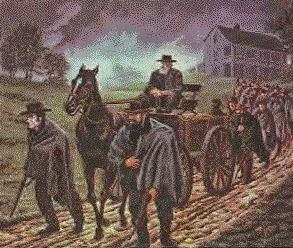
Brown and raiders leaving for Harper's
Ferry, Sunday night, Oct. 16, 1859
(artist unknown)
In 1859, October 16th fell on a Sunday.  That cold, rainy night was the time that Brown and his raiders left their Maryland farm, walking into the town of Harper's Ferry, Virginia [today in West Virginia, the state having been created four years after the raid].  As Brown surmised after extensive preparatory work, Harper's Ferry was completely vulnerable and taken off guard.  The two federal armories, Harper's Ferry and Springfield, Mass., were under civilian supervision, without a military presence of any kind.  This is why Brown knew that seizing the armory was a feasible strategy.

Brown left some men at the Maryland headquarters with different orders than those who went with him to seize the town and the armory.  It is often said that Brown seized the "arsenal," but the arsenal was only one part of the operation.  Properly speaking, Brown seized control of the town and the entire federal armory operation.

Although the number of raiders with him was small, Brown had sufficient men to carry out his plan, which was to make a quick strike, rally available enslaved men, gather important hostages (slaveholders) from the immediate vicinity, and withdraw to a strategically advantageous position.  From that position, he intended to barter hostages for more enslaved men before withdrawing into the mountains nearby.  There is ample witness, even from local testimony, that had Brown gone into the mountains with his men, it would have been almost impossible to get him out or stop his movement deeper into the South.  (Because I am writing on these matters now, I'm not going to give explicit citations, but it was the opinion of both a local political figure and the armory superintendent that Brown's mountain strategy was very strong.  Brown himself stated that he and his men had spent considerable time exploring the mountains surrounding Harper's Ferry, and that he knew them better than many of the locals did.  I do not think that was a vain boast.)
Brown's Plan (Jacob Lawrence)

Typically, historians immediately project failure into the raid by discussing the death of Hayward Shepherd, the black porter and "freeman" at the train depot.  None of Brown's men were pleased at the killing of Shepherd, but there is good evidence that Shepherd was deliberately killed because he was extremely difficult, refused to cooperate, and was trying to get away to warn whites in the vicinity.  Apart from some of the slaveholders who tried to fight Brown's men, Shepherd was probably the most troublesome figure at Harper's Ferry.   Shepherd was of that stripe that Adam Clayton Powell Jr. and Malcolm X later referred to as a "house" servant.  He may not have been enslaved on a plantation, but he was entirely bound up in the interests of the slave masters, which had become a source of income and prosperity for him.  A liberated black man, he was a token in the community, since free blacks were not allowed to stay in Virginia; the community of slaveholders loved and trusted Shepherd completely because he was thoroughly their man.  His patron was the mayor, Fontaine Beckham, his former master, and Beckham and enabled him to amass money and property in a manner impossible for his enslaved brethren.  Apparently, Shepherd did not care that his prosperity was made in spite of the plight of his brethren, and he was willing to risk his life and disdain every warning from Brown's men, even to the point of trying to sneak over to the Maryland side to warn whites.   It is no wonder that local whites whined and wept over his death.  I doubt there was any mourning in the slave quarters for Hayward Shepherd; even Osborne Anderson, the only primary witness among Brown's men to write an account of the raid, spoke of Shepherd as an unfortunate but problematic figure.
Having failed tactically, Brown withdrew to make a last
stand at the HF engine house (artist unknown)

Shepherd's death was no signal that Brown was going to fail.  It only signified that Brown's men were consistently following orders.   The real problem with Brown's own tactical failures, which were signs to his men that things might not work out.  I respectfully disagree with Tony Horwitz on this point: I fully believe Brown's testimony regarding his failure, and I think it makes sense--he failed at Harper's Ferry because he delayed; he delayed because he became overly ponderous and worried over managing his hostages.  Brown bent over backwards to assure hostages and railroad personnel that he was not going to do them harm.  Brown let a train pass through and even walked the train across the bridge himself to assure the engineer that the train was not in danger.  When the night grew cold, he then made the lethal mistake of taking the hostages into the armory facility where it was warmer; he had intended to keep the hostages at convenient points of escape on the Maryland side of the bridge.  He wasted time "parleying" (as Anderson put it) with his hostages, in part trying to get them to agree to hand over choice enslaved men, and afterward trying to get them to agree to cooperate in a safe withdrawal from the town.  He pondered and got lost in his own extreme tendency to be excessively thoughtful; he became paralyzed long enough that opposition forces gathered and cut off escape routes.  John Brown failed at Harper's Ferry because of tactics, not strategy.  This is a long misunderstood and misrepresented point.
From John Hendrix, John Brown: His Fight for Freedom

Historians' attempts to belittle Brown's overall plan, and even the entry into Harper's Ferry itself, are not well founded.  Much has been made of Frederick Douglass' warning (of which we know only from Douglass) that Harper's Ferry would prove a "steel trap" for Brown.  Perhaps Douglass actually said this to Brown prior to the raid; but if he did, Douglass was speaking from ignorance.  Like others, he probably believed the town and armory were under military supervision.  But Brown conducted advance tours incognito, studied the whole town and operation meticulously (this was his nature), and had a plan that was quite good--except that it was time sensitive.  Brown admits to all of this in the journalistic accounts taken immediately after the raid, and repeatedly states these matters in personal letters from jail.

One of the pikes Brown designed to
arm the liberated slaves
The most unfortunate point missed in conventional (and often hackneyed) accounts of the Harper's Ferry raid is that Brown's larger plan--his intention to start a south-wide liberation movement was never tested.  I believe the invasion of Harper's Ferry was a political statement, as Robert McGlone has pointed out; but I hope to provide even more persuasive evidence than he does to that end.  Regardless, the raid was not Brown's plan, and his south-wide plan ought not to be dismissed as quixotic, simply because he failed to carry out his plans in the town of Harper's Ferry.   Had Brown withdrawn into the mountains, it is doubtless that he would have drawn many enslaved people away from plantations and farms, and that he would have been able to throw the entire South into a state of panic, offset the "peculiar institution," and become an entrenched movement that the small, undeveloped U.S. army could not have stopped, nor local militia effectively prevented from spreading across slave states as far as Texas.  The problem is serious consideration is rarely given to Brown's plan, nor is his plan placed in the context of the larger situation among slaves and slaveholders in the late 1850s.  Many local slave revolts had taken place, often overlooked by conventional historians.  Brown could have found ample opportunity in various regions to build his movement even further.  This was the material of which revolutions are made.
Original sketch of Brown's hanging (Alfred Berghaus)

Unfortunately, Brown failed--John Brown failed, and is to blame for his own failure.  However, as a man of faith and purpose, he did not fail to regroup and seize upon the next possible opportunity to serve the cause he loved.  As a prisoner, he decried any vain notion of rescue and he resented northerners who sent harassing letters to Governor Wise of Virginia.  He was a realist enough to see that his hanging would still serve the cause of the enslaved African.  Every evidence is that Brown found a sense of peace and spiritual contentment in the waning days and weeks of his life in Virginia.  He knew his martyrdom ("martyr" is a Christian word in its origins, which simply means "witness") would provoke the nation in both its best and worst inclinations; perhaps he understood, too, that since whites valued white lives above black lives, then his death would move whites in the North more than the deaths of many blacks.  Even his jailer later said that Brown seemed joyful on the day of his hanging, December 2, 1859.   Of course, I attribute this much to his Christian faith and belief in the divine purpose being fulfilled, regardless of human failure.  But Brown went happily to the gallows, hoping it would in some way make amends for his failed leadership, and even more that he would prove a hinge upon which would turn the next great movement for black freedom.

History has shown that he was correct.

Sunday, September 29, 2013

Autographa--
Two John Brown Letters to be Auctioned in October

One of the leading auction houses for historical manuscripts, Heritage Auctions of Dallas, Texas, is currently advertising two John Brown letters to be sold between October 16-18, 2013.  Probably coincidentally, the letters will be sold during the 154th anniversary of the Harper's Ferry Raid (or as some of us Browniacs like to call it, "Independence Day").

The most notable letter, starting at $4000, is written from Brown to his half-sister and brother-in-law, Florella ("Florilla") and Samuel Lyle Adair on April 22, 1856.  Brown wrote the letter from his sons' settlement, known as "Browns Station," to the Adairs in the burgeoning free state center of Osawatomie. (Brown later earned the sobriquet, "Osawatomie Brown" engaging the proslavery enemy at that place; the enemy identified Osawatomie as a target of assault because it, following the town of Lawrence, was distinguished for its anti-slavery stance.)  The Adairs met at Oberlin College and Samuel was an ordained Congregational minister; they went to Kansas in advance of all the Brown family to establish missions work, and were also expressly anti-slavery.  Brown's letter to the Adairs reports events preceding the attempted coup by proslavery terrorists--including the proslavery courts that endeavored to prosecute free state activists, especially abolitionists like the Browns.  Brown was particularly mindful of a proslavery Judge named Cato, who was intimidated the previous day when Brown and his men showed up at court unarmed to oversee the hearing.  "The Court is thoroughly Bogus," Brown wrote, but the Judge had not the nerve to avow it openly."  Brown also mentions the arrival of a relative, Orson Day, the oldest brother of his wife, Mary Day Brown, who answered the free state call and migrated to Kansas; the Browns labored to prepare a dwelling for Orson in advance of his arrival. 

A little over a month after this letter was written, Brown, some of his sons, and a number of local allies, struck a preemptive blow against proslavery neighbors involved in a plot to eliminate the abolitionist element in their vicinity.  The strike resulted in the deaths of five proslavery men, including a man and his two sons, both young adults.  Unfortunately, this so-called "Pottawatomie massacre" has been consistently portrayed in a one-sided manner--as if Brown were the originator of terrorism in the U.S., and as if the attack were simply an act of malice, retaliation, or gratuitous political violence.  Most popular narratives continue to present a one-sided approach and do not take into consideration the evidence that abolitionists in that locale were literally in danger of an imminent assault by invading proslavery forces, and that the proslavery assault was enabled and guided by local proslavery people--including the unfortunate "victims" of Brown's assault.  Initially, Brown had gone to Kansas to protect his family and support the free state cause against militant assault; a genuine study of the evidence will show that Brown would not have taken such harsh action were it not considered a matter of necessity, not only by him, but by others in the vicinity.

Of additional interest is a bonus: an older letter from Samuel Adair to Florella, only months before their marriage in 1841.  Adair wrote from Oberlin, Ohio, but speaks of being called to pastoral positions.  He answered one such call in a Congregational Church in Sandyville, Ohio, where he was pastoring at the time he married John Brown's younger, half-sister Florella (born 1816).  Florella first met Samuel while studying at Oberlin College, notable in history for both its anti-slavery and coeducational stance, as well as its heterodox "Perfectionist" doctrine, especially espoused by evangelist Charles G. Finney, who divided his time between Oberlin and New York City.   

As for the Brown-Adair letter of 1856, it is not unknown to me, although this is the first time in recent years (as far as I'm aware) that it has come up for sale.  In the mid-20th century, the Rev. Clarence S. Gee, a Brown documentarian and genealogist of the Brown family, obtained a copy of the letter, which today can be found in the Gee Papers at the notable Hudson Library and Historical Society in Hudson, Ohio.   Prior to that, Katherine Mayo (who did the greater part of the research work for biographer Oswald Garrison Villard) made an excellent transcription of the letter in 1909, now available in Villard Papers of Columbia University's Rare Book and Manuscript Collection.


The second letter is not signed by Brown, but represents business correspondence of the firm of Perkins and Brown, which the abolitionist founded with Simon Perkins, Jr. of Akron, Ohio.  The letter, dated May 1, 1851, is less interesting to many people, who are mainly focused upon Brown's controversial abolitionist activities.  However, for a few enthusiasts like me, it is always exciting to see any document in Brown's hand, including those offering insights into his earlier life.  The letter, written to one of Perkins and Brown's clients named Beall, pertains to matters of an overdrawn account.  The letter reflects the extensive business loose ends and concerns that plagued Brown following the folding of their wool commission operation in 1849; that spring, Brown had moved his family to the Adirondacks, but he was obligated to make frequent and extensive trips to Springfield, Mass., the site of their former operation, to deal with legal and business matters over the next few years.  Conventional writing on Brown's wool business has greatly exaggerated his role as a "bad businessman" in the failure of the wool commission house.  While there is some truth in the portrayal, it is also true that Brown's efforts to support wool growers met with unified opposition and counter-tactics (including surveillance and subterfuge) by powerful manufacturers in New England.  He also found it difficult to work with the wool growers themselves, who had not yet evolved as a community in regard to their collective interests.  Their refusal to work cooperatively for the greater good in preparing wool for market, as well as their ongoing demand for immediate results from Perkins and Brown, proved a great disadvantage in addition to the opposition of manufacturers.  As a last measure, Brown tried to circumvent the powerful manufacturers by proposing partnerships with European firms in Belgium and France.  However,  ultimately he found them unreliable, particularly when they could purchase cheaper wools from their own colonial wool growers.  More often than not, Brown was left holding the (wool) bag, and bears the blame for the Perkins and Brown failure.  Yet a half-century later, the wool growers of the same region finally formed a coalition and accomplished many of the things that Brown had sought to realize in the 1840s.  It seems that Brown was a multi-faceted visionary.

The letter from Perkins and Brown is entirely in John Brown's handwriting but does not have his signature, rather being signed, "Perkins & Brown."  It was previously put for sale by Signature House Auctions (Bridgeport, West Va.) in 2010, and either was not sold at the time, or is now being resold by Heritage Auctions with a starting price of $1,500.

Interested in purchasing these letters?  Visit the Heritage Auction site at:
http://www.ha.com/c/search-results.zx?N=793+794+791+792+2088+0&chkNotSold=0&Ntk=SI_Titles&Nty=1&Ntt=%22John+Brown%22&ic=homepage-search-


Tuesday, September 17, 2013


John Brown Legend
ca. 1945
William H. Johnson

oil on board
38 5/8 x 36 1/4 in. (98.2 x 92.2 cm)
Smithsonian American Art Museum
Gift of the Harmon Foundation

1967.59.1145

Monday, August 19, 2013


Take Note-- 
EQUALITY WEEKEND

COUSINS OF REFORM:

Elizabeth Cady Stanton
and Gerrit Smith
   
By Norman K. Dann, PhD

Women's Equality Day Program

Sunday, August 25, 2013
2pm

Gerrit Smith Estate National Historic Landmark
5304 Oxbow Road
Peterboro, NY 13134

$3 Adults
Free for Students

315-280-8828
  
Elizabeth Smith Miller
In the Kitchen Tea

Celebrate the namesake of our favorite costume
Amelia Bloomer

Tea catered by The Copper Turret of Morrisville
Hosts dressed in 1951 Bloomer costumes
  
September 22, 2013 - 12:30 pm
Smithfield Community Center
Peterboro, NY
  
Reservations needed - $35 by September 1, $40 by September 15
  
Mail checks to: Smithfield Community Association,
PO Box 72, Peterboro, NY 13134 or
National Abolition Hall of Fame and Museum
2013 Induction Weekend


Jonathan Walker

Myrtilla Miner

Elijah Lovejoy

John Rankin


Saturday, October 19, 2013

Abolition Symposia
1 pm - Elijah Lovejoy presented by Ary J. Lamme III
2 pm - Myrtilla Miner presented by Christopher Anglim
3 pm - John Rankin presented by Dr. John R. Kaufman-McKivigan
4 pm - Jonathan Walker presented by Alvin F. Oickle

5 pm - 19th century Antislavery Dinner, catered by the Copper turret of Morrisville, NY (Reserve)

7 pm - Induction Ceremony with 19th century Readings and Music, directed by Hugh C. Humphreys

Sunday, October 20, 2013
9 am - Heritage Sites Open
9:30 am - Guided Tour Gerrit Smith Estate National Historic Landmark
10:30 am - Guided Tour National Abolition Hall of Fame and Museum

Harriet Tubman 2013 Commemorative Year
1 pm - Harriet Tubman: Myth, Memory, and History by Milton C. Sernett, PhD
2 pm -North of the Law by Linda Robertson (Video about Sarah Bradford, Tubman biographer)
3 pm - Beyond the Underground Railroad: Harriet Tubman, Moses of her People by Tubman relatives 


REGISTER BY OCTOBER 7, 2013


Quick Links


 About Us

   The Peterboro Mercantile, a community heritage shop, the Gerrit Smith Estate National Historic Landmark (GSENHL), and the National Abolition Hall of Fame and Museum (NAHOF) are open Saturdays and Sundays from 1-5 pm beginning Saturday, May 19 and ending Sunday September 23, for special events and tours, and by appointment. The GSENHL is a site on the National Park Service Network to Freedom (national Underground Railroad trail) and both sites are on the Heritage NY Underground Railroad Trail, a program of the NYS Office of Parks, Recreation, and Historic Preservation. Adult admission is three dollars. Students and 2013 Stewards are free. The projects are recruiting volunteers for the 2013 season.
 For more information and the check updates on programs: 
  315-280-8828.
  

Thursday, August 15, 2013

A Novel Approach--
The Color of Historical Fiction: James McBride Spoofs the John Brown Story in The Good Lord Bird

I'm never really sure of how I feel about historical fiction in general, especially when it takes on themes that are dear to me.  The only work of fiction about the Old Man that I have both enjoyed and actually read from cover to cover is Terry Bisson's Fire on the Mountain, which is an amazingly thoughtful effort that engages counter-factual history (which is fiction) in a manner that is moving and multi-perspectival.   I would recommend Fire to anyone and everyone, and I keep it with my John Brown books.  While Russell Banks' widely praised Cloudsplitter (which I keep behind my John Brown books) illustrates the author's great ability as a novelist, I never read it all the way through.  I just got tired of watching the author telling me a story that was not the story I knew to be true, period.  Like the late Boyd Stutler, the godfather of John Brown studies, I'm just not that fond of historical fiction--and frankly there's already too much to read in terms of history to spend more time reading someone else's fictive portrayal of the Old Man. (Still, I have promised to read Marilynne Robinson's Gilead, which has been fervently recommended to me.) Now there's James McBride's The Good Lord Bird.
. . . it seems a lot of people think that they can engage in meaningful historical reflection by reading novels about real people.  

Before noting The Good Lord Bird, let me add: what annoys me about historical fiction is that it seems a lot of people think that they can engage in meaningful historical reflection by reading novels about real people.  And I think that reflects both error and laziness.  We already live in a culture and generation that is virtually ahistorical and intellectually lazy when it comes to history.  In John Brown's case, it's worse, because lots of people are already grossly misinformed and prejudiced in their thinking due to terrible high school texts, bad TV documentaries, and lots of prejudiced talking heads.  A work of fiction about Brown (even if it is basically friendly) is absolutely the last place that one ought to start thinking about Brown in historical terms.  Yet, inevitably, many will do so, as the following comment reveals from a reader on Goodreads:
Was John Brown a terrorist, martyr, hero, lunatic, saint or deluded fool? After reading The Good Lord Bird I would still hesitate to give a straight answer, although James McBride does appear to be leaning toward a heroic, almost saint-like depiction of the raider of Harper’s Ferry toward the end of this rollicking ride through the latter part of Brown’s life.
I would hope you would hesitate, lady.  I wonder how many biographies of Brown she's read?  Now, this may be something that just happens to John Brown, especially among whites, too many of which presume he is "complicated" and "troubling," and have this big historical problem in their minds about the Old Man that drives them to the latest novel.  Maybe it happens to Lincoln or Henry Ford or Richard Nixon, too, but I doubt it.  It seems to me that whenever someone writes fictional work about John Brown, it is forced to carry water for historical inquiry. Nevertheless, why the *&%! did this reader think she was going to get "a straight answer" about a historical figure from someone's fictional rendition?  Frankly, it's kind of stupid, yet this is the issue that always comes up with another work of historical fiction about John Brown.

As I said, I am a biographer and historian, and I teach history and theology.  I can never read enough across the disciplines in which I teach and research, so the idea of reading novels is pretty much out of the question.  Furthermore, to unwind by reading a novel completely misses the point for me.  That's what movies are for.  However, the fact that I have little use for fiction (yes, I know there are good arguments for "the power of story," etc.), I know many others love novels and sometimes historical fiction is a starting point for people who want to read history.  To each his own.

Now that I've done my song and dance about fiction, here's some info on The Good Lord Bird, and you can decide for yourself whether you want to read it:

Publishers Weekly

"Musician and author McBride offers a fresh perspective on abolitionist firebrand John Brown in this novel disguised as the memoir of a slave boy who pretends to be a girl in order to escape pre–Civil War turmoil, only to find himself riding with John Brown’s retinue of rabble-rousers from Bloody Kansas to Harpers Ferry. “I was born a colored man and don’t you forget it,” reminisces Henry Shackleford in a manuscript discovered after a church fire in the 1960s. Speaking in his own savvy yet naïve voice, Henry recounts how, at age 10, his curly hair, soft features, and potato-sack dress cause him to be mistaken for a girl—a mistake he embraces for safety’s sake, even as he is reluctantly swept up by Brown’s violent, chaotic, determined, frustrated, and frustrating efforts to oppose slavery. A mix-up over the meaning of the word “trim” temporarily lands Henry/Henrietta in a brothel before he rejoins Brown and sons, who call him “Onion,” their good-luck charm. Onion eventually meets Frederick Douglass, a great man but a flawed human being, Harriet Tubman, silent, terrible, and strong. Even more memorable is the slave girl Sibonia, who courageously dies for freedom. At Harpers Ferry, Onion is given the futile task of rousting up slaves (“hiving bees”) to participate in the great armed insurrection that Brown envisions but never sees. Outrageously funny, sad, and consistently unflattering, McBride puts a human face on a nation at its most divided."
James McBride

New York Times Book Review

"A MAGNIFICANT NEW NOVEL by the best-selling author James McBride…a brilliant romp of a novel…McBride—with the same flair for historical mining, musicality of voice and outsize characterization that made his memoir 'The Color of Water,' an instant classic -- pulls off his portrait masterfully, like a modern-day Mark Twain: evoking sheer glee with every page."


Library Journal

"McBride continues exploring the long history of America's color line, begun in his landmark memoir, The Color of Water. A young slave in the Kansas Territory, Henry Shackleford must flee with abolitionist John Brown after Brown clashes with Henry's master. Complicating matters: Brown thinks Henry is a girl, a disguise Henry maintains up to the bold raid on Harpers Ferry."

Kirkus Reviews

"In McBride's version of events, John Brown's body doesn't lie a-mouldering in the grave--he's alive and vigorous and fanatical and doomed, so one could say his soul does indeed go marching on. The unlikely narrator of the events leading up to Brown's quixotic raid at Harper's Ferry is Henry Shackleford, aka Little Onion, whose father is killed when Brown comes in to liberate some slaves. Brown whisks the 12-year-old away thinking he's a girl, and Onion keeps up the disguise for the next few years. This fluidity of gender identity allows Onion a certain leeway in his life, for example, he gets taken in by Pie, a beautiful prostitute, where he witnesses some activity almost more unseemly than a 12-year-old can stand. The interlude with Pie occurs during a two-year period where Brown disappears from Onion's life, but they're reunited a few months before the debacle at Harper's Ferry. In that time, Brown visits Frederick Douglass, and, in the most implausible scene in the novel, Douglass gets tight and chases after the nubile Onion. The stakes are raised as Brown approaches October 1859, for even Onion recognizes the futility of the raid, where Brown expects hundreds of slaves to rise in revolt and gets only a handful. Onion notes that Brown's fanaticism increasingly approaches "lunacy" as the time for the raid gets closer, and Brown never loses that obsessive glint in his eye that tells him he's doing the Lord's work. At the end, Onion reasserts his identity as a male and escapes just before Brown's execution. McBride presents an interesting experiment in point of view here, as all of Brown's activities are filtered through the eyes of a young adolescent who wavers between innocence and cynicism."

Goodreads (four stars)

"Henry Shackleford is a young slave living in the Kansas Territory in 1857, when the region is a battleground between anti- and pro-slavery forces. When John Brown, the legendary abolitionist, arrives in the area, an argument between Brown and Henry’s master quickly turns violent. Henry is forced to leave town—with Brown, who believes he’s a girl.

Over the ensuing months, Henry—whom Brown nicknames Little Onion—conceals his true identity as he struggles to stay alive. Eventually Little Onion finds himself with Brown at the historic raid on Harpers Ferry in 1859—one of the great catalysts for the Civil War.

An absorbing mixture of history and imagination, and told with McBride’s meticulous eye for detail and character, The Good Lord Bird is both a rousing adventure and a moving exploration of identity and survival."

Metro

James McBride’s new novel, “The Good Lord Bird,” is his second in a row to explore the issue of slavery in the years just prior to the Civil War. It was while researching his last book, “Song Yet Sung,” that he became fascinated with the story of the abolitionist John Brown, who led the violent slave insurrection at Harpers Ferry, West Virgina.

“I’d heard John Brown’s name many times in the past but never really quite knew who he was,” McBride says. “When I started to research him, I became fascinated with his story. The challenge was to find a way to write about him that was interesting and funny.”

Given the dark subject matter of the time period and of Brown’s tragic final days, the humor is the most surprising element of “The Good Lord Bird.” The story is told through the eyes of Onion, a young slave boy who becomes a part of Brown’s crew under the mistaken assumption that he’s a girl. Over the next few years, he crosses paths with luminaries
like Harriet Tubman and Frederick Douglass, the latter depicted making drunken advances on the disguised Onion.
“My approach is to make fun of everybody,” McBride explains. “In real life, I admire Frederick Douglass. He was a great man, but he was flawed as well. The people who built this country weren’t gods. They were flawed people, and you often wonder if the women in their lives
had the chance to write the stories of these men, how their account would read.”

McBride himself was surprised at the opportunities for satire afforded by Onion’s disguise. “The business of identity – self identity, inner identity – always drives the outer story,” he says. “I wanted Onion’s identity issues to be strong enough to push him to freedom at the end
of the book. I really didn’t consider all of the factors that would go into this character playing a girl at the outset; I just thought it was funny. Then as the book evolved and he got into these situations where he had to pretend to be a girl, it thickened the plot and just became delicious.”

In the end, McBride came to admire his subject, despite the misguided violence of some of his actions. “I think John Brown was one of the greatest Americans that ever set foot in this land,” he says. “John Brown was a man who represented an ideal and was willing to die for
it. He was way ahead of his time. I admire his sense of religion, his sense of purpose, and his unwillingness to compromise on the issue of human rights.”

Source: Shaun Brady, "Forging a 'delicious' tale out of difficult history," Metro (15 Aug. 2013)

Review by Christine Brunkhorst in the Minneapolis Star Tribune, 17 Aug.
Review by Margaret Quamme in the Columbus Dispatch, 18 Aug.
Review by Kevin Nance in USA Today, 18 Aug.
Review by Joel Lyons, in New York Daily News, 21 Aug.

Tuesday, August 06, 2013

"Grandeur in a Degenerate Age": William F. M. Arny, New Mexico’s Link to John Brown

Here I am in the land of big sky and no humidity, New Mexico.  I love NM—it’s about as “far away” as you can travel without leaving the continental U.S.  There’s lots of history here, too.  And while the Old Man never made it this far to the southwest, there is a NM connection to the John Brown story, in the person of William Frederick Milton Arny.  Now, since I’m working on another project and writing in-between family and vacation time, what follows is a series of pasted items about Arny.
W. F. M. Arny
www.territorialkansasonline.org

William E. Connelley, A Standard History of Kansas and Kansans.  Chicago: Lewis Publishing Company, 1918.

“Kansas has produced no more eccentric, generous or beloved character than William F. M. Arny. Although not a native of the state, he was a son in all that stands for its independence and humanity. He was born in the District of Columbia, March 6, 1813, and after graduating from Bethany College, West Virginia, acted for a time as secretary for Alexander Campbell, the famous Disciple preacher. At the age of twenty eight he was on intimate terms with all of the leading men of the nation, especially with such as Abraham Lincoln and others of force and originality. In 1850 Mr. Arny settled in McLean County, Illinois; was active in the organization of the republican party, and in 1856 was a committeeman in that state appointed to raise money to settle Free State men in Kansas. In that year he made a trip of investigation to the territory, and its condition so appealed to him that in the spring of 1857 he settled in Anderson County. 

The people of Kansas, who had come thither to stay and build a real commonwealth of equals, accepted William F. M. Arny as a valuable accession to their forces, electing him both to the Leavenworth constitutional convention of 1858 and the House of Representatives of the First State Legislature, which assembled with the outbreak of the Civil war. At that time he was also closing his faithful stewardship of the relief fund and the goods entrusted to him in behalf of the sufferers from the grasshopper plague of 1857. He had been elected a delegate to the Grasshopper Falls convention soon after coming to Kansas, had handled thousands of dollars and over 9,000,000 pounds of relief goods. In 1861 President Lincoln appointed him secretary of the Territory of New Mexico. He was a great favorite with the Indians in that region, and, in the prosecution of his official duties, accomplished much in exploiting the mineral resources of New Mexico. But in that matter, as in all other measures with which he was identified and prominent, he did not profit financially; in fact, seemed always careless of personal gain. Naturally he died poor, albeit honored and deeply loved  which is better than to have died financially prosperous. On his return from a trip East he stopped off at Topeka, was taken ill and died suddenly September 18, 1881. A short time before, at the theater, he had been robbed of his money and passes, and a collection of $125 was taken up among his old Kansas friends to pay the expenses of his burial. His body was forwarded to Santa Fe, where funeral services were held in the palace.”

Arny's gravestone at the
Santa Fe National Cemetary

“New Mexico Territorial Secretary. He was well educated for the day, and notably religious. He was converted from the Baptist to the Disciples of Christ Church and formed a lifelong relationship with that church to the point of traveling widely and conducting revival meetings. In 1848 a split over church matters developed and he moved to Bloomington, Illinois where he became interested in scientific agriculture, printing, and teaching. A new dispute occurred and in 1856 he moved to Kansas, settling first in Lawrence and then in Hyatt. Again he became heavily involved in political turmoil and when his friend Abraham Lincoln was elected president in 1860 Arny sought a political appointment. He was named Indian Agent to the Utes and Jicarilla Apache of northern New Mexico, succeeding Kit Carson. He found the problems immense and the resources scarce and accomplished what was possible with the means at hand. In 1862 he was appointed Territorial Secretary of New Mexico, holding that position until 1867 and serving occasionally as acting governor. In 1867 he was appointed agent for two years for the mountain Utes in Abiquiu, New Mexico and for the Pueblos along the Rio Grande. In 1870 he became Special Agent for the Indians of New Mexico and he extended his concerns to the Mimbres and Mescalero Apaches, conferring with Victorio, Cochise and other noted Apache chiefs. In seven months he made a visit to every tribe in New Mexico, southern Colorado, and southeastern Arizona, took Indian census, evaluated their condition, and made a full report. His reappointment by President Ulysses S. Grant was strongly disputed in the 1872 Senate, but he was eventually confirmed. In the summer of 1873 he was named the Navajo agent where, again, disputes and complications hampered his efforts. In 1874 he took a large contingent of Navajos to Washington, DC but his difficulties could not be overcome and he submitted his resignation on July 22, 1875. His last six years in New Mexico were lived in financial impoverishment. In 1879 he learned that he had inherited a large fortune in England, but he arrived there too late to collect.”


William F. M. Arny examined by the Senate Investigation Committee on the Harper’s Ferry Raid (Washington, D.C.: 1860)  

Excerpts only

January 16, 1860.

William F. M. Arny affirmed and examined.

. . . .

Question. Were you acquainted with John Brown, who was mixed up with the troubles and difficulties in Kansas, and who has been recently executed in Virginia?

Answer. I was. With reference to that, I should like to say a few words.

The Chairman. Certainly; any explanation you please.

The Witness. As a member and general agent of the National Kansas Aid Committee, I became acquainted with some matters pertaining to John Brown's operations in Kansas, which may throw some light on his operations at Harper's Ferry; but before I give testimony in regard to it, I would prefer to be sent home for my books and papers, so that I can give a full and accurate statement of the amount placed in my hands by individuals and committees, and how it was appropriated, so as to show definitely what was given to John Brown as far as I know, by whose order, and for what purpose. If this investigation is designed for a full exhibition of the relation of other parties to John Brown, it will be impossible for me to testify accurately, and so as not to do injustice to persons who are absent, unless I can have access to my memoranda, records, and books kept at the time, in which were recorded the events, to some extent, as they transpired.

Question. Will you state when your acquaintance with John Brown commenced?

Answer. Between twenty and twenty-two years ago.

Question. When did you first see him in Kansas ; when was your acquaintance with him resumed there?

Answer. My first personal connection with him in Kansas was after the beginning of 1857. I saw him previous to that, however, but not in Kansas. . . . I last saw him in the fall of 1858. . . . During the summer and fall of 1858, I saw him some half dozen times.

Question. Where was he then; where did you see him?

Answer. I saw him in Lawrence, Kansas. I saw him at my own house once or twice; he spent a day or two with me there. I saw him down on the borders of Missouri while I was engaged in surveying a railroad there. I think these are all the places where I saw him in the Territory during that year.

Question. Did he tell you then, in any of those interviews, of any plans that he had in contemplation to make a descent on any of the Southern States with a view to incite insurrection amongst the slaves? 

Answer. In my conversation with him, growing out of a communication that I was requested to make to him by Mr. Richard Realf, he said some things in regard to a plan that he had, but gave me no details in regard to it.

Question. What was the character of the plan? You may give that without going into details. What sort of a plan was it?
. . . .

The Witness. It may be as well to state here that in all my conversations with Brown I opposed any project of even carrying off slaves, and my connection with him was more interposing to prevent him from getting means to accomplish anything of that kind.
. . . .
The Chairman. Well, you returned to Kansas. Now, you can go on.

The Witness. I think the first time I saw Brown after I got into the Territory was while I was engaged in surveying a road through Missouri and from Missouri to the Neosho valley, and during the time of the troubles in Linn county, Kansas. It was directly after what were termed the Marias-des-Cygnes murders, when Hamilton came over from Missouri and killed a lot of men, taking them from their farms in Linn county, on the borders of Linn. After speaking to Brown in regard to the position of things in the Territory at the time, I said to him that I understood that an organization was established in that county and neighborhood in which I was very glad to learn they had decided that no invasion should take place of the territory of the State of Missouri ; I then remarked to him that I had seen [Richard] Realf in New York. He was standing a little way off. He immediately came close up to me. He said, "I am glad to hear that, for I thought Realf was gone to England and had not attended to what we had appointed him." I then told him that Realf asked me to say to him that he did not know where to write to him, and that if I fell in with him to say to him that he had been engaged in the matter to which he was appointed, and that he could not learn definitely what Forbes was after, but that he had gone to Washington; that was about the substance of the message that Realf gave me. Brown then asked me if I knew who Forbes saw in Washington. I told him, no. Well, said he, you were in Washington. I said, yes. I then immediately remarked to Brown that I thought it very strange that he would be engaged in an enterprise such as Realf had intimated to me they were engaged in. ''Why strange,"' said he. Why, said I, "Brown, when I knew you twenty years ago over in Virginia, you professed to be an abolitionist, and an abolitionist of that class that are termed non-resistants, and you refused to use arms in any shape or form; even when you were opposed, you would not resist, and you were considered ultra on that subject at that time; how is it that you have changed?" He then referred to the fact that he had sent his sons into the Territory of Kansas in 1853 or 1854 with a lot of blooded cattle and other stock with the intention of settling. “You know they did settle on the Pottawatomie, and that after they settled there, part of their cattle was stolen; they were
notified to leave the country, and they had to sacrifice their cattle."

The Chairman. I do not think it important to know Brown's reasons for this thing. We want to get at the facts.

The Witness. I am only detailing the conversation I had with him. There were three conversations with him; he was at my house two days. 
. . . .

Question. You have said, as I understand, that Brown, in speaking of his plan, referred to some action taken by that committee, and that you were present when that action was taken. Now state what the action was that was taken, to which Brown referred?

Answer. Mr. Brown applied to that committee

Mr. Collamer. State when and where.

Answer. He applied sometime in the month of January, 1857, at a meeting of that committee, at the Astor House, in New York, for some arms, and other assistance, to organize a company of men and equip them, to repel the invasion in Kansas by Missourians. The action of the committee, to be short about it, was a refusal at that time to let him have the arms, and an agreement to let him have some other matters that would assist him in a peaceable settlement in the Territory of Kansas.

By Mr. Collamer:
Question. What were they? 

Answer. Clothing and other things.

By the Chairman:
Question. What do you mean by a peaceable settlement?

Answer. That he should settle there in the Territory of Kansas, and not go out. The policy of this committee was a policy of self-defense, and opposed to any attempt to invade the States or any Territory.

By Mr. Davis:
Question. Do you mean clothing for himself or for others?

Answer. Clothing for himself and others.

Question. For distribution?

Answer. Yes, sir; for persons that he was acquainted with and that he represented were in a destitute condition. 

By the Chairman:
Question. Was that the action that Brown referred to?

Answer. Yes, sir; he referred to that action, and 1 think I can give the exact words, after speaking of that action.

By Mr. Doolittle:
Question. Was this an application for the arms which were in Iowa at that time?

By the Chairman:
Question. You say that Brown told you of some plans that he had to arm a party of men for the purpose of stampeding slaves from the slave States, and in telling you of that plan he referred to the action taken by this committee at Buffalo, and you now tell us what that action was. That action was an application of Brown for certain arms for certain purposes, and a refusal of the committee to let him have those arms for those purposes, and a proposition by that committee to aid him in a peaceable settlement. I want to know how Brown referred to that action in connection with any plan of running off slaves. What had that to do with running off slaves?

Answer. In my conversation with him, I was finding fault with him for proposing a plan of that kind; and, in finding fault with him in regard to that matter, he classed me with the abolitionists, with the republican party, and with this committee, and he said we were all alike a set of cravens, that we all refused to give him assistance to carry the war into Africa.

Question. You spoke of applications he had made to some people in the East. What applications did he speak of there that he had made? 

Answer. After his application to the committee at the Astor House, in New York, in 1857, and a refusal by all who were there to do anything for him at that time, and after the settlement of the ownership of these arms, which was made afterwards at the same meeting, he then addressed a letter, a copy of which I have and can furnish to the committee if I have my papers, to the people of the States. 

Question. What States?

Answer. Of the free States, asking for aid.
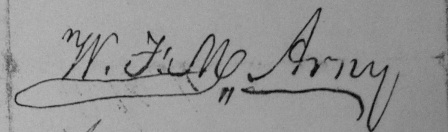
Arny's signature from a John Brown document
excerpted from Gilder Lehrman image 


William Arny's Reminiscence at Brown’s grave, July 4, 1860

“I have known John Brown to give the last dollar from his scanty purse in Kansas to Free State men whom he met in a worse condition.  The life of him whose remains rest before us, is full and brimming with such deeds.  The record of that life he has left us, a solitary mark of grandeur in an otherwise degenerate age."  

Source: "Celebration at North Elba; The Fourth of July Among the Adirondacks," Liberator (27 July 1860): 1