
Thursday, May 23, 2024
The Apple Doesn't Fall Far from the Tree


Monday, December 04, 2023
My Latest--John Brown's Expert: Boyd B. Stutler & His Unfinished Biography of John Brown

In the early 1950s Stutler took on a biographical project under a publisher's contract. He never finished the work, and the only material surviving from the biography is six chapters and an outline that he shared with Gee (the original subsequently turned up in West Virginia too, but for many years it was not apparently known by archivists and historians there).
In 2000, when I was researching Gee's papers, I copied that unfinished manuscript and used it as a source for my first book on our subject, Fire from the Midst of You: A Religious Life of John Brown (NYU Press). Over the years, however, I so frequently relied upon Stutler's materials and revisited many of his research ventures, that I became more conscious of his life and contributions and thought it an obligation to bring the manuscript to publication someday.
 |
| Boyd B. Stutler (West Virginia State Archives) |
John Brown's Expert can be ordered from Amazon, Barnes & Noble, or directly from Lulu Publishing.
Endorsements for John Brown’s Expert
DeCaro has brought us another gem! Veering slightly from his own John Brown biographies, DeCaro critically explores the life and work of Boyd Stutler, a passionate, conservative mid-twentieth-century editor and zealous chronicler of Brown’s immensely important life. Like a detective, DeCaro follows Stutler’s steps through decades of work, piecing together the man’s long journey scouring libraries, archives, museums, and private collections to compose, but ultimately never finish his much-anticipated Brown biography. DeCaro has done it for him. Rich and pleasurable, a must-read!
Kate Clifford Larson, author of Walk With Me: A Biography of Fannie Lou Hamer, and Bound For the Promised Land: Harriet Tubman, Portrait of an American Hero
***
Louis A. DeCaro, Jr., one of the all-time top authorities on the antislavery warrior John Brown, has performed a great service by issuing the unfinished biography of John Brown by the late Boyd Stutler (1889-1970), another all-time top authority. To date, scholars have known Boyd Stutler through the West Virginia Memory Project, the finest online resource for primary materials on Brown. In John Brown’s Expert, DeCaro provides us not only with Stutler’s previously unpublished narrative of Brown’s pre-Kansas years but also with a richly detailed account of Stutler’s own life, including his fascinating exchanges with publishers, scholars, and general Brown aficionados. Anyone seriously interested in the history of abolitionism will want to read John Brown’s Expert.
David S. Reynolds, author of John Brown, Abolitionist, and Abe: Abraham Lincoln in His Times
***
In John Brown’s Expert, author Louis DeCaro has ably raised from obscurity the pre-eminent researcher into the life of the famed abolitionist. Stutler comes across as an old-fashioned just-the-facts newspaperman loath to take sides in the debate over Brown’s rightful place in history. He never completed his intended Brown biography, but his legacy lives on in the massive amount of research he left behind and in DeCaro's important book.
Eugene L. Meyer, author of Five for Freedom: The African American Soldiers in John Brown’s Army
Wednesday, April 19, 2023
"Why Was Brown Silent on the Conditions of Free Labor in the 19th Century?": A John Brown Scholar Responds
In response to an article on this blog, "Why Was Brown Silent on the Conditions of Free Labor in the 19th Century?" (Oct. 31, 2022), another reader, Christian Chiakulus, has responded to Len Bussanich, who originally posed the question. Initially, Len wrote:
John Brown lived and worked in Springfield, MA. He must have known or heard about the conditions in the factories. I guess my question now is, why is there no examination of Brown's actions in the context of the industrializing North? Why would he-or the abolitionists-remain silent to the same oppressive conditions wracking the labor force in the North and not question, challenge or even confront the same capital dynamics that shaped the South as well as the North[?]
Last month, I noted that Christian, who is doing graduate work on John Brown, responded to Len quite insightfully, and rather than append his response to the original post, I thought it was worth presenting here. His response to Len is substantial and is reproduced completely as follows:
Thanks for these comments, this is a great discussion to have. Len, for what it's worth, Brown frequently did lament the state of "the poor" generally in America, not only that of slaves. In an 1855 letter from Ohio (so not a slave state), he wrote "I believe there is ten times the suffering amongst the poor in this State that ever existed before... Should God send famine, pestilence, and war upon this guilty hypocritical nation to destroy it, we need not be surprised."* Mr. DeCaro's point about Brown's agrarianism is the most pertinent, in my opinion; Brown seems to have been almost Jeffersonian in his lionization of agrarianism as the best way of life. He also didn't live to see the industrial revolution really take hold in the US, so while of course he would've been aware of factory conditions in New England, they had not yet reached the appalling heights of exploitation and prevalence that they would a few decades after his death. To add to LD's point about the racism among the white working class in the antebellum era, DuBois in Black Reconstruction outlines the extent to which the nascent socialist movement in the US capitulated to anti-black attitudes generally and even to the Slave Power itself to a degree. Socialist leaders here were well to the right of Marx and Engels on the issue.
John Brown and the Working Man (AI art)

While I also would love it if John Brown had come out strongly and openly against capitalism, I think he still did enough to earn the title of a hero to the working-class. His broad concern for the poor, advocacy for small wool growers, and Biblical belief in holding all property in common (see for example the Provisional Constitution) are solid evidence that, at least towards the end of the life, he was moving in that direction. [CK]
Christian's succinct and substantial response is appreciated.--LD
---------
*Christian quotes from John Brown to Henry & Ruth Brown Thompson, Jan. 23, 1855, in Chicago History Museum Collection.
John Brown Invited to "The Cookout" by Journalist Touré
So, the journalist Touré writes in The Grio (Apr. 19) that John Brown is one of thirteen "white folks" who get invited to "The Cookout." Why he chose thirteen is unclear, except perhaps he could not get his list narrowed down to the conventional ten names. At any rate, Touré even places the Old Man as No. 1 on the invitation list. That's the upside.

So, how would I parse this story?
Well, on one hand, it's kind of sad that a short list of so-called whites that might be invited to the quintessential African American "Cookout" is more cultural and contemporary than historically substantive. To his credit, I suppose Touré is only greasing the palm that feeds him because he knows that his readership is more geared to the contemporary, and so he's playing that game. But imagine if, in a couple hundred years, someone were to read this list and take it as a real social and political gauge of what it meant to be a good "ally" in the struggle for justice--well, it leaves a lot to be desired.
On the other hand, I'm impressed that even in a generation that tends to forget the past and revel in celebrity culture, John Brown still manages to get noticed and get his invitation in the mail. I must be honest: it's even a bit surprising to me because the cues as of late have been quite otherwise. The black history calendar by Ebony Magazine, which has notations for every day of the year, completely overlooked the Old Man, acknowledging neither his birthday (May 9) or his date of execution (Dec. 2)--two dates that African Americans in previous generations would never have overlooked. I just figured that's the process of time and change and that Brown is now a dusty figure in the attic of black memory. But I guess I was being pessimistic.
So, Captain Brown (as black people in the 19th century referred to him), have a great time at "The Cookout." You're still one in a million.
Wednesday, December 28, 2022
A Response to Mark Tapscott's Anti-Brown Screed
Recently, an investigative journalist named Mark Tapscott published a critical piece in response to my Christianity Today (CT) article earlier this year ("Why White Evangelicals Should Claim John Brown," Jun. 22, 2022), in which I present Brown as an authentic Christian figure who merits reconsideration on the part of his community in this era because of his commitment to racial justice. Tapscott is an accomplished editor, and a journalist with a commitment to promoting Christian faith among politicians in this nation’s capitol, something that I (nor probably John Brown) would not oppose. However, in earlier days, Tapscott worked for President Ronald Reagan as communications director at the Republican National Committee and as Assistant Director for Public Affairs at the U.S. Office of Personnel Management, and his political involvement with the right-wing also dates back to working for the Reagan-Bush campaign in 1980. To no surprise, then, Tapscott's complaint against my article, which is entitled, "Canonizing John Brown Would Mark the End of a Scripturally Faithful American Evangelicalism" (Dec. 26), amounts to little more than a screed. It appears on PJ Media.com, a self-proclaimed “center-right” publication, a subsidiary of the conservative Salem Media. Conservatives typically hate John Brown and their objections tend to follow along similar lines, so there's nothing really new here.
It is no surprise, of course, that Tapscott should take a polemical stance toward my effort in CT, which actually was somewhat pared down by the editor, and might have been less vulnerable to attack had my argument on behalf of Brown’s legacy been published. Still, it is important to point out that Tapscott represents a perspective that has has defined conservative Christianity in this nation for many years, and it is one that I know well because of my own upbringing. On one hand, conservatives stand for traditional moral and social values; on the other hand, conservatives are devotees of the status quo and have always been opposed to progress in matters relating to racial justice going back to the days of slavery. The instinctive reaction to Brown among conservatives was critical in his own day, and has been ever since. There are exceptions, of course, but hatred of Brown is typically overt among writers and activists with strong commitments to right wing political interests. As I have noted in another post ("The Fool As Biographer," Sept. 18, 2019), perhaps the most hostile and malignant work on Brown in the later twentieth century was done by Otto Scott, a journalist and historian who served the interests of industry and the right-wing. Tapscott seems more authentic in his Christian beliefs than Scott, but his inclinations are the same as a watchdog for conservatives. To no surprise, my piece on John Brown as an evangelical was more than he could take. Of course, the title of his piece is very telling. Tapscott presumes to speak for "scripturally faithful American evangelicalism." Well, so did the evangelical slaveholders and apologists for slavery in Brown's time. So did likewise the evangelical defenders of Jim Crow segregation and opponents of the Civil Rights movement. And so did the evangelical conservatives who supported apartheid in South Africa in the Reagan era. This is Tapscott's social and political DNA, so we should not be surprised that he sees himself defending "scripturally faithful American evangelicalism." It is a trait of people like him to believe themselves the guardians of what is "scripturally faithful" even though they are at best selective moralists.
Before going forward, a word must be offered with regard to evangelical as well. Conventionally, we have used terms like fundamentalist and evangelical with strong social associations, even though they are essentially theological. This is especially the case with evangelical, where it stands theologically as a category in juxtaposition with other theological brands like "liberal," "neo-orthodox," and "post-liberal." In fact, in theological terms, one can be an evangelical and left-leaning in politics. For
instance, one may be a socially conservative evangelical and hold to Democratic Socialism in many respects. European evangelicals are not necessarily right-wing in the way that "American" evangelicals invariably posture themselves. One example of this is found in the book by British historian Carl F. Trueman, Republocrat: Confessions of a Liberal Conservative. In 19th century terms, Brown was a left-of-center evangelical--which is to say that his theology was very conservative while his politics were "radical" compared to proslavery conservatives. In contrast, Mark Tapscott represents a tradition that, in Brown's time, counseled in favor of the legal rights of slaveholders, subordination of black people's human concerns to white people's preeminence, and harshly rejected any demand for immediate emancipation as "radical." So the question for Mark Tapscott is, "whose evangelicalism is really scripturally faithful?"
An Authority on the Subject?
Tapscott’s claim to making an authoritative reading of Brown is based on “a great deal of time” spent in the 1970s, when he says he carefully read the scholarship on Brown. In other words—and this is important—Tapscott’s reading of the literature on Brown is out of date at best. What Tapscott read in those days is unclear, but even so, he's running on the fumes of his own past. I wonder, has Tapscott read my religious life of John Brown? Has he read the epic cultural biography by David S. Reynolds? Probably not.
Tapscott also stakes his authoritative voice on having read “the coverage and commentary” on the 1859 Harper’s Ferry raid in “the nation’s top newspapers of that day.” Indeed, Tapscott continues, he had intended to do a doctoral dissertation on John Brown, although clearly (and thankfully) he changed course and went on to other things. Tapscott reveals, in fact, that he set aside his doctoral work in its third draft because he was called higher up—that is, he was summoned to serve in two of Reagan's presidential campaigns and other services to the actor-turned-president. Tapscott even provides the unseemly title of his unfinished opus: “John Brown and Gnostic Millenarianism in the American Political Regime.” Gnostic millennarianism?
I have never admired Ronald Reagan. I am old enough to remember his presidency and I know about his reputation as a governor before that, and I believe his record on race and racial justice exemplify the larger problem of conservativism in the US. So if this is the man to whom he devoted his youthful energies, it is really no surprise that Tapscott has taken issue with my piece in CT. Still, I am at least grateful to Reagan that he so prevailed upon a young Tapscott that he was obliged to abandon that travesty of a dissertation project, and left poor John Brown alone. Unfortunately, he has now found occasion in my article to take up his attack once again.
 |
| Mr. Tapscott |
Whose Evangelicalism?
.jpg) |
| white evangelicals (made on dream.ai) |
instance, one may be a socially conservative evangelical and hold to Democratic Socialism in many respects. European evangelicals are not necessarily right-wing in the way that "American" evangelicals invariably posture themselves. One example of this is found in the book by British historian Carl F. Trueman, Republocrat: Confessions of a Liberal Conservative. In 19th century terms, Brown was a left-of-center evangelical--which is to say that his theology was very conservative while his politics were "radical" compared to proslavery conservatives. In contrast, Mark Tapscott represents a tradition that, in Brown's time, counseled in favor of the legal rights of slaveholders, subordination of black people's human concerns to white people's preeminence, and harshly rejected any demand for immediate emancipation as "radical." So the question for Mark Tapscott is, "whose evangelicalism is really scripturally faithful?"
So, given that evangelical has become associated with politics in the USA, it has increasingly become entangled with the right-wing so that the term has been all but ruined for theological discussions. The wedding and bedding of evangelical by the rightwing whites have thus rendered it increasingly reactionary and hostile toward anything that challenges the status quo as they see it, the culmination of which was the rise of Trump, which some would say has brought utter ruin to the party of Lincoln. Certainly, the fixed intent of conservative evangelical watchdogs like Tapscott is to protect the top-down narrative of US history--a narrative that has treated slavery more as an unpleasant (parenthesis) and made powerful white men the basis of its claims.
This is why Tapscott has sounded the alarm of complaint about my article. It clearly galls him that another Christian, writing in an evangelical publication, should suggest that John Brown should be understood any differently than as a fanatic and killer.
An Authority on the Subject?
Tapscott’s claim to making an authoritative reading of Brown is based on “a great deal of time” spent in the 1970s, when he says he carefully read the scholarship on Brown. In other words—and this is important—Tapscott’s reading of the literature on Brown is out of date at best. What Tapscott read in those days is unclear, but even so, he's running on the fumes of his own past. I wonder, has Tapscott read my religious life of John Brown? Has he read the epic cultural biography by David S. Reynolds? Probably not.
Tapscott also stakes his authoritative voice on having read “the coverage and commentary” on the 1859 Harper’s Ferry raid in “the nation’s top newspapers of that day.” Indeed, Tapscott continues, he had intended to do a doctoral dissertation on John Brown, although clearly (and thankfully) he changed course and went on to other things. Tapscott reveals, in fact, that he set aside his doctoral work in its third draft because he was called higher up—that is, he was summoned to serve in two of Reagan's presidential campaigns and other services to the actor-turned-president. Tapscott even provides the unseemly title of his unfinished opus: “John Brown and Gnostic Millenarianism in the American Political Regime.” Gnostic millennarianism?
I have never admired Ronald Reagan. I am old enough to remember his presidency and I know about his reputation as a governor before that, and I believe his record on race and racial justice exemplify the larger problem of conservativism in the US. So if this is the man to whom he devoted his youthful energies, it is really no surprise that Tapscott has taken issue with my piece in CT. Still, I am at least grateful to Reagan that he so prevailed upon a young Tapscott that he was obliged to abandon that travesty of a dissertation project, and left poor John Brown alone. Unfortunately, he has now found occasion in my article to take up his attack once again.
A Thankfully Unfinished Work
 |
| "a fabrication of his own mind" (made on dream.ai) |
As to what is suggested by Tapscott's title, whatever “gnostic millenarianism in the American political regime” means, it certainly would be a fabrication of his own mind. Brown was neither gnostic nor millenarian. He was a practical Calvinist, a Protestant Biblicist with a common sense approach to life, and a child of both the Congregationalist Reformed heritage and the American Revolution. There is no evidence that Brown was a fanatic caught up in millennial delusions. Now, I write this humbly but honestly: no one alive has studied John Brown and written about him more than I have at this point in history. While this doesn’t make my opinions sacrosanct, I can at least write that no in-depth scholarship on Brown would draw such a ridiculous conclusion as suggested by the title of Tapscott’s forsaken manuscript.
Unqualified CriticThus, Tapscott would fancy himself the man to answer my article by presenting himself as a de facto authority on John Brown. In fact, as far as Brown is concerned, Tapscott never finished his work, did not prove his point (such as it was), and probably read the newspaper coverage of the Harper’s Ferry raid without sufficiently weighing the political and social agendas that shaped them. I would suggest to Tapscott that he read my extensive treatment of Brown’s last days, in my book, Freedom’s Dawn (2015), in which I show that only journalists from papers sympathetic to the South were allowed to cover the immediate aftermath of the raid as well as John Brown’s last days. I have shown that newspapers like the NY Herald especially dominated as a news source for most papers, especially in the weeks between Brown’s trial and execution. The Herald, like Virginia’s press, presented Brown in a certain light, as did local papers in Jefferson County, where he was incarcerated. The only exception is the NY Daily Tribune, which had to send a man undercover to smuggle reports back on Brown. I have documented all of this in my book, but I doubt that a younger Tapscott was so discerning or careful. His reading of newspaper coverage in 1859 was probably of the ham-handed, delicatessen style—you know, pick something here, pick something there, without considering what was going on in the press in John Brown’s case. If I have not made my point clear enough: Tapscott is no authority on Brown. He is a half-read anti-Brown snob whose conception of the abolitionist is quite likely more the concoction of his own thinking, his own conjuring of mind, rather than the man who lived. Anything he writes in protest of my article, then, must be taken for what it is: prejudiced, reactionary, and politically motivated rhetoric that is intended to buttress his yellowing historical bigotry. Certainly, he overestimates himself in this case.
Secondly, contrary to Tapscott, Brown had no “seething desire” except when it came to the ending of slavery. Yet this is probably something Tapscott cannot appreciate because, at the bottom line of his historical narrative, slavery is a tolerable problem for him, while it is John Brown who must be rooted out of history and destroyed. This is the nature of conservative Christians in this country. They are invariably given to the hypocritical inclination, in the words of Christ, to strain out gnats and swallow camels. For even if John Brown is unsightly to the piety of conservatives, he is but a gnat in their view of things. Yet Tapscott’s tone suggests he is not so incensed by what was done to millions of Africans in this nation. He sees no need to address even the legitimacy of Brown's grievances against slavery. All that matters is his perception of Brown as a murderous, fanatical, and self-centered demagogue--the image of whom he has constructed in his own, using bits and pieces of the record to argue his point.
Quite to the contrary, had Brown successfully operated a regime of fugitives in the Allegheny mountains, he would not have proven a “seething dictator” as Tapscott says, but rather as a brave and self-sacrificing leader. His devotion to the rule of law, and the values of the US. republic and the principles of his forebears would also have been significant to his leadership, even as they were throughout his efforts in Kansas and Virginia. But Tapscott ignores all of this because he is intent only on impugning Brown and making a mockery of my argument as a biographer.
Tapscott shows his own misreading of history by arguing that Brown “tragically” misunderstood the words of the New Testament letter to the Hebrews 9:22, which reads: “And almost all things are by the law purged with blood; and without shedding of blood is no remission” (Authorized or King James Version, which Brown read). Of course, the original intent of Hebrews was to point out that in the Old Covenant or Hebrew text, sins could only be atoned for through the shedding of the blood of sacrificial animals. Sacrificial bloodshed for atonement was the basis of Hebrew priestly religion (quite in contrast, I should add, to pagan religions, where animals were routinely slaughtered to appease deities, read fortunes, etc.) In the Christian Testament, the author of Hebrews thus argues that the sacrifice of the crucified Jesus on the cross is a superior and once-for-all blood sacrifice that availed all people who would trust in him. Hebrews also argues that the sacrifice of Christ necessarily renders the older Hebrew sacrificial system obsolete. As Tapscott himself knows, Christians do not believe in animal sacrifice, not because they eschew the value of blood atonement, but because they believe the sacrifice of Jesus the Son of God supersedes and abrogates animal sacrifice forever. Yet this does not negate the grounding principle, as the Bible teaches, that there is no remission for sins without bloodshed. In other words, Christianity sees the idea of sin, judgment, and bloodshed as inseparable. So did John Brown.
Prescient and Prophetic
Now, whether one agrees with this theological shop talk or not (and I do not assume that all my readers do), I only point this out because Tapscott says Brown tragically misunderstood this text. He claims this is so based upon Brown's famous last written words, where he says that he believed that “the crimes of this guilty land will never be purged away but with blood.” These are indeed Brown’s last written words, for he believed slavery was an immense and wicked sin that had overcome the nation. As a result, Brown held that a vast measure of slavery’s crimes was so extensive that, absent repentance on the part of slaveholders, divine justice would require judgment upon the US. Accordingly, he believed that justice would require the shedding of blood. This position was not unique, and the specter of God's judgment had haunted the nation since the early days of the nation. Perhaps the most famous evidence of this is found in the words of the slaveholder president, Thomas Jefferson, who famously wrote: "Indeed I tremble for my country when I reflect that God is just: that his justice cannot sleep for ever. . . ." Many abolitionists in Brown's time apprehended that God's justice might be heaped upon the nation with the result of bloodshed. So why Tapscott makes so much of this indicates the desperation of his effort. Furthermore, Brown's only point in his last written words was that, in attempting to subvert slavery without engaging in full-scale insurrection, he had failed. It would now take far more bloodshed, Brown concluded, to end slavery. John Brown was right, for it would take a civil war and a national bloodletting for slavery to end. Certainly, Tapscott is wrong in his reading of Brown's words.
Wrong, Wrong, Wrong
In fact, it is quite amazing that Tapscott is so blind to the prescient even prophetic vision of John Brown. The abolitionist understood that slavery was so wicked that it would result in bloodshed on a wide national scale. But this was not simply a political reading of the signs of the times, but also a theologically-grounded survey of the country, which Brown rightly referred to as a "slave nation" in his last days. Brown recognized that the nation was heading toward civil war and that the South would rather perish than surrender its slave power and stolen black labor. Again, Brown was right and Tapscott is wrong.
And Tapscott is wrong on all accounts. His charge that Brown was a “radical ideologue” is an implicit admission that he sides with the conservative slaveholders, his forebears. Apparently, Tapscott does not see that those Christians who were opposed to black liberation all along have been the real radical, ideological demagogues, and that it is they who have brought shame upon the evangelical heritage.
Tapscott finally finishes his peculiar screed by pointing out that Brown’s role in the Provisional Constitution that he wrote in 1858 would entail that he would have control over the military and the treasury had his south-wide plan been successfully launched. Tapscott concludes by charging Brown with being hungry for “the power and the money.”
Of all the ham-handed, misinformed charges against Brown by Tapscott, this is probably the most contemptible because it is essentially accusatory and judgmental while ignoring the principles and history of the man. Brown practiced reparations when liberating enslaved people and he believed that enslaved people deserved more than freedom. He believed they deserved to receive wages for their stolen labor and the injustice heaped upon them. That Tapscott should charge that Brown had an eye on wealth and power for their own sake is completely antithetical to the biographical record and to the man. It is a baseless accusation against a man long dead in spite of the evidence. It is a false witness.
Tapscott's Failure
Mark Tapscott’s reactionary screed against Brown is fraught with errors, baseless charges, and half-read history. He presents his article as an expert rejoinder, but he is a ham-handed historian who reads the record through skewed lenses. His old homework on Brown from the 1970s, unfinished and questionable, does not make him competent to address Brown, so his vituperation should not be taken any more seriously than his selective reading of the evidence. A careful reading of John Brown’s life will not find him without flaws. Contrary to Tapscott's article, I nowhere have called for Brown to be canonized. I have called for him to be included in the church because he was a devout believer, no less than "Stonewall" Jackson, his pious Calvinist counterpart in the South. After all, no man is above criticism and no man is without fault. The premise of my piece in CT is one that I continue to defend: John Brown deserves to hold a place in his own Christian society and context. If racists like Whitefield, Edwards, Dabney, and others are to be uncritically assessed and embraced by evangelicals, then John Brown should have a place in the history of the evangelical movement too. Tapscott hates John Brown viscerally and so he barks at any notion that the abolitionist was a Christian, let alone someone who might teach us a lesson about how we treat our fellow man. As Brown might say, Tapscott is "besotted" by the fallacies of his own historical rhetoric.
Underestimation Too
Furthermore, in overestimating his own knowledge of the topic, Tapscott also underestimates me when he writes: “I know aspects of John Brown’s life that apparently escaped Professor DeCaro and which render as absurd and dangerous his encouragement that evangelicals adopt as a hero. (I should note here that Tapscott consistently misspells my name throughout his screed, which suggests how little he did his homework.) Perhaps, then, had he actually considered my work on Brown, he would not suggest that “aspects of John Brown’s life” have “apparently” escaped my attention. Quite to the contrary, the problem for Tapscott is that he has not sufficiently studied either the Pottawatomie episode of 1856 or the Harper’s Ferry raid of 1859. In fact, it appears that Tapscott’s understanding of Brown’s actions in Kansas and Virginia is skewed and misinformed by selective reading and biased presupposition—something quite typical of anti-Brown conservatives. Tapscott, like others, simply does not know what he does not know, yet he presumes his conclusions are all that there is to say about the subject. I think this is called hubris.Pottawatomie, Again
Along these lines, then, Tapscott then charges that I have obscured the record of Brown, who was a “vicious killer and a political radical with a seething desire for dictatorial power.” Of course, Tapscott is twice wrong here. Brown was not a vicious killer and the circumstances of Pottawatomie attest that his response to the proslavery terrorism that threatened his family in 1856 was harsh but tactical and delimited. As I have consistently argued, Brown and his family were literally living under the threat of imminent, murderous assault and were without appeal to protection from either territorial or federal constabularies. His harsh action in killing five pro-slavery thugs was essentially preemptive and did function to save his family in the immediate sense (his son Frederick was afterward murdered, in the summer of that same year, at the onset of a surprise proslavery invasion upon Osawatomie.) The fact that Brown and his family were alive and able to depart the Kansas territory in late 1856 is in large part due to the Pottawatomie strike. Furthermore, apart from this special incident, I would ask Tapscott where Brown figures in the record as a “vicious killer.”"Seething Desire"?
 |
| made on dream.ai |
The Real John Brown
To be sure, Brown was personally (and by his own admission) at times given toward imperiousness. But Tapscott is subverting biography in his claims, presuming in particular that it is lust for power and wealth that drove Brown to Harper's Ferry. But this is something that no capable biographer has ever argued. Were Tapscott at least fair, he would have pointed out that abundance of evidence that John Brown was also a humane, devoted man. This lack of balance is everywhere present in Tapscott's screed. He concedes nothing, even in fairness, and insists that his 1970s thesis is all we need to accept.Quite to the contrary, had Brown successfully operated a regime of fugitives in the Allegheny mountains, he would not have proven a “seething dictator” as Tapscott says, but rather as a brave and self-sacrificing leader. His devotion to the rule of law, and the values of the US. republic and the principles of his forebears would also have been significant to his leadership, even as they were throughout his efforts in Kansas and Virginia. But Tapscott ignores all of this because he is intent only on impugning Brown and making a mockery of my argument as a biographer.
Misreading Brown Reading Scripture
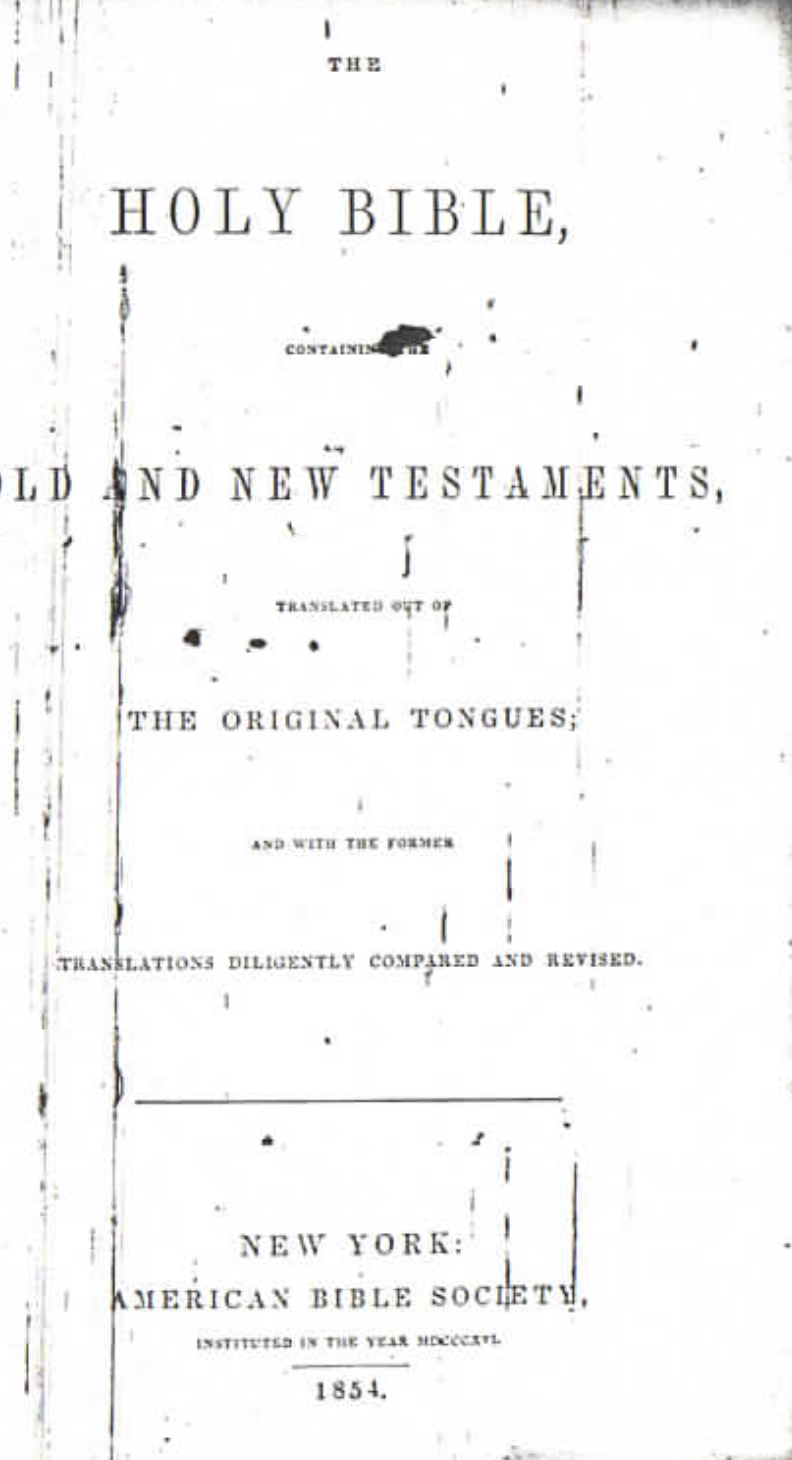 |
| Title page of Brown's Prison Bible (Chicago History Museum) |
Prescient and Prophetic
Now, whether one agrees with this theological shop talk or not (and I do not assume that all my readers do), I only point this out because Tapscott says Brown tragically misunderstood this text. He claims this is so based upon Brown's famous last written words, where he says that he believed that “the crimes of this guilty land will never be purged away but with blood.” These are indeed Brown’s last written words, for he believed slavery was an immense and wicked sin that had overcome the nation. As a result, Brown held that a vast measure of slavery’s crimes was so extensive that, absent repentance on the part of slaveholders, divine justice would require judgment upon the US. Accordingly, he believed that justice would require the shedding of blood. This position was not unique, and the specter of God's judgment had haunted the nation since the early days of the nation. Perhaps the most famous evidence of this is found in the words of the slaveholder president, Thomas Jefferson, who famously wrote: "Indeed I tremble for my country when I reflect that God is just: that his justice cannot sleep for ever. . . ." Many abolitionists in Brown's time apprehended that God's justice might be heaped upon the nation with the result of bloodshed. So why Tapscott makes so much of this indicates the desperation of his effort. Furthermore, Brown's only point in his last written words was that, in attempting to subvert slavery without engaging in full-scale insurrection, he had failed. It would now take far more bloodshed, Brown concluded, to end slavery. John Brown was right, for it would take a civil war and a national bloodletting for slavery to end. Certainly, Tapscott is wrong in his reading of Brown's words.
Wrong, Wrong, Wrong
In fact, it is quite amazing that Tapscott is so blind to the prescient even prophetic vision of John Brown. The abolitionist understood that slavery was so wicked that it would result in bloodshed on a wide national scale. But this was not simply a political reading of the signs of the times, but also a theologically-grounded survey of the country, which Brown rightly referred to as a "slave nation" in his last days. Brown recognized that the nation was heading toward civil war and that the South would rather perish than surrender its slave power and stolen black labor. Again, Brown was right and Tapscott is wrong.
And Tapscott is wrong on all accounts. His charge that Brown was a “radical ideologue” is an implicit admission that he sides with the conservative slaveholders, his forebears. Apparently, Tapscott does not see that those Christians who were opposed to black liberation all along have been the real radical, ideological demagogues, and that it is they who have brought shame upon the evangelical heritage.
 |
| made on dream.ai |
Of all the ham-handed, misinformed charges against Brown by Tapscott, this is probably the most contemptible because it is essentially accusatory and judgmental while ignoring the principles and history of the man. Brown practiced reparations when liberating enslaved people and he believed that enslaved people deserved more than freedom. He believed they deserved to receive wages for their stolen labor and the injustice heaped upon them. That Tapscott should charge that Brown had an eye on wealth and power for their own sake is completely antithetical to the biographical record and to the man. It is a baseless accusation against a man long dead in spite of the evidence. It is a false witness.
Tapscott's Failure
Mark Tapscott’s reactionary screed against Brown is fraught with errors, baseless charges, and half-read history. He presents his article as an expert rejoinder, but he is a ham-handed historian who reads the record through skewed lenses. His old homework on Brown from the 1970s, unfinished and questionable, does not make him competent to address Brown, so his vituperation should not be taken any more seriously than his selective reading of the evidence. A careful reading of John Brown’s life will not find him without flaws. Contrary to Tapscott's article, I nowhere have called for Brown to be canonized. I have called for him to be included in the church because he was a devout believer, no less than "Stonewall" Jackson, his pious Calvinist counterpart in the South. After all, no man is above criticism and no man is without fault. The premise of my piece in CT is one that I continue to defend: John Brown deserves to hold a place in his own Christian society and context. If racists like Whitefield, Edwards, Dabney, and others are to be uncritically assessed and embraced by evangelicals, then John Brown should have a place in the history of the evangelical movement too. Tapscott hates John Brown viscerally and so he barks at any notion that the abolitionist was a Christian, let alone someone who might teach us a lesson about how we treat our fellow man. As Brown might say, Tapscott is "besotted" by the fallacies of his own historical rhetoric.
Fortunately, long after this journalist is dead and forgotten, people will still be reading about John Brown and will be inspired by his heroic commitment to human liberation and equality. At the very least, Brown is going nowhere in the national memory because he is a folk hero. As Charles M. Blow has written recently, "[t]he folk hero is transcendent. He defies convention and defies gravity." At best, I would argue, John Brown is here to stay because of his Christian witness, which even men like Tapscott cannot naysay.
My argument, that white Christians should open their eyes to Brown's Christian witness, is not going away. The time may yet come when evangelicals of goodwill may turn their eyes back to history to find a devout Christian who made a difference in matters of racial justice.
And John Brown will be there.
Saturday, December 17, 2022
Prompting John Brown: Some Experiments in AI Art
The other day I was playing around with a couple of online sites that generate art from prompts--written descriptions--using artificial intelligence (AI). A friend of mine sent me an informative video about AI art. You can view it here:


 Keep in mind, that AI images are not copies of known images but sort of reinventions based on the written prompts, based on what the AI gleans from what has been posted online. An article I read described it (and this is my best effort, so forgive me if I'm wrong) analogously as grinding down a tree into saw dust and then using the sawdust to construct a chair based on the available descriptions of a chair. There are also different AI generators using different styles, including imitating famous artists, etc. One thing is for sure, every rendering is unique and you can regenerate images endlessly from the same prompt.


I also did a whole series of these on Dall-e using the same prompt but variously trying to add artistic flavors like Dali, da Vinci, and even impressionism. They were all very nice, but they invariably made John Brown a black man and mostly made the baby black too. Maybe someone who knows about AI can explain this to me, and while I'd like to think that I'm missing something technical here, my tendency is to believe AI reflects a cultural bias rooted in deep racism, or at least, racialism.


Somewhat frustrated, I switched to the Dream AI generator and put in a simple prompt: "white John Brown making vow while placing hand on shoulder of a black man." In my simplicity, I figured I could possibly lead AI to get closer to the idea of the lost daguerreotype. Instead, I got these interesting images based on my stilted prompt:
.jpg)
.jpg)

While these AI images are all interesting, none of them came close to what I was hoping to get, although it is no surprise. My prompt was simplistic and perhaps I was asking too much. Like other AI images, there's a weirdness to these images although in some sense they do capture Brown's devotion and the pathos of his bond with black people.


At any rate, I tried putting in various phrases about "John Brown the abolitionist." Interestingly, however, as long as I used "John Brown the abolitionist" I kept getting renderings of Brown as a black man. Here are some of the generated black John Brown images:


 Keep in mind, that AI images are not copies of known images but sort of reinventions based on the written prompts, based on what the AI gleans from what has been posted online. An article I read described it (and this is my best effort, so forgive me if I'm wrong) analogously as grinding down a tree into saw dust and then using the sawdust to construct a chair based on the available descriptions of a chair. There are also different AI generators using different styles, including imitating famous artists, etc. One thing is for sure, every rendering is unique and you can regenerate images endlessly from the same prompt.
If you're interested in playing around with prompt-to-image AI art, it appears that Dall-e is one of the best. But access to it is limited and then you have to pay to keep playing around on it. One with open access is Dream by Wombo. You can enter your prompt and use different generators that produce different kinds of images, and you can repeatedly generate different images from the same prompt.
AI and Bias: Kissing the Black Baby?
At the same time, I do wonder whether AI reflects certain biases that are embedded in the culture since AI can only work with what has been put online. For instance, the first inclination to portray John Brown as a black man may suggest that many people, who are largely ignorant, believe Brown had to have been a black man because he is associated with black people in their minds. This bias would apply to both blacks and whites who simply do not know enough about history--something not surprising in the USA. The video above shows that AI is biased toward the west, and I suspect biased more toward the USA, which is far more ignorant of history as a culture than are European peoples generally speaking.
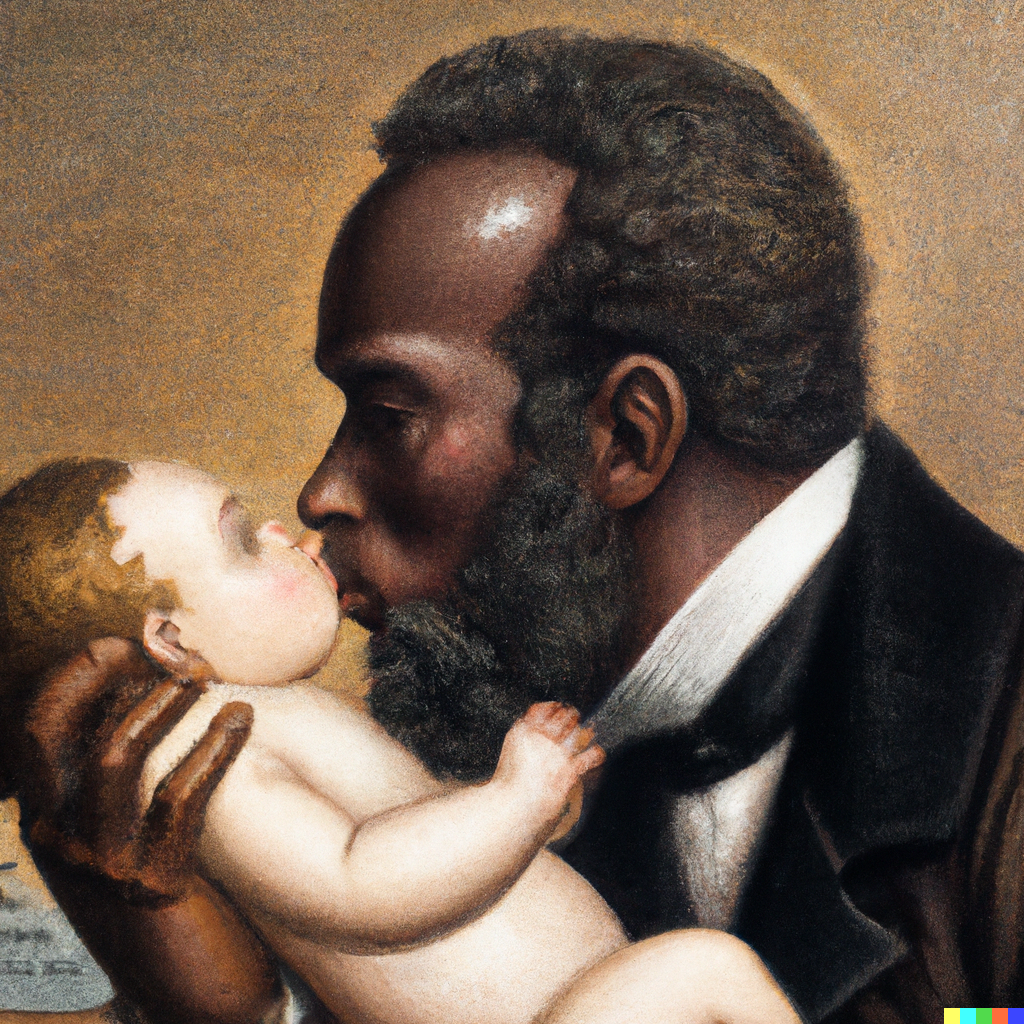
I encountered this again using Dall-e, one of the leading AI text-to-image sites. I repeatedly and repeatedly tried entering prompts about "John Brown kissing a black baby on his way to execution." Whenever I did, I kept getting images generated of John Brown as a black man kissing a black baby. It was experientially like AI refused to follow the prompt. Was this a fluke?
I thought I'd try one more thing by entering Hovendon, along with the prompt about John Brown kissing the black baby, etc. This is a clear reference to a very famous painting, "The Last Moments of John Brown" (1884), by Thomas Hovendon, which is held by the Metropolitan Museum of Art in New York City.
 |
| Hovendon's "The Last Moments of John Brown" |
"Certainly," I said to myself, "the AI will pick up on this prompt and give me a rendering akin to the Hovendon painting." But I was wrong. The baby might change variously from black to white, but the AI John Brown remained black--and I tried this over and over again. Here are several examples of what the Dall-e AI kept producing with the prompt, "Hovendon's painting of John Brown the abolitionist kissing a black baby":


AI's White John Brown
Although my initial efforts to generate pictures of John Brown produced black versions, I did variously produce images of Brown by adding qualifiers like "white abolitionist" or "bearded white abolitionist."


I should stress that these were made on maybe two or three different AI sites, but this will give you an idea of what AI will generate. The prompts here were brief and simple, always saying Brown was a white abolitionist in the 1850s or antebellum era.
Trying to Recreate a Lost Image
Since Dall-e is among the most sophisticated AI image generators, I then tried to recreate a lost daguerreotype that exists only by descriptions in a number of sources. The image was made about 1848 by the black Daguerreian, Augustus Washington. Washington's two surviving daguerreotypes of John Brown (below) have survived and are familiar to Brown enthusiasts. The lost image is said to have pictured Brown posing with his black friend and associate, Thomas Thomas, from Springfield, Mass. Jean Libby has documented the surviving daguerreotypes from this photographic session among the other John Brown images in her wonderful book, John Brown Photo Chronology The most famous of the two images shows Brown with his hand uplifted as if making a vow, and holding a small banner said to have been emblazoned with "SPW," for "Subterranean PassWay," which was apparently what John Brown called the underground railroad--a term that perhaps preceded the advent of railroads in the 1830s and '40s. The lost image is said to have pictured Brown with his hand uplifted and his other hand on Thomas's shoulder.
 |
| (National Portrait Gallery) |
 |
| (Nelson Atkins Museum of Art) |
So, I began to use prompts that stated something like "John Brown the white abolitionist, posing with hand uplifted as if making a vow and his other hand on the shoulder of a black friend," or various efforts at this idea. I omitted the fact that Thomas held the small "SPW" banner because I thought it was too much. This was one of the better images rendered, although it is hardly what I expected:

.jpg)
.jpg)

While these AI images are all interesting, none of them came close to what I was hoping to get, although it is no surprise. My prompt was simplistic and perhaps I was asking too much. Like other AI images, there's a weirdness to these images although in some sense they do capture Brown's devotion and the pathos of his bond with black people.
From Kansas to Harper's Ferry
I'm closing this post with a couple of AI images based on simple prompts that went something like, "John Brown the white abolitionist" fighting pro-slavery forces in the Kansas territory," and "John Brown the white abolitionist" attacking Harper's Ferry with a group of white and black men. Here is the Kansas image:

Quite weird, this John Brown in Kansas. The face, the hat, the uniform, and the way his hand melts into the suggestion of a weapon. Nearby, a be-capped, bearded black man holds a weapon and turns as if looking to hear a word from Old Brown. Behind Brown are some strange-looking allies that suggest Star Wars more than antebellum Kansas. AI is wonderful and weird.
Then, there's John Brown attacking Harper's Ferry. This is what I got:


What the *&#. Go figure. Both of them.
The first one shows John Brown brandishing some kind of rail in the air, with what looks like tall silos or buildings in the background. I guess that's some kind of an attack. The other is a bizarre, surreal rendering that strongly suggests conflict, and Brown seems to be the be-capped figure at the far right standing tall. There are sharp angles, movement, arms groping and extending, and the suggestion of fire or light breaking into the room. I guess it's the Harper's Ferry engine house and Brown's last stand at the marine breakthrough.
This was definitely not a trip through history. It was not even a computer-generated survey-and-selection of available John Brown images. It was like dreaming with artificial intelligence, the bits and pieces of images and words, scrambled and rehashed, yet strangely discernible in a sense.
Maybe you'll want to play around with AI now that you've seen the weird fun it offers.
Postscript, Post-image
Oh, yes, before I close, I could not resist being a little silly. So I tried one more thing.
I thought it might be fun to take a figure that is very familiar in western culture and then put him into an episode of pop culture television that most folks over forty will also recall, and therefore which might also be discernible to AI--the first interracial kiss broadcast on national television, with a little twist.
And I was right. AI had no problem whatsoever getting the prompt. Go figure.<>

Monday, October 31, 2022
Why Was Brown Silent on the Conditions of Free Labor in the 19th Century? Responding to a Thoughtful Reader
A thoughtful listener of my John Brown Today podcast named Len Bussanich has previously submitted his reflections on Old Brown, prompting a response on that platform that I hope was useful. Now, once again, I am pleased to receive a comment from Len on this platform following the last entry. Partly because my response is too long to fit into the comment section, and partly because I think he raised a good question worthy of posting, I thought it best to copy Len's note to me below, followed by my response. I hope that blog readers will find it useful.
Len writes:
I've always been interested in the "dichotomy" between slave labor in the South and industrial/mill labor in the North. The Industrial Revolution essentially began in this country in Massachusetts, also the hotbed of abolitionism. Some of your wealthiest capitalists were also abolitionists. These same abolitionists and their followers were calling for the destruction of slavery in the South but said virtually nothing about the dehumanizing conditions farmer girls turned factory workers endured in the mill factories in Massachusetts and elsewhere in New England. John Brown lived and worked in Springfield, MA. He must have known or heard about the conditions in the factories. I guess my question now is, why is there no examination of Brown's actions in the context of the industrializing North? Why would he-or the abolitionists-remain silent to the same oppressive conditions wracking the labor force in the North and not question, challenge or even confront the same capital dynamics that shaped the South as well as the North. Cotton as we know drove agricultural expansion in the South and industrial expansion in the North.
There was a man however in the North named Brownson who was examining and writing about the brutal conditions in the North, Orestes Brownson and his piece, The Laboring Classes.
Orestes Brownson Perhaps I am asking too much of John Brown, but he detested slavery and yet he essentially remained silent on the dehumanizing nature of industrial labor and wage slavery.<>

Hi Len,
Thank you for writing and for sharing your continued thinking and reflections on John Brown. Your question, as to why Brown seems to have been silent regarding the plight of exploited free laborers is interesting, to be sure.
In my study of his letters, I have never seen any expression of concern over the struggles of free laborers in the factories of the North. I'm not even sure I can recall an incident where his family or biographers recount such concerns.
The closest that Brown comes to fighting for free white labor in the North is his involvement in the wool business on behalf of the wool-growing farmers of Ohio, western Virginia, and Pennsylvania, expressed in his desire to open a wool commission operation in New England that would push back against the abuses of the manufacturers by protecting the interests of the growers. This was a cause that gripped him in the 1840s, although he lost that battle by trying to create a solution. The farmers were not ready to "unionize" (it took another half century before they actually did), the manufacturers were too powerful (and dishonest), and were able to undermine his efforts. Earlier in his life, in northwestern Pennsylvania, Brown interceded on behalf of settlers who were fighting the encroachments of a powerful Philadelphia land company. He felt they were unjustly being treated and tried to stir up a movement against this company. Although his efforts apparently came to naught, he did ruffle the feathers of the company's agent. I unpack these earlier episodes of his struggle for justice in my little book, John Brown--The Cost of Freedom (2007).
In light of this, I can only offer a couple of thoughts. First, Brown was an agrarian by nature and orientation and this shaped the arc of his life and activities. His most urban experience was in Springfield, Mass., 1846-49, and by then he was primarily caught up in resisting the expansive power of the slaveholders, especially after the Fugitive Slave Law of 1850. I think that despite his forward-looking ways, Brown was more a product of agrarian society, and that was where his treasure was: fighting for settlers against a powerful company, or fighting manufacturers for farmers, and all the while moving steadily toward militant opposition to slavery.
Second, although it may be that Brown did not spend any energy on behalf of the struggling and exploited laborers of the North, I suspect he knew about their plight and sympathized. He was likewise sympathetic to the concerns of women. But if he did not come out in favor of the laborers or of women, it may be because he felt that the problem of slavery was far worse, more politically apocalyptic for the nation.
Perhaps too, he not only felt the concerns of free white labor and women, in general, were secondary to the black struggle, but he was put off by evidence of racism among free white laborers in the North. So, while he was aware of their struggles, perhaps Brown felt he had to prioritize the interest of the black struggle despite the inequities of the North. I know the antebellum apologists of the South often referred to the exploitation of the Northern laboring class, but perhaps in Brown's mind, he felt it was a category error to compare immigrant and poor white laborers in the North to enslaved Africans. The former were greatly exploited but they were free in some sense, whether or not they were despised for reasons of class or ethnicity. Still, this wasn't the same as the wholesale racist treatment of blacks, whether in southern slavery or northern "freedom." (A good book here is the modern classic by Leon Litwack, North of Slavery).

Far be it from me to underrate the sufferings of the Irish people. They have been long oppressed; and the same heart that prompts me to plead the cause of the American bondsman, makes it impossible for me not to sympathize with the oppressed of all lands. Yet I must say that there is no analogy between the two cases. The Irishman is poor, but he is not a slave. He may be in rags, but he is not a slave. He is still the master of his own body . . . . He can write, and speak, and cooperate for the attainment of his rights and the redress of his wrongs." (Dec. 1, 1850)
I do not think I'm stretching it to suggest that if Douglass felt this way about the poor Irishmen living under the British empire, he felt the same about poor white factory workers in New England. They were victims, but only the racist chattel slave system was, in Douglass's words, the "grand aggregation of human horrors." I suspect that this would have been John Brown's sentiments and those of his black and white counterparts within the abolitionist movement.

Thank you for your note, Len. I hope this is useful in your continued study and reflection.--LD
Saturday, September 17, 2022
Don Pedro, John Brown, and Black Enslavemen
The sketch below is of the "big daddy" of the sheep world in the 19th century United States, Don Pedro. Don Pedro was brought to the US by a Frenchman, E. I. DuPont de Nemours, who initially settled in New York in 1801.
 |
| Don Pedro Hagley Museum and Library |
After a lot of breeding and even selling off of the feisty Don Pedro, DuPont reacquired him and moved the busy sheep to a new farm in Delaware, near Wilmington. To preserve and propagate the breed, he even offered Don Pedro to neighboring farmers for free, although initially few farmers valued the offer enough to use him. Eventually, however, farmers caught the Merino "fever" and Don Pedro was at it again.
At ten years old, Don Pedro was described as “very strong and active,” “stout, short, and wooly,” with large, spiraled horns, short legs, and a weight of 138 pounds, with fine fleece, 1 3/4 long, thick, and close to his body. Don Pedro died in 1811, but his pedigree lived on, well into the time when an abolitionist named John Brown was pursuing excellence in the fine sheep and wool trade.
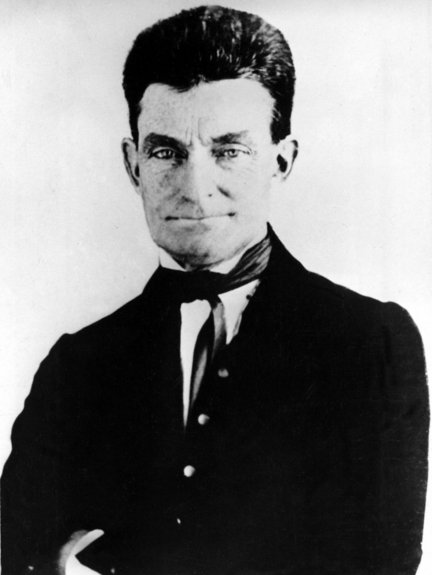
Now, as historical detail goes, this is perhaps no more than interesting trivia, but it adds color to the John Brown story, getting beyond the standard "drive-by" biographies offered.


MORE IMPORTANTLY, let us not forget that while John Brown was buying Don Pedro's kids from farms in Connecticut in 1839, African children were being sold away like livestock in the South, African people were in general treated like living property (our nation practiced "chattel slavery," not just slavery), African men were used to "breed," African women were routinely reduced to breeders as well as raped by white masters and their family members, and black children were sexually molested and violently abused.

White society then, and largely today, went on with its daily business with little regard to the vast and horrible nature of black enslavement in this nation, and today many white people do not want to talk about the realities of slavery, do not want to talk about what this nation owes the descendants of African slavery in this nation, and do not want to admit that their ancestors were slaveholding thieves of stolen black labor and stolen black bodies.
Say what you want about the Germans, but they've done far better in facing the atrocities of their history than have white folks in this nation, especially the ones whose forebears benefitted from black enslavement, and even more especially among the white evangelicals with slaveholder and "Confederate" pedigrees.

As he waited to hang in his Virginia jail cell in 1859, I wonder if John Brown thought about the long trail that led him from Don Pedro sheep in 1839 to Harper's Ferry twenty years later, especially when he took his quill pen and marked off Revelation 18:13 in his Bible:
"And cinnamon, and odors, and ointments, and frankincense, and wine, and oil, and fine flour, and wheat, and beasts, and sheep, and horses, and chariots, and slaves, and souls of men."
Subscribe to:
Posts (Atom)